
Tyler James Williams on 30 Years of Acting and Protecting the Next Generation
Special | 35m 23sVideo has Closed Captions
Actor Tyler James Williams talks about his acting process and what drives his work.
In this episode, Tyler James Williams gives a masterclass on his own acting technique: studying people, building characters, and finding the humanity behind every performance. We talk about his love for New York, how “Men In Black” made him fall in love with art and entertainment, and the care he has poured into creating the character of Gregory Eddie on “Abbott Elementary.”
Problems playing video? | Closed Captioning Feedback
Problems playing video? | Closed Captioning Feedback
Support for American Masters is provided by AARP, The Rosalind P. Walter Foundation, Thea Petschek Iervolino Foundation, Burton P. and Judith B. Resnick Foundation, The Philip and Janice Levin Foundation,...
Support provided by:

Tyler James Williams on 30 Years of Acting and Protecting the Next Generation
Special | 35m 23sVideo has Closed Captions
In this episode, Tyler James Williams gives a masterclass on his own acting technique: studying people, building characters, and finding the humanity behind every performance. We talk about his love for New York, how “Men In Black” made him fall in love with art and entertainment, and the care he has poured into creating the character of Gregory Eddie on “Abbott Elementary.”
Problems playing video? | Closed Captioning Feedback
Where to Watch American Masters
American Masters is available to stream on pbs.org and the PBS app.
Buy Now
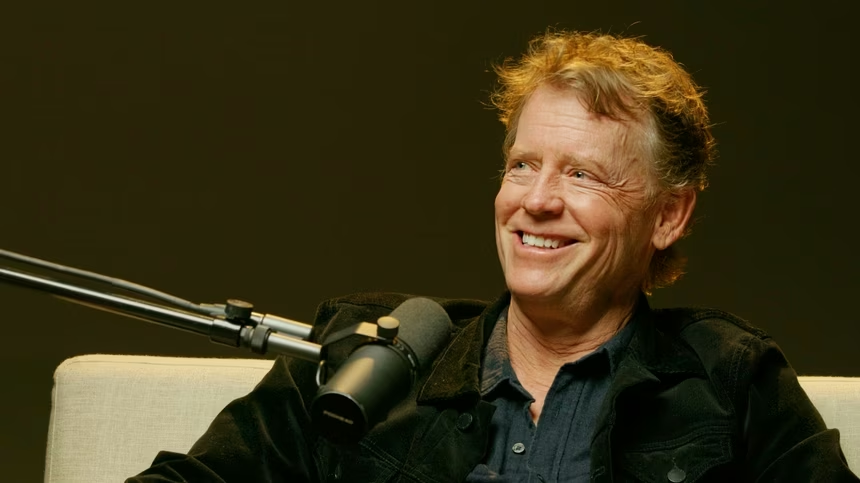
A front row seat to the creative process
How do today’s masters create their art? Each episode an artist reveals how they brought their creative work to life. Hear from artists across disciplines, like comedian Chris Fleming, actor Greg Kinnear, sports journalist Taylor Rooks, and more on our video podcast "American Masters: Creative Spark."Providing Support for PBS.org
Learn Moreabout PBS online sponsorshipMore from This Collection
How do today’s masters create their art? "Creative Spark" presents narrative interviews that go in-depth with an iconic artist about the creation of a single work. Each episode offers a unique window into the world of art and the creative process of artists and cultural icons across a wide range of disciplines, from music and comedy to poetry and film.
Mike Faist Embraces the Unknown
Video has Closed Captions
Actor Mike Faist explores the creative process behind his work on East of Eden. (44m)

The Many Passions of Matteo Lane
Video has Closed Captions
Comedian Matteo Lane on stand-up, painting, singing, performing on Broadway and much more. (55m 8s)
Michael Sarnoski: What Robin Hood and Folklore Tell Us About Ourselves Today
Video has Closed Captions
Filmmaker Michael Sarnoski breaks down his revisionist version of the Robin Hood story. (28m 4s)
Why Atsuko Okatsuka’s Comedy Connects Across Cultures
Video has Closed Captions
Comedian Atsuko Okatsuka returns to the show to talk about her creative process. (30m)
Greg Kinnear on Acting, AI, and Why Movies Still Matter
Video has Closed Captions
Oscar-nominated actor Greg Kinnear shares some "big thoughts." (27m 33s)
Chris Fleming Embraces the Chaos
Video has Closed Captions
Comedian Chris Fleming talks about the process behind his iconic manic stage persona. (39m 17s)
How Leslie Jones Became a Comedian
Video has Closed Captions
Comedian and actress Leslie Jones does a deep dive on her creative process. (31m)
Phoebe Robinson Shows Her Work
Video has Closed Captions
Comedian Phoebe Robinson takes on hustle-culture in biting comedy special. (31m 45s)
Sarah McLachlan: Making Music to Connect and Heal
Video has Closed Captions
Singer-songwriter Sarah McLachlan opens up in a candid interview about making music. (37m 19s)
How Natasha Rothwell’s Life Brought Her to “The White Lotus”
Video has Closed Captions
Actress Natasha Rothwell on her creative process in "The White Lotus." (33m 40s)
Daniel Dae Kim Leads Spy Drama and Fights for Industry Change
Video has Closed Captions
Actor Daniel Dae Kim on his groundbreaking career and new project, "Butterfly." (21m 48s)
Phil Rosenthal’s Secret Recipe: Good Food and a Laugh
Video has Closed Captions
TV writer and host Phil Rosenthal talks about finding our shared humanity in food and comedy. (22m 53s)
Providing Support for PBS.org
Learn Moreabout PBS online sponsorship- This is a little artist.
This isn't a child that you need to trick into a performance.
They may not have the tools yet to understand how to use their instrument, but they are an artist.
One way or another, you just have to figure out how to put them in a position to learn something new about themselves.
When they feel empowered, when they feel like they know what they're doing, when they don't feel afraid of the atmosphere, when they ask you a question about why does that light look like that, or Why is that sitting right there?
And you actually tell 'em.
You watch an artist turn on.
And that's the fun part of directing.
(upbeat music) - This is "American Masters: Creative Spark".
I'm your host, Joe Skinner.
Our guest today is Tyler James Williams, an actor who you might know from shows like "Everybody Hates Chris" and "Abbott Elementary".
Tyler has lived and breathed sitcoms for most of his life.
We talk about his creative process and how it's evolved over the past 30 years and the responsibility he faces now in bringing on the next generation of young talent in "Abbott Elementary".
He has starred as teacher Gregory Eddie in the hit sitcom for the past five seasons, since the show's launched during the height of the pandemic in 2021.
How has the pandemic changed acting?
- The nature of the business changed fundamentally, right?
Like there used to be a world where you are even auditioning in person that that's not even really happening anymore.
You're kind of sending tapes in to casting agents.
And I think that changes the way artists approach their work.
You're not getting as much active feedback, and it allows you to kind of make bigger swings and bolder choices.
So I feel like I've noticed that performances are becoming bolder, right?
They're not as safe as they used to be, I think, because casting and producers are seeing bolder audition tapes.
But I think there's also this aspect of now that we're in this new normal, you have to consider whether or not your character went through those things to get to this normal as well.
I know a lot of the shows don't like to address the pandemic 'cause we all lived through it and it was traumatic and awful.
But there is a new way in which we interact with one another.
The way we communicate with each other has changed because so much of it was digital for so long.
There's even ways in which people are more, I would say, superficially polite in a way that we learned in the pandemic.
And you save kind of the rawness of yourself for your online persona.
So I think your art has to reflect that as an actor, how people navigate conversations.
There's almost a hesitancy, I think, not to either offend or to read out where the person that you're talking to is before you give them your full self.
And I think that that, you know, with acting, you always want to keep secrets for your character and I think it just allows you to layer some more secrets in there, which has been nice.
But I think we're still in flex of that.
I think we'll look back much like the Hollywood Golden Era and everybody's saying, yeah.
So it is like, we'll look back and be like, this is clearly a pandemic show or something that happened right after it.
- Hmm.
So then, you know, that brings us to "Abbott Elementary", which was developed in the heart of the pandemic, right?
So how did that impact your approach to Gregory?
- So I remember we talked about it pretty early on and we had to ask the question as most shows did, that started during the pandemic of are we going to address this, and our world did... Is the pandemic happening?
And I think ultimately the decision was made for it not to be the case because people aren't sitting at home in quarantine wanting to watch shows about the other people in quarantine.
But I remember most of the first season we were masked, like triple masked at this point, right?
Because we had kids too, right?
You can't get one of them sick.
And for me, with Gregory, it did add a layer to him feeling outside of this group.
A lot of times I was rehearsing with actors whose faces I had never really seen before.
Most of our crew, I didn't know what they looked like until after our first year.
So there was this feeling of, like, distance and disconnect that really served my character specifically.
I'm not sure what the other actors, but Gregory needed to feel as if he was outside of the core group.
And I think an inability to see the way the person you're talking to is mouth move until you're actually rolling for the first time, really helped enable that.
- For people that aren't familiar with "Abbott Elementary", how would you define 'em Gregory?
- I think you can define him in two ways.
One is, by way of his job, he's a teacher who cares deeply about his community and his kids and goes out of his way to stretch himself in ways that are very uncomfortable, right?
He's a very awkward and not comfortable in his skin, somehow ever kind of guy.
But I then think outside of his job as a person and as a human being with autonomy, I think he is kind of a snapshot of the modern day man that doesn't get shown a lot.
I think we focus a lot on the extremes, right, that what was it?
The Manosphere doc.
And I feel like that's an extreme side, that it does exist, but that's not what the average man is.
And because we get so much of our entertainment and media from social media, it oftentimes bloats or makes a fantastic idea of who men can be, right?
Because it requires people to have these big personalities.
I think Gregory reflects when we look back on it years from now, what the average man was going through at this time.
Just trying to make a way, trying to provide for his soon to be family that he's trying to build, picking up multiple jobs if that's the case.
I think one of the best arcs that we have is that he's not just a teacher, but he's also like a lift driver and also delivering food.
And to me, that's a snapshot of what it means to live in the 2020s.
Good people just trying as the world kind of spins out around them, but trying to make their world a better place.
- It feels radical to have a character with just nuance in this time.
- I think, oftentimes, society wants people in situations to be simple.
They want there to be a bad and they want there to be a good.
And good storytelling, good character development is nuanced in that sense and shows pretty much a character who exists in the shade of gray exclusively.
And I think that's kind of what he does.
He is neither to me good nor bad.
He is trying to exist.
He's trying to find his way in the world and carve out a niche for himself.
Every decision he makes is not gonna be great.
And I think we saw some of that with the Janine-Gregory argument that happened at the end of this year.
And it's like, yeah, he's gonna have an opinion that maybe that opinion isn't all the way right.
His intentions may be, but that's okay.
It doesn't mean you throw him away.
It doesn't mean that he is a big bad now or that, you know, Janine is somehow in danger because of it.
It means that he's trying to figure himself out as more people are.
- What are the different tactics when you're first building a character like Gregory?
- I always try to have a conversation with the writer first and foremost because I believe we all share ownership of the character, but they're the original owner of this character, right?
So it was a lot of conversation with Quinta about how she saw him, but then it does become my job to fill in the gaps.
What are his wants?
What are his needs?
What happened to him to get him to this point?
I think the why is always very important for me.
Like we know that he wants to be a principal, but why.
I have to sit there, and I'm a big journal person, so I have journals and journals just from my personal life, but then also from each character that I've had to kind of live in the skin of, because I think it's important to know what the inside of their mind sounds like.
It reinforces the intention behind every scene.
I think it's a really good way to stay on track and keep a north star if you understand.
At the top of this day, what's on his mind as it is on for most people, you know, with people are starting families, they're looking at expanding and creating more security and stability.
Those are things that you need to be ruminating on as you're deciding what you're gonna do to deliver each line.
So I have a lot of grand big picture conversations with him.
And then in those things tuck away little secrets.
I think my secret for season five was that he's planning to propose to Janine.
So everything ran through that, every argument that they had ran through that.
It rooted the intention of why he was putting his foot down on certain things 'cause he's trying to create a stable world where there isn't one, is, I'm now working on secrets for season six, but that'll always be the case.
That's what keeps me grounded in him are the little things that he doesn't tell other people.
- And do you find yourself going back to those kind of original north stars from when you first build the character?
Or have you kind of been surprised by where Gregory's gone, where you've taken the character over the years, over the seasons?
- I think, like, people, they've evolved.
I think in the beginning he was trying to be a principle because I think for him he wanted to be successful, and I think that's what success meant for him.
This was the goal.
This is what I went to school for.
This puts me in a position of power.
It's something that my dad can look at and be like, yeah, he's actually doing something here.
People can look up to me.
I can make decisions.
And I think for most men, it's a dream to be in a position of power in some way.
It's a signifier of not only success but hard work and the ability to get somewhere.
Over the course of the seasons though, I noticed that my writing in just his mind changed to, it's bigger than that.
I think he's now come to the place where he's realized that that's a shallow dream.
Success and power for power's sake doesn't really do much.
I think now he actually wants to make a difference in the lives of individuals, even if they are six and seven, you know, that he realizes that's the more important time.
It's not telling people what to do.
It's impacting the future generation.
And now heading into this story arc where he becomes, you know, vice principal, the journaling has definitely changed.
It's definitely changed from what it was in season one.
Absolutely.
But that's what I like about doing TV.
The character should evolve and you should be to look back at the pages and see how he's not the same person that he was before.
- I've read that you had, like, an acting coach at some point in your career, right?
Could you talk about that experience of first working with an acting coach?
- Yeah.
So because of how early I started, I don't think I ever really had a chance to pick up traditional training.
So it wasn't until after we finished everybody hates Chris, I was 16, and I could feel that I was like, I just didn't have the tools I needed to craft the career that I wanted to.
I'd been riding off of like natural talent, but I was picking up that people are doing this efficiently.
Like they know what they're doing, they're not guessing about a performance.
So I sat down with a coach who had a lot of really interesting actors at the time who've now gone on to have beautiful careers.
And that's where I picked a lot of that up.
He was a coach that said if your script, when you go into an audition room only has the lines that were printed on the page, you're not doing enough work.
Your page should be littered with thoughts, opinions, perspectives, intentions, background behind each line, subtext, all of it.
Like it should be full of things.
Even sometimes for me, it's manifested into, like, doodles and drawings of just where this person is and how they're seeing the world or if they feel small.
That was one thing I did a lot.
If the character feels small, drawing small versions of themselves by lines.
But it really did key me into the prep work it takes to be an actor.
And that's where I really was like, oh, this is what I love.
I like the performing.
The performing is nice.
But the deep character work, the fleshing out a human being and putting tendons and muscle on their bones, looking past what's written there and filling in those gaps.
That's what's fun.
That's the fun part.
So, yeah, don't ever try to look at my script to see what your line is.
It's full of other, that means nothing to you, means nothing to you, but everything to me.
- Is that the moment that you fell in love with acting, would you say?
- Yeah, I think I liked performing, but I didn't know what it was I liked about acting until my late teens.
And it feels like it's the study of people, of human beings.
I get a opportunity to study every human being I come across and try to figure out why they are the way that they are and then take pieces of that and reflect it on screen so, hopefully, they seek parts of themselves and that's what they resonate with when they see the character.
I spend the majority of my time when I'm not on set still doing the same thing.
I love to people watch, I love to see two people walking and trying to figure out what is their dynamic?
How do they know each other based on body language?
When are they comfortable?
What did that person say that made that one uncomfortable?
Now, how do they hold their body?
What was it that... Did they feel caught?
Do they feel embarrassed?
Do they feel empowered?
And that's, you know, when you get to just the basis of acting with intention, that's it.
You're trying to figure out what is the intention coming behind this.
And I think the study of people is what I really love.
Reflecting it and performing it and showing it to them is part of that process that I will always enjoy doing.
But the prep work is really where I'm having my most fun.
- You know, something I say a lot is that I think art is really an empathy machine.
- It really is.
- And, you know, the way you talk about acting, it feels like something that everybody should do.
- I feel like maybe I've even said that before.
It was like, I wish everybody was forced to look at the world the way we were because then you allow people to be themselves and go through whatever it is that they're going through.
But your emotional intelligence is at a place where you understand why they're doing that and you hold space for them in that process.
I think the attempt to demonize people and make it black and white and go good or bad, and then that's it, is what kind of gets us to the place that we're in now in society where we're stuck in this loop that we can't seem to get out of.
I've had a fair amount of peace I've noticed then a lot of my friends and people I grew up with who aren't in the field because I can see things that way, because I can see what somebody is going through.
I can tell even by the way... You can see a video of somebody online, I can tell you by the way that they're standing, whether or not they're comfortable.
And something about that knowing gives you peace.
Knowing that no matter what that human being is saying out of their mouth, they're going through something right now.
It helps you remember that context is what's most important.
Everybody should take an acting class if they can, if they can.
I mean, I understand that life is hard and there's a lot to do, but if you have it in your schedule, it'd be nice to take one.
You might learn some things about interacting with human beings.
- You know, you've been doing this for 30 years.
How do you keep it fresh?
- I think I have... And I'm in one of these periods now, so it's actually very... I think it's timely for you to ask that now 'cause I don't think if I gotten that question two years ago, it would be the same.
I oftentimes have to detach myself from the industry and just focus on the work.
I think at times people can get lost in the politics including myself, the politics, in almost the game that is the industry and forget why we decided to do this in the first place.
I think that's how people burn out.
They don't burn out from the art form.
They don't burn out from the love of what they do.
They burn out from the industry itself.
And I think it's a anchoring point that you have to find.
For me, it is quite literally walking and watching people.
That's what I fell in love with in the first place.
Trying to figure people out, having conversations with people.
And although I think it's what people imagine the therapists do and why they're so self-conscious when they talk to them.
But I have the ability to have someone possibly come up to me and say, love your work, and continue conversation there.
And then watch them try to settle into the place that is, two human beings having an interaction.
And watch how their face puts that where their eyes go, where they choose to look, where they choose not to look.
That grounds me as an artist.
That's the art form that I'm trying to recreate at any given time.
A real human being in front of a camera trying to exist.
But 30 years in, I think people can get really jaded.
And what they're jaded by is not the art form, they're jaded by the industry.
And the industry is always gonna change.
And that's remembering that is a big part of it.
- Is that part of what pulled you back to New York?
I think it's the people watching capital of the world.
- It's 100% what pulled me back to New York.
Like, it's like... And I've been back now for about a year, so I spend the six or seven months, we spend shooting "Abbott" in LA, and then I'll just go back home.
And what I love most about New York, even when I'm in my apartment, I look out at the other apartments and there's so many different people living so many different lives.
And it feels like everyone is the main character of their own story here.
Where my theory about LA is, there's always like a main character of LA on whatever day it is.
(laughs) You just have to figure out who it is, and hopefully, it's not you 'cause that means something bad is happening.
But going to places where I can walk outside.
And not to be creepy, but anybody who walks by can just focus on and then see what's happening there.
It's just not as much of the culture here 'cause it's a driving city.
But it's 100% why I was... Not only I moved back, but I was feeling like a pull to move back, like I was being tethered from across the country.
'Cause I needed it, I needed to refill my cup with something.
- Since we're kind of working backwards chronologically here too, you know, you grew up in Yonkers, right?
- Yeah.
Yeah.
- So what was your relationship to New York City growing up?
- Yonkers was where we slept.
(both laughing) Like I slept in Yonkers, but I spent the majority of my time in Manhattan.
Because especially at that time, we're talking like early 2000s, late '90s, the industry was booming, especially on the East Coast where it's just not as much anymore.
So as a kid I was auditioning constantly, and it just made sense that you go to the city at the top of the day and you just stay there until you've had your last audition and then you went home.
So it was a big part of the tableau that was my life.
And even now, the things that I crave, I think once you become an adult, you tend to crave things from home, whether it be smells or music or sounds.
I notice I can't even sleep as well in LA as I do in Manhattan.
Like I can hear it moving, and I can hear life happening.
It's in my blood in a very interesting way.
And when I moved back I was like, all right, so where am I gonna live?
I was like, it only make sense that I'm in Manhattan because it's where I remember spending the most of my time.
- Hmm.
So, you know, I know you started really young so you may not remember even, but if you had to think about what was that first spark that got you excited about the arts?
What would you say?
- First spark was, and I remember it clearly was "Men in Black", first thing.
Something about the chase sequence at the beginning, I believe Will is like running circles, is this the Guggenheim?
I think it is.
He's running circles in.
There was something about seeing a performer in that city, being a person in that city that just made me believe like yeah, I know that that's Will Smith.
Like I'm old enough to understand, I know that that's who that is.
But I fully believe that he's just a man in the city that I could have walked by on any day.
And that was like the initial spark.
After that, it wasn't even, like I said, it wasn't even necessarily performing, but as I got representation and that would get new roles and things to read for, it was the ability to become these people at any given time.
Slip into it.
I can be one person on the train and another person in a room and then change that up in a room two floors down later and then be that same person back on the train going home.
That's the beauty in it to me.
Especially in the city where... I mean it's like 8 million people on the island of the Manhattan.
You could walk past the same person twice and you'd never know it.
That ability to disappear while also still having a rich context of life back there is what... To this day, it makes me smiling, it gets my brain moving.
- That's great.
You know, I love that you said "Men in Black".
I just, for some reason, assumed you'd say something like "The Lion King" on Broadway or some kind of very New York-specific experience.
But, you know, men in Black's that perfect marriage of LA and New York in some ways, right, 'cause it's that Hollywood kind of movie.
But I remember too seeing it and thinking, wow, like, oh, here's New York, here's New York, here's New York.
- Yeah... Yeah.
And one of these people could be aliens 'cause that's how New York works.
I've also noticed I have New York bias in things when I watch things.
I assume that they're shot in New York.
I'm like, yeah's definitely New York, or it's definitely set in New York for that reason.
But... - So "Spider-Man" probably thrilled you when it came.
- Oh, spider... I was like, yeah, of course.
Where else would we do this?
This is... Yeah, "Spider-Man" is here, Will Smith is here and "Men in Black", it's like, Spike is somewhere shooting something.
Yeah, all of this is happening at the same time.
- So then, you know, fast forwarding again back to "Abbott Elementary", and you're kind of moving into directing sometimes too, a couple episodes.
You know, it had me thinking as a child actor now, as an adult actor, working with a lot of kids though as a director, it just, you know, you seem especially qualified to direct kids.
So how do you approach working with kids on the show?
- I feel like the thing I approach the kids on the show with first and foremost is the understanding of where they are currently.
Although there is a big narrative of like parents who get their kids into the business and all.
And it happens.
And kids who never really wanted to be in the business end up there.
And it's a really hard experience.
But more times than not, you wouldn't make it if you didn't have something in you that also wanted to be here.
You can tell when a kid doesn't want to be there.
And unfortunately, that doesn't make for good TV.
So I think the number one thing that I always try to approach them with, I think, works is the understanding of this is a little artist.
This isn't a child that you need to trick into a performance.
They may not have the tools yet to understand how to use their instrument, but they are an artist one way or another.
You just have to figure out how to put them in a position to learn something new about themselves.
And that related a lot to coaching on a sports team or, like, a basketball team for example.
You have a bunch of really talented guys, but until you put 'em in a system that works for them as an individual, you can't force them to learn a system.
You have to look at them and give them the tools necessary to thrive.
And I think that's how I approach directing kids all of the time.
What do they need right now?
Do you not understand what you're doing?
Because I can try to tell you to get to a moment, but if you don't understand how to get there or what this moment even is, we need to have a conversation before cameras even roll to get you there.
And I think the other thing is just, you've gotta get them feeling empowered.
When kids feel empowered and they feel safe to take creative risks, all the things that every director's trying to trick a kid into of like, I knew a director who would hold a candy bar or something by camera.
I'm like, he's not a dog.
Sorry.
Okay.
He can get there another way.
When they feel empowered, when they feel like they know what they're doing, when they don't feel afraid of the atmosphere, when they ask you a question about why does that light look like that?
Or why is that sitting right there and you actually tell 'em, you watch an artist turn on.
And that's the fun part of directing.
Performing part of what I do is beautiful and I love it.
But first and foremost I love working with and being in the process of acting, watching a little performer find something and make a choice and take a risk that they're technically not supposed to, but it made the scene what it's supposed to be.
That's when you know you won.
That's when you leave no matter how long the day was feeling like you did something.
- That's beautiful.
Do you find yourself writing a lot of wrongs from past direction that you've received?
- 100%.
That's really what's in the front of my mind, the majority of the time is, I've seen a lot of people do it.
I've seen a lot of people do it poorly, trying not to do those things.
Another big thing is, directing is a difficult job, there's a lot of things you have to think about.
Your mind is split in every possible way, never at any point in time.
Should those children feel that frustration?
And I know that it's a high bar to reach and everybody falls short of it.
And I'm sure at some point I will fall short of that as well.
But if they're feeling your frustration and then their performance is affected by that, you lost the battle.
And I think that's the number one thing I try to avoid as much as possible is remembering what we're doing, that this should be fun for them.
And you're never gonna get your best performance out of being frustrated with a child.
It's not gonna happen.
- Yeah.
You know, I'm raising a kid right now and it's like they teach you, you know, you can't just yell at your kid.
You have to redirect them.
You have to give them a reason, something else, a purpose.
- Right.
And also sometimes too, we've had this happen on set before, sometimes you can't redirect them and you redirect the scene.
That's just the answer here.
If he's a kid... If there's a kid being a kid in a scene where they're supposed to be a kid, I can't really argue with the authenticity of that.
If it means I need to move a camera, then I have to move a camera.
The camera can move.
We can re-block this scene.
This kid being a kid is the goal.
That's what we're here to do.
And I think that's also part of it is like so much of our industry is like, time is money, and things have to be done a certain, it's like, yeah, but we're also trying to recreate authenticity.
And I remember there was one scene we were shooting in this last... It was a cold open of the second mall episode.
And there was a kid that I needed to kind of get up and run out of the room in a very specific way at a very specific time.
And because all the other kids were screaming, he wasn't hearing it and couldn't quite get it.
And then, you know, you do more than three takes, he's gone, mentally just not focused anymore.
And so we moved the camera outside.
It was like, let's just put the camera outside of the room then so we don't have to have a closeup of him.
I'm gonna have to cue him so he sees it, but then you're gonna see that look in his eyes that he got queued.
It's fine.
The joke still works from outside.
I just need to get him up, run, and move.
And I think having that flexibility when working with kids is 100% necessary.
You do more than three, four takes, they're not gonna pay attention.
Whatever it is you just told them, gone, immediately gone.
It's like having a kid in any other scenario.
You work around them though, and you'll probably get something better because of it.
- I love that.
I mean, I just think it's great to talk to you about this because you are so uniquely positioned.
Like you don't often have the confluence of events that lead from a child actor becoming an adult actor and then being able to direct with kids.
You know.. - It doesn't always happen.
- It's a crazy coincidence that "Abbott Elementary" has such an ensemble of kids on the show.
You know, just gives them such a great opportunity, I think, to be able to work with you as a director.
- Yeah.
I mean it's also a great opportunity to work with them.
I think It made me realize and be less afraid of working with children in the future, especially as a director.
I'm down.
Like, I think a lot of directors are afraid of that because like all then all my prep's gonna go to hell.
Like that's kind of the fun part of it though, right?
Like you do the work and everyone's prepared.
So now when I'm looking at other things in the future, I'm more likely to lean towards something with kids than not.
It doesn't intimidate me because I kind of understand what's going on in their minds.
And I think that made me, what intimidates most people is I don't know how to get this kid to do what I need them to do.
My perspective is, you and the kid are on equal footing.
I remember, and everybody hates "Christopher's" director who actually did that with me, who needed a lot of credit, is Jerry Levine, who was also a child actor.
And he was our resident director for that show.
And he was the first director who approached me as an artist.
'Cause we had shot the pilot and Jerry didn't do the pilot, it was Reggie Hudlin.
But then Jerry came in after the fact and we had a series of directors before Jerry that I could feel, like (indistinct) be patronizing.
You're talking down at me like you're trying to get, and then you come over here and then you do this thing.
And I'm like, I know I shot the pilot.
(both laughing) Part of the reason why the pilot worked was because you found a kid that worked.
Jerry approached me as an artist.
It was like, what do you feel like you would do here?
So that by the time we were in season four, it was almost symbiotic.
He wasn't even directing me at a point.
He was just giving me takes.
That was the first time as a kid, somebody was like, do you want another one?
I was like, "I can have another one?"
He was like, "You wanna do something?
Go for it."
But it took another child actor who turned into a director to do that.
So at this point in my career, all I'm looking for is, well, who am I gonna set that off for?
And where are they gonna be in 30 years?
That's the beautiful part of it.
If in 30 years from now you have somebody who's in the position I'm in currently, saying, I got my first start on "Abbott" and I learned how to perform and got the freedom to make choices as an actor because I worked there and I worked with this director, pack it up.
I don't want to, but I could die that day.
I'm good.
Like that's fine because I did... I took the baton that was given to me and I held it in a way that was responsible and found other people to pass it off to in a healthy way.
And ultimately, from an artist's perspective, that's legacy.
- I think that's a really beautiful note to end on.
Thanks so much for coming in.
- Yeah.
(indistinct) Thank you.
Great conversation.
(gentle music) - [Joe] That's our show.
A big thanks to Tyler James Williams for taking the time to talk.
American Masters: Creative Spark is a production of the WNET Group, media made possible by all of you.
This episode was produced by me, Joe Skinner.
Our executive producer is Michael Kantor.
Original music is composed by Hannis Brown.
This episode was mixed and mastered by Josh Broome.
Funding for American Masters: Creative Spark is provided by the Rosalind P. Walter Foundation, the Anderson Family Charitable Fund, the Marc Haas Foundation, Sue and Edgar Wachenheim III, the Charina Endowment Fund, The Ambrose Monell Foundation, the Kate W. Cassidy Foundation, the Philip and Janice Levin Foundation, and by PBS viewers like you.
Thanks.
See you soon.
(gentle music)











Support for PBS provided by:
Support for American Masters is provided by AARP, The Rosalind P. Walter Foundation, Thea Petschek Iervolino Foundation, Burton P. and Judith B. Resnick Foundation, The Philip and Janice Levin Foundation,...