
How Leslie Jones Became a Comedian
Special | 31mVideo has Closed Captions
Comedian and actress Leslie Jones does a deep dive on her creative process.
Comedian and actress Leslie Jones does a deep dive on her creative process. She speaks candidly about family life and the comedians like Richard Pryor who influenced her at a young age. We talk about the time she first fell in love with comedy in college and the many years she spent honing her craft. We learn about the process behind her most recent comedy special, "Leslie Jones: Life Part 2."
Problems playing video? | Closed Captioning Feedback
Problems playing video? | Closed Captioning Feedback
Support for American Masters is provided by the Corporation for Public Broadcasting, AARP, Rosalind P. Walter Foundation, Judith and Burton Resnick, Blanche and Hayward Cirker Charitable Lead Annuity Trust, Koo...
Support provided by:

How Leslie Jones Became a Comedian
Special | 31mVideo has Closed Captions
Comedian and actress Leslie Jones does a deep dive on her creative process. She speaks candidly about family life and the comedians like Richard Pryor who influenced her at a young age. We talk about the time she first fell in love with comedy in college and the many years she spent honing her craft. We learn about the process behind her most recent comedy special, "Leslie Jones: Life Part 2."
Problems playing video? | Closed Captioning Feedback
How to Watch American Masters
American Masters is available to stream on pbs.org and the free PBS App, available on iPhone, Apple TV, Android TV, Android smartphones, Amazon Fire TV, Amazon Fire Tablet, Roku, Samsung Smart TV, and Vizio.
Buy Now
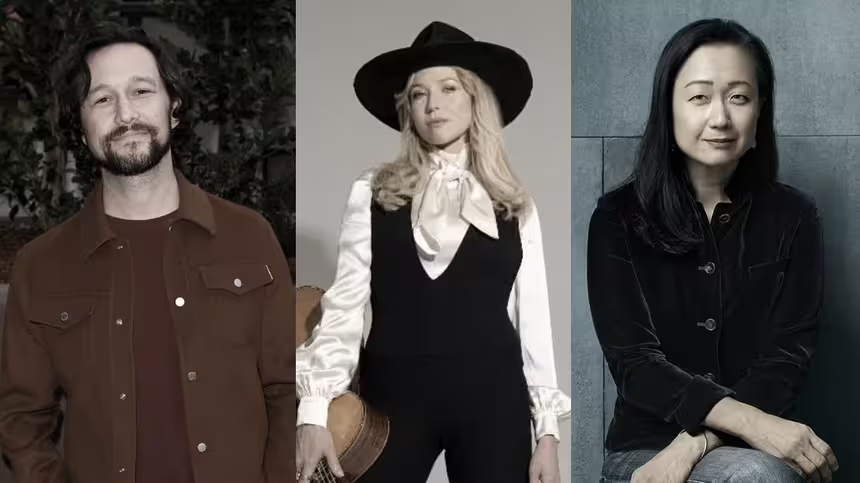
A front row seat to the creative process
How do today’s masters create their art? Each episode an artist reveals how they brought their creative work to life. Hear from artists across disciplines, like actor Joseph Gordon-Levitt, singer-songwriter Jewel, author Min Jin Lee, and more on our podcast "American Masters: Creative Spark."Providing Support for PBS.org
Learn Moreabout PBS online sponsorshipMore from This Collection
How do today’s masters create their art? "Creative Spark" presents narrative interviews that go in-depth with an iconic artist about the creation of a single work. Each episode offers a unique window into the world of art and the creative process of artists and cultural icons across a wide range of disciplines, from music and comedy to poetry and film.
Phoebe Robinson Shows Her Work
Video has Closed Captions
Comedian Phoebe Robinson takes on hustle-culture in biting comedy special. (31m 45s)
Sarah McLachlan: Making Music to Connect and Heal
Video has Closed Captions
Singer-songwriter Sarah McLachlan opens up in a candid interview about making music. (37m 19s)
How Natasha Rothwell’s Life Brought Her to “The White Lotus”
Video has Closed Captions
Actress Natasha Rothwell on her creative process in "The White Lotus." (33m 40s)
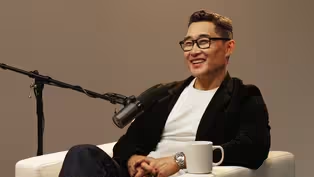
Daniel Dae Kim Leads Spy Drama and Fights for Industry Change
Video has Closed Captions
Actor Daniel Dae Kim on his groundbreaking career and new project, "Butterfly." (21m 48s)
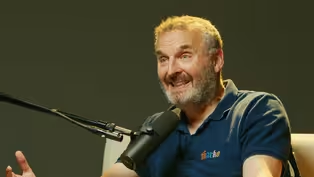
Phil Rosenthal’s Secret Recipe: Good Food and a Laugh
Video has Closed Captions
TV writer and host Phil Rosenthal talks about finding our shared humanity in food and comedy. (22m 53s)
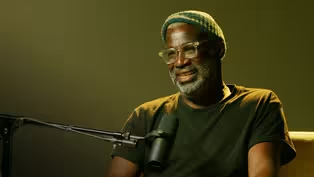
Tunde Adebimpe Channels His DIY Roots Into Raw Solo Debut
Video has Closed Captions
Musician Tunde Adebimpe on his creative process behind his solo album debut. (37m 28s)
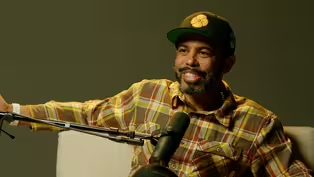
Daveed Diggs Takes on Cyberpunk Rap
Video has Closed Captions
Rapper and actor Daveed Diggs on his creative process as a rapper and songwriter. (25m 28s)
Lucy Dacus Makes Her First Loves Songs
Video has Closed Captions
Singer-songwriter Lucy Dacus talks about love songs for her new album, "Forever is a Feeling." (23m 49s)
Providing Support for PBS.org
Learn Moreabout PBS online sponsorship- How do you know you're a comedian?
Well, I always tell people that if you can make your mom laugh, that's great.
But if you can make your mom laugh, and your mom's mom's friends, cousins, uncles, mailmans laugh, then you're a comedian.
You know what I'm saying?
Living room comics is different than an actual professional comic.
And people be like, "No, you're not professional "until you get paid."
No, 'cause a lot of professional comedians don't get [censored] paid.
You're professional when you know how to perform for the audience that you perform with.
Whether it be a white audience, whether it be an old audience, black, whatever.
- This is American Master's Creative Spark.
I'm your host, Joe Skinner.
Our guest today is comedian Leslie Jones.
You probably know her best from the five-season run as a cast member on Saturday Night Live.
At 47 years of age, she was the oldest person to join the cast in the show's history, after years of cutting her teeth on the stand-up circuit.
She's back with a new special on Peacock called Leslie Jones' Life Part Two, about aging, relationships, and fame.
I talked to her about the journey she took to develop her unique sense of humor and her disarmingly honest disposition.
Thank you so much for coming in.
- Appreciate it.
- It's really great to have you here.
- Thank you.
Anything for PBS.
- Yeah, you were saying you came up on PBS.
- Yeah, I came up on PBS 'cause we wasn't allowed to watch anything else when my parents wasn't in the house.
I don't know how they knew, but they would convince us that they knew if we turned the channel.
So it was 321 Contact, The Electric Company, Zoom, I remember Zoom, like that was my show.
That was my show.
So it was, yeah, it raised a lot of us.
- What was your first exposure to comedy, though, when you were a kid?
- Ooh, my dad.
My dad always had all the comedy albums.
He always played, he would always sneak and listen to the comedy albums on his headphones, like in front of the record player.
He would just sit and listen to music.
And a lot of it was comedy stuff.
"Pigfoot," so you don't know about "Pigfoot."
But "Here Come the Judge," "Here Come the Judge."
He would listen to that album.
He would listen to Richard Pryor.
He would listen to Millie Jackson.
He would listen to Redd Foxx.
And anything my dad was interested in, I was interested in.
But the first time I saw, I really actually watched Richard Pryor perform, there was something that hit me in the pit of my stomach that I was like, oh God, this is the most wonderful laugh because this man has just talked about a situation that's happened with me.
How does he know this?
And it's so precise and it's so funny.
And I thought, maybe I could do that one day, but I never ever thought I was a comedian, but I just loved Richard Pryor.
- But you were really funny around friends, right?
That's when you first- - I think they didn't call me funny.
They called me a goofy [censored] or like, you're just like wild.
I just remembered my teachers being like, she's just crazy.
Like she's, you know, I was just always doing something.
We were always, you know, doing jokes and doing, but I never thought of it as comedy.
I just thought of it as being a bad-ass kid 'cause that's what they would say, you a bad-ass kid.
(both laughing) - So when did it start to feel like something that might be real, like a real part of your life?
- Oh, not until college.
You know, I mean, you go through the not realizing stuff until stuff happens to you.
Like my friend signed me up for a comedy contest.
And when that happened, you then look back and realize, oh, I was always the one that was silly at the party, or I was always the one that when I talk, people would laugh or why does people always wanna hang around me?
'Cause I'm always doing something silly.
And then when she signed me up for the contest, when I walked on the stage and touched the mic, it was, that was it.
That was it.
It was just saying my name.
I don't even remember the first words I said, but I just remember saying something and it feeling like relief.
It felt like, I can't, and I tell people this, people don't believe this, and it's not gonna be like this for everyone.
It's a different thing for everybody.
But for me, I saw a road.
I just saw a straight line.
This is the way I'm going.
I'm gonna be a comedian.
- Interesting word choice, relief.
Why do you think it was such relief?
- Because I didn't know what the [censored] I was gonna do.
I changed my majors three or four times, but again, stuff started hitting you when that happens to you.
Oh, I was also a DJ.
I was also, had this show.
I also didn't have to do my communications class because I did one speech and the lady was like, "You don't need this," and just passed me.
So that stuff starts coming to you and you're going, "Oh [censored] this is probably where I was supposed to be."
And it was a natural type of thing.
I was a natural.
I was a natural.
I knew exactly the timing and everything.
And I'm not saying that I didn't need to do more comedy to get better, but I understood the songs and the beats.
I just needed to learn how to play the instrument.
- Yeah, yeah.
Yeah, it's interesting.
I was reading your memoir and it says, you were saying how you love Ramada ends when you're moving around a lot.
Do you feel like moving around influenced the way that your pursuit of comedy and your interest in being in front of an audience?
- I don't even know.
I think it influenced me not being scared to perform in front of different type of people, if that makes any sense.
I don't know.
The moving around for me was, I loved it.
I loved being able to start over.
My brother hated it, but I loved it 'cause you got to see different places.
You got to meet different people.
I went to different types of schools.
I just remember the road trips being just fun as hell 'cause my dad would just put us all in the van and we got to stop at those hotels that had themes to the hotels.
And as a kid, it looks like a giant castle to you.
If I was driving by it now, I'd be like, that's a [censored] hole.
You know what I mean?
But when you're a kid and you see castles and all that, you're like, this is [censored] great.
And for a kid too, my dad would come home with his rations 'cause he was in the army and didn't know that going to the field meant he was going to fight.
I didn't know that.
I just thought going to the field was he's going to train, but he was going back and forth to Korea and he would come home with his rations and me and my brother would build tents inside of his room and we would camp and eat those rations 'cause we were just fascinated with it.
But I always think about the secrets we don't know that our parents protect us from.
And I just wish I knew that about my father because later in life, because when we was watching "M*A*S*H" and all of that and how he was loving "Hogan's Heroes," that type of, like if I knew that, I would have been like, "Tell me about it."
Like I would have made him talk about it because that might've been one of the demons that made him drink so much.
I'm sure of it.
I mean, I went over to Tokyo and I performed for, I forgot what they call the troops that are on the front line.
I forgot what they call, infantry.
- Yeah.
- And they literally are walking around with six packs of beer.
It's almost like they keep them drunk, you know?
And when you go and do the type of things that soldiers have to do, and they have to do this because they are defending our country and then they come back and you don't take care of that mentality, it's just like sad, you know?
So I didn't know that.
All that time, I'm just thinking my dad's crazy or my dad's just, he just drinks too much.
But he was probably dealing with some [censored] demons.
- Yeah.
- You know?
- But it sounds like it was a creative life at home regardless of having to deal with that.
- Yeah, 'cause he was always into music.
He was all, oh my God, TV.
We watched everything on TV 'cause he always wanted to be famous.
He always thought he was gonna get to manage somebody famous or, you know, whenever we would have fish fries or dinners and stuff, him and my uncles would sing and they actually sounded good, which was hilarious.
But, you know, my dad always, that's why I hate that he's not alive to see this 'cause he will be like, "I didn't even know this.
"I thought we was coming to talk about masters.
"I didn't know this was supposed to be "about me being an American master."
And I'm like, my dad would love this [censored].
It's crazy.
- Yeah, you know, my dad was a big drinker too.
And, you know, when you have like an alcoholic in the home, in my case, some siblings find themselves kind of being like the equilibrium in the home, trying to keep everybody calm.
I'm curious, like, you know, did you find yourself filling any particular kind of role in the house?
- No, because it was never, my dad would drink quietly, you know what I'm saying?
And if he got drunk, if anything, he was just very funny and he just liked to talk a lot.
It was never violent, but it was always, when we got older, we started realizing that it's bad.
You know what I'm saying?
My mom probably was the one who kept everything equal and made it normal.
But at some point we started realizing, especially after my mom got sick, we started realizing that, oh my God, he's drinking himself to death.
Like, this is bad.
We started seeing it 'cause it's never gonna get good.
It's never gonna get better.
It's gonna get worse and worse and worse.
And us as children, this is what I realized when I got 30 years old, 30 and in my 20s, my parents had me at 18 and 19, two children.
Can you [censored] imagine?
Can you [censored] imagine raising two children at 18, 19, back in those days when he's in a, think about that [censored].
Think about that [censored].
The stuff that they did and had two children, I can't take care of plants.
Do you get what I'm saying?
And I'm 58.
I would have never did what my parents did.
And think about when you was 30 and think about if you was 30 with two children and a sick wife.
Do you understand what I'm saying?
Grace has to be given to parents sometimes because they're doing the best that they can.
And they're also living off of the way that they were raised.
My dad was raised that way.
He was raised to be a disciplined and be a hardcore man.
So what else does he know?
He's doing the best he can.
And I remember asking my dad, I was like, you so hard on me.
Like, you was so hard on me.
Like, why was you never was hard on Keith and you should have been hard on him.
And he was like, you're right.
But I was hard on you 'cause I knew what you was.
I knew what my child was.
I've never had to bail you out of jail.
I've never had to give you money.
I've never had to come save your life.
He was like, you are self-efficient as soon as you left this door.
And if I am gonna get blamed for raising a self-efficient child, blame me.
Because look at you now.
You know what I mean?
So I always tell people, like, unless it was abuse, abusive, terrible.
He locked me in the closet and took my clothes type.
Like, you know, that's a whole different thing than a father that is a drinker, but he still shows up every day.
'Cause I never not knew my dad didn't love me.
You know?
- Yeah.
You know, it's true.
I feel like when we're kids, we see our parents as this kind of whole other thing.
And then it takes a while when we're adults to learn that they're human beings too.
- They were human beings too.
You don't even know your parents' real name until a certain age.
You'd be like, I've only known you as, I literally used to write to my grandmother and I used to put Big Mama on the envelope.
And she told me, she was like, "Hey, you have to put my name on the envelope.
No one knows who Big Mama is."
(laughs) So yeah, when I found out my dad and my mom's full name, I was like, damn, that's crazy.
You know?
So yeah, it's great.
So I always tell kids now, you know what I mean?
It's different.
So different.
- Leslie Jones would leave school to further pursue comedy.
She faced ups and downs in L.A.
's comedy clubs while she worked odd jobs around town.
She bounced around between New York and L.A.
for years developing her craft.
She told me how much she loves physical performers like Buster Keaton, Jackie Chan, and Lucille Ball.
Jones is a towering six foot presence and brings her own physicality to her standup.
- When I first started comedy, I was so into just figuring out what it was I'm on stage.
Am I physical?
I wanted to always be the comic that you remember at that set.
So I always try to do a very physical joke so they can just, you know, you're gonna keep that type of stuff in your head.
I'm not ready to settle down.
Y'all heard that before, ladies?
That's all right, ladies.
We still be strong though.
We be like, that's all right, bro.
You ain't gotta be with me.
That's all right, you ain't gotta be with me.
But three months from now, I'll be fine as hell.
Three months from now, you gonna try to get with me.
Three months from now, you better watch out.
(audience cheering) We go to the gym.
(audience laughing) We be on the Stairmaster playing our favorite song.
I hate you so much right now.
(audience cheering) But as far as writing, it was always me talking about the situation on a level of like, okay, so whenever I would watch women perform, men ain't [censored] men ain't [censored] men, this ain't, men, this ain't, but I would always come on stage and go, "Yeah, men ain't [censored] but women ain't [censored] either."
So then I would come from that perspective.
So not only am I performing for the men, the women are laughing too, 'cause they're like, "[censored] you telling our."
Like, you know what I mean?
So I always thought I wanted to be like Seinfeld or like Richard Pryor and be able to tell a good story, but you have to develop what you are.
And when you start in comedy, it's like a toddler.
In your first two years, you're gonna do all the [censored] jokes, all the [censored] jokes, all the sex jokes, all that stuff you're gonna get out your system, but soon you start knowing how to hold the mic.
Soon you know if you wanna drink on a stage while you're performing.
Soon you know how you wanna dress on stage, till you have developed your style and your point of view.
That's what that first 10 years is.
You're not funny until 10 years.
I don't give a [censored] 'cause I was one of the funniest [censored] in my first two years, but I would dare to quantum leap back, I'll tell that [censored] you are not as funny as you think you are.
You know what I mean?
'Cause I remember me changing, growing.
I remember my first writer, Eric Marino, said to me, "You're funny as hell, "but I can walk into Walmart "and your special will be the same "as the other girls that go up there."
And after that, that was a challenge for me to really start being more vulnerable, talk more about what is actually funny to me.
So yeah, it's a journey and it's supposed to be.
You're not supposed to get that [censored] easy.
I tell people to stop asking for easy [censored].
It's never gonna-- The long and narrow road is the best road.
That wide road that's giving you all them options and, and then you just end up on a narrow road anyway, 'cause you done [censored] up.
It's too many decisions, you know what I'm saying, that people are getting now.
You shouldn't blow up after three years.
I tell TikTokers, I tell Instagramers, you are nothing like me, nothing.
Because I can see a TikToker that's killing, and then maybe three weeks later, you'll have them, "I'm gonna take a mental break "because it's blah, blah, blah, blah, blah."
Bomb in front of a [censored] audience.
You can't take no mental break 'cause you got another show at 10.
So yeah, [censored] all that [censored] sorry.
(upbeat music) I like doing goofy [censored].
So whenever I can do a physical joke, it's just so fun.
It's so fun 'cause you, especially if you do mirror time, which I tell a lot of comedians to do, is stand in front of the mirror.
I mean, when I was coming up, dude, I was very hardcore.
I was like, I rehearsed between, I think it was like two and four every day.
If you call me during that time, I literally would curse you out because you know better.
This is my job, I am training.
But I would always do at least a half an hour of mirror time where I would do the joke in front of the mirror so I could see what they're seeing.
I can fix my face.
I was very serious and hardcore about it.
I mean, you start off like that, but that's any profession, isn't it?
Like being a doctor, an intern, you wanna be a professional, you know?
So my process was always kind of very Virgo-ish, you know, perfectionist, you know what I'm saying?
So if I did a joke this way and it ripped, I would take that, but I would always make sure that I'm not missing the other tags.
But I will tell you when I first started, I would only do black clubs and you get black tags, you know?
You get, you know, the black comics tags.
When I started doing white clubs and starting getting those different branches, that's when [censored] just started really becoming like, oh, this is so good, you know?
- So "Leslie Jones' Life Part Two," where's that title come from?
- It's just really telling my side of being this age and looking through the ages.
And, you know, it's looking at life from the perspective of my age and seeing how everybody else is handling the early ages.
You think [censored] life is [censored] easy?
Let me let you know something.
Influencer is not a [censored] job.
(audience laughing) It's not a job.
It's not a job.
You know who was the influencer?
My dad.
Wash the dishes.
No, he influenced me.
You get these spoiled man children who they mama done told them they special too many [censored] times and they ain't no, had nobody ever punch them in the [censored] face.
You know what I'm saying?
Like real talk, like real, life is not easy, but it's not over either.
You know what I mean?
- You see what I'm talking about.
I don't even know if I answered the question.
- Can you walk us through the life cycle of a joke?
- Oh, wow.
It usually starts off with whatever makes me laugh or either the idea of where a joke can go.
- I mean, the one I had in parentheses here is about planning your own funeral, but that's the end of it.
- Yes, yes, that's a good one.
No, that's a good one.
That's a good one 'cause I was gonna say the other one, but a lot of jokes come from honesty, I didn't realize I was famous until I realized I was famous.
And then I said, "Oh, what's gonna happen when I die?"
You know, like, am I gonna have a crazy ass funeral?
Like, is people gonna be lined up and [censored]?
Like, am I gonna be in a six hour funeral?
And that's where it started.
And me and my writer was like, "Oh [censored]."
You know, I always had how I wanted my funeral.
I had wrote this as an Update actually at SNL.
And I want everything at my funeral.
I want Run from Run-DMC to be the preacher.
I want the little girl from the Sia videos to come out and do an interpretive dance of my life.
There's gonna be a cash bar because my cousin Tamina bartended and she need that money.
- And then you'll be buried.
- No, I don't want a burial.
I want my naked body to be put on a float and floated out to sea.
So that's where it really starts.
It really starts at what I would want.
'Cause I always wanted to go out like a warrior.
Like, you know, seriously set on fire type [censored].
But then I just exaggerated.
It was like, wouldn't it be cool if, you know?
And then you just see stuff that makes me laugh.
Like the little boy swimming to the raft.
That [censored] is just so [censored] funny to me.
I've been taking care of him since his birth.
Him and his whole village.
Just for him to swim this one time.
(audience laughing) He got the best coaches.
I got him Katie Ledecky, all that.
He takes a golden cup and put it on top of his head and he swims out to the raft.
As you can see, I don't know how to swim.
(audience laughing) So my process for a joke is get what makes me laugh first.
And then just continue to perform it because it forms itself.
You're doing it and whatever comes to your mind, whatever line, sometimes you'll be performing, at least for me, I'll be performing and my mind will be like, "Say this, say this.
"Oh, say this, say this."
And then if you're good, you have a writer with you that's writing down, "Oh, yo, that line.
"Yeah, that [censored] was funny.
"Oh, that line is this."
And then it just boogies together.
Reps, reps, reps, reps.
You just gotta continuously go up and do your joke.
It's just like a song.
It's like a song.
You gotta know that song back and forth before you can play with it.
You know what I'm saying?
You know how many times probably Ariana Grande probably changed her song because she knows it from back and before?
Then you can add those ahs and oohs.
You know what I'm saying?
That's what a joke is.
- When you're preparing a special, are you trying to just make people laugh first or are you trying to change the way people think?
- Both.
I'm making you laugh about something that's serious, does make you think about how you think.
My job is to be a comedian.
I am there to make you laugh.
If something that I say happens to make you think, that's great, but I'm there to make you laugh.
That's why I tell people, just go up and just make people laugh.
That's your job.
Your job is to be a levity.
That's what music is.
That's what art is.
That's what television is.
All that [censored] is supposed to be something that takes some [censored] off your mind.
That's why TV is dying because we too, don't nobody wanna know about the [censored] we know that [censored] coming.
I wanna know about some dragons and some butterflies that fly out my ass.
Give me something other than the [censored] that I'm going through every day.
That's what our job is to do, is to bring you into a room and make you laugh some of that [censored] off, just like a gym.
- How do you square that philosophy then with guest hosting on something like "The Daily Show," which has a different format?
- Because that's a different genre.
You go in with that.
That's not me doing standup.
That's me doing an update and which is different.
And that's why people fail a lot because they don't know how to tell the difference.
So in an update, I have to, and I'll learn this [censored].
'Cause when I went to SNL, I had to learn how to write sketches and seeing I was the main person that would just write the joke, right?
You know, this is the joke.
And it was like, no, but where did that come from?
Like, where does this place at?
Well, what does the set look like?
What are they wearing?
Who is this?
And it's a whole different thing.
So when you go to Daily Show, you are picking a subject and you're talking about that subject.
Yes, it's good to have the comedian thing so you can be able to do the timing and the deliverance, but you gotta have real writers with facts and [censored].
People look your [censored] up.
You know, you can't just come out there and be like, "Blah, blah, blah, blah, blah."
And they'd be like, "That's not true, [censored]."
Like, you know, that's where the writers come in.
- So it must be liberating then to work on standup.
It seems so much more sort of individualistic compared to like "SNL" and sketch work versus "Daily Show."
- Way freer, way freer.
And you're by yourself.
You don't have to depend on anyone else.
It's a one-on-one thing.
Standup is way different than anything else.
I had actors come and be like, "We just, they're mesmerized 'cause they're like, 'We can't do that.'"
You know what I'm saying?
Yeah, the standup is the [censored].
It's way different.
That's why I'm gonna die on stage.
Hopefully.
- I don't know what to say to that.
(both laughing) I hope not.
I don't want you to die on stage.
Sounds horrifying.
- I'll be real old though.
I'll be real old.
I'll just be like, "That was funny."
Ugh.
Leslie's last laugh.
- So do you think comedians have a responsibility in our culture?
- Ooh, the ones who take on that job.
I remember Lorne saying to me, he was like, "Hey, you better make a decision "'cause you're getting a little political.
"So you need to decide, "are you gonna be a politician comedian "or are you gonna be a goofy comedian, which one?"
So I think the people who take on that role, yes, they might have a certain responsibility, but we're jesters.
We're the people who lighten up the situation.
King's called us out 'cause they about to raise taxes and send some [censored] to the guillotine.
We need somebody to lighten this mood.
Ooh, the King.
He's about to kill someone.
Oh, aboogity, boogity, boo.
That's our [censored] job, honestly.
But I think there's a responsibility if you're hurting someone.
If you're hurting someone, it's really hard to tell because I've seen jokes off of some hardcore [censored] and I've seen jokes about [censored].
I've seen jokes about [censored] and they'd be funny, yo, if you are coming at the right angle.
If you're coming from a place where you can do... If it makes you laugh in a way that's making you... Then it's [censored] funny.
- So you'd say there's not necessarily boundaries in comedy, but it's about how you're coming into it?
- I think so.
I think that if you have bad intentions, that's gonna wear on you anyway.
And you're only performing for hurt people 'cause hurt people hurt people.
You know what I mean?
I always tell people that laughter is supposed to be about joy, not evilness.
So I try to stay on that side.
I understand that there's comedians out there that gotta be... I understand that.
But are you funny?
Or are you just mean?
'Cause you can insult, like Don Rickles insulted [censored] Joan Rivers, but they were good at that [censored] right?
- Yeah.
- Exactly.
- I love roast comedy.
It's some of my favorites.
- Some of it is.
There's certain ones that I'll be laughing my ass off, but some of them I'll be like, "Get off the stage, sir.
"You smell bad."
- All right, well, we're running out of time here.
So I just wanna ask, what do you want people to take away from your new special?
- Oh, damn, that's a good question.
Let me think about the jokes.
Stop taking [censored] so serious.
Yeah, 'cause there's sections of it.
I love to make everything funny.
I've been through hell.
There's been times in my life that I was in hell, but it's like being able to look at that and know I made it through it with a good mind and lesson and can go back and make it funny enough for someone now going through the same hell that can stop and laugh at that [censored].
'Cause every joke that I do, when I do it, they be like, "Oh my God, oh my God."
I didn't, you know what I'm saying?
That's what all of it's for.
So what I want them to take away is that I'm not talking from some rich girl sitting on the top of the hill type [censored].
I'm talking from [censored] experience and take that and know that you're gonna be okay.
You're gonna live through that [censored].
And yeah, you're gonna die too.
Everybody gonna die.
Everybody gonna die.
What you do here now before it's over is what counts.
You don't wanna be in your 80s and 90s looking back at your life going, "Damn, I should've, damn, no."
[censored] live.
Yes, it's hard out now.
You, y'all generation, y'all [censored] have it really hard.
I get it.
Live, start being happy, start fighting sadness and evilness and all that with happiness and goodness.
I swear to God, it becomes contagious.
You have to get up every day and choose to find joy.
No one can do it for you.
I could sit here and I could talk till I'm blue in the face.
I'm not gonna be able to change your click in your head where you have to go in to that switch and click negative to positive.
I had to do it and I'm here to tell you it can be done.
That's what I want you to get from that special.
Live your [censored] life.
Life part two.
'Cause life gone life, no matter whether you accept it or not, life gone life.
Change gone happen.
Whether you wanna accept it or not.
If you can do it easily with a laugh or you can painfully cry through the misery, which you will regret because you'll get to a point in your life and go, "Damn, it really wasn't that bad."
It really wasn't that bad.
And now I know how to do this.
You know what I mean?
So that's what I want them to get.
- That's a great note to end on.
Thanks so much for coming in.
- Thank you so much.
- [Joe] That's our show.
A big thank you to Leslie Jones for taking the time to talk.
Just a reminder that you can watch this episode and more on our channel on YouTube at youtube.com/americanmasters.
Subscribe while you're there for more from American Masters.
Creative Spark is a production of the WNET Group.
Media made possible by all of you.
This episode was produced by me, Joe Skinner.
Our executive producer is Michael Cantor.
Original music is composed by Hannes Brown.
This episode was mixed and mastered by Josh Broome.
Funding for American Masters Creative Spark is provided by the Rosalind P. Walter Foundation, the Anderson Family Charitable Fund, the Mark Haas Foundation, Sue and Edgar Wachenheim III, the Cherena Endowment Fund, the Ambrose Monell Foundation, the Kate W. Cassidy Foundation, and the Philip and Janice Levin Foundation.
Thanks.
See you soon.















Support for PBS provided by:
Support for American Masters is provided by the Corporation for Public Broadcasting, AARP, Rosalind P. Walter Foundation, Judith and Burton Resnick, Blanche and Hayward Cirker Charitable Lead Annuity Trust, Koo...