Made Here
Seeds of Change
Season 19 Episode 12 | 27m 56sVideo has Closed Captions
An organic farmer in Maine sets out to transform the prison food system.
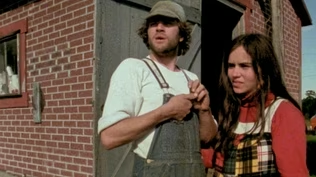
Filmed over the course of two-years, Seeds of Change chronicles the intersecting stories of lifelong farmer Mark McBrine and several incarcerated men as they grow their own food from a 5-acre prison garden unlike any other.
Problems playing video? | Closed Captioning Feedback
Problems playing video? | Closed Captioning Feedback
Made Here is a local public television program presented by Vermont Public
Sponsored in part by the John M. Bissell Foundation, Inc. and the Vermont Arts Council| Learn about the Made Here Fund
Made Here
Seeds of Change
Season 19 Episode 12 | 27m 56sVideo has Closed Captions
Filmed over the course of two-years, Seeds of Change chronicles the intersecting stories of lifelong farmer Mark McBrine and several incarcerated men as they grow their own food from a 5-acre prison garden unlike any other.
Problems playing video? | Closed Captioning Feedback
How to Watch Made Here
Made Here is available to stream on pbs.org and the free PBS App, available on iPhone, Apple TV, Android TV, Android smartphones, Amazon Fire TV, Amazon Fire Tablet, Roku, Samsung Smart TV, and Vizio.
Providing Support for PBS.org
Learn Moreabout PBS online sponsorshipPart of These Collections
Public Affairs & Social Issues
Encounter diverse perspectives on a range of public affairs topics and contemporary issues
View Collection
Providing Support for PBS.org
Learn Moreabout PBS online sponsorshipHi I'm Eric Ford for Made Here.
Filmed over the course of two years, Seeds of Change from Portland, Maine, director Maximilian Armstrong takes a look at the prison food system in Maine.
The film chronicles the intersecting stories of lifelong farmer Mark McBride and several incarcerated men as they grow their own food from a five acre prison garden.
We see the transformation of an outdated system and the possibility that food can heal not only the body but the mind as well.
You can watch Seeds of Change and other great Made Here films streaming on vermontpublic.org and through the PBS app.
Enjoy the film and thanks for watching.
Both of my grandfathers were farmers.
I spent most of my time at my mother's father's farm up in Carroll Plantation, Maine.
He knew after a while when I got to be about ten or 12, that someday I wanted to farm.
And so he spent time.
He told me back then, if you want to be a farmer, you're going to have to learn how to do everything.
I've got to say, probably I learned more life lessons there than I have anywhere else.
I had no idea some day that I'd be working in a prison.
I started when I was 25 years old, so I've been here for quite a while and seen quite a bit.
I go down to the chow hall every day because that's where you can get the feel of the day.
You can get the feel of the day every day by going to the chow hall and just feeling the atmosphere.
The last place you want have big problems is in the chow.
It can go sideways pretty quick.
I sometimes it's rowdy in there.
Depends what's on the meal tray.
You know, pretty much any facility that you're in that you're going to have the same meals throughout the month, on the same days, depending on where you are.
It is kind of like movie, but you get to steel tray and food is just plopped on the platter and depending on how long they keep food of certain places, there will be maggots.
Some of the boxes inside the freezer were marked Gray J for prison consumption only.
And that didn't really make you feel great about eating or serving that.
The trays that they were giving us wouldn't even have you everything on it, which you wouldn't want.
Even if you ate everything on the tray, you still wouldn't be full to know that you're going to get these exact same meals every single day and to know the quality of the meal is going to be that same quality.
It really just puts you in a kind of a lull.
You're hungry, but you're not looking forward to going to the chow hall.
My philosophy is that food can either be poison or it can be medicine.
When you first came to Mountain View, what was the state of the Garden and the agricultural program?
Well, when I came here, there was not.
We were able to lease a piece of land from Inland Fisheries and Wildlife, take that field and end up starting what we're doing now.
It's huge.
I've worked in gardens before, but I've never worked in that big on this five acres.
I'd like to see us be able to produce £100,000.
It may be a stretch, but I know it's possible.
I remember my first day driving down there.
We got in the pickup truck.
We no longer had to be handcuffed.
The doors were locked.
I rolled the window.
Now and I put my hand on the edge of the window like I was free.
That just boosted the morale of the whole crew.
Everybody that went was like, Wow, this is awesome.
You know, we're actually driving in a regular pickup truck.
And then after our first week of work, we all felt very ambitious and like we were ready to go back to work on Monday.
The weekends seem like it took forever to go by so we could get back out in the field.
Hey, guys, you want to come on over and we'll get a plan together for the day here.
So I want to get a couple of guys to start harvesting the cabbage.
We have people that want to be busy.
We have people that want to learn and to see people that take an interest and learn these things.
It's rewarding to be able to see that kind of a team come together.
Okay, good.
Now let's go.
Honestly that job, it's not an easy job.
For the most part, we're lugging five gallon buckets of rocks and we're shoveling compost.
You know, we showed up.
It was just a field.
I'm not going to tell you, it's not work to do.
Organic farming farming's always been difficult.
Probably always will be.
Yeah.
Youre all set.
its work.
You know, straight up.
It is a process.
You're not just going to go out there, jump the tractor and the roads are just going to make themselves.
You're putting in the effort to get that return back.
It's not like it's an easy, fancy job, but when you have a good crew and you have a good boss and everybody's working together in unison, it makes easy work out of it.
And then after seeing it all come together.
Beds are built, irrigation lines are in.
You know, it's nice to know, you know, I had a part in that.
that's beautiful.
Pinks and reds and the golden yellows.
You love doing that, dont you?
food's kind of always been part of what I've done, no matter what part of my life I was in.
My wife when I met her had her own cake decorating business.
We eventually were able to get our own farm.
We grew market vegetables, we had grass fed beef.
We ended up having pastured pigs, chickens, turkeys.
It was our full time living as a family.
And then we found out that my dad had brain cancer.
We as a family, my wife, my children, myself, we ended up taking shifts to help my mother around the clock to take care of him.
As we cut back markets and different venues, it got harder and harder to be able to sustain the farm.
And that's when I decided that I needed to get something that was constant, that I knew the hours.
It's a fairly unusual step to make from working as a farmer to being employed at a prison.
From the beginning, I had the intention of trying to get into the kitchen.
I really had a desire to be able to do something that was meaningful.
So with that in mind, I came and applied and eventually became the food service manager.
When Mark came on board, that's when it all changed.
It all changed.
He would buy all his potatoes from local farmers and they would bring bags of potatoes ready to facility.
You would buy fresh eggs from local farmers.
You could tell by the quality of the product that it was something you'd buy in a grocery store.
If there was one most important thing we do, I really believe it's the scratch cooking.
We started a bakery program where we bake all of our own bread products.
When I first went up to visit Mark at the correctional facility, I was blown away by the ecosystem that I saw there.
There was a team leader structure where senior bakers were overseeing new bakers.
Amber Lamptey came up, saw what we were doing and said, I have something you might be interested in.
The run of the mill flour.
It is the initial stream of flour that comes off our stone mill in the morning, every morning that we could make available to Mountain View Correctional Facility at a really reasonable price.
Better food doesn't have to cost you more money by using these raw ingredients and doing homestyle scratch type cooking.
It's a lot more like a home cooked meal.
It's better quality and the cost is less.
You look around out in the chow and you see people all the smiling and talking and associate with each other.
It was almost like looking around a bloated restaurant Seeing people just going about their daily business.
Once I got here, the food got better.
But it wasn't until I got onto the agriculture crew that we actually really started enjoying the meals because the kitchen was using all of the fresh produce for each meal.
We were eating fresh stuff straight from the garden.
Often what we pick today is what is going to go on the plate tonight or tomorrow.
Okay, lets head over to the kitchen.
There were so many types of vegetables in the garden, I couldn't even possibly begin to name them all.
There's at least 50 types of red used that I know and that they grow in there.
They asked how much of it I can handle doing, and I said Bring it.
And we would get crates and crates of it.
Last summer we didn't use anything from can.
We're using everything we could from the garden, fresh vegetables.
The canned stock just stayed there instantly.
When we brought the food back, they were cutting it out and cooking it up.
Fresh lettuce and fresh tomatoes and cucumbers.
Just knowing that I had helped bring that food in and was able to eat that first broccoli and stuff, it gave me a sense of pride.
We're not perfect here.
We've gotten some attention.
York Times had mentioned that we're a bright spot in the country.
To me, that just shows the situation that there is in a lot of the places for the food, because we're by no means doing everything that we should.
It's a work in progress.
Mountain View.
They help us up big time.
If there's more than what we could use that to time in the kitchen, then we donate it to local food pantries.
Everybody can use fresh vegetables Come from most of our situation.
We want to be able to find something that we can do that isn't just feel, it's just something to do.
You know, that we're actually doing something that has a meaning behind it.
And that's one of the biggest things for me.
When I wake up in the morning, I sit there in my bed and I wait for a few minutes and I get up and just ready to go because I'm like today, like, every day is a day that I can actually do something that I want to do, something that's good for all the rest of the residents that are here.
So it's more or less the feeling of doing something that I feel is very necessary to be done.
It's pretty amazing for me.
I'm come of environmental, so I got to make a phone call It's been two years since I've seen my son, so.
And I mean, I talk to him, but still being in here, he doesn't know where I am.
If you get arrested and you're in there for a month or six months, you lose your job, you lose everything.
Especially if you don't have a family or a support system for you.
If you don't have the means, that could be putting you right into the criminal lifestyle.
We call it life on the installment plan.
You know, you come in for two or three years, go out for a year to come in for two or three years.
It's just a way of life.
All in all, I had 17 felonies that I ended up getting charged for.
I didn't call home for about six months, so I just felt ashamed.
I don't think any of them realized how much crime I had committed.
I grew up in eastern Maine, up in the county.
The first time I ever tried math, I was at work and I had a friend call me up.
I was pretty much like, gosh, or I'll try it.
I went from spending 20 bucks to 100 or $200 a day.
It took right over my work.
I ended up losing my relationship, so I started using even more.
I thought, Hey, I got to get money somehow.
So I went around and I broke into some auto garages.
I took thousands and thousands of dollars worth of tools off the shelves, out of drawers, anything I could get my hands on pretty much.
And I traded those all for a cheap high.
I racked up a $75,000 bill.
That's what I owe now in restitution.
And I probably got $1,000 worth of drugs out of it all You have a sweatshirt or anything?
I mean, it's oh, really?
I mean, I've seen nothing's technically minds.
I don't know what I'm doing.
I don't know what I'm wearing out of here.
No one.
I don't know.
No one knows.
How are you going to live with this for something else right here.
What can I wear out of here?
I'll get your jeans.
Sweatshirt.
Oh, okay.
What size jeans?
I dont know, honestly.
it's been like years since I've worn them and said that make sure your money's there and your Google voucher.
That's your Google voucher.
So to make sure its all there.
these guys were on the way out, they're going to be your neighbors again.
Freedom's a powerful thing.
I'm not going to be institutionalized.
I got out in two years.
I'm good.
Done.
I missed both of my sons turning 21 years old.
I am striving to make sure that my sons are going to be better men and not have to make the mistakes that I had to.
Nothing on this planet is worth breaking a family apart for.
People are incarcerated in America and in Maine because of mental health issues, because of substance use disorder, because of poverty, neglect, trauma.
Those are really the reasons why people are incarcerated.
Very small numbers of people are incarcerated nationally in the state of Maine because they're bad, evil people.
Some people are more comfortable being in prison and keep going back to prison.
That's their choice.
I don't want to be back there ever again.
And if I stick to the course, I never will be.
I set up an interview with Tim.
I got to know him a little bit.
a lot of people go into prison and you just have reservations about somebody that's been there.
But I feel very confident that he doesn't want to go back there, and I just feel that he's not going back there.
we could actually use a lot more Tims if we can find them.
I didn't know that I'd be working in a restaurant today and be honest, it's hard to get used to being so free at Mountain View.
Mark came out one day and asked if I would like to be involved in a culinary apprenticeship program.
I feel like it greatly prepared me for my job now.
What do they usually say before they arrest you?
Put your hands up.
I want to be a dad that my children look forward to seeing on a daily basis.
I plan on just making a better future for me and my kids.
Oh, did you see the little pumpkin that just started down the aisle?
I've been free for one year on the 21st of this month.
I am starting to grow all my own produce and raise my own meat birds.
It's just amazing to know how impactful food is in a correctional facility.
Every prison in America should have its own garden program.
Just that alone will give so many prisoners a bigger sense of confidence for when they get released.
They won't necessarily feel like they're worthless, because when you get out and you feel worthless like that, you're going to fall back into a life of crime every time.
at root.
I think food is the social issue of our time.
Food is health, food is happiness.
And it's beautiful.
It should be beautiful.
Food is a beautiful thing.
I didn't know everything that was going to happen in my life.
None of us really do.
I knew that I wanted to farm.
There's definitely a lot of trials and I think you need to be patient.
You need to be willing to work hard, and it's got to be something that's passion.
I think most farmers somewhere along the line got that passion.
I kind of blamed my grandfather.
A lot of people talk about sustainable agriculture.
I'm definitely more of a regenerative agriculture person because if we just sustain something that isn't good, then we haven't really gained a whole lot.
And though it's important to be sustainable, I'd rather be trying to renew and rebuild.
We have a lot that we can do to grow from here.
Vermont Public partnering with local filmmakers to bring you stories made here for more visit vermontpublic.org










Support for PBS provided by:
Made Here is a local public television program presented by Vermont Public
Sponsored in part by the John M. Bissell Foundation, Inc. and the Vermont Arts Council| Learn about the Made Here Fund