Vermont Public Specials
Katherine Paterson on a Lifetime of Moving, Writing, and Starting Over
Season 2026 Episode 9 | 52m 41sVideo has Closed Captions
Katherine Paterson is the award-winning author of Bridge to Terabithia and over 40 other books.
Katherine Paterson is the award-winning author of Bridge to Terabithia and over 40 other books. In this interview, Vermont Edition host Mikaela Lefrak talks with the author about her life, legacy, and writing, at Paterson's home in Montpelier, Vermont.
Problems playing video? | Closed Captioning Feedback
Problems playing video? | Closed Captioning Feedback
Vermont Public Specials is a local public television program presented by Vermont Public
Vermont Public Specials
Katherine Paterson on a Lifetime of Moving, Writing, and Starting Over
Season 2026 Episode 9 | 52m 41sVideo has Closed Captions
Katherine Paterson is the award-winning author of Bridge to Terabithia and over 40 other books. In this interview, Vermont Edition host Mikaela Lefrak talks with the author about her life, legacy, and writing, at Paterson's home in Montpelier, Vermont.
Problems playing video? | Closed Captioning Feedback
Where to Watch Vermont Public Specials
Vermont Public Specials is available to stream on pbs.org and the PBS app.
Providing Support for PBS.org
Learn Moreabout PBS online sponsorshipMore from This Collection
Special episodes from our daily radio show.
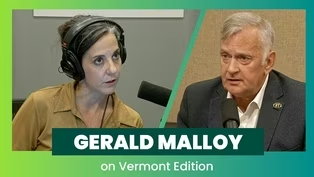
Congressional Republican primary candidate Gerald Malloy discusses his platform
Malloy is a U.S. Army veteran and defense contractor from Weathersfield. He joined us in studio. (24m 33s)

Vermont Public's 2026 Democratic primary debate for governor
Video has Closed Captions
Vermont’s Democratic candidates running for governor met for a live debate at Vermont Public studio. (56m)

Vermont Public's 2026 Democratic primary debate for lieutenant governor
Video has Closed Captions
The Democratic candidates running for lieutenant governor in Vermont met for a live debate. (56m)
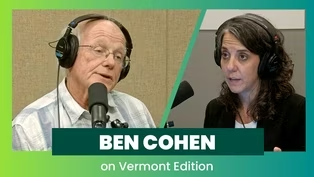
The uncertain future of the Ben & Jerry's Foundation
Co-founder Ben Cohen discusses the foundation's origins, the company's social justice mission. (17m 58s)
Providing Support for PBS.org
Learn Moreabout PBS online sponsorshipKatherine Paterson is the award winning author of Bridge to Terabithia and over 40 other books.
When I started, I had to write on the dining room table, it was the only place I had to write.
And then I'd have to clean it up for the next meal.
Vermont Edition host Mikaela Lefrak talks with Paterson about her life, legacy and writing at her home in Montpelier, Vermont.
I truly love this world.
And I'm not eager to leave.
You have lived so many places in your life, beginning in China.
You were born in China.
Your father was a Presbyterian minister there.
And then when you moved back, you lived in a number of different towns in Virginia and West Virginia and North Carolina.
What?
What was the first place that you remember thinking of as home?
Well, Wang Fu.
I was there till I was five, and we - my parents you know, missionaries have a bad name, but my parents were different shall we say.
And and so we lived in a Chinese house and we lived on a compound because my father was asked to be principal of the boys school.
So he found property where he could have the school and, and everybody who lived there with Chinese except us.
And the because I was the middle of five and I had two baby sisters very quickly.
I would wander over to Mrs.
house, who was the Bible woman, and she was a widow, and have lunch with her everyday because it was guaranteed Chinese food at her house.
And it wasn't always guaranteed to be Chinese food in my house.
So I was very much at home there.
Did you grow up speaking Mandarin?
I was I was bilingual, and my mother used to get very annoyed because we'd never speak Chinese to foreigners.
She wanted us to show off our Chinese.
My older brother and sister and I. And we never would because we knew that wasn't appropriate.
And I found a letter that my father had written to his mother, and I was not two years old.
It was the summer before I turned two in October, saying, I don't remember the other children talking this much.
And the Chinese, dont remember it either.
So apparently I couldn't be shut up in either language, so don't try to shut me up today, Mikaela.
Never.
I read somewhere that you tried to return to China as an adult and weren't able to.
You wanted to teach and be a missionary and went to Japan instead.
Why weren't you able to to reenter China at that time?
Well, that was I mean, it was the Communists were not letting anybody in who had any kind of a religious label.
And so I thought, well, maybe I'll go to Taiwan for other reasons.
I did not.
And I had a friend who was Japanese, and of course, I hated the Japanese because of the war, because we'd been bombed and then we'd been occupied.
And the Japanese soldiers were very scary.
And that's why you had to leave China when you were young.
Of course and she said, you know, if you'd give the Japanese people a chance, I think you might feel differently.
And I thought, well, I love you so.
Yeah.
And it was really absolutely wonderful four years.
And I really expected to spend the rest of my life there.
And then I met John Paterson, then that- That guy.
changed my plans.
How did you two meet?
Well.
He came.
I was I had gotten a scholarship to Union Seminary in New York City.
And so I was there for my leave here from Japan.
And he was in a tiny church in western New York.
And they had a program for ministers who'd been out in the field.
And so he came for that program, and he and one of the other guys, the last night they were there, were looking for somebody to play bridge with.
And so somebody sent him over to our apartment and I don't didn't play bridge.
But two of my apartment-mates did so.
But it was like that advertisement of the guy comes through the door and, and your roommate meets him at the door, and while you're getting dressed in the other room and and so I met the young man at the door while my roommates were getting all primped for these two young ministers.
And I couldn't tell this to the general public.
Oh, it's a bad example, but but he said, don't you?
He said, wouldn't you like to play?
I said, I don't know how to play, Ill go study.
And he said, wouldnt you like to learn?
I said, no.
Well, yeah.
So the telephone rang the next morning and of course I was the first one up.
You know, Im Miss always did my homework.
I was always the first one up.
I'm not I'm not that bad anymore.
so it was John Paterson that Id barely met the night before, and I thought he wanted to speak to one of my apartment mates, but no, he wanted to speak to me and he said, would you have lunch with me?
I thought, okay, I mean, why not?
And after he said, would you have time for a walk?
And I said, yeah, sure.
So I, I really cannot remember what he said, but I realized he was going to marry me.
And he began, the first letter I got from him was from the airport.
February the 28th.
I saw him several times and we got married July the 14th.
Wow.
Fast.
It worked out pretty well.
Sure did.
It's it's much more complicated story than that.
But that's that's the bare bones.
You two got married in 1961- ‘62.
Excuse me.
And went on to have four kids together.
And after you became a mother, as when you started to write.
Yeah.
And I'm so curious to hear what it was like in those early years, trying to build a career as a writer or to, you know, put together your first manuscript and send it off to an agent or an editor.
I'm not sure how you went about that and what it felt like to do that, while also being in a traditional marriage, raising young kids.
Right?
As the the sort of feminist revolution was, was happening.
Was that a movement you identified with or did it feel very separate?
I, I didn't have time to think about.
Having a revolution.
Believe me.
You know, I, I really began I had a professor in seminary before I went to Japan, and she stopped me in the hall one day and she said, Have you ever thought about being a writer?
and I've been a reader since I was 3 or 4 years old, and I love being a reader, but I, I knew what good literature was.
And I said to Doctor Little, I, I said, I never I wouldn't want to add another mediocre writer to the world.
And she said she was my seminary professor- She said, maybe that's what God is calling you to be.
And I couldn't believe God wanted anymore mediocre writers.
So I went to Japan, and she actually got me my first writing job.
What was it?
I wrote a book called “Who Am I?” for fifth and sixth graders about the Christian faith.
Good propaganda.
Seriously.
Yeah, yeah.
I mean, propaganda has a bad name, but what what it is, is this is what I believe in.
I'd like to share it.
And so then I thought, well, you know, I'm not going to go back to school teaching with four little kids.
I'll be a writer.
So seven years later, that's how long it took to write and publish your first book or your your first novel.
Yeah, yeah.
And so and that was, you know, you can call it luck or you can call it providence.
I tend to go with Providence, but I wrote, I decided- this lady in the church knew that I had writing ambitions.
And so she said, let's go to the Montgomery County adult, you know, program at night.
And they're doing a writing program in Maryland where you were living at the time.
So I thought, mom's night out, you know.
So we went and I thought, you know, I because I am the way I am.
I wrote something every week and.
I published one short story that I wrote during that program, and the little magazine that published it died the next month.
And then I, I sold once one poem in the little magazine that bought, that died before it published the poem and and then I thought, well, if I can do a story a week, I can do a chapter a week.
And I started writing my first novel, and then when I got got it done.
I went to the library, see who published books that I liked.
And they say, I mean, you know, the whole thing is crazy.
It was a novel set in 12th century Japan, and if I'd known anything about publishing, I'd known that nobody would buy that.
They wouldn't think American young people would want a book about 12th century Japan.
But.
But in a way, you were writing what you knew.
You had studied.
Yeah, well, I knew what I cared about.
Yeah.
And the young woman who, in those days, some of the publishers had what they call “slush piles” and I've seen the slush piles in my day.
It's just theyre shelves Row after row after row of manuscripts have come in without an agent or without anyone to recommend them.
And in those days, sometimes people read those things.
And so I tried several places and just happened.
It came to this publisher, and the young woman who had to read took it to the senior editor, and the senior editor had just come back from Japan, loved Japan.
There you go.
And published it.
Still in print.
And then you were you were off to the races and she she I was given to Virginia Buckley, who was just coming off of, of maternity leave and therefore had nothing on her desk.
And Virginia and I worked together for 40 years.
It's a special partnership.
Absolutely.
I would not be you would not be interviewing me today if it were not for Virginia Buckley.
Wonderful, wonderful editor.
And people think editors just tell you what to do.
She would never tell me what to do.
She would just ask me the question.
Yeah, and make me solve the problem.
That's really editing.
Well, whatever you were doing with her produced some magic.
between 1975 and 1980, you won two National Book Awards and two Newbery Medals.
That's also the period in which you published your most well-known novel, Bridge to Terabithia.
What what was that period like for you?
How did those awards and that recognition change your life?
Well, the first after I won the Newbery for Bridge to Terabithia I met the first Newbery winner that I'd ever met.
And she said to me, you know what comes with the metal?
And I said, no.
She said, A divorce.
Congratulations Katherine.
But it didnt fortunately.
And but the hardest book to write Was “Jacob” because I, I had one By the time while I was working on “Jacob” I won Bridge to Terabithia Newbury honor.
Newbury honor for “Gilly” National book award and I won the National Book Award for Master Puppeteer.
And I thought, this book doesn't have a chance.
And I thought, I'll send it to Virginia with a fake name on it.
And if she thinks it's worth publishing, then you'll be okay.
so I was a long time writing the book.
Took.
I was almost three years, I guess, and Virginia said, just call me one day.
And she said, are you working on anything?
And I said, yeah, but I don't know if it's any good.
And she said, just promise me you won't send it to me under a pseudonym.
People always ask me which is my favorite book, and I don't really have a favorite, but by gum “Jacob Have I Loved” is the one I'm proudest of because I thought I could never get that book done.
And I did, you know, and I'm really very proud of it.
Can we go back to that comment that that other Newbery Award winner made to you about what comes with an award is a divorce?
I wonder about that because it's, you know, it's a funny story, but also, I've been curious if if that level of success and the the time you were devoting to writing, if that caused any strain in your relationship, especially at this time when it wasn't typical in the way it is today for for women to be working as much as men?
Yeah.
And you're never supposed to make more money than your husband or be more better known than your husband.
Yeah, I've often said that John Paterson was the only man in my generation that would have stayed married to me, because all my friends who really achieved something did get divorced.
And a lot of them.
Newbery winners got divorces.
Because it was very hard for the man in that situation.
And I know it was hard for John, but he.
He he stayed there.
He knew he was lucky, stayed there with me.
You and John and your family moved to Barre in the mid 1980s, after living in Maryland for many years near Washington DC.
Did you?
How do you feel about moving?
Well, when we were, we went to Norfolk for eight years.
And in between the two.
Yeah.
And Norfolk, when John was called to Norfolk, I said, John, you do not want to go South.
And he said, I've lived in the South.
I said, no, you have not lived in the South.
Takoma Park, Washington is not the South.
And of course, John integrated our church in, Takoma Park.
And I mean, it became integrated when he was He was there.
A couple of people even left the church over that.
And I, you know, he he's a Connecticut Yankee and he just.
No, he just said, I lived in the South.
I know what the South is like.
And it was it was very difficult in many ways because both of our daughters are of color and.
And at the time, my older daughter had an African-American boyfriend who came to see her.
And that caused a stir, of course.
Both of your daughters are of color?
They're both adopted.
The girls are both adopted Our older is Chinese and our younger daughters is half Apache and half Kiowa.
And so you were worried for them moving to the South at that time?
Yeah.
Well, I, I it was yeah, it was hard for them.
Yeah.
And so when after eight years and, you know, there were many good things and you know, I had friends there that I. Cherished that, you know, my whole life was living in a place long enough to have friends.
I couldn't bear to leave and then leaving them.
And so when John was thinking about coming to Vermont, I said, okay, one more move.
I'm.
Well, here we are 40 years later in your Vermont living room.
You stuck to that.
I'm just struck by how varied the places are that you've lived.
And it must have been a real, just a real mentality shift to move to a place like Barre, Vermont, from living in the South.
Both.
Both in, you know, I mean, technically Takoma Park, but, you know, in the DC area.
And then we went to Norfolk, Virginia, which is certainly the South.
Do you remember what it was like to move there and to try to to meet people and make friends?
Oh, yeah.
Yeah.
It was so different from the South.
And because if somebody moves in the South, you run over with a pie.
No one brought you a pie?
No.
And I mean, I'm sorry, but New England seemed very cold to me.
And and John, you know, South everybody is just so slushy and and I said I need a little smush and slush.
It was nice.
And besides, I remember one afternoon I thought, oh, my heavens, it's time to start supper.
Its dusk.
And I rushed downstairs and started getting supper ready.
And I looked at the clock and its three oclock in the afternoon!
Oh, mercy.
How did you meet friends?
How did you make friends?
I think it's a thing.
It's something we, many of us struggle with.
It is so hard.
And especially if your kids are all grown up.
And I remember in Norfolk, of course.
After leaving my dearest friend in Maryland behind.
And I had a lot of friends there because there were so many writer friends there, and I was just so lonely.
And somebody asked me to make a talk at the library, one of the big libraries.
And so I did.
And at the question and answer time There was a young woman at the back who was asking.
The most intelligent questions I ever gotten from somebody.
I thought, this is somebody very interesting.
And so afterwards I, I went up to her to thank her, and her name was Catherine Morton.
She's still one of my dear friends to this day.
And I was with her when her child died.
So I mean, we had that kind of a friendship that she wanted me to be with her when her child died.
So then I had to leave.
And Mary Lee Settle who is a wonderful adult novelist, and I had lunch together every week, and that was another friendship, you know, that I had to leave behind.
Come up here no friends.
And everybody's kind of shy about trying to make friends with the minister's wife.
Who's won a couple Newbery Medals, too.
I would be intimidated.
And and so Grace Greene moved here the same summer we moved and they lived not too far away.
So I guess Grace was probably my first friend here.
I had I had met her when she lived in Massachusetts because she was a library, and I was by this time I was talking to a lot of librarians and so and so Grace and Dan and John and I began having this picnic in our one year in our yard, one year their yard, and invite all the children's writers and illustrators in the area.
And we had wonderful times.
And Nancy says, that's where I first met her.
I don't really remember, but we've had lunch almost every Wednesday since.
Im still stuck on this this, like, moment in your life when you moved here with your husband and you had all of this personal success with your with your children's literature, and then moved to a small town in Vermont, was there where you didn't know anybody.
Was there ever a point where you were like, we got to get out of here.
I want to leave.
No.
Why not?
We were in the most loving church I've ever been in.
I've been in churches all my life.
And John was so happy.
because Norfolk had been difficult in many ways.
And here was a church where people were so open hearted and not, I mean, as opposed to outside, where I felt a sort of chilling.
The church, the church was well worth the moving.
And in fact, when John retired, I said to the session, you know, John knows we're supposed to move, make way for the new minister.
And he's perfectly willing to do that, but I'm not.
And so if you'll let us stay, I will- We will try to behave ourselves.
Well, of course, you know, they don't want the retired minister telling the new minister how to do things.
So.
It kind of seems like, you know, as somebody who you've moved so many times in your life, but, it seems like the church has been a way for you to find home.
Yeah.
In every place that you've lived.
Yeah.
And and, I like having writer friends.
Yeah.
There's a lot of writers in Vermont.
Because we know.
We kind of understand each other's situations in ways that people who don't write often think that it's easy and you never have any doubts or problems.
But those who have who've been through the trenches, they know.
One of the books I wanted to ask you about was was Bread and Roses, too.
Yeah, it's about the 1912 textile mill strike in Lawrence, Mass.
And the children of workers who were sent to live with foster families in Barre during the strike.
I'm curious how how you researched that in your own community and where in a place where you had lived, how you got to know that side of Barre.
did you meet people who had family members who had been through something like that?
Well, I, I'm not one of these people who knows, you know, has someone got ideas for books that they'll never live long enough to write them.
Somehow I doubt that.
I finish a book, and I think, well, that was a good career while it lasted.
how many books have you written?
Like 40?
I- I- Well, a lot, a lot.
I used to say over 30.
And and my agent said, Katherine, youre going to have to say over 40 And I said, I haven't written more than 40 books.
And she said, would you mind going to your website and counting?
And you're like, oh.
But.
But anyhow, I was, you know, I was between books and I was at that time the Vermont Area History Chamber was on the top floor of the Aldrich Library, and I was just wandering around there and I saw that picture of the kids on the, on the porch of the labor hall.
I thought, there's a story in there.
And so Karen Lane was the librarian at the time and knows as much about Vermont history as anybody in the world.
And so I began asking her about it.
And so she put me on some things.
And The old Barre newspapers, there were a lot of information in them.
There wasn't as much information on the strike as you would expect.
And.
I really had to dig for that.
After, after or about the same time my book was published.
There's a was a very good nonfiction book called On the Strike.
And.
Which would have helped me immensely, but I didn't have it at the time.
But I really loved writing that book because.
Of course, you had to get into the the history of the time and the the bravery of those people just absolutely astounded me.
And it was the women.
You know, it was the women who were the brave ones in that.
And of course, they sang when they marched and somebody said, you cannot defeat a singing protest.
And I think, well, that's how the civil rights protests- My husband was jailed during that.
He he went south to to march and was jailed.
And they were put into one cell and they were they couldn't even lie down in the cell.
They were just jammed together.
And they just sang all night and ran the jails crazy.
But there's just something about people singing that's very powerful.
Do you like to sing?
Do you like to sing?
I used to pretty good.
And now I have no high.
And I have no low.
So.
So I try not to sing too loud.
Old age takes a lot of stuff from you.
Well, if you don't mind, I would love to talk about old age a bit.
Sure.
Because we were in this, this period in our culture right now where we are very interested in longevity and kind of figuring out how to live forever.
That seems like one of the, the focuses of many of our tech billionaires right now is, how can I beat death?
How can I slow aging and a lot of a lot of money and a lot of time is going towards that.
I feel like there's a new TV show and podcast every day coming up on on how to how to live forever, how to exercise or eat to change, to change your fate.
You're 93 now.
You seem to have figured out something that these tech billionaires have not.
Well, I love this world.
I truly love this world.
And I'm not eager to leave it.
But there comes a time when you have to move out and.
And not overcrowd the universe.
There's also one thing about old age, like not being able to sing as well as- I could sing pretty well.
That's pretty much gone.
My hearing is, which used to be very good, even with hearing aids is imperfect.
My sight, which, you know, been reading all my life, it's harder for me to read because my eyes aren't strong, I work so your the the losses begin.
And then I think I was thinking the other day, you know, finally you've lost.
Enough things that you realize that you're ready to go.
Im not quite there yet.
And I kept saying, I don't want to die before Margaret and Nick get married.
And are they your grandkids?
Yeah, yeah.
Younger daughter.
And I just I love Nick.
And Margaret would, you know, Nick would hung around for Margaret forever, and Margaret would go off and find herself or find a new job or.
Margaret.
Well, maybe she knew you were waited round for that.
She said, if I put this off, Nana will live forever.
Well, they finally got married.
And so the day they.
They wanted me to marry them, actually.
So that's another long story I won't get into, but I did.
I didn't say the “I now pronounce you” because I refused to pay the $40.
I'm too Presbyterian.
So their father, their Quaker father, her Quaker father paid the $40 so he could he could do it.
But but, you know, we took all these pictures of the church, and I'd been standing up for 45 minutes.
And as you can see, I'm old, creaky.
And so I said when they said, well, let's go down to the lake because they got married at Lake George let's go and they can take more.
I said, I think I'll just go back to the house and rest.
Because I wanted to go to dinner afterwards.
And so I was lying on my bed and my son John opened the door.
And there I am lying on the bed.
And he said, Mom!
I said Im not asleep I'm just resting.
said Oh thank God, because everybody was sure that I was going to live long enough for Margaret and Nick to get married Now they're married, so I'll- And I've been working on this book and and so Mary, my youngest said, I said, she said, well, what's the situation?
I said, well, weve sent everything to London that we could send right now.
She said, you dont think that means that you can die do you?
I like to hang around a little longer.
maybe see it published or something.
You know, I pray that I'll be happy and ready to go when the time comes.
But right now, I say- just a little more time please Not forever.
I do not want to live forever.
And I do not want to live past the time where I can enjoy life and and enjoy the people I love and my friends.
And.
Every day there new things to to make life interesting, enjoyable.
Well, you have been so.
You've thought so much about death and grief throughout your life, have experienced it yourself, have supported people like your friend who you mentioned when her child died, you saw your son lose his best friends when he was a little boy, which was the the basis for your best known novel, Bridge to Terabithia.
And I wonder if you if you see a connection there between kind of looking death in the eye, you had cancer to when you were younger.
Mother, is there a connection for you between having to look death in the eye, seeing what death and grief are like, including for people who are, who are young, who for whom they're not ready to go, and how you feel now about it, this, this what seems like a really healthy acceptance and also joy in your older years, I don't know.
I, you know, I just had such a good life.
I, I can't imagine anybody who's had a better life than I've had.
And so- I guess I'm just very grateful for it.
And I've tried to do, you know, all the estate stuff, all the things so that when the day comes that there won't be, as I say, I want my children sad but not mad.
Because it's very hard if things aren't taken care of.
And so I think got to start getting rid of things so they won't have so much stuff to go away when I when I go, because I will go a few of my children are not very accepting of the fact that I will go.
I mean, I'm 93, for heaven's sake, and it's a lot longer than a lot of people live, especially- There's this really great book about death and grief I know called Bridge to Terabithia.
Maybe you could suggest they read that.
You know, I probably shouldn't tell you this, but Bridge to Terabithia sells more than all my other books put together.
And I thought not too long ago, I guess it was last year.
I wonder what is about that book that makes it sell year after year after year so I, I thought I'd better read it, I read it, it's a good book for a better read.
Id better read Gilly Hopkins.
That's a better book than Bridge to Terabithia.
I better read Jacob, I read Jacob.
And I thought- Good, better, best.
Me.
Who's literary critic.
After years looking at what I've written.
So it's kind of fun.
Why do you why do you think that is?
Well, I just think I'm just talking objectively about literature, not about theme or anything like that.
I just I just think it's better written.
But why do you think Bridge to Terabithia has had such staying power?
It has its its 50th anniversary.
Its 50th birthday is next year.
I know I want to live long enough to- Yeah, you gotta stay around for that one.
The day it celebrates its 50th.
I think there is something about it that has made people bring their own grief to it.
Which is why I don't want children to read it when there's not emotionally ready for it, no matter how well they read.
And and I can't be the judge of that.
I think parents are, and teachers are much better judge.
You have to know the child.
Ive had this rather marvelous experience lately which has gone on over many years, and I got a letter from a 16 year old and this was ten years ago, back in two pages, single space typed, and she said that she had to write to me to thank me for what Bridge to Terabithia had meant to her when she was nine.
And she said that, you know, growing up, her parents had painted her bedroom pink and she hated it and she hated pink.
And she knew there was something wrong with her.
That she was different somehow and weird.
And then she read Bridge to Terabithia and the girl was doing boy things, and the boy was doing girl things, and she thought it was all right for me to be different.
And she at the end of it, she said, you probably didn't want to read all this from about a book he wrote 40 years ago from a weird kid A queer kid in California.
But I just had to tell you this.
Well, I've treasured that letter I wrote back to her, and I say her name was Amethyst McKay.
I said Amethyst- You were the dream, the dream reader for every writer, the one who takes the book and makes it her own.
And I guess I got one more letter from her after that.
And that was that was it.
And so.
I'm doing this book of essays, and I wanted to use that letter, but its been ten years since I heard from her and I thought, I don't know what what her situation is.
And so I began to track her down, and I actually found a phone number for her.
And I called and it was machine that said this is Cam leave a message.
And so I said, you know who I was and that I had gotten this letter from her ten years ago, and I wanted to use it in a book of essays, but I felt I couldn't without her permission, and I had hardly hung up when the phone rang and it was Cam, who is now Cam, and We had the most wonderful conversation.
And she said, of course you can use my letter.
I'd be honored and you can use my name.
I'm Cam now, but I was Amethyst then, and I mean, it was just unbelievable.
So I shared that with my agent who's helping me with this book, bless her heart And she said that should be a whole chapter of its own, because this whole book is about how important readers are to writers.
And that's the most wonderful, you know, example of what happens to a book when it's given to the reader.
And so.
I sent the essay to Cam and she said, I know it's hard for somebody your age, but I've been They since I was 16.
And I said, we can do that.
And she said, of course, when we first started, I was Amethyst but I appreciate your saying, Cam now.
Yeah.
is that for a book you're working on now?
Working on now.
Because, you know, people always say, what's the best thing about being a writer?
And it's the readers.
Yeah.
You know, somebody that takes your book and makes it their own.
And that's what you identified as first since you were a little girl.
Yes, yes yes, yes.
When is that book coming out?
When is that book coming out?
Oh.
‘27.
In conjunction with the 50th anniversary of Guess What?
So I have to live that long.
They know what they're doing over there at that publishing house.
I read somewhere that you you always either wrote by hand or on your typewriter.
Is that still the case?
No.
I used to do everything by hand, and I've had- How many operations and I thought- Jane Austen didnt have carpal tunnel Charles Dickens didnt have carpal tunnel.
They wrote much longer books than I did.
But it was suggested that I switch.
I really- So I compose on the computer now, but I don't like it because it makes it makes things look too perfect.
And when you're in the first draft, you have to know you're making trash.
You know?
Otherwise youre too satisfied with something that's no good.
So.
I, I, I switch to handwriting when I get stuck because, you know, from it's kind of a, a good process right from here and I would prefer to do that, but I, I'm old.
Now I have a fake elbow so it's hard to touch type.
You're bionic.
I've got a rod up my leg screws across my ankle.
I've got a fake elbow I'm a wreck.
Far from it.
Last question for you.
Where do you like to write?
where do you where do you sit?
Do you have a special place you like to write?
Yeah, I when I started, I had to write on the dining room table, thats the only place I had to write And then I'd have to clean it up for the next meal.
And then.
I guess when we moved to Maryland.
I had a big desk in what was technically the guest room, and so that was nice because I had a desk with drawers and I was more private and I didn't have to move things all the time.
Yeah.
And then in Norfolk, the only place I had was the front porch.
It was a sort of a louvered porch, but it was boiling hot in the summer and freezing in in the cold weather.
So each of the kids had a bedroom.
And so when they started going off to college, I said, how long do I have to keep these rooms as memorials to the dear departed?
And John said, if I get into Dartmouth, you can have my room.
And Mary said, no, you can't, I can't.
You can have my bed Poor mom.
So I had the small bedroom.
And here I have a study, and I had and Barre we got, we bought a big house so I would have have a study.
So, you know, in my latter years had more space but process, you know, people say, and I think I have written around interruptions all my life and in order to very often the only thing to do is to get up before anybody else was up and also before my boss was up, my boss being my self critic, that kept saying, what makes you think you can be a writer?
So one of my essays is on how to be a good boss Because if you have a bad boss, it makes- your one employee is very unhappy It will not do good work.
Theyll report you.
Thank you so much for hosting us in your home and it's been a real honor.
Well, Thank you very much.











Support for PBS provided by:
Vermont Public Specials is a local public television program presented by Vermont Public