
Sudan crisis deepens as war enters 4th year and aid cut off
Clip: 6/9/2026 | 5m 22sVideo has Closed Captions
Sudan crisis worsens as civil war enters 4th year and Hormuz closure disrupts aid
It’s the world’s largest humanitarian crisis, yet aid groups say it has received far too little attention. As Sudan’s civil war enters its fourth year, nearly two out of every five people face emergency-level hunger and humanitarian officials warn the crisis has been compounded by the closure of the Strait of Hormuz. Nick Schifrin reports. A warning, some images in this story are disturbing.
Problems playing video? | Closed Captioning Feedback
Problems playing video? | Closed Captioning Feedback
Major corporate funding for the PBS News Hour is provided by BDO, BNSF, Consumer Cellular, American Cruise Lines, and Raymond James. Funding for the PBS NewsHour Weekend is provided by...
Sudan crisis deepens as war enters 4th year and aid cut off
Clip: 6/9/2026 | 5m 22sVideo has Closed Captions
It’s the world’s largest humanitarian crisis, yet aid groups say it has received far too little attention. As Sudan’s civil war enters its fourth year, nearly two out of every five people face emergency-level hunger and humanitarian officials warn the crisis has been compounded by the closure of the Strait of Hormuz. Nick Schifrin reports. A warning, some images in this story are disturbing.
Problems playing video? | Closed Captioning Feedback
How to Watch PBS News Hour
PBS News Hour is available to stream on pbs.org and the free PBS App, available on iPhone, Apple TV, Android TV, Android smartphones, Amazon Fire TV, Amazon Fire Tablet, Roku, Samsung Smart TV, LG TV, and Vizio.
Providing Support for PBS.org
Learn Moreabout PBS online sponsorshipGEOFF BENNETT: It's the world's largest humanitarian crisis, yet aid groups say it has received far too little attention, even as Sudan's civil war enters its fourth year.
Sudan's conflict and the suffering it has created are growing more severe.
Nearly two out of every five people face emergency levels of hunger.
And humanitarian officials warn the crisis has been compounded by disruptions to global aid following the closure of the Strait of Hormuz.
As Nick Schifrin reports, the toll on civilians continues to mount.
A warning: Some images in this story are disturbing.
NICK SCHIFRIN: In the fields of Sudan, it's time for the harvest.
The colors may be bountiful, bright green and red, but the harvest is not.
Farmers are fighting three simultaneous battles, drought, displacement, and now a deficit of fertilizer and fuel.
The closure of the Strait of Hormuz has hiked prices for Sudan's farmers and reduced the country's access to food, just as parts of Sudan suffer from famine and the devastation of a brutal civil war that's entered its fourth year.
TJADA D'OYEN MCKENNA, CEO, Mercy Corps: People are suffering, and this is entirely manmade and can be stopped.
NICK SCHIFRIN: Tjada D'Oyen McKenna is the CEO of Mercy Corps, a humanitarian organization working on Sudan's front lines.
TJADA D'OYEN MCKENNA: Some people have had to resort to eating leaves to survive because of a lack of food.
And even when people do have access to it, the ability to afford it is even worse at this point.
We are seeing this irregularity of supply, as well as the price spikes are really locking in food insecurity and hunger situations for years to come.
NICK SCHIFRIN: What will happen to Sudan if the strait isn't open?
Cindy McCain was until recently the executive director of the World Food Program.
CINDY MCCAIN, Former Executive Director, World Food Program: In the worst-case scenario, the country could implode and just turn into complete anarchy.
NICK SCHIFRIN: The war has already pushed the country toward collapse, on one side, the government's Sudanese Armed Forces, on the other, the paramilitary rebel group, the Rapid Support Forces, or RSF.
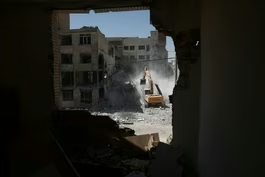
Sudanese cities have become battlegrounds.
Both sides are accused of war crimes.
In Darfur, Sudan's largest region, where famine has been declared, the RSF is accused of genocide.
TJADA D'OYEN MCKENNA: What I'm seeing is a country and a population that is living with the effects going on into the fourth year of a war and crumbling civilian infrastructure that accompanies that.
MARCO RUBIO, U.S.
Secretary of State: Sudan remains a very frustrating situation.
NICK SCHIFRIN: Last week, Secretary of State Marco Rubio once again labeled Sudan a proxy fight.
Saudi Arabia and others support the Sudanese Armed Forces, and the United Arab Emirates support the RSF.
And foreign weapons and assistance have helped fuel the war.
MARCO RUBIO: The divisions between the UAE and Saudi Arabia have truly complicated our ability to bring that to an end.
What we're focused on there now is identifying two cities -- or four cities, two on each side, that will serve as points of distribution for humanitarian aid.
NICK SCHIFRIN: But humanitarians say the world has not put enough pressure or pressure or provided enough assistance to Sudan's neediest.
TJADA D'OYEN MCKENNA: It's shameful, really.
There are lives being lost that did not need to be lost because of this indifference that we're seeing.
In three years, going on four years into this conflict, we do not see any strong political will to end the conflict.
NICK SCHIFRIN: The humanitarian needs are staggering, tens of thousands dead, many buried in unmarked mass graves, like Mohamed Alswai.
More than a year ago, the RSF shot him dead and hastily buried him.
His brother Abubakar is only now able to provide him a proper re-burial.
ABUBAKAR ALSWAI, Brother Killed in War (through translator): It is so painful for us.
Even the kids have come to me and said: "Uncle Mohamed, Uncle Mohamed is dead.
Uncle Mohamed is buried outside."
NICK SCHIFRIN: And this is the world's largest humanitarian crisis; 30 million need assistance; 11 million are displaced.
Many have fled their homes into camps where there is not enough food or water.
The stories of sacrifice here are everywhere, Safiya Abu Bakr, whose husband was killed in a Sudanese airstrike, Hussein Sharif, shot in the head by an RSF sniper, giving him partial paralysis, and Fatima Mohammed, she and her kids separated from her husband by war.
FATIMA MOHAMMED, Displaced Mother (through translator): We are waiting for the war to end so we can return and live peacefully with our children and their father, and for the children to live securely.
This is all we hope for.
NICK SCHIFRIN: But theirs will be a hope deferred, because there is no end in sight to the hardships caused by the closure of the Strait of Hormuz or the war that has forced them to flee their homes.
For the "PBS News Hour," I'm Nick Schifrin.
 New
NewA Brief But Spectacular take on changing the lineup
Video has Closed Captions
A Brief But Spectacular take on changing the lineup (3m 20s)
 New
NewHow Maine Democrats view Platner's scandals, chances to win
Video has Closed Captions
How Maine Democrats view Platner's scandals and chances to oust Sen. Collins (6m 25s)
 New
NewNew book spotlights grandparents raising children
Video has Closed Captions
'Grandfamilies' spotlights grandparents stepping in to raise children (8m 6s)
 New
NewNews Wrap: Israel's bombing campaign continues in Lebanon
Video has Closed Captions
News Wrap: Israel's bombing campaign against Hezbollah continues inside Lebanon (4m 16s)
 New
NewPulte unqualified to lead U.S. intelligence, Jeffries says
Video has Closed Captions
Bill Pulte 'deeply unqualified' to lead U.S. intelligence efforts, Jeffries says (6m 49s)
 New
NewRoger Bennett on what to expect at the World Cup
Video has Closed Captions
Roger Bennett on what to expect at the World Cup (8m 14s)
 New
NewTexas ruling ignites debate on sports gambling and addiction
Video has Closed Captions
Texas Tech ruling ignites debate on sports betting and gambling addiction (5m 49s)
 New
NewU.S. strikes Iran after American helicopter downed
Video has Closed Captions
U.S. retaliates against Iran after American helicopter downed near Strait of Hormuz (3m 51s)
Providing Support for PBS.org
Learn Moreabout PBS online sponsorship
- News and Public Affairs

FRONTLINE is investigative journalism that questions, explains and changes our world.
 New Episode
- News and Public Affairs

Today's top journalists discuss Washington's current political events and public affairs.
 New Episode
 New Episode
 New Episode

 New Episode
 New Episode
 New Episode
 New Episode
Support for PBS provided by:
Major corporate funding for the PBS News Hour is provided by BDO, BNSF, Consumer Cellular, American Cruise Lines, and Raymond James. Funding for the PBS NewsHour Weekend is provided by...