Vermont This Week
September 4, 2026
9/4/2026 | 26m 46sVideo has Closed Captions
DOC defends “Risk Containment” policy; Frustrations mount as new women’s prison remains in limbo
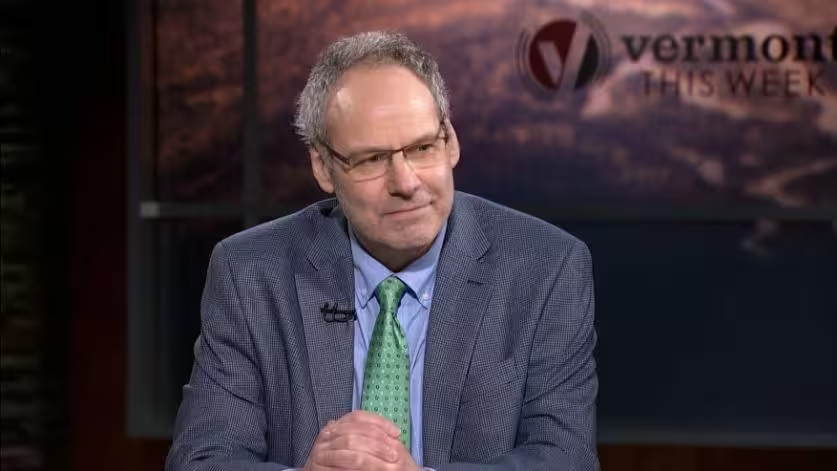
DOC defends “Risk Containment” policy; Frustrations mount as new women’s prison remains in limbo; GOP candidate for Chittenden State's Attorney says he’ll resign; Moderator - Mitch Wertlieb; Liam Elder-Connors - Vermont Public; Calvin Cutler - WCAX; Charlotte Oliver - VTDigger.
Problems playing video? | Closed Captioning Feedback
Problems playing video? | Closed Captioning Feedback
Vermont This Week is a local public television program presented by Vermont Public
Sponsored in part by Lintilhac Foundation and Milne Travel.
Support provided by:


Vermont This Week
September 4, 2026
9/4/2026 | 26m 46sVideo has Closed Captions
DOC defends “Risk Containment” policy; Frustrations mount as new women’s prison remains in limbo; GOP candidate for Chittenden State's Attorney says he’ll resign; Moderator - Mitch Wertlieb; Liam Elder-Connors - Vermont Public; Calvin Cutler - WCAX; Charlotte Oliver - VTDigger.
Problems playing video? | Closed Captioning Feedback
Where to Watch Vermont This Week
Vermont This Week is available to stream on pbs.org and the PBS app.
Support the crew
Help Mitch keep the conversations going as a member of Vermont Public. Join us today and support independent journalism.Providing Support for PBS.org
Learn Moreabout PBS online sponsorshipLawmakers scrutinize the Department of Corrections policy that's keeping more prisoners past their minimum sentences.
Plus, frustrations mount as a new women's prison remains in limbo, and the Vermont GOP appoints a candidate with no legal background to take on Chittenden County State's Attorney Sarah George.
All that and more ahead on Vermont this week.
From the Vermont public studio in Winooski.
This is Vermont this week, made possible in part by the Lintilhac Foundation and Milne Travel.
Here's moderator Mitch Wertlieb.
Hi, I'm Mitch Wertlieb, it's Friday, September 4th, and with us on the panel today, we have Liam Elder-Connors from Vermont Public, Calvin Cutler from WCAX, and Charlotte Oliver from the VTdigger.
Thank you all so much for being here today.
We're going to start with this really interesting story, Liam Elder Connors about the Department of Corrections defending its changes they've made to their risk containment policy.
What are the changes?
What is the risk containment policy?
Sure.
So this is a policy that Doc uses when they're looking at whether or not to release someone at their minimum sentence.
A lot of times when people are adjudicated and convicted of a crime, right, they have a range of time they might be in prison for.
So a minimum and a maximum.
It's not like they have to spend five years in prison.
It might be a minimum of three years in a maximum of seven years.
So when the minimum comes up, doc is taking a look using the risk containment policy on whether or not to release them into the community on some sort of, usually community supervision program.
So they might still be technically under the care of the Department of Corrections, but out in the community again.
And so what they're doing is they're looking at individuals and they're assessing their risk based on how they behaved in prison, whether or not they've had violations of of furlough or other community supervision programs before.
And they're also looking at their past criminal backgrounds and convictions, or just generally their past criminal history.
And that's where some civil liberties advocates, criminal justice reformers and defense attorneys have raised questions about the policy.
Well, tell me about the changes, though, because on one level, it sounds like, okay, doc can take a look at a particular prisoner.
And, you know, like you said, based on their behavior in the prison, say, okay, they're not ready to go back out into the world yet.
But Governor Phil Scott apparently put his thumb on the scale with this, and he sort of wanted these changes to be made.
So what was he telling the doc?
Yes.
The Doc officials have testified in court that the governor had requested that they look at a way to slow down the release of people from prison in the interests of public safety and victim safety.
And so what what's happened is previously people were generally released at their minimums, not not all the time, but now more people are being held beyond their minimums based on this risk containment policy and the concern that some reformers and defense attorneys have is that one of the things that's being taken into consideration could be someone's criminal history, and that might include things that they actually haven't been convicted of, that they could be in a plea deal, have agreed to have certain charges dismissed, but that could still be taken into consideration when DHSC is looking at reasons to not release them back out into the community.
And so the defender, General Matt Valerio, testified this week that he's seeing a lot more people in prison appealing their their sentences to judges and asking for a change and to sort of reflect this new policy.
And some people saying they might not have taken the plea deals they took just based on the way this policy is playing out.
It's interesting.
We have a quote from defender general Matt Valerio in talking about this, because the other problem that he said, he says, you know, if you doubled the size of the prisoner's rights office, we would not have enough people to handle the caseload that is coming in as a result of the change in policy.
So, Liam, what is he saying there that, you know, if you're going to make these changes and hold people past their minimum sentences, we need the staff to to deal with them.
And we don't have the staff right now.
I think more of the point he's actually making there is that this change in policy has resulted in a lot of people who are held in prison appealing their sentences.
So I think it's just a reflection of how much this policy has has affected the inmate and the incarcerated population that a lot of people are having problems with, with the way it's playing out.
And the ACLU has concerns about this, too.
That's right.
Yeah.
They were one of the groups that testified this week with concerns generally kind of about that.
It's at odds with some of what the legislature has worked at over the years around criminal justice reform, trying to reduce the prison population.
And obviously this would lead to potentially a higher population because people are not being released at their minimum.
Okay.
Really appreciate the update on that.
Charlotte Oliver, I want to turn to you for this next story because this also deals with the Department of Corrections.
They are now required to provide language services to detainees.
I'll be honest, I would have thought this was already happening.
It was not what brought this change about.
Yeah, it was not happening.
Just assume out a little bit.
I talked to immigration lawyers with the Vermont Asylum Asylum Assistance Project back in March, and they complained that some of the clients, their clients, people they talked to who were being held in Vermont's prisons were weren't getting language services.
So they they told me about one person who spoke Haitian Creole, didn't speak any English, who was held in solitary confinement and had no idea why they were there.
Oh.
It's terrifying.
Yeah.
So I think it's scary.
You know, it's something I, I think a lot of people don't know is going on the Vermont doc contracts of the federal government to hold it in two prisons in the state.
Most of the time it's Northwest State and Saint Albans and Regional Correctional Facility.
And I, I know that this complaint came after the Human Rights Commission filed a complaint against doc back this winter in January, and they they we don't know what's in the complaint because the complaint is private.
But the settlement was a result of that complaint, and it's a legally binding mandate that says the department.
Now, when someone goes through intake, when they go into a facility, they have to be they the department has to log what their preferred language is, and instructions to them have to come in their preferred language or through an interpreter, which might be on their tablet in a prison.
And it also mandates that immigration lawyers with the Vermont Asylum Assistance Project come into the facility every couple of weeks and get to meet with all of the immigration detainees who are there at that time.
So they're now able to bring in their laptops, maybe like a phone, which they weren't allowed to do previously.
Since Commissioner Murad took over last summer.
So use some technology to help these people out with some of this.
Right, right.
That's the idea.
Yeah, I'm just curious.
I don't know if this has come up in the course of your reporting, but, you know, obviously there's a due process issue here, right?
I mean, if you're incarcerated, if you're being held and you can't talk to your your legal representation, that's a huge issue.
I'm wondering, I mean, do you think this could have a ripple effect or set precedent in other states?
I'm thinking we've seen during the Trump administration's immigration enforcement agenda, there's been people, of course, that have been held here in Vermont, but other states I know Louisiana is one, and there's been a lot of national reporting about people that fight to the same point, have been sort of detained, and they can't talk with their family, can't talk with, you know, legal staff.
I mean, is did that ever come up at all?
I think it's something interesting to think about.
A lot of other states have massive detention centers where exclusively Ice detainees are held.
In Vermont, Ice detainees are held among Vermont residents who have been either detained or are incarcerated serving out a sentence.
So I think it's a different situation.
I know this also applies to people who aren't just immigration detainees, but maybe like Vermonters who don't speak English so well or like, you know, prefer to communicate in another language.
So I think it's interesting to consider, I think in Vermont here, the Department of Corrections has a unique supervision over these people that might not exist in other states because the federal government has control of the facilities.
And, Liam, now, you've been reporting on this too.
One of the things I found interesting is that the doc was actually glad that the lawsuit was brought.
Right, because it kind of forces them to do something about this, you know?
Yeah, I would say it was I have covered a number of lawsuits and settlements in the past, and I don't generally have both sides telling me how happy they are at the end of it.
But, you know, both the Human Rights Commission and the Department of Corrections said that they felt like they got to a really good place, and it was a collaborative process.
And on Doc's side of things, they said they were able to update a lot of outdated policies because, like Charlotte said, it's not just obviously the interest right now has to do with the Ice detainees and the number of immigrants that are being detained by the federal government in Vermont prisons.
But there are obviously people who don't speak English who are also end up there, not through the federal immigration process.
So doc has said this is something for them that they wanted to do and get done for a while.
We're going to stick with the subject of prisons here, because there has been a new women's prison that folks have wanted to get built here in the state of Vermont.
It's just not happening.
Frustrations are mounting as far as getting this new women's prison.
And what's wrong with the current one?
Well, the current prison is in really rough shape.
It's the oldest prison in the state right now.
It's more than 50 years old, and the conditions aren't great.
There are unsanitary conditions.
There's a lot of concerns about overcrowding there as well.
Commissioner Murad I mean told lawmakers this week that they literally had frogs coming out of the drain in the prison, which you think, you know, not ideal, not not an ideal situation at all.
And everyone agrees that it's it's not a good place to be holding anyone, regardless of it's men.
If it's women, just people shouldn't be there.
But the state has had trouble finding a spot to build the new prison.
They've run into local towns who don't want it there when they've found land.
Zoning boards have nixed the project.
They had a bitter who said they would sell them land recently, and then the bitter withdrew that project.
So they're they're saying they're kind of stuck right now.
And lawmakers this week expressed frustration and were even mulling eminent domain, which is a pretty drastic step but not popular usually and certainly not popular.
Not something I've seen.
And I'm sure you haven't seen it either, Calvin, but it's pretty remarkable to even hear them float that idea.
Yeah, I mean, I don't think we've seen Eminent domain even floated since the construction of the interstate system.
Right.
And so I think that was the last time it was used.
And you're right.
I mean, this is a pattern that we see throughout state government.
I'm thinking about the Green Mountain Youth campus, the replacement for Woodside.
I think they're now on maybe their third site that they're looking at.
And I know heading into this session there was chatter about specifically act 250.
But, you know, to what degree can local neighbors and people in town challenge a certain project or bring it to court, should it go to environmental court versus another?
So the appeals piece of of act 250 reform has has, you know, that didn't really make it over the finish line this year.
But certainly I mean, to your point, we've been struggling without a women's prison for an adequate women's prison for years now.
And it's not helping the people who are inside.
It's not helping the community.
But these are very tough to to cite, as you said.
So it's a real, real snafu throwing this one out there to everybody.
But is this also complicated when it comes to, as we were just talking about before, immigration detainees in the women's prison, do they have the capacity to keep any of those detainees in the women's prison?
Do you see, actually told me this week that they've stopped holding federal immigration detainees in the women's prison.
They actually requested the feds to to stop sending them women to that facility just because they don't have the space for it, and struggling to make sure they have enough space for all of the state detainees and incarcerated individuals that are there, which is pretty remarkable that they're getting to that point.
And were they doing with with the federal?
Yeah, I imagine they're being sent at a at a state somewhere else.
But I mean, there were sometimes people were actually coming to Vermont that were being that were detained out of state as well.
So it's not necessarily everyone that was the feds were detaining were from Vermont.
Okay.
What about next steps for the women's prison?
Any idea where this is going to go?
You know, that's a stumper.
Yeah, I think I think if we knew that and I think the state would know that and and they don't know right now, at least as far as what they're saying publicly, lawmakers were pretty clear.
They hope when the next session starts, they'll have more of an answer to that.
But but as of right now, state officials are waiting for dock and building in general services to to regroup and kind of figure out what the next steps are.
It's important to bring it up, though.
It's not a problem that's going away anytime soon.
No, and it's certainly been it's been around for a while.
And like Calvin said, I mean, these are tough facilities to find locations for.
But you know, the at some point I think we're going to hit a tipping point where the women's facility is really not functional anymore.
And it's getting to that point.
They're trying to do $1 million worth of upgrades right now just to kind of keep things steady as it is $1 million worth of upgrades.
Well, all right, there's a lot that's happening there.
There's a lot that's happening politically.
This is a really interesting story, Charlotte Oliver, about the I'm sorry.
Yeah.
Calvin, I want to start with you on this one.
This has to do with GOP candidate for Chittenden County State's Attorney saying that he'll run for the position if he wins or resign.
Yeah.
Why?
It's super interesting.
I've never seen a case like this.
I mean, as you know, in the Democratic primary, Sarah George beat Bram.
Chronic failed for in the primary.
And now there is an empty space on the ballot.
And as or were for many GOP candidates statewide and also in some county races and basically what the GOP is now doing, they are installing Jace Laquerre He's a software developer from Chittenden County.
He was the youngest ever RNC delegate back in 2017 or 2016 to to the RNC.
And what essentially is happening is he is now going to be running.
And he says that if he is elected, he will drop out and Governor Phil Scott will appoint a replacement.
And this is really sort of caught the attention of a lot of political observers.
Wait a minute.
Like Sarah George, she basically put out a very lengthy statement saying, you know, Vermont, this isn't right.
Vermont voters know what's best, and this is undemocratic, essentially, that, you know, this, that potentially the governor could be installing somebody that isn't even earning the votes doesn't feel like direct democracy.
Exactly.
Yeah.
Maybe that's a better way to put it is direct democracy.
The governor was pressed on it earlier this week, and he said, everything we're doing as above board.
He says he didn't have anything to do with this or didn't coordinate with the GOP in any way.
But, you know, he's saying this is the system we have.
And if that's what the voters of Burlington and Chittenden County want, we'll see.
I mean, I think it's worth noting, you know, the GOP, I was talking with Paul Dame.
He said that historically, Sarah George has never been up in a general election.
She was appointed her first term.
And then she won the primary in and didn't have a challenger in November.
So this is the first time she's up against a general election with a higher turnout.
So it's not just a Democratic primary.
So we'll have to see.
I mean, it's really sort of captured the imagination of a lot of people, because I can't think of a single time in state history that something like this has happened.
Well, I think it speaks to how much their people want to try to remove Sarah George from office as as the top prosecutor in Chittenden County, that how much people have kind of focused on on her office as being responsible for this perception and of disorder in the county and spikes in crime and looking for a way to try to beat her in an election that they're going to this extent.
So I think it's in some ways, to me, it's more about that.
There's a real effort among contingency in the county to try to have someone else in that office, and they're looking for any, any way to do it.
And I think what's also pretty interesting about this, too, is we wouldn't necessarily be in this situation.
But lawmakers last year, they passed an omnibus election bill, and it basically removed what some called the sore loser provision or second bite at the apple.
And that basically is the the idea of if you lose, let's just say if Bram loses that Democratic primary, he could run as an independent or run as a Republican in November.
And but that has been removed.
So he can't run.
There is now a write in campaign for him that's happening.
We don't know a lot about who's coordinating that.
But I remember talking with Tanya in the legislature, progressive from Chittenden County when that election bill was passed, and she said this is going to create some shenanigans.
I don't like this.
This not is not necessarily democratic.
And that was her concern at the time.
And so it's just interesting to see here we are strategically we'll see if this pays off.
We just don't know.
That's my question.
Does anybody here think Sarah George has anything to worry about?
Charlotte.
Do you think so?
I'm not sure.
I think she's garnered fans and skeptics.
She's considered a very progressive prosecutor.
She's opposed to cash bail.
I think some people love that and some people are really concerned about that right now.
It's a little bit of a toss up.
I'd say it's going to be so interesting.
I think that the points been made that like, she didn't do well in Burlington, right.
Like that.
That's the problem.
So maybe there's there's something to to look at there.
But we're going to have to see come November.
Of course.
Burlington, by the way, has requested the state get involved with helping them out with some of their well-publicized problems, things like homelessness, drug use.
Charlotte Oliver, what does Burlington want and what do they want from the governor specifically?
I think it's interesting.
So Burlington City Council passed a resolution last week that asks the governor to come back in and support Burlington again, which, if you'll remember, he did last fall for a few months, he had this plan to provide extra law enforcement support.
He rolled out the accountability court, which basically fast tracked cases and connected people to social services.
This request is pretty similar.
It asks for more court resources, especially for treatment courts, which are designed to connect people with social services and are generally for more low level crimes.
I think it's important for people to keep in mind that this happens as violent crime is down in the city, even though people still seem to be really concerned about crime perception versus statistics.
Yeah, you could say that.
And that doesn't mean that crime overall is necessarily down.
I don't have those numbers on me right now, but violent crime is down.
I'll also add that like some of the some of the proposals in this resolution are extremely specific.
They asked for a certain number of beds to be reopened at a state psychiatric facility.
So they really range in their asks.
They also include support for 100 bed low barrier shelter in Burlington, which I know is one thing Mayor Emma mulvaney Stanek has said is really important because she thinks the governor's plan last year lacked any like addressing any, any provisions that would address homelessness in the city.
So I think it'll be interesting to see how he responds to this.
Last week, he said he was disappointed in it at first glance.
He said that he thought other parts of the state were suffering as well that were less affluent, but he hasn't spoken on it recently.
Besides saying he'll meet with the mayor soon.
Interesting.
One thing that really stood out to me.
Last Friday morning I attended a meeting at City Hall and there was dozens of longtime businesses staples in on Church Street in the downtown core.
And it was to to put it, frankly, I mean, it was emotional.
I mean, people really were airing all kinds of concerns and grievances and really painting a picture of just how dire the situation is for businesses.
They talked a lot about, you know, addiction and quality of life issues and things like that, things that maybe the city has control over other things.
Chief Burke was there and he said, this is the judiciary.
You need to go to state lawmakers with some of these concerns about, you know, releasing people on conditions, etc.. And one thing that really stood out to me, too, and I haven't seen any reporting on it yet, but there was some data that came out basically showing Burlington's sales and meals.
Room tax receipts are down, you know, which we've known they've been falling for a while really since pre-COVID.
But what was really interesting is South Burlington and Williston, theirs are going up.
So Finney Crossing, I think it's called in Williston and then City Center in Burlington.
I mean, some could make the case that these other cities in in Chittenden County are eating Burlington's lunch.
So it's a real sort of like there is only so many.
The pie is so big, and we're slicing it up different ways.
But there's a tension there, too, with Burlington wanting help from the state and surrounding communities to help shoulder some of the burden of the social services that they're providing as well.
And, you know, other communities have been reluctant to do that, pointing to the fact that how Burlington is struggling and not wanting to take on that while also benefiting, you know, it sounds like potentially economically from these things.
So I think it's pretty interesting to see both, you know, state officials say like, Burlington can handle it on their own, while at the same time saying, like Burlington is not doing, you know, like this, you know, so who's responsible here?
Is it on the city to fix these problems, or is it the state and the communities around it to help them out as well?
And great question.
Yeah.
How do you how do you balance all of all of that?
Governor Scott, you know, he kind of had two statements on two separate days that were sort of contradictory.
One of them is, why should the people in Newport be trying to help Burlington when potentially some would say this is Burlington's problem.
But then the other day, then Governor Scott says, no, we need Burlington to do well.
There are huge tax base.
It's an economic driver.
And when headlines get out nationally, police said the state police headlines about nationally, it's that reputation thing.
So it's just it's challenging.
It is challenging.
And we're going to see what happens with that.
The mayor wanted to meet with the government on this.
Right.
Do we know if they're going to at any point?
Yes.
The governor.
Yeah.
The governor said they do have a meeting scheduled.
He said he didn't know when it was one of those.
He took the question and he's like, I know we've been scheduling it.
We're in talks.
We don't know when, but there will be a meeting at some point in the coming weeks.
Okay.
I want to take the last few minutes of the show to talk.
It's kind of a sad story, and I know that everybody in this table has some sort of connection to this place.
But in Burlington, sort of an iconic club is closing down.
Radio Bean is closing.
Let me start with you, Liam.
Elder Connors, because, you know, you have been to this venue many times.
Your band has played there, right?
What does this mean?
You know, I think a lot about the first time I went to radio bean I think was probably when I was in college.
I mean, I grew up in, in Vermont, but wasn't really going there a ton when I was a kid.
But going to college and going to some of the open mics there that they used to host regularly, and just really seeing a place that you could go to to play music, to hear music, to see art, to just sort of be in a in a creative space was pretty remarkable.
And it's a it's a spot that has fostered a lot of music and bands and, and creative community in Burlington and the greater Burlington area for more than two decades now.
And the fact that they're closing their doors pretty soon due to some financial hardships is really tough and a big blow for the music and art scene around here.
And I think, you know, it's doesn't sound like it's totally potentially gone.
There could still be another group that comes in.
I think that's the hope from the current owner.
But at least for right now, what we know of as radio bean is certainly going away.
At least the one that I, I kind of grew up with.
You know, I heard those same hopes for something coming in, maybe to replace nectars, which is also close.
That hasn't happened yet.
Calvin Cutler, what are some of the reasons that that radio being is showing?
I mean, there's been certainly as you mentioned, there's been financial struggles for a lot of venues, but they specifically Lee Anderson, the owner and operator, really pointed to what's known as dram shop laws, which is essentially liability insurance for bars and clubs and restaurants.
And it's interesting, lawmakers, we've seen this movie before.
I did a piece probably 3 or 4 years ago when a lot of venues were struggling to get insurance because of just how risky Vermont was in their eyes, because we had a chain of liability that went all the way from the bartender to the landlord, the legislature went back.
They fixed that.
We are now considered less risky.
We're kind of the middle of the pack, but still, I mean, this is a national trend that we're seeing for a lot of bars, a lot of restaurants, a lot of clubs.
If you make more, if you sell, more than 50% of your sales is alcohol.
Are you open till two in the morning?
Do you have a lot of college kids that come in?
What kind of music is played?
These are all factors in the insurance marketplace and of how they determine risk.
And in many insurance companies eyes radio being and the lamp shop is still risky per se.
So it's it's really interesting.
We'll see if lawmakers go back to the table and make more changes, maybe.
And sure that all of our briefly last word you're going to get to radio bean before it shuts down.
Oh yeah I'm going there tonight for DJ tacos last set.
I am glad that you're giving them some love as they close down, and we're going to have to leave it there for today.
Thank you so much to our panel this week, Liam Elder Connors from Vermont Public, Calvin Cutler from WCAX and Charlotte Oliver from digger.
Thank you so much for watching and listening to me.
I'm Mitch Wertlieb I hope to join us next Friday for Vermont this week.
We'll see you then.
 New Episode
- News and Public Affairs

Top journalists deliver compelling original analysis of the hour's headlines.
 New Episode
- News and Public Affairs

Today's top journalists discuss Washington's current political events and public affairs.




 New Episode
 New Episode
 New Episode

 New Episode
 New Episode
Support for PBS provided by:
Vermont This Week is a local public television program presented by Vermont Public
Sponsored in part by Lintilhac Foundation and Milne Travel.