Vermont This Week
September 11, 2026
9/11/2026 | 26m 46sVideo has Closed Captions
Maternity care in Vermont | Vermont communities take aim at data centers
Brattleboro Memorial Hospital to keep birth center open | Maternity care in Vermont | Vermont communities take aim at data centers | Moderator - Mitch Wertlieb; Lola Duffort - Vermont Public; Kevin McCallum - Seven Days; Hannah Bassett - Seven Days.
Problems playing video? | Closed Captioning Feedback
Problems playing video? | Closed Captioning Feedback
Vermont This Week is a local public television program presented by Vermont Public
Sponsored in part by Lintilhac Foundation and Milne Travel.
Support provided by:


Vermont This Week
September 11, 2026
9/11/2026 | 26m 46sVideo has Closed Captions
Brattleboro Memorial Hospital to keep birth center open | Maternity care in Vermont | Vermont communities take aim at data centers | Moderator - Mitch Wertlieb; Lola Duffort - Vermont Public; Kevin McCallum - Seven Days; Hannah Bassett - Seven Days.
Problems playing video? | Closed Captioning Feedback
Where to Watch Vermont This Week
Vermont This Week is available to stream on pbs.org and the PBS app.
Support the crew
Help Mitch keep the conversations going as a member of Vermont Public. Join us today and support independent journalism.Providing Support for PBS.org
Learn Moreabout PBS online sponsorshipIn a sudden about face Brattleboro Memorial hospital says it will keep its birthing center open.
Plus, look at maternity care in Vermont overall and communities across the state take aim at data centers.
All that and more ahead on Vermont this week.
From the Vermont public Studio in Winooski.
This is Vermont this week, made possible in part by the Lintilhac Foundation and Milne Travel.
Here's moderator Mitch Wertlieb.
Hi, I'm Mitch Wertlieb.
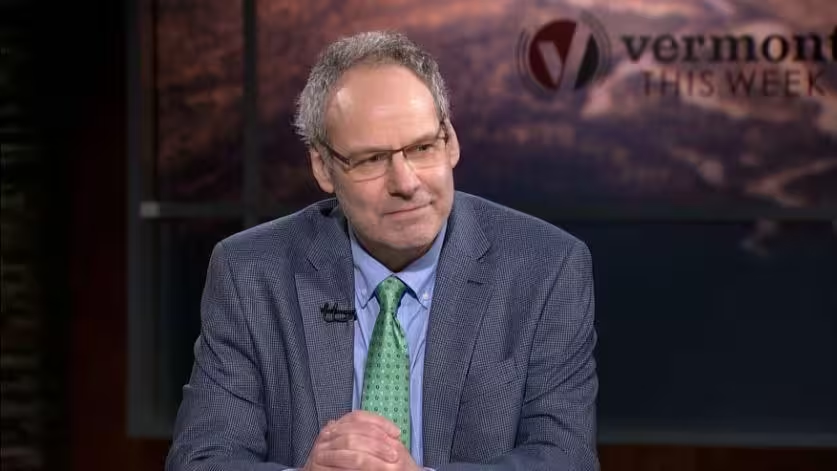
It's Friday, September 11th, and with us on the panel today, we have Lola Dufort from Vermont Public, Kevin McCallum from seven days, and Hannah Bassett also from seven days.
Thank you all so much for being here today.
And before we get into our show, we just want to take a moment to acknowledge that today marks the 25th anniversary of the nine 11 attacks, and the images from that day are forever imprinted in the minds and hearts of Vermonters, Americans, and the world at large.
And while we won't be talking about the events of that day on the show today, we know the impacts of the attacks are still being felt.
For those interested in hearing a first person account of what happened.
I was really moved by the conversation that Vermont Edition host Mikaela Lefrak had this week with Captain Michael Donovan of Ludlow.
He's now retired.
He served as a lieutenant with the New York City Fire Department on 9/11, and you can find that interview at Vermont Public.
Today, though, panel, we're going to start talking about a really amazing story.
And Hannah Bassett, this started out with your story in seven days about maternity care in Vermont.
Overall, I was prepared to talk about three different birthing centers that have closed or are about to close.
Springfield Hospital's birthing center closed in 2019, Copley's Birthing Center in 2020.
And then the news was going to be well, Brattleboro Memorial Hospital was about to close its birthing center in December, but Lola Duffort it turns out that Brattleboro will not be closing its birthing center.
What happened?
How are they able to stay open?
Well, a mix of things.
The staff down in Brattleboro have been mounting this kind of superhuman grassroots effort to try and convince leaders on the ground there to try and change course and seem to have been able to convince them to give them more time, right, to try and find a sustainable path forward for maternity care in the region.
They fundraise privately hundreds of thousands of dollars.
The maternity unit there has also been working with leadership on just efficiency improvements.
Right.
But I think big picture right there is not yet a plan in place.
That means Brattleboro, the birthing unit in Brattleboro is going to break even this year, right?
It is probably still going to lose millions of dollars.
And so I'm really glad that we're sort of having both of these conversations at once.
Right.
Because maternity care in Vermont is still incredibly vulnerable as it is across the United States, particularly in rural areas.
We have seen two places closed just since 2019.
And as Hannah's reporting in seven days this week laid out really well, there's basically only one birth center in Vermont that breaks even.
And that's UVM.
You know, the article you wrote about it lays out because we've been talking about this issue so much on this show week by week, but now we have this sort of the scope of your article really brings it home.
And one of the things I found striking, and I think Lola was referring to this or alluding to it, nearly 1 in 3 expectant Vermonters has to travel beyond a half hour radius to get to a birthing center, which is not recommended because, as we know with officials, I'm sure have told you, births are unpredictable.
Things can go wrong quickly.
What is the overall impact of that?
Nearly 1 in 3 number.
And that 1 in 3, I'll just add, was an estimate created through data before Copley closed last year in 2025.
Really?
So it's possible that number has gotten worse and more challenging for Vermonters looking for obstetric care.
But the risks are multifold when a labor and delivery unit closes.
It's not just the delivering of babies that goes away in that area.
It's the whole spectrum of perinatal care before you have a baby, during and after.
And that has really serious consequences for the health of the birthing person, the health of the baby.
Our community is ability to attract and sustain younger people, which we need in this state very badly.
And the stories that I heard from some of the women who I spoke with about their experiences say, giving birth to their first child at Copley, but not having that option afterwards just showed that it can result in really close calls.
Luckily, it seems like there hasn't been a, you know, incredibly devastating incident, but people are pushing on their way to the hospital now because it's a further drive.
Yeah.
And one of the things you pointed out in the article is that, as you say, even though the worst sort of incident hasn't happened yet, a lot of the people who work in this field are worried about that exact thing.
They're saying it's kind of only a matter of time, right?
Yeah, I think the birthing people and the providers are saying, you know, it's an incredible thing that the quality of care here in Vermont remains really high.
That's one thing I think that's worth emphasizing.
There's a difference between quality and access.
The quality the data shows is holding strong.
It's the access.
But if you can't access the high quality care, it's not of much help to you.
I want to jump back to to Lola for for a moment here and talk about this bridal memorial.
So obviously this is good news.
And it really just came out yesterday that they're going to be able to keep this birthing center open.
But as you were saying, this is not a panacea.
This doesn't mean that a year from now, for example, they won't be right back having these same financial difficulties.
Yeah.
So the leaders at Brattleboro Memorial Hospital haven't said, like, okay, you have.
Exactly.
You're on a one year probation.
They've said indefinitely we're going to try and keep this place open.
But I was talking to the chief of obstetrics there, and she was like, of course, if we're losing $5 million two years from now, of course we will be having this conversation again.
And so I am expecting that we will probably see a conversation this winter, right when a new legislature is seated and either Phil Scott returns to Montpelier, you know, Amanda beats him.
But I'm expecting that when our leaders return to Montpelier, there is going to be a huge push for them to take a look at maternal care, because the reason we're having this conversation, the reason that maternity care is in such trouble, is because of the way that we pay for it, right?
Giving birth is expensive because it is highly specialized care that is hard to schedule, right?
And so if you want to have that care on standby cost a lot of money, that the fixed costs are really high.
In an era of declining births.
You now have less volume paying for that.
And also we have always kind of under reimbursed maternal care.
Right.
And so and this is commercial payers.
This is public payers right.
Like Medicaid vastly vastly under pays for maternal care but so do commercial insurers.
And so I'm I'm expecting there to be a big push a to pressure the state of Vermont to increase its reimbursement rates for Medicaid, because that's how we pay for a lot of births in Vermont.
And, you know, I'm wondering to what extent there's also going to be pressure on our private insurers to to change how they pay for care.
Of course, the problem there is okay.
Like if we hike reimbursements here, where do we squeeze the balloon.
Right.
Where does that money come from?
Yes.
And I think that, you know, it's going to be it's probably going to be a not great budget year in Vermont.
But I do think that there is now a lot more public attention being paid to this problem, both nationally and in Vermont.
Right.
I feel like when this happened with Copley, people were still kind of just talking about this as like a Copley thing, right?
What happened in Springfield didn't get a ton of attention.
And I think that's changing with Brattleboro.
I was just talking to a friend of mine who was like, it's so weird that we talk about reproductive care and reproductive choice.
And, you know, people say it's such a scandal when women have to cross state lines to get an abortion, but we haven't yet started included, including finding a safe place to give birth.
Right.
And Vermont is still, if we step back and look nationally, not a terrible place to give birth.
From a rural perspective, right.
Like our coverage compared to the rest of the country is still pretty good.
And I don't want to say like, it's great, we're fine.
Like, sure, sure.
But they're right.
Nationally, 60% of rural hospitals no longer deliver babies, which is pretty astounding.
That is amazing to me.
And so I do think that there seems to be sort of a larger public interest and understanding of this.
Well, what are the folks that you've been speaking to and you spoke to for that article saying about what they would like to see done or what they think could be done at this point, as Lola mentioned, Medicaid reimbursement is a really important part of this conversation.
But the challenges facing labor and delivery units are really multifold.
There's the amount that these hospitals get paid back by Medicaid, by private insurers.
Their staffing challenges, are they able to recruit and retain the right people they need for these 24 over seven units?
As Lola said, these births are not things you can schedule most of the time.
So you need to have there's this high fixed cost for having those experts on hand all the time.
And our own rate is among the lowest in the nation.
And that's a lot of these things are national problems.
I think the way that Brattleboro announced the reversal of its decision was interesting.
They announced they were affirming its commitment to keeping the birthing center open, and they cited a Rural Health Transformation grant that they got approved earlier this week.
But that does not address all of those layers and all of those challenges that keep labor and delivery monetarily losing part of a hospital's budget.
Yeah.
And, you know, it doesn't do anything to solve the demographic problem that we have here in Vermont.
As you're saying, it's this double edged sword where we want more young people to to move here.
We want younger families to start here.
But they can't do that if there aren't a good number of places for them to have these birthing centers where they don't have to travel more than half an hour.
Yeah.
There's folks who I spoke with in LA County who are in that Copley service area, who gave birth to the fourth generation in their family at Copley while it was still open.
They had to go to NVR for their second child.
They had an amazing experience, they said.
All went well for their family, but now they're really reconsidering if that's where they want to stay long term because there is not the access to care there, as they're trying to decide whether or not to grow their family further.
That's the cautionary tale, and that's what we have to look for.
Read the article in seven days.
It's comprehensive, really excellent reporting on that issue.
And it's so important.
Kevin McCallum, you were writing about an issue that a lot of people are interested in right now, not just here in Vermont, but around the country, and just do with data centers, these often huge facilities that take tremendous amounts of power to do things.
Vermont communities are taken it upon themselves now to say, no, we don't want these here because the governor has not embraced a Vermont will not embrace data centers kind of policy.
Right?
That's right.
If anybody thought that the governor's veto of a bill to protect the state from data centers was going to end the debate about the wisdom of doing so, they're certainly sorely mistaken, right?
If anything, his veto of that bill just inflamed the debate.
And what it caused is small communities, regular communities, to decide that maybe they need to step forward now and do something to protect their community from the possibility of a large data center coming there and and raising their electric rates and sucking up all their water.
And so it kind of reanimated this the legislative debate that occurred during the session about whether data centers do, in fact, represent an existential risk to the state.
And I found that very interesting.
I didn't really pay super close attention to the data center bill during the legislative session, because I kept asking people, well, where does somebody want to build a data center?
And of course, they could not name a place where there was a data center being proposed.
And so we're like, well, we've got a little more pressing things to focus on.
And so we went and focused on more other, other things in the session.
What are some of these towns that are taken it upon themselves to say exactly.
But just.
But so that bill got vetoed by the governor because he didn't think it was necessary.
He didn't see any imminent threat on the horizon, and he didn't want to just institute a bunch of new regulatory rules and rules and regulations for something he didn't see was a threat.
But these towns certainly see them as a threat.
They look at Texas, they look at other places around the country.
They see these stories about these just massive football field sized black boxes being dropped down next to residential areas, and then all the all the fossil fuel usage and water usage and, and power usage that they're, that they're engaging in.
And they say, we don't care that one is not knocking on the door with a formal proposal to build something in Vernon or Saint Albans or Burlington or South Burlington, we're going to say, no, we're just going to right now hit the pause button and pass some rules that make it even harder for one of these developers to try to come to town and knock on the door and build something.
So last month, there was already one town that had said no thank you to data centers.
Before the session was over was Royalton.
And then after the governor's veto, two more towns, South Burlington and Morristown, both put their heads together and said, well, what are we going to do?
And they and they basically instituted moratoriums while they work on their zoning rules, because they realized that their zoning rules might actually allow a developer to sort of sneak in a data center, as unrealistic as that may seem, that such a massive facility could sneak into a town, I think there was some real concern that like, well, what are these things?
Are the industrial uses, are they office uses?
It's just a it's just a bank of servers.
So like maybe.
So they really just wanted to hit the pause button and say, let's make it abundantly clear what the rules and regulations will be should a data center developer come knocking at the door.
But let's play devil's advocate here.
To the governor's point.
I mean, you've mentioned Royalton.
You mentioned Morristown.
My stomping ground, South Burlington.
Maybe that's a little more realistic, but you mentioned, like the giant football field sized buildings that these take the facility it takes.
You couldn't really put something like that in Royalton, right?
No, it's not the governor's point.
Like the likelihood of this actually happening.
Why should we create a law to have been something that is not likely to happen anyway?
Exactly what the governor said.
He said he thought the chances of a major large data center coming to Vermont were slim to none.
So it was a total waste of time to be passing rules to prevent that.
But what his concern was is that we would be basically signaling to the world that Vermont is not open for business when it comes to new technologies, with new new businesses, new industries.
And he wants to sort of do the opposite.
He wants to signal to the world that we are open to those kind of things.
And so he just thought it sent the wrong message and it was something of a slippery slope.
And so he said, no thanks.
And what I found interesting is that it has now created this sort of regulatory patchwork here in the state, where we've got individual communities stepping forward and say, well, if the state's not going to do something, then we're going to do something.
And the governor has often been an advocate for a more statewide approach to some of these big issues.
And so I find I find that very interesting.
Meanwhile, there's a bit of a side note to this, and this is something we were talking about before the show here.
Julie Moore, the Secretary Natural Resources, actually talked about these data centers in Washington, D.C., right.
And did not take the governor's for you.
She had a very different view.
Well, so she would say that.
So she went to Washington, D.C., to advocate for certain data center regulations and a whole bunch of folks who were behind the data center legislation in Vermont were like, isn't this a giant contradiction for the head of our natural resources agency to be going to D.C.
saying, yes, please give us more power to say, you know, to regulate data centers at the same time as the governor has vetoed this legislation?
Of course, she's being a very good soldier, and she's saying, no, no, no.
There is no contradiction.
You know, his.
His objections were different than the objections we are bringing forward here, you know, and it's pretty contested.
Of course, this is coming at a time when, you know, as you said, we weren't super paying attention to the data center legislation, in part because there were no active data center proposals that we knew of.
And it feels somewhat unrealistic to expect a data center to be built anywhere, or at least most places in Vermont.
Right?
Especially given our rocky soil, our lack of infrastructure, etc.
but the data center conversation has taken on this crazy valence politically just in the last like two months.
Absolutely right.
Where now there is there is this bipartisan.
Absolutely like no pushback where, you know, Republicans in red states are now saying, oh, okay, okay.
Like maybe these things aren't so great.
And so I think we're also yeah, I wonder to what extent Phil Scott would veto a data center bill next year.
I go ahead.
There's a lessons to be learned here, too.
In New Hampshire, just across the border, there was a proposal in southern New Hampshire that was flying under the radar.
When that became known, there was a lot of pressure put on Governor Ayotte to hear what her stance and other red governor and kind of a purple state trying to walk this line.
So it's as little as said, it's becoming very much a bipartisan concern.
That is not an issue until it's an issue.
It's kind of fascinating to me, as you pointed out in your article, Kevin, even you mentioned Texas before as red a state as you can pretty much get now, even there, they're sort of backing off their former embrace of these data centers.
Yeah, I think to Lola's question about whether the governor would, would, would veto this.
Again, I think he signaled in his veto message that he might be open to approving, signing off on some sort of regulations against data centers, but just not the sweeping ones and the specific ones that the legislature outlined.
I mean, there were there was a long list of things that were going to be prohibited or highly regulated by data centers.
They wanted to make sure that there was no impact on ratepayers anywhere in the area.
With one of these data centers located, they wanted to require the to the maximum possible the use of renewable energy.
And there were just a whole host of things.
And they also, I think one of the things that I think was a bridge too far for some people in his administration was they were going to require the developers of data centers to pay for other climate measures in the area around the data center.
So, like, not only are we going to make you clean up your power use, since you're going to be using a lot more power, that power comes with greenhouse gas emissions.
And so you're going to have to pay to help people buy some electric vehicles and maybe some heat pumps in the community.
And that's when they started to go, whoa, whoa, whoa, this is a lot.
And so yeah, but I think if it was stripped of some of those provisions, I think the governor certainly with a secretary like Julie Moore advocating for some of the problems that the water usage that these facilities are facing are having.
I think he would sign some version of a data center bill if one came forward next session.
It'll be interesting to see how this conversation has changed maybe a year from now as we talk about these and learn more.
When I think data centers, I and maybe I shouldn't be thinking this, I think AI in part of it.
There's more news here.
Kevin McCallum and open this up to everybody.
To a federal judge has made a decision about Vermont's what would have been the first case, I guess, of Vermont's new law on AI, saying that a video that was generated that, you know, dealt with some political things with a ballot, this is protected free speech because it was satire.
What are we talking about here, a little background?
Well, we're talking about the state's effort to get its arms around how we deal with political advertising, running up to an election that might contain AI generated videos that we've already seen, examples of AI faking.
We have robocalls.
I think that last year that sort of sounded like a particular politician.
And so lawmakers passed this pass, this bill to try to ban or at least require the disclosure of what was that weird phrase, a synthetic media, thank you very much.
A very strange phrase.
But they wanted to make sure that we didn't have these political ads.
We already have a lot of ads during political season.
Right?
But what would happen if all of a sudden now we had sort of ads with AI generated content?
And so they were like, well, if you do that, you have to have a disclosure.
So then we had an example of an ad floating around before the primaries that was generated with AI about Becca Balint.
That was, I think, generated by not entirely sure, but certainly spread by a citizen journalist.
And it was ridiculous.
It was absurd.
It was, you know, this backhoe picking up Becca Balint and dropping her into a dumpster.
And and the Republican candidate was there driving the backhoe.
It was absurd.
And so the Republican candidate, Mark Coestor, had said, no, this is just this is satire.
This is totally cool.
This is this is allowed.
This is not a problem.
And a judge agreed with them.
And I was a little bit surprised by that, because I thought that the way that the legislature had had written that law was pretty clear, that if you if it was clear that you used AI in the generation of it, and it was before a certain amount of time before an election, that it was pretty straightforward.
There was this exception, though, for satire and parody, and the judge ruled the federal judge, William Sessions, ruled that when he when he saw that video, he was like, this is this is clearly satire.
This is this is over the top.
And it was right.
It reminded me of The Onion.
Remember that satirical newspaper where still around, it's still around.
Doing like, you know, they had they have pictures of a shirtless Joe Biden washing his Trans Am on the lawn of the of the white House.
These are hilarious.
And but they're not that far from what this video was, which they use the images of actual politicians, but then put them in these absurd scenarios.
So he ruled that the attorney general couldn't block them because it was satire.
Yeah.
I mean, I think one of the intent of the legislation was deception, right?
Because with AI you can pretend to be someone else.
And so the judge was saying, like, this is clearly satire.
It's obviously absurd.
And I think this points to a like, new technology is hard to regulate because it's new, and B speech is notoriously hard to regulate because, you know, the First Amendment is tends to be very jealously guarded by our judiciary.
And so I think the deal with this particular video is that, again, it didn't have a disclaimer or anything about that.
But again, you know, the images were so bizarre and so strange that it does fall under that it did look satirical, not commenting on the quality of or the sentiment or anything like that, that I think that's important to point out.
It's just that, look, this is satire.
No one's going to take this seriously.
And so it is a First Amendment issue.
And judge agreed with that.
And I think anyone who watches that video doesn't come away with it, thinking that Becca Balint is making these statements in that video, even though it says, I am Becca Balint, and I'm going to do this and I'm going to do this, and I stand for this.
You get to the end of that video when she's wearing a beret and getting picked up by an excavator, and you kind of realize this is not a political trusting Vermonters to see see through that.
Vermont Guard members are back home from one of their longest deployments since the Afghanistan war.
Eight months they were gone.
I want to mention, as well, as we wrap up here, that a nonprofit has bought Vermont community to buy the Vermont Community Newspaper Group.
Five local papers will now be under that.
It's a nonprofit.
So I guess good news for local journalism in that sense.
And that's what we're going to have to leave it for this week.
Thank you so much to our excellent panel.
Lola Duffort from Vermont public, Kevin McCallum from seven days and Hannah Bassett also from seven days.
Thanks so much for watching.
Im Mitch Wertlieb, We'll see you next Friday right here for Vermont this week.
 New Episode
- News and Public Affairs

Top journalists deliver compelling original analysis of the hour's headlines.
 New Episode
- News and Public Affairs

Today's top journalists discuss Washington's current political events and public affairs.



 New Episode
 New Episode
 New Episode

 New Episode
 New Episode
Support for PBS provided by:
Vermont This Week is a local public television program presented by Vermont Public
Sponsored in part by Lintilhac Foundation and Milne Travel.