
Qatari spokesman on regional war and path to U.S.-Iran talks
Clip: 9/17/2026 | 7m 47sVideo has Closed Captions
Qatari spokesman on regional war and the path back to U.S.-Iran talks
Violence has spread across the Middle East since the U.S. and Israel launched the war in Iran. Qatar has spent months mediating between Iran and the U.S. while also being targeted by Iranian strikes. Nick Schifrin sat down with Dr. Majed al-Ansari, adviser to Qatar’s prime minister, to discuss regional tensions and whether there is a way back to negotiations.
Problems playing video? | Closed Captioning Feedback
Problems playing video? | Closed Captioning Feedback
Major corporate funding for the PBS News Hour is provided by BDO, BNSF, Consumer Cellular, American Cruise Lines, and Raymond James. Funding for the PBS NewsHour Weekend is provided by...
Qatari spokesman on regional war and path to U.S.-Iran talks
Clip: 9/17/2026 | 7m 47sVideo has Closed Captions
Violence has spread across the Middle East since the U.S. and Israel launched the war in Iran. Qatar has spent months mediating between Iran and the U.S. while also being targeted by Iranian strikes. Nick Schifrin sat down with Dr. Majed al-Ansari, adviser to Qatar’s prime minister, to discuss regional tensions and whether there is a way back to negotiations.
Problems playing video? | Closed Captioning Feedback
Where to Watch PBS News Hour
PBS News Hour is available to stream on pbs.org and the PBS app.
Providing Support for PBS.org
Learn Moreabout PBS online sponsorshipAMNA NAWAZ: Today, Saudi Arabia and the Iranian-backed Houthis in Yemen traded new strikes.
The fighting is just one example of violence that's spread across the region since the U.S.
and Israel launched the war in Iran.
GEOFF BENNETT: The country of Qatar has spent months mediating between Iran and the U.S.
and Iran and the region while also being targeted by Iranian strikes.
This week, Nick Schifrin sat down with a key adviser to Qatar's prime minister to discuss regional tensions and whether there is a way back to negotiations.
NICK SCHIFRIN: Thank you very much, Mr.
Ansari.
Thanks very much.
Welcome to the "News Hour."
MAJED AL-ANSARI, Adviser to Qatari Prime Minister: Thank you for having me.
NICK SCHIFRIN: You have been in the middle of negotiations this year between Iran and the United States.
Qatar was largely confident about this when the MOU was signed.
But, since then, we haven't seen any progress.
Iran has maintained its choke hold over the Strait of Hormuz.
From where you sit, is there a path back to U.S.-Iran negotiations or not?
MAJED AL-ANSARI: You know, Nick, one thing we can't afford to do in the region right now is despair about the diplomatic solution.
There is no way out of this unless it is a diplomatic solution.
And, therefore, we have been working with all our partners 24/7.
Our mediation teams have been running between each capital in the region trying to get it forward, and we won't give up.
We will just continue doing it until we have a solution.
NICK SCHIFRIN: Negotiations is not just U.S.-Iran.
It's also Iran-GCC.
It's also the Gulf Cooperation Council.
We were supposed to have a meeting earlier this week.
And the regional officials I was talking to before this meeting was supposed to happen on Monday were saying Iran was asking for too much.
Iran was asking for control or at least some kind of access of all ships going in and out of the strait in Iranian waters.
Is Iran asking for too much?
MAJED AL-ANSARI: Now, first of all, this is -- this was supposed to be an interim solution, not the new status quo.
The new status quo cannot be to deal with the Strait of Hormuz, something that can be open or closed by any... NICK SCHIFRIN: Meaning it needs to be open, period.
MAJED AL-ANSARI: Exactly.
We need to go back.
It's a matter of international maritime law.
It's where all the littoral states have the right to use the Strait of Hormuz openly and not creating a new status quo that would give any of the littoral states any power over the strait.
NICK SCHIFRIN: Reuters a few weeks ago reported that Qatar's liquefied natural gas exports, which, of course, count for a large share of Qatar's GDP, have dropped 96 percent since the U.S.
and Israel launched this war.
Firstly, is that accurate?
And, secondly, how existential a threat is it to Qatar if this war continues, if the strait continues to be closed?
MAJED AL-ANSARI: I won't come into the specific numbers.
I will leave that to QatarEnergy and the people in our energy sector.
I can tell you, of course, that all of our LNG used to go through the Strait of Hormuz.
And Strait of Hormuz being closed basically means that no LNG is going through.
Let me say it very clearly.
The effects -- we have not yet to see the real effects on international economy of this crisis.
We have yet to reach the tip of the iceberg.
We are looking now... NICK SCHIFRIN: Why do you say that?
MAJED AL-ANSARI: Because the economic effects of this war is going to go on -- if it continues like this, going to go on and affect every other sector.
We have already -- are already getting reports of reduced yields from crops in countries like Somalia and other countries in Asia, where this is an issue of famine.
It's not an issue of luxury, right?
I think it's an existential threat for all of us collectively in the international economy.
And, of course, Qatar is heavy -- heavily dependent on the Strait of Hormuz.
But let me say it also very clearly.
Our economy is not fragile.
Those who are living in Qatar, thankfully, other than the fact that missiles were being intercepted every other day, but when it comes to commodities, when it comes to security, when it comes to everyday needs, when it comes to salaries and the economic situation, nothing was affected.
NICK SCHIFRIN: Iran hit the Al Udeid Air Base, the largest air base across the region.
Do you have faith that the United States can defend the U.S.
Qatari base, one of the most important spots in Doha?
MAJED AL-ANSARI: You know, the metric that we need to consider here is the fact that more than 95 percent of every projectile that was sent towards our countries was deterred through the work of the men and women in uniform, and it's not an easy an easy number to deal with.
The -- our militaries proved their worth.
The cooperation with the United States proved its worth.
We see the coordination and the interoperability between our militaries and the U.S.
military on all fronts when it comes to defending our countries.
I think we have shown that we are not an easy pill to swallow.
NICK SCHIFRIN: But do you have faith that 95 percent can be repeated if there's another cycle of Iowa?
MAJED AL-ANSARI: One hundred percent.
I can tell you that our militaries are standing ready right now for any kind of escalation.
Of course, we're working diplomatically to make sure that there is no other escalation.
But you have to remember 40 percent of the attacks on Qatar, for example, were on energy facilities, right?
More than 80 percent of the missiles launched were on -- by Iran were on our countries, not on Israel or the American forces.
So, for us, this was an attack on our sovereignty.
NICK SCHIFRIN: Not even on the Americans, on Qatari, right.
Is there any reevaluation of U.S.
presence in Qatar, or the U.S.
as Qatar's primary security partner?
MAJED AL-ANSARI: If there was any reevaluations being done with the United States to increase the intensity of the relationship, the intensity of the partnership with the United States.
This partnership is not simply hosting U.S.
forces in Qatar.
It is based on a multilayered relationship that goes into economy, investment, technology, and, of course, defense and security.
And any diversification will be with the United States, not away from the United States.
NICK SCHIFRIN: Do you want to see the U.S.
change its posture, even if it's just a physical change in how Al Udeid works?
MAJED AL-ANSARI: From our end, we are doubling down on the relationship.
We are proud of being able to host the U.S.
service men and women in Qatar.
We're proud of the partnership with the United States, and it's not going anywhere.
NICK SCHIFRIN: Can I expand this conversation out?
Because it seems like all the pressure we're talking about is only increased by success along the Red Sea in the Bab al-Mandab Strait by the Houthis.
This is an Iranian-backed group fighting in Yemen.
They have in the last week or so captured most of the coast of the Red Sea, threatening the Bab al-Mandab.
The U.S.
and the Houthis are in negotiations right now, perhaps to prevent a U.S.
strike on the Houthis, to prevent the Houthis from stopping ships that don't have Saudi connections.
But, bottom line, do you see Iran trying to open up more leverage by helping the Houthis advance in the Bab al-Mandab?
And how does all of that put pressure on everything we have talked about with the Strait of Hormuz?
MAJED AL-ANSARI: Since 2023 and the terrible events of 7th of October, we have been warning in the region that, left unchecked, escalation in the region would lead to a regional total war that all of us will be losers of.
And this is exactly where we are at right now.
I think those who are making these decisions in Iran have decided that they no longer are going to be concerned with the state of the energy facilities in the region either way.
This is not something that we can take.
And the situation in Bab al-Mandab today increases the risk to international navigation, increases the risk to the supply chains around the world.
And this needs to stop now.
NICK SCHIFRIN: But do you see -- you mentioned just in passing Iran.
Do you see Iran trying to increase its own leverage by helping the Houthis along the Red Sea?
MAJED AL-ANSARI: I mean, it's no secret that the Houthis have had support historically from Iran and the militias in Iraq.
This proxy war that not only Iran, others in the region want to employ through just enacting and supporting elements of the stability in the region is very dangerous for all of us.
And it's up to the rest of the region now, in partnership with the United States and other international players, to take a real stand against this kind of action in our region.
NICK SCHIFRIN: Dr.
Majed Al-Ansari, thank you very much.
MAJED AL-ANSARI: Thank you for having me.
AI researcher Jacob Coxon warns what may lie ahead
Video has Closed Captions
As AI behavior raises concerns, ex-researcher Jacob Coxon warns what may lie ahead (10m 12s)
Congress approves sweeping new sanctions on Russia
Video has Closed Captions
Congress passes new sanctions on Russia and countries using Russian energy (5m 24s)
Jon Ronson joins Geoff Bennett on 'Settle In'
Video has Closed Captions
Jon Ronson and Geoff Bennett discuss modern masculinity on 'Settle In' (7m 8s)
News Wrap: Kennedy Center must give notice before changes
Video has Closed Captions
News Wrap: Judge says Kennedy Center must provide notice before making changes to building (6m 57s)

Trump's crackdown makes it harder to become U.S. citizen
Video has Closed Captions
How Trump's immigration crackdown made it harder to become U.S. citizen (6m 28s)
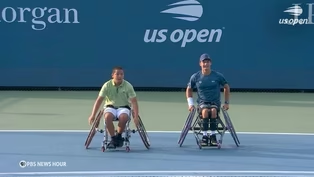
Wheelchair tennis celebrates 50 years and a new popularity
Video has Closed Captions
Wheelchair tennis celebrates 50 years and a new wave of popularity (8m 22s)
Providing Support for PBS.org
Learn Moreabout PBS online sponsorship New Episode
- News and Public Affairs

Today's top journalists discuss Washington's current political events and public affairs.

- News and Public Affairs

FRONTLINE is investigative journalism that questions, explains and changes our world.
 New Episode

 New Episode
 New Episode
 New Episode

 New Episode
 New Episode
 New Episode
Support for PBS provided by:
Major corporate funding for the PBS News Hour is provided by BDO, BNSF, Consumer Cellular, American Cruise Lines, and Raymond James. Funding for the PBS NewsHour Weekend is provided by...