
Protecting the mental health of our healthcare workers
Clip: 3/28/2026 | 8m 6sVideo has Closed Captions
Protecting the mental health of our healthcare workers
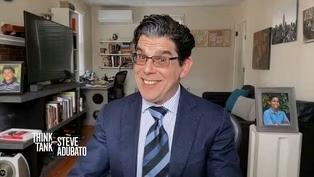
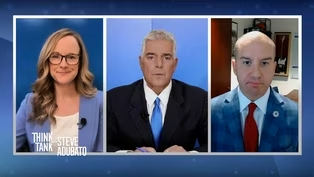
Steve Adubato speaks with Corey Feist, JD, MBA, Co-Founder and CEO of Dr. Lorna Breen Heroes’ Foundation, about how this non-profit protects the mental health of our healthcare workers.
Problems playing video? | Closed Captioning Feedback
Problems playing video? | Closed Captioning Feedback
Think Tank with Steve Adubato is a local public television program presented by NJ PBS
Protecting the mental health of our healthcare workers
Clip: 3/28/2026 | 8m 6sVideo has Closed Captions
Steve Adubato speaks with Corey Feist, JD, MBA, Co-Founder and CEO of Dr. Lorna Breen Heroes’ Foundation, about how this non-profit protects the mental health of our healthcare workers.
Problems playing video? | Closed Captioning Feedback
How to Watch Think Tank with Steve Adubato
Think Tank with Steve Adubato is available to stream on pbs.org and the free PBS App, available on iPhone, Apple TV, Android TV, Android smartphones, Amazon Fire TV, Amazon Fire Tablet, Roku, Samsung Smart TV, and Vizio.
Providing Support for PBS.org
Learn Moreabout PBS online sponsorship- Hi everyone, Steve Adubato.
We kick off the program with an important conversation with Corey Feist, who's co-founder and CEO of the Dr.
Lorna Breen Heroes' Foundation.
Corey, great to have you with us.
- Thanks for having me, Steve.
Great to be with you today.
- You got it.
Tell everyone who Dr.
Lorna Breen was and why her legacy matters so much.
- Dr.
Lorna Breen was an emergency medicine physician and physician leader in New York City who died by suicide at the peak of the pandemic in April of 2020.
Lorna cared as fiercely about her patients as she did her colleagues and their wellbeing, and was struck with a singular mental health episode because she was overwhelmed by what she saw in the emergency room at the peak of the pandemic.
She was so overwhelmed by that we had to medically evacuate her out of Manhattan and get her first and only mental health treatment of her whole life.
When she started to recover from that treatment, then she talked about the stigma around getting mental health treatment and how that would burden and actually impede her ability to be a doctor, the only thing she's ever wanted to do for her whole life.
Lorna took her life on April 26th, 2020 and thrust her story and our family and now our foundation into a national spotlight where we are envisioning this future where systems care for health workers as fiercely as healthcare workers care for others, and we're really trying to redesign that from the inside out.
But Lorna was really the symbol for many in the country of health workers need to be taken care of.
They care for others so deeply, it's time we look at them and say, "We care about you too," and that's what our foundation has been doing since the summer of 2020 when we began it.
- And, Corey, your family connection to Dr.
Breen, describe it.
- I'm married to her little sister Jennifer.
So Lorna was my sister-in-law, Lorna was the crazy aunt to eight nieces and nephews, including two of my kids, - As I read about Dr.
Breen, loved snowboarding, hanging out with her eight nieces and nephews, as you said, appeared to love life and be committed to her work, particularly during the horrific period, you gotta realize, if she took her own life in April 26th, 2020, that means the pandemic was raging at that point.
We talk so much when we've done programming around suicide, looking for signs, but were there any?
- No, not really, Steve.
I mean, well, let me take you back.
So this happened in about a three to four week time.
So Lorna was getting her MBA at Cornell, she was at the top of her game, she had never had a mental health episode in her life, but she contracted COVID and it knocked her down.
And then she did what so many firefighters on 9/11 did, which is run back into that burning building.
And Lorna was just completely depleted.
So in the retrospect, retrospectoscope, if you will, you could say we should have never allowed a health worker who is in that fragile estate to go back into the healthcare delivery.
And that was really the singular thing that was the root cause of starting this whole thing to begin with.
And then when you add to that the stigma that healthcare workers uniquely have and the penalties that they carry for just doing anything about their mental health, if and when they need it, those are the kind of things that we look at at the foundation and say, "This is a completely preventable issue for healthcare workers, we just need to allow them to be human, as opposed to heralding them as heroes like we did for so many months and years in the pandemic."
- Do you believe Dr.
Breen was particularly worried that if she said something and acknowledged that she was struggling mentally, that she was at risk of losing her medical license?
- Yes, so she told us that as much, and I was a healthcare attorney at the time, and I was running a large medical group of physicians and other advanced healthcare workers at the University of Virginia in Charlottesville at the time, and it was something that I had never heard about.
And when we finally got her mental health treatment, Steve, she said, "Now that I've obtained mental health treatment, my hospital credentials, my ability to work in a hospital is now compromised and my license to practice is at risk."
And what I would just quickly tell you is that this is one of three drivers of suicide among health workers.
Just a few years ago, the American Hospital Association published their first ever suicide prevention guide, and it lists this issue as the first one.
And it is something that we are working to change in New Jersey right now, we've changed these licensing questions now in 37 states across the country and in over 630 hospitals.
We got 10% of the hospitals, we've got another 90% of the way to go, including 100% of the hospitals in New Jersey that we're working with right now.
- You're a not-for-profit as we are a not-for-profit media company.
Your funding comes from where?
We'll put up the website right now.
- Yeah, we've been funded by individuals, by grants, by foundations, we've been supported by Johnson and Johnson and many other organizations who have a deep commitment to taking care of health workers.
And so that's how we are funded, yeah.
- Final word to all of us who've been patients, family members of patients who have been served so well by healthcare professionals, what can and should the rest of us who are so dependent upon extraordinary physicians like Dr.
Breen, what could and should we be doing?
Got a minute left.
- Yeah, recognize that health workers in the United States have the worst mental health of any worker class in the United States.
The CDC and NIOSH published a report about this two years ago.
- NIOSH is an acronym for?
- The National Institute for Occupational Safety.
- Okay.
- They identified that about 50% of the workforce is burnt out, about 50% of them intend to leave, and violence and threats among health workers is up to historic levels.
So every individual just, A, needs to be aware that their workforce is at an incredibly fragile state and to treat them like humans and to check in on them when they're asking you as a patient, "Steve, how are you doing?"
Take a pause and say, "Actually, how are you doing?
Are you taking care of yourself?
What can we do as patients to support you?"
I think that would go a incredibly long way, and it's something that every person has the ability to do from coast to coast.
- Corey, thank you.
We appreciate it.
- Thank you, yeah.
- You've made a difference.
- Thank you so much.
- That's Corey Feist, who's the co-founder and CEO of the Dr.
Lorna Breen Heroes' Foundation.
We'll be right back.
- [Narrator] Think Tank with Steve Adubato is a production of the Caucus Educational Corporation.
Funding has been provided by Johnson & Johnson.
NJ Transit.
South Jersey Industries.
Newark Board of Education.
PSEG Foundation.
EJI, Excellence in Medicine Awards.
A New Jersey health foundation program.
Horizon Blue Cross Blue Shield of New Jersey.
The Port Authority of New York and New Jersey.
And by Robert Wood Johnson Foundation.
Promotional support provided by BestofNJ.com.
And by NJBIZ.
Author Noel Maurer talks the history behind The Panama Canal
Video has Closed Captions
Author Noel Maurer talks the history behind The Panama Canal (9m 25s)
Hackensack Meridian Health and their role in FIFA World Cup
Video has Closed Captions
Hackensack Meridian Health and their role in FIFA World Cup (10m 47s)
Providing Support for PBS.org
Learn Moreabout PBS online sponsorship
- News and Public Affairs

Top journalists deliver compelling original analysis of the hour's headlines.

- News and Public Affairs

FRONTLINE is investigative journalism that questions, explains and changes our world.












Support for PBS provided by:
Think Tank with Steve Adubato is a local public television program presented by NJ PBS