Vermont This Week
October 9, 2026
10/9/2026 | 26m 42sVideo has Closed Captions
Gray, Rodgers clash in tense Lt. Gov debate | Candidates for U.S. House face off in debate
Gray, Rodgers clash in tense Lt. Gov debate | Candidates for U.S. House face off in debate | Sen. Sanders endorses Janoo for Vermont governor | Moderator - Mitch Wertlieb; Kevin McCallum - Seven Days; Calvin Cutler - WCAX; Lola Duffort - Vermont Public.
Problems playing video? | Closed Captioning Feedback
Problems playing video? | Closed Captioning Feedback
Vermont This Week is a local public television program presented by Vermont Public
Sponsored in part by Lintilhac Foundation and Milne Travel.
Support provided by:


Vermont This Week
October 9, 2026
10/9/2026 | 26m 42sVideo has Closed Captions
Gray, Rodgers clash in tense Lt. Gov debate | Candidates for U.S. House face off in debate | Sen. Sanders endorses Janoo for Vermont governor | Moderator - Mitch Wertlieb; Kevin McCallum - Seven Days; Calvin Cutler - WCAX; Lola Duffort - Vermont Public.
Problems playing video? | Closed Captioning Feedback
Where to Watch Vermont This Week
Vermont This Week is available to stream on pbs.org and the PBS app.
Support the crew
Help Mitch keep the conversations going as a member of Vermont Public. Join us today and support independent journalism.Providing Support for PBS.org
Learn Moreabout PBS online sponsorshipThe two candidates vying to be the state's next lieutenant governor traded personal barbs during a tense debate this week.
Why did you not speak out against the mistreatment of migrant workers on your family farm?
And did you use your influence to direct the investigation?
Vermonters have a chance in this election to really think about the type of leadership they want in the state.
I don't want a self-serving, self-interested bully.
Plus, candidates for Vermont's sole seat in the U.S.
House of Representatives face off, and Vermont's senior senator Bernie Sanders, wades into his home state gubernatorial politics for the first time in six years.
All that and more ahead on Vermont this week.
From the Vermont public studio in Winooski.
This is Vermont this week, made possible in part by the Lintilhac Foundation and Milne Travel.
Here's moderator Mitch Wertlieb.
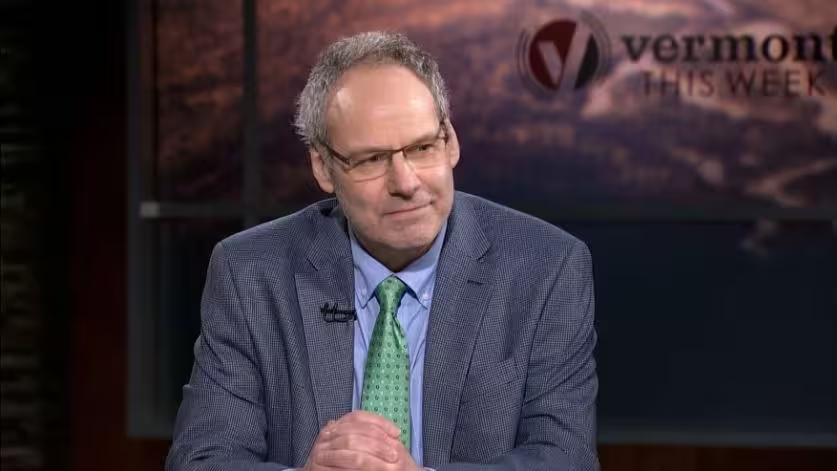
Hi, I'm Mitch Wertlieb.
It's Friday, October 9th, and with us on the panel today, we have Kevin McCallum from seven days.
And joining us remotely today, Lola Duffort from Vermont Public and Calvin Cutler from WCAX.
Thank you all so much for being here today.
Well, Calvin and Lola remotely, we miss you here in the studio, but we are so glad you're joining us remotely.
I want to start Kevin McCallum talking about this interesting debate that we had recently between lieutenant governor candidates.
You know, this is Vermont.
I joked last week on the show about we don't really get nasty here.
We don't really do that.
But things did get a little personal and they have been getting personal.
Let's hear this exchange from that debate recently.
This week.
Your family farm was at the center of serious labor violations around its treatment of H-2a migrant workers.
Why did you not speak out against the mistreatment of migrant workers on your family farm?
And did you use your influence to direct the investigation?
Wow.
You know, John.
Seems like kind of a new a new low here.
I guess I'll say this.
Vermonters have a chance in this election to really think about the type of leadership they want in the state.
When I think about what we see nationally right now, I think about what I want for my kids.
I don't want a self-serving, self-interested bully who not only bullies his town and fails to follow the laws that he helped create.
You know, I don't want that in Washington.
I definitely don't want that in this state.
Okay.
So, you know, a little bit cringey there.
I would say, you know, especially for Vermont.
But I want to ask you this, Kevin, because I feel like anybody who hasn't been paying attention to this race maybe doesn't know Vermont politics too well, might sort of see that exchange and think initially, just not knowing the context.
Wow.
Molly Gray didn't quite answer John Rogers question there about her family farm.
Give us some context.
What is going on there?
Sure.
Well, I think the broader context here is that it represents a pretty dramatic escalation in the negativity of this campaign that we've been seeing building over the last several weeks.
It was a fairly tame affair for the first few weeks and months of the campaign.
But then we started to see these instances where John Rogers was taking some personal shots at Molly Gray, and I first noticed it when the Tunbridge Fair video started to circulate, wherein he was criticizing her for writing the obituary of Vermont Dairy, which is, of course, not true.
And then there was also some instances where he was trying to point out that her positions on certain liberal issues were falling short or were questionable.
And then and then finally, you know, there was this when I interviewed him in Manchester, he had this very sharp jab at her about having run for Congress when she had the job before, unlike him, who's been working really hard in that job.
So he's been pointedly going at her for several weeks now, and I was very surprised to see the degree to which he escalated that attack during the debate.
And so I was struggling to catch up with what he was actually talking about.
What were the facts that he was alleging?
What was the farm that he was referring to?
And you're absolutely right.
A viewer who's unfamiliar with these two candidates, and the race so far could very easily have assumed that the violations he was referring to were on Molly's farm.
Like, it's her farm, it's her responsibility.
And so I think in that sense, the attack is probably pretty effective.
But you could also, I think, argue that it backfired a little bit on them because Molly Gray was able to counterpunch pretty well, I think by pointing out that, you know, that it was a new low.
So we can get into that for sure.
Well, speaking again, he said family farm.
He sort of implied your family farm.
This to be clear, as I understand it, this was not a farm that she was running at the time.
It is linked to her family.
But the incident that Rogers was talking about did not occur under her sort of supervision.
Absolutely right.
This is a farm where she grew up in Newbury, and she references a great deal in her campaign as being someone who grew up on a dairy farm in Vermont, and the Rogers campaign felt that there was a disconnect there between this sort of constant reference by her about this farm.
But then there's never been any mention of the fact that there was this labor violation issue at the farm just a couple of years ago.
And just to be clear what kind of violation we're talking about, we're talking about appropriate housing, sufficient housing.
There's these workers and there's rules about what kind of housing they are allowed to live in.
And, you know, you're not allowed to have people living in barns, essentially.
And there were workers who were living in modified barns, and they didn't have sufficient insulation.
And there were space heaters, and there was a shower.
And in an area that it's not the kind of thing you or I would want to live in, but I think it's also something that's fairly common in a lot of farms in the state of Vermont.
Calvin Cutler, what was your take on all that?
I think this is really an instance of the power of social media as well.
Last I checked, this video has been shared at least on the platform X, formerly known as Twitter.
It had over a million views and it was getting picked up by the Daily Mail.
It was getting picked up by sort of the conservative, sort of the conservative version of The Onion, the Babylon Bee.
I mean, this has really been picked up in a lot of conservative circles on on Twitter.
And to your point, it has been clipped in such a way in the original, you know, question where Molly Gray, you know, said John, I will give you another chance to ask a different question.
That certainly has gone viral.
So I think we'll have to see what exactly comes of this in the race, if anything.
I mean, again, we'll see what happens on on Election Day.
But, you know, to Kevin's point, number one, it is an indication that this race is getting real testy and real nasty.
And number two, just the power of social media and how things can spread.
And we haven't seen a lot of that in Vermont.
Politics get sort of amplified on the Twitterverse, so to speak.
But this is a really interesting example of that happening.
And I also think, you know, backing up a little bit.
This is a reflection of the fact that John Rogers is in an incredibly difficult reelection campaign.
There hasn't been a pull out yet that has shown him doing particularly well.
He's either 10 or 20 points behind, depending on the public polling that's out there.
And so it is not surprising that he would a be trying to get as much attention on this race as possible.
Right.
Because I think people do not pay super close attention to the lieutenant governor's race and be trying to do whatever he can to weaken his opponent.
You know, we've talked before about how the lieutenant governor's position there is not a lot to do.
I don't want to downplay it too much.
You're next in line for the governorship, obviously, but, you know, there is a lot of, I guess, onus on that position in government.
They didn't talk a lot about the issues, perhaps as a result of that.
Or does this make sense to you that the issues weren't brought up too much in this debate?
Well, I think both of these candidates are trying to make the case that this job could be a very substantial job in the state of Vermont, that it hasn't been it hasn't been used that way as a real policy position for at all over the years.
But Molly is Molly gray is trying to make the point that this is a really important job in the state.
If the person in it chooses to, you know, use that platform to advance important issues and push back on certain policies.
And she's trying to suggest that John Rogers has just not done that.
You know, that there's all these really important issues in Vermont that really need a counterbalancing voice and that she would bring that and that he hasn't.
He?
For his part, has said, wait a minute.
Like I work my tail off in this job.
Like I think this job is best.
Best serves Vermonters by being an advocate for people who have problems.
If you can't, you know you're dealing with a tax department that's, you know, something is a problem for you and you don't know how to go about it, and you don't know what the phone number is or how to address it.
You come into my office, whether you're a Democrat or a Republican, and we'll get to the bottom of it.
We'll help you.
And so he has claimed that he's like the hardest working lieutenant governor that the state has ever seen.
And he's trying to use that again to suggest that, well, that's not really how Molly Gray used this job when she had the chance.
So I'm the best one to to have it for another couple of years.
A good reminder that Molly Gray was in this position as lieutenant governor from 2021 to 2023.
Do I have that right, folks?
Yeah.
Give them what Lola Duffort was saying about the polling numbers.
And it's true.
John Rogers has been polling behind here.
How do we feel about how Molly Gray answered that question again?
What Calvin was saying was, you know, conservative media, that sphere is sort of using that clip against her.
Was this maybe the best way she could have answered it by sort of saying like, that's a new low kind of thing?
I think.
So, I mean, I in a debate like that, what real space do you have to get into the nitty gritty debate about the labor violations at a farm that year that is your family farm, but you're not connected to it.
You're on the defensive, right?
If she were to try to sort of push back on all of the things that John was saying about her family farm, she would have had been on the defensive.
And instead, what she did is she found a way to sort of skip over all of the factual things that he was referring to and go on the attack and make it about him and make it about his being him being a bully, and even make these insinuations about him, about some of the challenges that he's had in his career as the lieutenant governor with the cannabis illegal cannabis a portion of his farm was not properly licensed and and some of the problems with his local town.
You know, it's.
A private road issue.
Issue with his.
So I thought she effectively sidestepped the issue he was bringing up in counterpunch in a very important way.
Yeah, it's really interesting.
I have not seen a race get sort of this testing in a while here in the state of Vermont.
Let's move on to another debate that was held for the candidates for U.S.
House of Representatives.
We're going to hear from Becca Balint, the incumbent, Gerald Malloy, and Ortiz as well, who was Adam Ortiz, who was also included in this debate?
Should there be term limits on members of Congress?
Representative balance?
Absolutely.
Absolutely.
Adam Ortiz no.
You vote who you vote for.
You don't like them.
You don't vote for them.
Is the U.S.. Mail in voting system secure?
Gerald Malloy.
I'd like to see it more secure.
No.
I think it is secure.
But we have a president who's casting doubt on that.
Yeah.
Should the federal government eliminate the death penalty?
Ortiz.
No!
Back it out.
No.
Thank you.
Should the federal government legalize recreational marijuana?
I don't.
Federal government.
Federal government?
No.
Yes.
If you lose this race, what job are you going to try to get instead?
Joe Malloy.
I become a farmer.
I actually did call Guantanamo Bay to see if I could do the MTA class.
So when we are in Cuba, I'm already there.
And I can be a civilian contractor or as an EMT.
All right.
Back about.
If I lose this race, I will commit myself to two of the issues that I care about literacy and food distribution to people who are hungry.
Well, I love lightning round stuff.
You hear some interesting responses there for any takeaways from that exchange that we heard there.
Well, one of the more interesting parts of the debate for me were the conversation that they had about the war in Iran.
And it to me, illustrated this really difficult dance and balance that Gerald Malloy is trying to strike.
I mean, he's, you know, trying to run as more of a Phil Scott Republican, given the Vermont electorate.
And obviously, you know, every Republican in America right now is really worried about a blue wave and the president's historically low approval ratings.
And so, you know, his answers about the war in Iran were really interesting because it illustrated this difficult thing that pro-Trump Republicans have tried to do where they don't want to repudiate the president, but they also don't want to be tied down by his political baggage right now.
Right.
So he was like, well, I want I want to see an end to Iran.
But, you know, we need to make sure they can't have nuclear weapons.
And I don't know if I would vote for a war resolution.
So things like that were really were interesting to me.
It's funny, you can see the candidate in Michigan is going through some of those those same problems there.
Kevin McCallum what was your impression of all that?
Yeah, I thought it was also noteworthy how long it took him to answer the question about whether he would abolish the death penalty.
I mean, I. Will tell you, though.
Just briefly, candidates were quick.
They were.
Very quick.
And I was a little surprised to see him really struggle with that one.
I mean, who doesn't know where they stand on that issue after years and years of campaigning for office?
It's very strange.
It's funny.
I had a different take on that.
I know it was a lightning round.
I know you're supposed to answer quick, but I like the fact that on a topic that is so consequential as that, we saw the horrific incident that happened just last week with this woman who they tried to execute her twice.
It did not work.
I mean, it's just a horrifying stuff.
He at least seemed to be thinking about it.
But, you know, you have a point.
How do you not know where you stand on such?
Certainly one way to look at it, but I. Yeah.
One more question for the panel before we move on on this one, does the incumbent here, Becca Balint, have much to worry about in this race, Calvin Cutler?
My inclination is to say no.
You know, in a year where Democrats up and down the ballot and rank and file Democrats are really bolstered by, you know, national headwinds, people coming out to vote against the policies of President Trump.
You know, there is a really accented candidate, and people are a lot of has a lot of enthusiasm behind Amanda Janoo at the top of the ballot.
I really I see this as a safe Democratic seat.
I think we can expect to see, you know, Gerald Malloy, you know, try to, you know, really kind of get the same margins of Republican voters as we've seen in the last, last few election cycles.
But I don't think Becca Balint has a lot to worry about.
Calvin Cutler, I knew you'd give me an excellent segue by mentioning Amanda name.
Thank you very much for that.
Let's talk about the governor's race, which a lot of people, it looks like a much more fascinating race at this point.
Amanda Janoo, the Democratic candidate for governor, got a pretty big endorsement this week.
I think you'll recognize this gentleman.
I personally like Phil Scott, and I've worked with the governor on a number of issues over the years, but I believe it's time for a change.
Time for new leadership.
Time for a kind of energy and bold ideas that we're not seeing in Montpelier right now, in my view.
Amanda, Janoo has the leadership qualities and the energy we need right now to become a great governor.
Kevin McCallum.
As we said at the top of the show, this is the first time in six years that the senior Senator, Bernie Sanders, has endorsed a candidate waded into these local politics.
Is this significant for Amanda?
Janelle?
Yeah, I think so.
Absolutely.
I mean, it's not terribly surprising to me that this endorsement came.
I mean, while he has not endorsed a gubernatorial candidate in recent years, that's because the Democratic candidates haven't been very strong in recent years.
He endorsed three different Democratic candidates Sue Minter, Christine and David Zuckerman back in the day.
So it's it's not a surprise to me that given the momentum and the strength that Amanda Ginny's campaign is demonstrating, and given the alignment of her progressive views with his that that he that he did that.
And what I found interesting is that Amanda very clearly was gratified and heartened by this in a way that the other endorsements she's gotten have not meant as much to her as this one.
And she, she, she, she claims to not really place a lot of import on kingmakers, right?
She runs a grassroots.
She has a very egalitarian view of politics.
She she runs a very grassroots campaign where she wants people endorsing her from every corner of the state, regular people, not just politicians.
And so she says that she doesn't place a lot of stake in the views of kingmakers.
But very clearly, from the statement she put out, she she was very heartened.
Bernie Sanders, very important political figure in her background, she has claimed that he has inspired her over the years.
And so, yeah, and the question of whether this is going to help her or hurt her is an interesting one.
I think it will most likely, on balance, help her.
But she is also trying to appeal to a broad, a broad array of Vermonters.
Right.
And certainly I could see some rural Vermonters listening to her messaging about the need to sort of strengthen rural economies, and they'd be attracted to that.
But then maybe when Bernie Sanders endorses her might make a few people say, wait a minute, wait a minute, Bernie Sanders.
That's not that's not who I support.
To Kevin's point, it's interesting.
Governor Phil Scott was asked about the Bernie endorsement and her appearing with Ro Khanna as well in white River junction.
And, you know, Governor Scott said that's fine.
But he doesn't see that as a strength.
You know, Scott said that he would much rather have the endorsement of a blue of blue collar workers, blue collar Vermonters.
And he even cited actually he was at an apple orchard, he said last week.
And he said he'd much rather have the endorsement of an apple farmer in the Champlain Islands than a politician who's been in office for 30 plus years.
So that's how the governor framed it.
So I think, yeah, Kevin, you're definitely on to something there for sure.
Will do for curious about your take on this.
Yeah, I think I think the Bernie Sanders endorsement will be really useful to her because she has a ton of momentum, but what she needs is more name recognition, right?
She needs her name and her campaign to be as visible to people as possible.
And that is what a Bernie Sanders endorsement can give her.
And so I think this is good for her.
I think a lot of rural voters in Vermont like Bernie Sanders, too, right?
So I don't know that this will hurt her with Phil Scott.
Democrats.
You mentioned, Lola, that Amanda Janoo could use some more name recognition.
Calvin Cutler what about money?
Could you use some more money?
All candidates usually can.
Absolutely.
Are the candidates doing on fundraising at this point?
What update can you give us?
Yeah, I mean money isn't everything in a race, but certainly in the final weeks it helps you get your name out there.
You can buy ads, you can buy things on social media.
Really sort of try to get your name and message out there and to lowest point, build, build name recognition and momentum.
And really what we're seeing is the money is also showing that this is a very competitive race.
In September, Amanda Janoo raised just shy of $300,000.
She spent about $70,000 and she's got about $280,000 cash on hand.
Heading into October, Governor Scott, he raised about $223,000.
He spent about 230,000.
And he's also got a little under 300,000 cash on hand heading into October as well.
And so, again, as I said, money isn't the end all be all.
But if you look at who Amanda Janoo, who is donating to Amanda Nunes campaign, you're seeing a broader sort of ideological coalition.
You're seeing a lot of ally Richard's donors are finally starting to open up their pocketbooks to her as well.
And as we alluded to last week, we're also starting to see outside spending.
The Democratic National Governors Association donated to a independent expenditure PAC last week of about $40,000.
And on the Republican side, the RGA, the Republican Governors Association.
They're also getting involved.
They donated $400,000 to a pack, which is so far spent about 150,000 160,000 on behalf of Phil Scott.
So, again, you know, these numbers aren't you know, it's certainly this is the most significant numbers we've had in some years, but it does really pale in comparison to the Sue Minter Phil Scott 2016 race where at this point, you know, both candidates had raised well over $1 million each on their own.
Plus there was outside spending.
So it's just one more indication.
Again, as I said, money isn't everything, but it's one more indication that this is certainly a really competitive race.
I want to talk about something that Kevin McCallum mentioned in.
That is how rural Vermonters are viewing all of this as we get ready for November 3rd.
And, Kevin, you've been writing about this group, Rural Vermont Rising.
At one point, they were just called Vermont Rising.
As I understand it, this is a group that's concerned about a lot of issues that they feel like Montpelier is leaving the rural parts of Vermont behind.
If I understand it correctly, they're they're very zeroed on things like act 181, act 250.
What can you tell us about this group and what their impact might be on this race?
Well.
That's an excellent question because we know that they had a significant impact during the legislative session in getting key elements of act 181 rolled back.
Right.
They put a lot of pressure on lawmakers to say that, look, these things that you're proposing, these environmental initiatives that you're referring to about roadways and about sensitive habitats, they may sound great for people in Montpelier, but for us, those are a real problem.
Those are a real concern.
We want to develop our land or they want to expand a farm or whatever.
What is that going to mean for us?
So they really pushed back hard on that.
And it had a very quick and powerful effect.
And they got key provisions of that law repealed.
And so then it was like, well, now what we've got, you know, thousands of people around the state who've gotten, you know, animated and agitated about something going on in Montpelier.
And there's a concerted effort to keep that momentum alive, to keep those people engaged with Montpelier.
The question, though, is whether the question for us was going to be, is this going to become kind of a political organization?
Are they going to be endorsing candidates?
Are they going to be raising money?
Are they going to be identifying individual candidates that they think people are more supportive of rural issues in rural communities?
And that's not really what's happening, right?
They are almost sort of trying to stay out of the the electoral politics part, dipping toes in here and there, which we can get into a little bit, but they're largely trying to be an advocacy organization.
I think when policy issues come forward in Montpelier in the next session and in future years, they want to be a very strong voice for rural Vermont.
But it doesn't sound like they're going to actively be campaigning or pushing for individual candidates in this upcoming election, unless some other folks have different views.
Yeah, I mean, they are putting out guidelines of here's what you can look for in candidates, here's the values that we are looking for.
Or, you know, hey, here's some questions that you can ask your candidate.
Where did they stand on 181?
Where do they stand on the veto override?
That type of thing.
But yeah, Kevin, as you mentioned, you know, certainly, you know, they are more of a advocacy group at this point.
And some of the issues that they have been shining a light on.
I'm thinking about the regional Planning Commission process in Orange County.
You know, it's gotten some eyeballs on it.
And so they are in some ways really pushing these, although they're not getting politically involved with candidates, they are really pushing a lot of these issues to the center, and they are getting some airtime.
All right.
I want to mention as we wrap up here, so sorry, Lola, we are fighting the clock here.
And I just want to mention that if you have questions for the governor debate, which is coming up October 21st, please send them to Vermont Edition at Vermont Public.
That's going to be a fascinating debate.
And briefly, I want to mention that a gentleman wore the same pair of socks for 101 days straight.
This was covered in seven days.
He says they didn't smell Kevin McCallum.
Do you believe him?
One of the harder hitting stories in seven days?
Yes.
And you believe him?
I believe him.
They did not smell.
All right.
I'm not going to try it.
We'll have to leave it there for this week.
Our thanks to the final Kevin McCallum from seven days.
Joining us from today, Lola Duffort from Vermont Public and Calvin Cutler from WCA.X I'm Mitch Wertlieb.
Thank you so much for watching and listening.
We'll see you next Friday for Vermont this week.
 New Episode
- News and Public Affairs

Top journalists deliver compelling original analysis of the hour's headlines.

- News and Public Affairs

FRONTLINE is investigative journalism that questions, explains and changes our world.
 New Episode
 New Episode
 New Episode
 New Episode
 New Episode
 New Episode
 New Episode
 New Episode
Support for PBS provided by:
Vermont This Week is a local public television program presented by Vermont Public
Sponsored in part by Lintilhac Foundation and Milne Travel.