Vermont This Week
October 2, 2026
10/2/2026 | 26m 46sVideo has Closed Captions
Poll shows Janoo closing in on Scott | Gray leading Lt. Gov Rodgers in new poll
Poll shows Janoo closing in on Scott | Gray leading Lt. Gov Rodgers in new poll | Scott administration using AI to probe state IT systems | Moderator - Mitch Wertlieb; Peter Hirschfeld - Vermont Public; Calvin Cutler - WCAX; Alison Novak - Seven Days.
Problems playing video? | Closed Captioning Feedback
Problems playing video? | Closed Captioning Feedback
Vermont This Week is a local public television program presented by Vermont Public
Sponsored in part by Lintilhac Foundation and Milne Travel.
Support provided by:


Vermont This Week
October 2, 2026
10/2/2026 | 26m 46sVideo has Closed Captions
Poll shows Janoo closing in on Scott | Gray leading Lt. Gov Rodgers in new poll | Scott administration using AI to probe state IT systems | Moderator - Mitch Wertlieb; Peter Hirschfeld - Vermont Public; Calvin Cutler - WCAX; Alison Novak - Seven Days.
Problems playing video? | Closed Captioning Feedback
Where to Watch Vermont This Week
Vermont This Week is available to stream on pbs.org and the PBS app.
Support the crew
Help Mitch keep the conversations going as a member of Vermont Public. Join us today and support independent journalism.Providing Support for PBS.org
Learn Moreabout PBS online sponsorshipNew polling shows Governor Phil Scott is facing the tightest gubernatorial race of his career.
Plus, a look at where Vermonters stand on the issues this election season and why some are raising concerns as the Scott administration begins using AI to probe weaknesses in state IT systems.
All that and more ahead on Vermont this week.
From the Vermont Public Studio in Winooski.
This is Vermont this week, made possible in part by the Lintilhac Foundation and Milne Travel.
Here's moderator Mitch Wertlieb.
Hi, I'm Mitch Wertlieb.
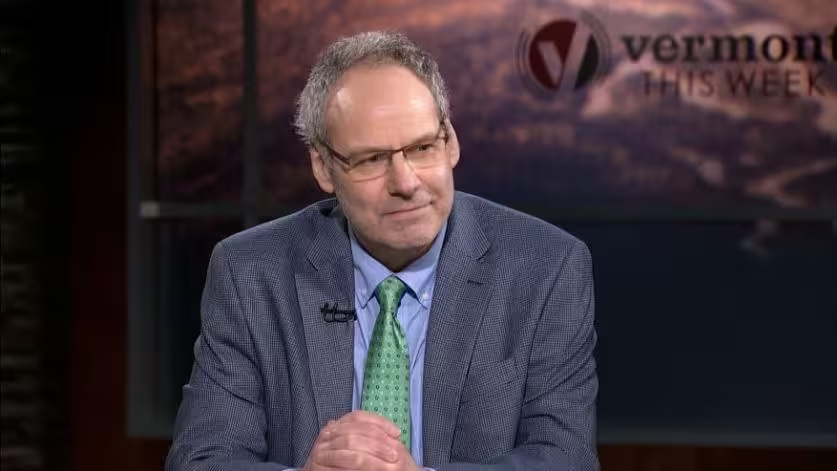
It's Friday, October 2nd, and with us on the panel today, we have Peter Hirschfeld from Vermont Public, Calvin Cutler from WCAX, and Alison Novak from seven days.
Thank you all so much for being here.
I want to start with this little story.
I got an email a couple of weeks ago from a listener or a viewer of this program who said, you know, I really enjoy Vermont this week, love listening to you talk about all the issues that matter to Vermonters.
But she, the listener, said, when I found that when you talk about Governor Phil Scott, you sort of talk about the upcoming governor's race as if it's a fatal complete, like he's already won.
And, you know, I take criticisms, criticisms to heart on this show.
I'm the host, and I really regret giving that impression.
Well, for that viewer, that listener, today's show will be of great interest to you because we're going to start talking about this poll, which in fact shows that Governor Phil Scott is, according to the poll for the Vermont public.
Did Pete Hirschfeld facing perhaps the most difficult race that he's had in at least a decade?
Yeah, conventional political wisdom heading into this election cycle, which was that Phil Scott is unbeatable, is being upended in real time right now for reasons that are both within and beyond Phil Scott's control.
The advantage, the built in advantage for Democrats nationally is even more pronounced than we thought it was going to be coming into this cycle.
And some of Phil Scott's big policy agendas in Montpelier, namely education reform, are, according to this poll, exceedingly unpopular with a lot of Vermonters, Democrats and Republicans alike.
Add to that that he is facing a challenger with political talents that he has not gone up against in the recent past, at least, and it is become a recipe for a much tighter race.
And a lot of people thought we were going to see this year.
It's weird though.
You look at the poll numbers and it shows that ZANU is within, what, ten points according to the Vermont public poll.
I mean, that would in most cases seem like a pretty comfortable lead for the incumbent.
Yeah, Phil Scott has a statistically significant lead.
It's outside the margin of error.
He still enjoys approval from 40% of Democrats, which have been a key segment of his winning coalition in Vermont.
But if you compare Phil Scott's approval among Democrats, of which there are more of them Vermont than Republicans from 2022, and we did the last Vermont public poll to today.
And he has hemorrhaged approval among that group of Vermonters.
He was he had a 70% approval rating among Democrats in 2022.
He's down to 40 now.
Yeah, that first number.
I had to emphasize that because again, that's pretty astonishing.
Calvin Cutler, what was your first impression seeing some of these numbers?
Yeah, I mean, it's interesting as we talk a lot about just the sort of auto level set, as we were saying before the program, a poll is just a snapshot in time, right?
I mean, there's a lot of different methodologies and a lot of factors that go into each specific poll.
So you can't put too much weight or too much.
I mean, there was also a Unh poll as well that showed Amanda Janoo up by about six points.
But yet to Pete's point, if you sort of unfocused your eyes and take a look at what the data is showing us in the trend lines, this is a very competitive race.
There's campaign finance numbers as well.
We can maybe get into those, but that is also showing that people are opening up their wallets in ways that we have not seen in a decade.
And it is very clear at this point, looking at the decline in support among Democrats for the governor, the fundraising numbers, you look at how many volunteers Amanda Janoo has, it is very clear that she has been able to consolidate support within the Democratic coalition.
And there's a lot of people that are lining up behind her.
Maybe not everybody, but more than we've seen.
Alison.
So Pete talked about her having political talent.
And I think something that's also really remarkable is that she's never held public office.
And before this spring, when she announced she was pretty much an unknown in Vermont, no one knew her name.
And so the fact that she has been able and, you know, just a few months really gained this traction and give Phil Scott a run for his money, I think is a pretty remarkable fact.
I think this is all so fascinating.
We were talking, you know, when we looked at the primary, for example.
Right.
I think a lot of people thought Allie Richards, who had more name recognition at the time than Amanda Janoo would probably be the Democratic candidate.
I think that was a fair assumption.
A lot of people made when managed to do one that primary.
I started thinking, you know what, maybe the Scott camp is going to get a little nervous here.
But then I was hearing things like, no, no, they wanted the progressive to win because it's easier to run against the progressive.
Are we feeling like there's some nervousness in the Scott camp now?
Yeah, I mean, it's an issue that we've seen sort of play out in Democratic primaries in other states.
I'm thinking in Michigan or I think I remember other states, but basically we've been seeing more progressive candidates sort of become the standard bearer of the party heading into November.
I think time will tell of whether sort of running that anti-establishment sort of let's try something new type of candidate is going to work because you hear it among, I mean, everyday Vermonters and everyday Americans, you know, the cost of housing is prohibitive.
People don't feel like they can start families because of how expensive it is.
There is I think there was a poll recently that showed people are sort of warming up to the idea of socialism.
I think if you really kind of look at all of these factors, there definitely is a anti-incumbency, anti-establishment energy out there, whether the governor and his team should be concerned about this.
I mean, I think the data shows that that they are actively like, you know, pushing back on this.
And they do see Amanda Janoo as as a threat for sure, and have begun to characterize her as being from the far left.
Governor Scott this week tried to cast her to the political fringe for comment.
She's made about the Air National Guard's F-35 fleet, and Jenna's political gamble here is that there's going to be a broad enough segment of the general electorate that is going to buy into the same ideas that were so successful for her in the primary, Allie Richards, who she lost, who she beat in the primary, made a calculated decision to to run more as a centrist, more as a moderate.
And the reasoning behind that is because historically in Vermont, we have tended to want a moderate voice in the governor's office.
If you look back at previous Democratic governors, whether they're Peter Shumlin or Howard Dean, their fiscal ideology is largely the same as either a governor.
Douglas or Phil Scott, for that matter.
So I think one of the things we're about to find out in this election is our Vermonters ready for the same kind of progressive firebrand in the governor's office as they've been so keen to send a DC.
What I think is interesting is when we frame or kind of call Amanda Janoo the progressive or far left candidate, there is this kind of element of, oh, she's fringe.
She's like, kind of not what most Vermonters want.
But what I think is interesting in some of the polling we've seen is a lot of the ideas that she's bringing to her campaign around universal preventative primary care, around a wealth tax are actually ideas that Vermonters, by and large, you know, a wide swath of Vermonters actually seem to be behind.
And so, in that sense, I you know, I think calling her fringe and I don't know if that's an accurate description.
Yeah, it's a good it's a good question.
I mean, these are, as the data shows in the Vermont public poll, these are very popular ideas, you know, banning data centers, pushing back on, excuse me, taxing second homes or pushing back on centralization of power for education in Montpelier.
These are all ideas that Vermonters, by and large, like.
But the other question to your point of, okay, if we do elect Amanda and her sort of fiscal sort of a vision into the governor's office, how are they going to implement it?
I mean, just the second home tax, for instance, that is a very weedy, very complex, very tough discussion of, yes, let's let's tax second homes.
How do you define a second home?
You know, and that's where I'm going to be really I mean, not assuming she wins, but like you really start to tease out some of these policies and it's really anything but clear, especially the school spending thing.
I think one of the theories that Amanda had coming into this was that this kind of populist vision, tax increases on higher and Vermonters taxing wealthy out of staters with higher property taxes on second homes really could connect with conservative Vermonters, if only they could hear that message from somebody that they were capable of really listening to.
And her campaign is relying on on what it calls relational organizing, which is where you enlist people that have come to see you directly and are responding to you directly and then saying, look, the only way this is going to work is if you go out into your community, you leverage these existing relationships that you have with your neighbors who might not otherwise think that they would be a Janoo supporter, and help them understand why it would be the right choice for them.
I want to dig into some of these, these numbers and other poll questions that we have.
I do want to quickly ask, though, you know, she has a background in economics, right?
She's she's an economist.
I wonder if she should be pushing that a little bit more when people maybe get scared away from some of the progressive or far left labeling that she gets.
Yeah.
I mean, I think I've gone to a number of her town halls, community events.
She's been doing a lot of events all over the state, and I think she does kind of get pretty into the weeds about her economic philosophy and this idea that when we are defining a success, it's not necessarily just by using the metrics of GDP or how the stock market is doing, but how are actual people doing on the ground?
How are Vermonters doing?
And I think that's resonating with people because I think they know that they're not doing that.
People aren't doing that.
Well there.
You know, there's, you know, incredible affordability issues in our state and all over.
And so to me, I see that resonating from her perspective as an economist.
Yeah.
One of the things Vermonters are very concerned about, politicians are concerned about is education reform.
One of the questions on our poll was school spending decisions.
The question was, in general, should decisions about school spending be made primarily at the state level or at the local level?
A whopping 57% of those who participated in the poll said at the local level.
What does that tell us about what Scott and Janoo need to do to win over these voters?
Well, I think they need to cater to number one.
People don't want to close their schools.
People want to keep spending this local, spending decisions in their communities.
They like voting on their school budgets, but also they want their property taxes to come down.
I think really the question of of what exactly this means for education reform in the path forward.
You know, as we know, there's these without getting to down the rabbit hole, we've got these voluntary merger study committees.
And on the other side of it is the foundation formula.
Basically, the government saying, here's how much your town is going, your school is going to receive.
Vermonters don't like that.
And so I'm like thinking I'm gaming out a year or two.
What does this mean for this grand bargain that the legislature and Governor Phil Scott agreed to with education reform?
I don't know, that's it's super unclear.
You know, one of the one of the terms in polling that polling uses is salient.
So you have these competing results, right?
It's a little bit of a paradox.
People want their property taxes lower, but they still want local control over spending.
That's what stood out to me when you get both.
So what do they care about more?
Right.
Well, if we look to the past legislative session where the legislature had a debate over consolidating governance right for school district mergers, lawmakers came face to face with a level of opposition to that concept that made them throw it overboard very quickly.
So?
So their sense seems to be that this local control thing is the thing that people care about most.
Phil Scott is still running headlong with this idea of moving to a foundation formula, with moving to a system where where Montpelier decides how much people spend on local schools and not local districts.
Amanda Janoo is doing exactly the opposite, saying, we're going to get rid of this education reform boondoggle and I'm going to be the one to do it if you elect me governor.
And she said what you would do instead.
She has she's talked about turning local schools, small schools that would otherwise not be financially viable into community hubs of sorts that offer myriad services, everything from food shelves to mental health clinics.
There are critics that say there are all sorts of reasons why this would not necessarily be a viable model, but she is offering an alternative.
This is the community schools model.
So a couple years back we got some federal money to pilot.
Pilot this idea of community schools.
So essentially it was, you know, taking schools and putting things like dental clinics or social services into the schools.
And I think that for the that money has dried up.
But I think for the schools that were able to do that, it was a pretty successful model, because we talk a lot about the fact that, you know, teachers are doing a lot more than educating kids, that there's a lot of needs that kids are coming to school with these days.
So I think the idea is, you know, within these schools trying to offer a wider array of services that will help help students.
Alison, I want to follow up quickly on that, because I heard you say that for the schools that were able to do that.
I'm guessing you're meaning the wealthier districts, the well, with the pilot.
So it was a pilot.
So certain schools got that federal money to do it?
Yeah.
So Winooski, for example, is one of the schools that I think, Amanda, sites that has really shown that this community school model work.
So they have a food pantry within their school.
They have a clothing shelf or clothing drive type thing.
So I do think there's promise in that model.
I think the idea, the kind of question, big question I have is paying for it and how that will will happen.
I mean, what I hear Amanda saying when she is out in these community forums is that she wants to deal with property taxes through property tax reform, not by consolidating schools.
So I think in Phil Scott's mind, those two things are kind of linked, intertwined.
Whereas Amanda has kind of said she feels like the property tax issue needs to be kind of separated from from the consolidation discussion.
Let's take a look at some other things that we got into in the poll data centers.
Not super popular as you might imagine.
I think this is being proven all across the country.
Would you support a ban on large scale data centers in Vermont?
Was the question.
64% of Vermont said yes.
And Pete Hirschfeld, I know that Governor Phil Scott has already vetoed at least one bill that would have blocked some of these data centers, right?
Yeah, it would have imposed new restrictions on the construction of data centers.
That would have made it much more difficult for them to be cited here.
And it was fascinating how quick and how robust the response was to that.
I can remember seeing all kinds of activity on different social media platforms.
People actually in some instances having rallies related to this.
But we're seeing not just in Vermont but across the nation a visceral response to the idea of data centers.
And I think for a lot of people, what they represent at this moment in time and the extent to which we're going to hand over the reins of our society to giant tech companies who are messing around with technology that scares a lot of people.
And and for good reason, in some instances, giant physical buildings, too, and the amount of water and etc.
this would all take up.
Yeah.
It looks like again, that surprises me a little bit in that Phil Scott, I don't know how much pushback he's necessarily getting.
You said on social media people, or are they actually calling him out specifically saying, hey, why are you.
Absolutely.
Absolutely.
Yeah.
No.
There.
Phil Scott was under attack from a lot of corners in the state for that for that veto rationale, I think, is that he thinks it's unrealistic for a data center to, you know, yeah, we talked about that a few weeks ago.
He said we're not going to build those things here.
We're too small.
Right, right.
And act 250.
You know, we have enough environmental protections and regulatory barriers in place that yes.
Your point, are they going to build one here?
But it's the messaging.
Exactly.
That's a nuanced case.
Right.
And I think it's objectively, it was a politically losing thing for him to veto that data center bill, even if he thought it was the right thing to do from a policy perspective.
We've mentioned taxes on second homes.
This was another question that was in the poll.
Would you should Vermont impose a newly year, a new yearly tax on second homes?
50, 57% said yes.
Not sure.
15%.
No, 28%.
But again, Calvin, you were pointing this out.
What is a second home?
What constitutes that?
How do you determine it?
Well, it's funny because I mean even what is that 40%, 48% of Republicans support this.
I mean, 3% 43.
Excuse me, I eat glasses.
This is a very politically popular, you know, question.
A lot of Democratic candidates are saying in Vermont, but also in other states.
But the real question is like when the rubber hits the road, how do you implement such attacks?
You know, you've got homestead and non homestead property taxes.
And you know, we're the tax department is coming up with a new property tax classification as we speak.
But who gets looped into that.
What the tax rate is going to be.
How do you determine what a second home is.
I mean we've been told that they want to avoid getting hunting camps scooped up in this.
But if you look at what the tax department is looking at in terms of definitions, if you can turn on a faucet or flush a toilet in the winter, that could be a year round home.
And there's a lot of people that have those.
So it's just it's really, you know, super unclear.
What I think you alluded to though, is that already within the education reform bill, there is kind of a study to classify to change the property tax classification.
So that is kind of something that is already a policy that is in this education reform law.
So it is something that is on the table.
Yeah.
And I think it's one of those things where people know it when they see it.
Right.
We're talking about a $4.5 million home on a beautiful lake that's inhabited by its owners for 2 to 3 weeks a year, and they live in, you know, Jersey or New York or somewhere and are fabulously wealthy people.
Right?
Those are the situations that that lead to poll results like this.
People who live in Vermont think that those people can afford to pay a little bit more money toward local schools.
Does it solve the problem?
That depends on who you talk to.
I mean, Amanda Janoo, as you were rightly saying, Alison thinks that you can solve the property tax problem almost literally overnight by assessing higher surcharges on those folks.
At one point in the campaign, she talked about potentially being able to raise $1 billion a year in new revenue with the second home tax.
Phil Scott has not either, like, warmly embraced the concept of a second home tax or rejected it.
It's sort of been something that he's accepted as part of these education reform packages, but I don't think he thinks it has nearly the capacity to provide economic relief for working class Vermonters that Democrats think it does.
When I sat down with the governor for a campaign interview, I was asking him, like, this is very popular in heck, maybe we can raise some money this way.
But the governor, he comes at it from the perspective of this is just putting your finger in the dam.
Like, this is not solving our systemic issues.
The governor and we saw this in his state of the state last time of he believes that the systems that we have here in Vermont were built for another age, built for the 1950s, in the 1940s.
And they just cannot the way that we conduct government and have local school budget votes and things like that, the way and maybe act 250 throw that in there.
From the governor's perspective, he sees a lot of our systems as outdated, and we need to fundamentally reform them and bring them into the 21st century.
Is that going to happen?
I don't know, but it's the governor basically says we need to build more homes.
We need to foundationally increase our tax base.
There's another race that people are paying attention to, of course, not just the governor's race.
The lieutenant governor's race is very interesting.
And we saw some poll results that showed that Molly Gray is leading the incumbent lieutenant governor, John Rogers, in this poll.
And by the way, if you want full poll results, please go to Vermont public elections.
They are all there for you to take a look at.
What does this tell us, folks?
Any surprises here that Molly Grace got a pretty fairly sizable lead?
It looks like they're saying blue wave, but also a red undertow as well.
You know, in terms of the national factors, a lot of different pieces went into that.
I mean, John Rogers also was in part elected last time on that change election that we saw during the property tax revolt, where Republicans gained some of the most gains per capita of any state capital in the country.
So last election was a real interesting moment.
I think it's a mix of local and national or, excuse me, local and national factors with this race, but also it has gotten a little nasty.
I will say this, this race has gotten there's been some offices.
Vermont.
We don't do nasty in Vermont, right?
No, never.
I mean, Molly Gray also has the name recognition, right?
She was lieutenant governor from 2021 to 2023.
So she's starting out already as kind of a known entity in Vermont.
So and Phil Scott, we talked about his approval numbers among Democrats cratering.
He still has a pretty big base of support among Democrats.
John Rogers is not enjoying that same phenomenon right now.
And to the extent that he was able to enjoy the coattail effect that Phil Scott had in 2024, it's becoming increasingly clear that voters are distinguishing those two Republicans on the statewide stage.
They perceive Phil Scott in a very different way than they perceive John Rogers.
John Rogers, of course, used to be a Democrat, but that hasn't carried over for support, I suppose, among Democrats.
For him, based on the polling we've seen this cycle, it is not okay.
We have to talk about.
It's already been brought up a little bit when we talked about data centers.
But AI are everybody's favorite friend.
The Scott administration is using AI and now apparently to probe state IT systems.
Pete Hirschfeld what?
You know, before I ask you that question, this is what Representative Laura Sebelius of Dover had to say about that.
The more powerful the technology, the more important it is that we understand who authorized its use, what authority they relied on, what we agreed to, what the technology can access, and what protections are in place and who is accountable.
People are worried about AI for so many reasons, but is there anything we should worry about with IT probing state IT systems?
Not even sure what that means to be honest with you.
So this is not a novel use of AI.
It turns out to be a pretty effective tool to identify security vulnerabilities effectively by sort of hacking your code to show you where the weaknesses are.
Other states are doing this as well, but I think part of the problem here is that this God administration did not bring lawmakers into this process in a way that would have made them feel more comfortable about what's going on.
They wanted to be able to do some vetting before this.
The administration made this step, and I've talked to security experts who say that kind of transparency is exceedingly important.
In instances like this.
You need people, you need watchdogs, you need legislators, you need an outside audience that has a window into what what an executive branch is doing, because that in and of itself becomes a safeguard to make sure things don't go too sideways.
I'm very curious very quickly to do you think this is an issue that Amanda might jump on?
And what I'm not sure.
She's mentioned how she feels about AI.
I mean, she's talked about banning data centers.
She's talked about banning slot cameras.
She is definitely, I think, understanding people's existential fears about AI, especially in recent weeks, we've seen national headlines that I think are making people very afraid of AI and the potential for what it might do, even if in this instance, it's not necessarily related to that.
Yes, it's the perception thing like we've been talking about here.
I want to mention very quickly some great news for music lovers and fish fans.
Calvin Cutler, I think you'll like this.
The Mockingbird Foundation, a nonprofit, has announced that there's a new endowment funded by fish fans.
Fans of fish are going to be creating scholarships for Vermont students who are studying music and music education.
If you want to find out more about being eligible for those, go to the Mockingbird Foundation to find out more.
We've got debates coming up next week.
Lieutenant Governor, October 6th, U.S.
House, Thursday, October 8th to want to send questions for the Governor of Vermont edition at Vermont Public.
Send those questions there.
Thanks to our panel, Peter Hirschfeld for Vermont Public Calvin Cutler from WCAX and Alison Novak from seven days.
I'm Mitch Wertlieb, thank you so much for watching.
See you next Friday for Vermont this week.
 New Episode
- News and Public Affairs

Top journalists deliver compelling original analysis of the hour's headlines.
 New Episode
- News and Public Affairs

FRONTLINE is investigative journalism that questions, explains and changes our world.
 New Episode
 New Episode
 New Episode
 New Episode
 New Episode
 New Episode
 New Episode

Support for PBS provided by:
Vermont This Week is a local public television program presented by Vermont Public
Sponsored in part by Lintilhac Foundation and Milne Travel.