Vermont This Week
May 29, 2026
5/29/2026 | 26m 46sVideo has Closed Captions
House Speaker Jill Krowinski will not seek reelection | Education reform
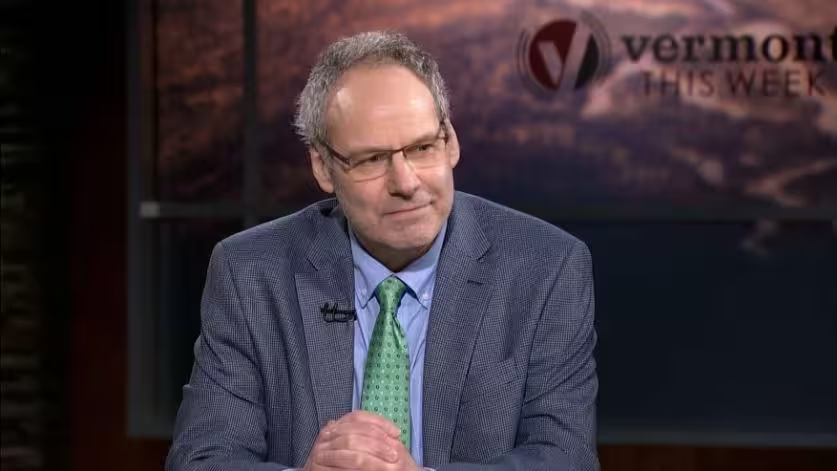
House Speaker Jill Krowinski will not seek reelection | Education reform | Lawmakers send data privacy bill to Governor Scott | Moderator - Mitch Wertlieb; Peter Hirschfeld - Vermont Public; Mark Johnson - WCAX; Ethan Weinstein - VTDigger.
Problems playing video? | Closed Captioning Feedback
Problems playing video? | Closed Captioning Feedback
Vermont This Week is a local public television program presented by Vermont Public
Sponsored in part by Lintilhac Foundation and Milne Travel.
Support provided by:


Vermont This Week
May 29, 2026
5/29/2026 | 26m 46sVideo has Closed Captions
House Speaker Jill Krowinski will not seek reelection | Education reform | Lawmakers send data privacy bill to Governor Scott | Moderator - Mitch Wertlieb; Peter Hirschfeld - Vermont Public; Mark Johnson - WCAX; Ethan Weinstein - VTDigger.
Problems playing video? | Closed Captioning Feedback
Where to Watch Vermont This Week
Vermont This Week is available to stream on pbs.org and the PBS app.
Support the crew
Help Mitch keep the conversations going as a member of Vermont Public. Join us today and support independent journalism.Providing Support for PBS.org
Learn Moreabout PBS online sponsorshipAs the legislative session winds down and election season heats up.
House Speaker John Krasinski announces she will not seek reelection.
The next group of leaders in this building will do a great job continuing on with this work.
I would not be leaving if I didn't think that we had the right people in the right places to do this work.
Plus, efforts to reform the state's education system near the finish line and a bill aimed at protecting Vermonters data privacy.
Heads to the governor.
All that and more ahead on Vermont this week.
From the Vermont Public Studio in Winooski.
This is Vermont this week, made possible in part by the Lintilhac Foundation and Millne Travel.
Here's moderator Mitch Wertlieb.
Thanks so much for joining us.
I'm Mitch Wertlieb.
It's Friday, May 29th and with us on the panel today, we have Mark Johnson from WCAX and joining us remotely, Peter Hirschfeld from Vermont Public and Ethan Weinstein from VTDigger.
Thank you all so much for being here.
It's an exciting show today because this may be the end of the legislative session.
We don't know if it's going to wrap up today.
By the time we're going to tape, some things are still moving.
Some things are in motion.
We can let you know that the Senate has passed out the education reform bill.
The House will take a look.
Now, we're going to get to that in just a moment.
But first, starting off at the top here, everybody, people, start with you.
This is some big news.
House Speaker John Krasinski announces you will not be seeking reelection.
Did she say why?
And what is the impact of this?
Well, the impact is to be determined.
I mean, this sets up of a ripple effect that we won't fully understand until the new legislature reconvenes next year and makes it to new leader.
But Senate President Pro Tem Phil Berreth announced in February that he is not seeking reelection, so that chamber is losing its leader.
And we found out yesterday that Joe Krinsky also will be stepping down.
She's held this really close to the vest.
There were a lot of people in Montpelier that were surprised by this, but she said, she's been in leadership for ten years now.
She was House Majority leader before she served as speaker.
And, a bit of a leadership vacuum in Montpelier, to say the least.
Yeah, it's going to be so interesting, you know, and all of this turnover that has happened.
Mark Johnson, you've seen this happen now in the last few years.
We had that big Republican sweep come in because of, the property tax issues there.
Seems like there's a real shifting going on here politically.
You know, and going back to Joe Krinsky.
You know, I find it fascinating that here we are, we're leading off with that is the story when the governor is announcing that he's going to seek reelection.
And I think that indicates just what a surprise this was.
I know that the representative was actively last week recruiting people for open seats.
And, you know, I have no inside information on this, but what I'm guessing is that, you know, just the grind of serving in Montpelier these days, the, you know, the in the country, the rhetoric, the vitriol is so much higher than it's ever been.
And the other reality and I know Phil spoke about this too, in terms of, deciding to step down from the Senate.
You know, being the House speaker and being the president of the Senate is a full time job.
It isn't a January to May job, and you're really pretty much working year round.
And again, you know, it's a it's a grinding job.
You sort of almost never win.
And yeah I mean it, but it, it also, you know, it takes you a little bit of time if you're the next speaker to get your legs under you to sort of form the coalitions that you need to.
So next year is really going to be going to be quite a year.
Ethan Weinstein, you heard, Peters saying that, you know, this is something that Joker whiskey kept close to her.
She hadn't, I guess, let this, out of the bag, so to speak.
What was the reaction among lawmakers to this?
Was there, general?
Amount of surprise here?
I think there was surprise.
You know, I was in the in the room when she announced to her colleagues that she wouldn't be seeking reelection.
And there were gasps.
There were tears.
You people, she's been in this role for a long time.
And and her colleagues form close relationships with her.
But as Mark was saying, I think it's hard to overstate just how, complex a position it is.
She's not just shaping policy in the House, but in a lot of ways, she's sort of serving as the human resources leader in this organization of 150 people with a lot of complex personalities, you know, competing political interests.
And, it's clear that that just took a toll after all this time.
It's going to be fascinating to see, you know, who goes for this role next.
I mean, are we going to start speculating on that now?
Mark Johnson Well.
I you know, these guys are much more in the building than I am to to give you some idea about who is in the leadership positions on that.
But I just want to go back and mentioned two.
And again, I don't know if this played into the decision, but you know, Joe Krinsky was the subject of a person who was a stalker and, you know, that kind of thing.
I just can't believe that there isn't going to be some sort of a factor in this.
But as far as who's next, you're going to have to ask, as these guys, as we sit here alone by ourselves.
I am going to ask these guys, what do you think?
Is there any is there any scuttlebutt there in Montpelier or already about this position?
I know this just happened.
It's breaking news, but still.
Yeah, of course.
I mean, that's that's all that I that's the first thing that happens when a speaker or a pro tem steps down.
Who's going to fill their shoes?
Andrew Perch, Lake, Washington County senator, who is the chair of the Senate Appropriations Committee, is someone that a lot of people think is in line to be the next pro tem in the Senate.
He's made clear that it's a it's a role he wants to serve in.
And he has been courting both Democratic and Republican votes for that election, later this year.
And in the House, Brattleboro Representative Emily Kornheiser, the Democratic chair of the Ways and Means Committee, who has been a real pivotal player in these 11th hour negotiations that we've seen going on over education over some of the more controversial tax provisions.
Has indicated that she might be interested in the job.
House Majority Leader Laurie Houghton is another name that people are throwing around.
When I asked her about whether she might be interested, she said that she's still focused on wrapping up here at the end of the session.
But but likely to be contested races in both chambers.
And certainly there's going to be a lot at stake in those elections.
It's going to.
Be so interesting to see.
And, you know, Mark Johnson, you were talking about the the difficulty of this job even here in Vermont, which, you know, sometimes we think we're in a little bit of a bubble, the national mood.
Terrible.
All of that, that can weigh on you.
I was wondering, maybe you were too.
I was pretty sure Governor Phil Scott was going to run for reelection, but he kept it.
He kind of held that decision up to the last minute.
Here's what he had to say about why he has decided to run again.
It's not easy work.
It weighs on you and, but at the end of the day, I feel a responsibility to to stick this out.
Mark Johnson, any doubt in your mind that, Governor Scott was going as well?
Yeah.
When Pete was nice enough to take me out to breakfast about a month ago, I thought I had been pretty convinced that I had a good argument about why Phil Scott wouldn't run again.
You know, again, just the the daily grind of the job.
You want to always leave when you're popular.
And I thought there was a pretty good possibility that he would say, you know what?
I'm done.
You know, but when the education bill compromise came through, which was really, I would say, politely complete capitulation, that there would not be any sort of a mandatory school closures.
I thought to myself, well, he is going to run again because he doesn't want to completely alienate all the rural communities, and that if he wasn't going to run, he was going to keep these lawmakers there until the middle of July and make them sweat it out until they agreed with them.
So and also, you know, I also spoke with my, my much smarter half, my wife, who said, you know, Phil Scott's a man of service.
And he, I think, sees himself as the best defense against the excesses of the Trump administration, which I'm sure will be his his number one argument when he runs for reelection.
I do want to ask you in a moment about, one of his potential challengers that you spoke with recently and as you knew but, Ethan and Ethan, let me start with you first.
You know, just what was your as a statehouse reporter?
Were you surprised that Governor Scott, decided to come back into the fold here to run again?
I was not surprised.
Ultimately, if you had asked me, you know, six weeks ago, a couple of months ago, it did seem possible that he might not seek this sixth term.
But at the end of the day, you know, Mark described the governor as, a defender against the excesses of the Trump administration.
I think he might also described himself as the defender against the excesses of a democratically controlled legislature, and their inclinations to, you know, do things like raise taxes on the wealthy or perhaps put forward a school reform package that, was not as ambitious as his initial ideas, though those ideas are not, you know, fully coming to fruition.
He's just legislated, or he's just, you know, been in control of the governor's office during this two year term when, Republicans have made gains in the House and Senate.
And I think, in large part they've they've wielded that power somewhat successfully.
And so if I'm the governor, I'm seeing, you know, these next two years, these could be pivotal.
We might be able to, get a lot done that he wasn't necessarily able to get done in those first few terms.
Well, Pete Hirschfeld, it's so interesting because one of the governor's biggest headaches and one of the things that he seemed to be frustrated with was this process over the education reform bill.
And, you know, Mark Johnson talked about the compromise that was reached where there won't be these mandatory mergers as part of the bill.
But the Ed bill has now moved out of the Senate.
What can you tell us about where that bill is now and what its chances of passing, getting out of the House are.
High likelihood that it passes the house.
And a high likelihood it passes the house precisely because it does not include the thing that Phil Scott had insisted it include up until a week ago, which is forced school district mergers.
Phil Scott retreated from that position.
I think he came to terms with the fact that the House and Senate were not going to be moved off of their opposition to mandatory consolidation, but what this bill does have, so so, you know, lawmakers from the governor, are going to tell school districts how or whether to merge, but they say they are going to tell schools how much money they can spend.
And that's because of what's known as the foundation formula, which is a really key provision in the legislation that would see Montpelier take control of the school budgeting process away from local boards.
Each school would get an annual grant based on the number and needs of its students.
Crucially, it's important to note that that foundation formula does not happen just because this bill passes.
There's a contingency in there that requires a future legislature to hold an affirmative vote to move forward with that foundation formula.
And I think that does figure into Phil Scott's thinking about coming back for two more years.
If you thought he had to put pressure on lawmakers to move forward with forced mergers, the foundation formula is going to make that dynamic.
It's going to put that on steroids.
This is going to be an incredibly difficult political decision for a lot of lawmakers to make that foundation formula would lead to significant funding cuts and a lot of school districts, it would lead to significant tax increases, potentially in other districts.
So this is by no means a fait accompli.
And they have as much or more work ahead of them on education reform than, than is behind them.
I mean, that does seem like it's going to be the major sticking point about, you know, which schools can spend and how much.
Ethan Weinstein, what are some of the concerns you're hearing about with the Ed bill here?
I mean, it feels a little bit like deja vu to this time last year.
You know, it's two years in a row where lawmakers and the governor are litigating these same issues of, when should a new education funding formula go into effect?
How are we going to consider school district mergers?
What should the governance of these larger districts look like?
I mean, we're going to be having these same fights for for years to come because, this reform package that, you know, the legislature is likely to vote out today and the governor is likely to sign, it, it charts a path that goes down the road, you know, two, three, four years.
And, it seems like if, if, the past is, is the future that, we're just going to have to negotiate it all again every single year.
I mean, is this getting us any closer?
Sorry.
You were going to say something.
For this as they did last year.
They are this year punting on the most difficult questions related to education reform and saying, we have these great ideas about what we want the education system to look like, but leaving it to a future General Assembly to actually pull the trigger on making it happen.
But what effect is this foundation formerly going to have on property tax, property taxes?
Because that's what this is ultimately all about, right?
Trying to bring those rates down.
Yeah.
We don't know yet because we don't have modeling and that won't be available to December.
That tells us what exactly the foundation formula is going to be.
They have to figure out how that formula is going to account for a more equitable, universal pre-kindergarten system, how it's going to fund special education, huge, outstanding questions about what sort of aid is going to be available from school for school construction, and where that money is going to come from.
There are no reliable spreadsheets that anybody can look at to say, here's how much the education system will cost under the foundation formula versus how much it costs.
Now, there's just an optimism that, by telling schools, here's how much you have to spend.
And then by, hitting that annual to annual, increases that are, you know, based on something akin to the rate of inflation that that will result in the, spending checks that I think everybody agrees need to be on education spending.
You know, two, two things really struck me about this, too, in addition to the pushback on the reforms to act.
250, you know, you're now seeing this muscle and strength coming out of rural communities saying, no, we're not going to do it this way.
I mean, you know, it shouldn't it?
County is a totally different breed of cat.
But, you know, when you've got these forced mergers that were being talked about, people were saying, you know, this is the heartbeat of our community.
And I think the same thing was happening with these changes to act 250 and, you know, I just sort of find it fascinating that and other people have said this too, that, you know, there was this commission that was set up and, you know, we here commission and study committee and you're kind of your your eyes glaze over.
But there was a committee that was set up about a year and a half ago with some very thoughtful people who are really studying this.
And you've really got to wonder whether or not the legislature is the place to be trying to do this.
It's a little bit like trying to repair the airplane while you're flying it, and you had this group of people that were really trying to think through.
This is an incredibly complicated process to think through.
And, you know, I just, you can't roll back the clock and do time over again.
But wow.
This just does seem a little bit like, just repeat over and over.
Yeah, I mean, it sounds like they're trying to get get out of town right now.
Ethan Weinstein, does that sound about right what Mark is saying here?
Like, let's get this done now.
But as you were saying before, we're going to be dealing with these same issues again next year.
That's right.
I guess the you know, here's what we can say, assuming that this, education reform bill does pass, as most expect, we will see that this fall there will be groups stood up of, neighboring school districts that are forced to have conversations with each other about whether or not to merge.
They're not forced to merge, but they at least have to get at the table, and they have to act in good faith.
Those conversations will stretch on for more than a year, you know, assuming that, this whole plan isn't blown up by next year's legislature.
The plan is for districts to vote on potential mergers in 2028.
So while we can't say what the property tax implications are given the bill under consideration, we do know that, there's going to be pressure on these districts to consider merging, but that's just the first piece of the puzzle.
Yeah.
You would think, is given all the attention we've paid over the last months, weeks, talking about education reform, that that might have been the only thing going on in Montpelier.
It was not.
Lawmakers have sent a data privacy bill, to the governor's desk.
Mark Johnson, this limits what, data can be collected, I believe.
And there's some issues about transparency here.
There's a statement, that was issued on this data privacy bill, and it says this legislation limits what data can be collected.
It requires full transparency with consumers about how that data is used, increases protection for sensitive information and bans on manipulative data practices, designed to exploit consumers.
Most importantly, it gives Vermonters a real tool to fight, back and the right to cou, to to correct their data, opt out of collection, obtain a personal copy and know exactly which third parties have received their data.
So there's a lot going on there.
They sound like they're they're pretty proud of this particular bill.
Yeah.
And not to be a negative Nelly on this.
So I went to a presentation that Representative Monique Pressley did, who's really been one of the main people on this.
And, you know, I got back to my car at the end of it.
And, I mean, I was it scared me to death.
I mean, the amount of information that is out there that is being collected, that is being brokered and that, you know, and part of it is our own fault.
I mean, every time you go into, you know, a pharmacy and get a bonus card, I mean, you're just giving away all sorts of information.
You know, you go on the internet, you go on social media, you're giving it to.
Now, I think what this bill doesn't have, and correct me if I'm wrong, is that one of the big hang up some previous privacy laws that the governor had an objection to is the idea that we, as consumers, could, sue these companies that are collecting this data or acting improperly, and, you know, it is it is just alarming how much money is, is being transacted in terms of the buying and selling of these lists.
I mean, we all know we're getting stuff in the mail and you say, well, how did this happen?
And, you know, part of it is our own fault.
And part of it is people that are just scraping the internet for all of this information.
Mark is right.
This bill does not have a private right of action, which would allow any one of us to sue Meta or Google or Facebook if they, mis collect and misuse our data in ways that might harm us.
But there are a number of other provisions in this bill that data privacy hawks think fall well short of what is needed.
And Monique Priestley, who's been sort of spearheading the data privacy conversation in Montpelier, voted against this bill.
I was talking to somebody from Consumer Reports, a couple of weeks ago.
Who called the version of the bill that is going to make its way to the governor's desk, an industry backed bill that and that Vermont would be better off passing nothing.
That this is the illusion of protection for consumers, that it doesn't come close to, to, putting the sorts of guardrails that we need on large data brokers and other big tech companies.
So do not confuse the passage of this data privacy bill as a data privacy win for Vermont, at least in the eyes of the people you know, the most hardcore data privacy watchdogs out there.
Well, and one of the real weaknesses of this, and correct me if I'm wrong, is that, you know, if you want to opt out of all of these places that are giving away your information, I mean, you have to do it individually step by step by step.
Oh, they make it hard.
Yeah.
And I mean, you've got a it's like, you know, a hand chipping away at a problem.
And what I've been told is that the number one thing we should all be doing is going in and putting a lock on your credit score.
So the people I mean, one of the big concerns about all this data is identity theft.
When you have somebody going in and somehow managing to take out a loan in your name.
So the first thing you should do is put a sort of a double check on your credit score so that people aren't, you know, basically defrauding you.
Well, even if there are weaknesses in this bill, unless the governor has more objections to it, it looks like it's going to it's going to fly because the Senate passed it 29 to nothing back in March.
The House passed it this week, 129 to 3.
So for money, you can tell this is going to go through.
Right.
The governor signs it.
Yeah.
This is, you know, the governor, either last year or the year before, I can't recall which vetoed a data privacy bill.
Because he felt like it went too far, created novel provisions, and for what would have been, you know, on the bleeding edge of data privacy protections.
But but this is the sort of bill that the governor said he could get behind because it doesn't do anything that any other state isn't already doing.
So I would anticipate him signing it into law.
Okay.
Yeah.
The industry was very much watching this because the last thing they want is a strong bill coming out of Vermont, which then gets replicated and bottled across the country.
Peters representative from Google in the negotiate literally in the negotiations.
Well, all right, well, let me stick with you because UVM got some good news, in that they wanted $12 million in state funding for their new athletic complex.
This is going to be a big 5000 seat arena to replace some older buildings.
And this passed because there was some found money.
What can you tell us about this?
Yeah.
That's right.
Previously, both the Senate and the governor were behind giving the University of Vermont $12 million, from what's called the Higher Education Trust Fund.
And this is a pool of money that's used to subsidize tuition for low income Vermont students that are attending UVM or state colleges.
House lawmakers did not like that idea.
One bit.
They thought it was crazy to take scholarship money away from kids so that UVM could build a state of the art, 5000 seat athletic and entertainment venue.
But surprise, surprise, a few weeks ago, State Treasurer Mike paycheck said, hey, we've got this unclaimed property division, abandoned assets that have been left for years and years, go into the general fund.
And the legislature is going to be getting $10 million more from that fund than they originally anticipated.
That will now become the money that provides the lion's share of this funding for UVM House lawmakers.
That feels a little less icky to them than it is coming from scholarships.
And so they have signed off on that somewhat reluctantly.
I'll tell you, I know there are a lot of House lawmakers who think that money could be spent in much more productive ways, but UVM is getting their money, and.
There are a lot of people at UVM who say, well, why don't we spend this on, you know, reach research studies and, you know, this whole thing with these athletic, buildings and such, it's really become like this arms race across the country where you've got to build one because the other universities building one, and the kids might go there.
And the bigger issue is that, you know, the the enrollment at UVM is decline is declining.
And there's this gap of, of kids.
And that's, that's really where the money is.
Yeah.
I mean, it's going to be really it's keeping up with the Joneses as you're describing it when it comes to these athletic complexes.
And that's kind of the world we live in.
I got to ask you guys, now that, you know, hopefully you'll be able to go home, Pete and Ethan today, putting in the extra hours there.
What are your takeaways from this, long extra session?
We've got about 30s here.
Pete, let's start with you.
You know, if it feels like this was a session defined by brinkmanship, but but it might be remembered for diplomacy.
I mean, the coming the meeting of the minds that we've seen over the last week, has been so jarring compared to the impasse that we've been at previous to that.
So, so that's that's what sticks out to me right now.
Keep in mind some.
I think we've talked about a couple of, you know, this is going to be remembered as the session when both the House leader and the Senate leader decided to step down.
And it could be a turning point for rural, rural Vermont, which saw a couple of big policy wins, both in terms of education and, act.
250.
So grateful for all the reporting you've done for us at the state House and right here in Vermont this week.
Thank you both.
And that does it for our show this week.
Thank you so much to our panel.
Mark Johnson from Wcax joining us remotely for from Montpelier, Peter Hirschfeld from Vermont Public and Ethan Weinstein from Vtdigger.
I'm Mitch Wertlieb.
Thank you so much for watching.
Join us next week for Vermont This Week.
 New Episode
- News and Public Affairs

Top journalists deliver compelling original analysis of the hour's headlines.

- News and Public Affairs

FRONTLINE is investigative journalism that questions, explains and changes our world.




 New Episode
 New Episode



 New Episode
Support for PBS provided by:
Vermont This Week is a local public television program presented by Vermont Public
Sponsored in part by Lintilhac Foundation and Milne Travel.