Vermont This Week
March 6, 2026
3/6/2026 | 25mVideo has Closed Captions
Town Meeting Day results
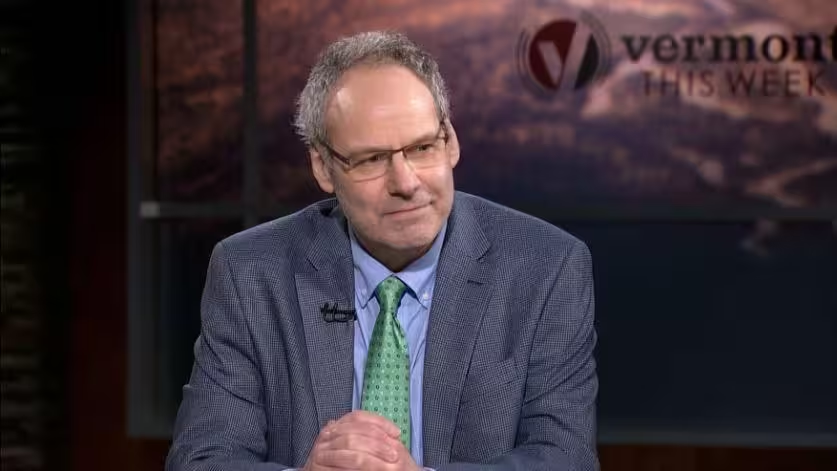
Town Meeting Day results | Moderator - Mikaela Lefrak; April McCullum - Vermont Public; Aaron Calvin - Seven Days; Lisa Scagliotti - Waterbury Roundabout.
Problems playing video? | Closed Captioning Feedback
Problems playing video? | Closed Captioning Feedback
Vermont This Week is a local public television program presented by Vermont Public
Sponsored in part by Lintilhac Foundation and Milne Travel.
Support provided by:


Vermont This Week
March 6, 2026
3/6/2026 | 25mVideo has Closed Captions
Town Meeting Day results | Moderator - Mikaela Lefrak; April McCullum - Vermont Public; Aaron Calvin - Seven Days; Lisa Scagliotti - Waterbury Roundabout.
Problems playing video? | Closed Captioning Feedback
How to Watch Vermont This Week
Vermont This Week is available to stream on pbs.org and the free PBS App, available on iPhone, Apple TV, Android TV, Android smartphones, Amazon Fire TV, Amazon Fire Tablet, Roku, Samsung Smart TV, and Vizio.
Support the crew
Help Mitch keep the conversations going as a member of Vermont Public. Join us today and support independent journalism.Providing Support for PBS.org
Learn Moreabout PBS online sponsorshipTown Meeting Day brought communities across the state together this week for one of Vermont's most cherished traditions, policies and actions that are taken do impact you, and this is your chance to have a say in how they run.
We'll break down the results.
Plus, voters approve 82% of school budgets despite property tax implications.
What that could mean for the future of education reform.
All that and more ahead on Vermont This Week.
From the Vermont Public studio in Winooski.
This is Vermont This Week.
Made possible in part by the Lintilhac Foundation and Milne Travel.
Thank you so much for joining us.
I'm Mikaela Lefrak in for Mitch Wertlieb.
It is Friday, March 6th with us on the panel.
Today we have April McCullum from Vermont Public, Aaron Calvin from Seven Days and Lisa Scagliotti from the Waterbury Roundabout.
Thank you all so much for being here.
So Tuesday was town meeting day, and in many of Vermont's 247 municipalities, people came together to vote on everything from school budgets to select board members.
Now, some people, not me.
Some people might describe what's discussed on town meeting day as mundane, but we all know here that it is anything but.
Let's kick things off with school budgets.
April Vermont voters approved 82% of school budgets this year, but that number kind of masks.
I think some of the important town by town debates that were going on, especially as we have this statewide conversation about public education reform and school district consolidation.
What stood out to you about this year's school budget votes?
Yeah, so there were 19 budgets that were shot down by voters on Town meeting day.
And, you know, some significant, districts and some of the larger districts are in areas that are relatively conservative with spending historically.
And even then, a couple of them had a per pupil increase at or below inflation.
So that was really striking to see.
Even with that level of discipline, voters still were not willing to go for it.
And then there were a couple as well that were more high spenders at smaller districts, in the mix there.
But even those small districts, I was looking at Wethersfield, and that's one of the ones that voters shot down.
And even in their budget materials, they're saying we didn't add anything this year.
We can't cut any more without impacting student experience.
And the things that are driving those budgets, they say, are health care, special education, tuition, in that case, things that they don't have control over.
So I think there's a really still a lot of frustration among school boards and school leaders about that.
The the weird limbo that we're in as we wait for the legislature to figure out education reform and what that might look like.
Yeah.
And it's an issue both in, in smaller school districts and much larger ones, including in Burlington.
Erin, first of all, congrats, on becoming a city boy.
Now that from your Royal county, and then you get to get seven days, in Burlington, they pass the school budget.
Yes.
I think stand out to you about that.
Not not particularly just because it, you know, there was a 4.6% increase.
But and as seven days wrote about a couple weeks ago, enrollment is declining in Burlington.
But, you know, Burlington seems to have no problem sort of, approving their school budgets, annually.
A little bit of a change from rural Vermont where, you know, a lot of these school budgets are often up for debate.
You know, the governor didn't want to even vote for his local, school school budget.
So, a little bit of a change, but all are quiet and at least, on that front in Burlington.
Yeah.
And, Lisa, a year you've been focused on what's going on in Waterbury, which is part of the Harwood Unified Union School District.
What happened there?
The budget, Harwood's budget passed, which I think was a huge sigh of relief amongst the the school leaders.
The, experience a couple of years ago, wasn't the same.
I, we took three votes in two years ago to pass the budget in our district.
But it passed with flying colors.
It was like 60%.
But what April says is true.
You know, I think one of the hardest messages, for the school, the school board's administrators to sort of convey to the public is how they're building these budgets.
And they have such a narrow amount of wiggle room in terms of what they can change and what they can cut to make a difference, to move the needle on the, the cost.
And essentially it ends up meaning that they can plan to do exactly the same things that they're doing this year, next year.
But the budget's going to go up because that costs more.
And in our district, that's exactly what happened.
And they still cut $1 million, from what's happening this year for next year's budget.
But it's still went up 5.4%.
Health care premiums for the staff, special ed, all of those things.
Transportation.
And they consolidated some preschool classes is how they're going to allocations, how they're going to try to save a little bit of money.
But yeah, it's it's a real balancing act.
And they're not adding anything, even though it feels like it's getting more expensive.
There's nothing new.
In those budgets.
Yeah.
Well, speaking of consolidation, there were two towns that voted to close their small schools.
That'd be Marlboro in Windham County and Red Sparrow in Bennington County.
Those of you who follow education reform might know about act 73, which passed last year.
And it includes things like class size minimums and a mandate for state legislators to come up with a new consolidated school district map.
And this could lead to the closure of small schools.
And it seems like some, districts are maybe trying to get ahead of that.
These two schools that are going to close at the end of the school year, both have fewer than 50 kids.
Their enrollment projections for the future were very low.
And April, I thought it was really interesting that these votes were both mandates.
Marlboro voted 311 to 65 to close their school, read to 232 to 36.
And then this story very different from what's going on in the Mountain Views School District in Windsor County, where they voted to fund a new middle and high school building.
Could you.
Well, first, actually, let's let's play a clip.
I think we have, school leaders talking about how they've needed these new facilities for quite some time.
We've continued to invest in the building that's failing, and they're seeing their tax dollars going into a failed building.
We are towns who spend, send more dollars than we use to support education, and we really want to see that support coming back to this high school that serves so many communities.
I think it sends a signal to Montpelier that it's time to step up and help us invest in our community.
Now, the last person you saw there was Benjamin Brickner, who's the chair of the Pomfret Select Board.
That's one of the seven towns that was voting on this issue.
April, what was the result?
Yeah, this was a redemption from two years ago.
Voters in that district had voted down a similar or not quite the same bond for this new high school, middle school, high school.
And then this time, it was a pretty strong vote in favor.
And there are some caveats in the way that it was phrased on the ballot that allowed some, I think, reassurance to voters.
One is that they raised a certain amount by outside funding, including donations and grants and things like that, and then also that the state changes the way it counts for capital bonds in their excess spending threshold penalty for tax, where you get double taxed.
As doubtful that this will only go forward if the legislature changes the way they're counting that that bond payment under the tax formula.
So they're it's not a done deal.
And I think it'll be really interesting to see how the legislature now goes from here as they continue to work on tax 73 regionalization.
This might be one of the regional high schools, potentially depending on how the map ends up going.
But then is it will the legislature actually fund the school construction aid program?
Will they, loosen up this, this tax penalty to to allow this to go ahead?
Lisa, you're getting riled up over here about this.
What do you think?
It's a that's fascinating, as would be really interesting to see what happens there, because this whole school construction thing is a big deal.
Yeah.
And right now, the state has not funded school construction projects since 2007.
When the recession hit, they quit, helping with school construction projects.
And the districts have been on their own to shoulder that.
And as a result, there's, like, billions of dollars.
Billions.
It was close to a billion, I think, of, unfunded maintenance, deferred maintenance projects and expansions and just upkeep, getting schools up to code, etc.. Our school board, and Harwood District just recently had their state senators for a visit and sent a letter to all of the lawmakers on the education committees, the money committees, to say, please change this in the formula to either help us with construction, aid from the state or don't penalize us if we go to do this ourselves or we have a bond, because then the debt that we're taking on to be able to do these building projects counts in our per pupil cost for education, and then they get a penalty.
So they're like either it's it's like a double whammy for them.
So like either you're not helping us, but then if we do it ourselves we're getting penalized.
So something needs to change here.
Yeah.
There is testimony being taken right now in the legislature on a bill that would, start.
They're trying to figure out an amount, to actually start that, money flow again as far as construction goes.
But as we know, everything about is tight right now.
So it's probably not going to be very much fundraising.
That's wild.
Yeah.
Well, Erin, on your new beat, Burlington's in the midst of building itself a very large new high school.
As I understand it, though, I found this quite interesting.
That high school that they're building is, for it can fit more kids than, Burlington currently has enrolled right now by by 1 or 200 kids.
So that that declining enrollment issue kind of touches so much of this conversation around.
Yeah, it's an issue across the state, right?
All districts are trying to to grapple with with this.
And, I don't think it's an issue that's going to go away, but you sort of have a, a tough problem to tackle here, because if, you know, there are some people who are proponents of, you know, taking the realistic path, quote unquote, to, try to adjust to what they presume will be, a terminal decline in enrollment.
While others say, you know, closing, accepting that, closing schools, taking away things like this, will only, you know, sort of perpetuate that issue and basically make it a foregone conclusion that student enrollment will be in perpetual decline into the future.
Yeah.
Let me share some other interesting results from town meeting day around the state, there were five different towns and cities that were voting on new measures.
This town meeting day in Winooski, Thomas Renner was elected as the city's mayor in an uncontested race.
And according to his campaign, he has become Vermont's first black mayor.
In Rutland City, Tom Donahue won an rather unconventional mayoral race.
The whole race was a right in due to the timing of the of the previous mayor's resignation.
I said this on Vermont Edition earlier this week when I was talking to our colleague Howard Waste his, April about results.
But one of my favorite things about Town meeting day is that, about once a year, we start using all of these words and phrases that we can never say the rest of the year.
You hear the phrase Australian ballot, a ballot, a million times, local option taxes are another thing that we suddenly talk a ton about, that you can never talk about it again.
And then you bring them up and they become a big thing.
Let's talk about them now for a minute.
A lot of towns were voting on local option taxes.
What are they?
They are an extra tax that, municipality can tack on to an existing statewide tax.
Like the sales tax.
Rooms and meals, alcohol.
Am I missing one here?
That's.
I think that's it.
So they can choose which of those they want to tack on to, and then they get to keep the bulk of the revenue, for the, for for local projects and, and.
Yeah.
And the legislature made it easier to pass these a couple of years ago.
And so we've seen now a couple of years where there's pretty significant number of municipalities voting on these.
And, yeah.
And there was a mixed bag this year.
Yeah.
Majority of them that were on the ballot or up for discussion did pass.
But then there were a couple like in Castleton in particular, where people were like, nope, it's not, it's another tax.
You know, you can you can frame it however you want and maybe it's not the property tax, but it's it's still another tax.
And people were cautious about it there.
But it can give towns a little bit more breathing room with with their budgets.
Yeah.
And on the the opposite end of the spectrum from Castleton which voted down and a local option tax.
Aaron, I saw that in Stowe.
They increased their existing one.
Yeah, yeah.
I mean, Stowe historically has this sort of issue with being, a very wealthy tourist town that sends a lot of money to Montpelier.
So they are always looking for ways to try to keep their wealth within town borders.
So to speak.
And so voters did approve a, the raising of the local option tax to 2%, unlike other towns that adopted a 1% local option tax, the first time this year that's going to need legislative approval for the charter change for that.
And so we'll wait to see how that goes.
But, I know that town leaders were enthusiastic about that.
And in Morristown, just north of there, I saw that my my former colleagues who did an excellent job covering town meeting Dave for the news and citizen and still reporter, wrote about how, Morristown, went with all three of the 1% local option taxes and Cambridge, just north of Stowe is, is also considering it.
That wasn't on the ballot this year, but I think you see more of these towns trying to take advantage of this and looking for ways to diversify their revenue streams, because as you're talking about Lisa, things, you can just sit still and things continue to get more expensive at the municipal level at the school level, all driven up by these health care costs, by these benefit costs usually.
So towns are, you know, trying to sell voters on this idea that you know, do you want us to continue to raise municipal taxes or do you want us to try to, you know, sort of diversify how we bring in revenue?
Hey, Lisa, are there any new local option taxes in Waterbury or the surrounding area?
Waterbury is now had a local option tax since 2024.
And that's totally right, because we hear our leaders in our town talk about how they are, even though that the municipal part of people's tax bills is the smallest portion of the school taxes the lion's share of anybody's tax bill, they're really mindful of that because they don't want to raise the municipal tax, knowing that the school taxes are going up.
So they're really trying to figure out, like, how do we build a town budget without trying to add on to that?
Because we know that the school budget is like this train coming down the tracks, and we don't want to add to that.
And so Waterbury put its, local option tax into effect in 2024.
It's been a year and a half now.
They estimated it was going to be about $650,000 a year.
But last year they got, over $900,000.
And so that's been exactly that kind of a new revenue stream.
So they're are using, they put it on the article for, town meeting on Tuesday.
They pulled it out separately.
So the people at town meeting were able to talk about and look at the list of how they're using that money.
They came up with four different categories that they would use it for.
And they're reducing debt by paying payments for, unlike fire trucks and a public works truck, they're spending it on gravel roads and sidewalks.
A new filtration, system for the town pool.
So these are all things that would be on the To-Do list that they would have had to pick and choose between them otherwise.
But there's, like this extra pot of money, that they're able to dip into and not increase the tax rate along the way.
Well, there is this there's 2% local option tax in Stowe.
If it gets approved, the legislature could bring it up to 3 to 6 million a year, which would account for about a third of their their municipal budget.
Now.
And a number of other towns voted to use some of their funds to bolster defenses against natural disasters like flooding.
April, you we're keeping track of some of these votes for Vermont public.
What?
What did you learn?
Yeah, we tracked five.
I mean, there might be more, depending on how they phrase it, but municipalities that voted, to put some money aside in case of, as we know, is coming more flooding or other similar disasters.
Partly because FEMA is not necessarily the most reliable.
We just saw the denial of, disaster, declaration for the Northeast Kingdom.
And also even if FEMA aid is coming through, there might be a lag.
And so then while you're waiting for it, you have to take on debt.
So having a little bit of money set aside can really help.
And some of these, towns are using their local option tax revenue for that purpose.
And so there's there you go.
That synergy between those two things.
Yeah, totally.
Lisa.
Yeah.
Whatever.
The project.
Yeah.
Yeah.
So one of the other items on our list was, $14,000 to go into a newly created natural disaster preparedness fund, and they're a big part of that is going to be to buy a trailer, to put supplies in that will be in a garage that's on high ground.
And so if not if, but when the next flood comes, they will have they want to be able to outfit it with supplies that they're going to need, like in the immediate response.
So that would be the stuff that they need.
As soon as, you know, the water starts to go down and they need to start mucking things out, etc.. And so it's not a lot of money, but they'll be hoping, you know, to put that in there.
So they have that for just that purpose, you know, so they have, you know, culverts washed out or whatever.
So they may be able to dip into this for some of those expenses right in the moment.
When, when the next flood happens.
Because we, we know it'll come eventually.
Yeah.
Well, that's an example of one of the, the town meeting day trends that we saw this year when a bunch of different towns are voting on some something rather similar in the same bucket.
And then every town meeting day, it always seems like there's a couple towns that have a vote that just is is their own thing.
It's only happening there.
And what example of that this year is in Brattleboro, where voters decided to get rid of their representative town meeting day.
For the past 65 years, they've elected 150 delegates to vote on Town meeting Day.
And now the legislature is going to have to decide whether Brattleboro is going to go to a traditional town meeting or Australian ballot, because voters approved both alternatives.
So we'll see.
We'll see what happens there.
And some, to go back to the the trends though, April, some communities were broaching larger national and international issues on their town meeting day ballots.
Could you could you talk us through some of those?
Yeah.
There's a long tradition of doing this in Vermont.
Yeah.
Commenting on on national and international issues.
There were several that were denouncing actions of the Trump administration or Ice, supporting Vermont's, resistance to handing over voter data, for example.
And then commenting on the situation in the Middle East, these so-called anti-apartheid, resolutions that we've seen now for at least two years, I think.
Yeah.
Commenting on on Israel and Palestine.
So, yeah, it's it's a chance for people to, to share their thoughts.
And, a lot of times it can be really contentious in the especially for an in-person meeting, and people can, debate it live.
Yeah.
Aaron, you've been following the city council in Burlington now, and some of these issues, brought in some of that contention that April's talking about.
Yeah, right.
Yeah.
It was a relatively quiet, town meeting day for Burlington.
Only two contested races in the entire city.
But a particularly contentious one in Ward eight, in Burlington, which is kind of a unique little pocket where that's mostly UVM students, is mostly contiguous.
The area around UVM.
So it's students and young professionals, and it sees, you know, citywide low turnout rate consistently year to year.
And again, the Democrats on the Burlington City Council blocked a partite free community pledge for the third year in a row, drawing the ire of the progressives on the council, which are in the minority right now.
And, and the the students that, you know, particularly who have been advocating for this for, for years and can't even get it to a citywide vote like in Montpelier, even though they keep voting it down.
So, you know, you saw a lot of sort of mudslinging in Ward eight, and a lot of it didn't even mention Palestine explicitly.
But the subtext throughout the whole thing was that there was this push to stop, the Democrats who had an opportunity to, increase their majority on the council to a, supermajority that would be able to override a mayoral veto.
And they failed to do that, leaving the council, once again, seven Democrats to, to five progressives.
So this is going to continue to be an issue.
And, I think it's, you know, even three years into this conflict, there's a lot of, passionate, you know, thoughts on either side.
Yeah.
Well, while we're discussing news related to the Middle East or to acknowledge the big international news of the week, this past weekend, U.S.
and Israeli forces, attacked Iran and killed the country's supreme leader.
And since then, the U.S.
has ramped up its presence in the Middle East, ramped up its campaign.
And the Vermont National Guard has been deployed as part of the war effort.
Let's learn a little bit more.
In the case of the Vermont Air National Guard and the 158th Fighter Wing, they were mobilized for Operation Absolute Resolve and then were tasked to take their F-35 base across the Atlantic instead of going home to be prepared to support this operation.
Aaron, you have been covering this deployment a bit for seven days.
What have you learned?
I mean, there's not much more to report than than what was said just there by General Keane.
We know that the Air National Guard was sent pretty much straight from, participating in the the Venezuela operation to the Middle East.
Other than that, they're keeping a pretty tight lid on things.
Obviously, the, three Vermont federal, congressional delegation, members have, you know, spoken out against the operation in Iran.
And as what they did in the operating in the Middle East or in Venezuela.
And, you know, that that's about all there is to report right now.
That's about all we know.
And there's also a bill in front of the legislature right now.
Relatedly, that would require the governor to review every order to place a unit of the Vermont National Guard in federal active duty status.
And then also to determine whether the order to deploy is in conformance with the requirements of the US Constitution.
So that's something that's up for debate right now in Montpelier.
Lastly, because I am sitting in for Mitch Wortley, I feel like I should throw in some sports news real quick just to Mitch, we miss you.
We're excited to see you next week.
And my bit of the sports report this week is that I want to give a little shout out to the University of Vermont women's basketball team, which won their first playoff game last night against Albany.
And they're going to be playing Umbc on Monday.
I'm very excited to cheer them on.
So yeah, let's go cats.
Yeah.
March Madness or you guys March Madness people.
Oh yeah, bring on the pulse.
All right.
Well, All right.
I think that is all the time that we have today that does it for Vermont this week.
Thank you so much to our panel.
April McCullum from Vermont Public, Aaron Calvin from Seven Days, and Lisa Scagliotti from the Waterbury Roundabout.
Thank you so much for watching.
And listening.
Mitch Wertlieb will be back next week and we will see you then.

- News and Public Affairs

Top journalists deliver compelling original analysis of the hour's headlines.

- News and Public Affairs

FRONTLINE is investigative journalism that questions, explains and changes our world.











Support for PBS provided by:
Vermont This Week is a local public television program presented by Vermont Public
Sponsored in part by Lintilhac Foundation and Milne Travel.