
Will Hezbollah abide by Israel-Lebanon ceasefire?
Clip: 4/16/2026 | 4m 45sVideo has Closed Captions
Why the Israeli and Lebanese governments accepted a ceasefire – and will Hezbollah abide?
For insights on the announced ceasefire by the U.S., Israel and Lebanon, Amna Nawaz spoke with author and journalist Kim Ghattas. Her recent book, "Black Wave," is about the rivalry between Saudi Arabia and Iran, and she is now a visiting professor at Dartmouth College.
Problems playing video? | Closed Captioning Feedback
Problems playing video? | Closed Captioning Feedback
Major corporate funding for the PBS News Hour is provided by BDO, BNSF, Consumer Cellular, American Cruise Lines, and Raymond James. Funding for the PBS NewsHour Weekend is provided by...
Will Hezbollah abide by Israel-Lebanon ceasefire?
Clip: 4/16/2026 | 4m 45sVideo has Closed Captions
For insights on the announced ceasefire by the U.S., Israel and Lebanon, Amna Nawaz spoke with author and journalist Kim Ghattas. Her recent book, "Black Wave," is about the rivalry between Saudi Arabia and Iran, and she is now a visiting professor at Dartmouth College.
Problems playing video? | Closed Captioning Feedback
How to Watch PBS News Hour
PBS News Hour is available to stream on pbs.org and the free PBS App, available on iPhone, Apple TV, Android TV, Android smartphones, Amazon Fire TV, Amazon Fire Tablet, Roku, Samsung Smart TV, LG TV, and Vizio.
Providing Support for PBS.org
Learn Moreabout PBS online sponsorshipAMNA NAWAZ: For insights on the announced cease-fire by the U.S., Israel and Lebanon, we turn now to author and journalist Kim Ghattas.
Her most recent book is "Black Wave," which is about the rivalry between Saudi Arabia and Iran.
She's now a visiting professor at Dartmouth College.
Kim, welcome back to the "News Hour."
Let's start with the Israeli government here.
We saw there Prime Minister Netanyahu was just on Lebanese territory days ago to visit Israeli troops.
It seems clear they intend to stay.
So why did he sign on to a cease-fire right now?
KIM GHATTAS, Dartmouth College: Benjamin Netanyahu and Israel generally signed on to a cease-fire because President Trump requested that they do so to give a chance to the U.S.-Iran negotiations that are unfolding.
As I like to say, beware of small nations.
As the U.S.
and Iran were entering those negotiations, Iran was threatening that it would not abide by a request for a cease-fire if the war continued in Lebanon, a small nation where much of this started 43 years ago with the Israeli invasion of Lebanon of 1982 and the creation and the birth of Hezbollah.
So Benjamin Netanyahu was under pressure to respond to President Trump's demand that there be a cease-fire so that the U.S.-Iran negotiations could proceed.
And that's what we're seeing unfold right now, and we will have to see whether they extend beyond the first 10 days that have been agreed.
AMNA NAWAZ: What about the thinking of the Lebanese government here?
Why would they accept this cease-fire?
KIM GHATTAS: Well, the Lebanese are exhausted.
This is their second war in a year-and-a-half waged by Hezbollah against Israel, but affecting all of Lebanon.
We saw a day of carnage in Beirut last year -- last week, forgive me, on Wednesday, 100 strikes in just 10 minutes across the country, including the capital, Beirut, which was devastating for a country the size of Connecticut.
And so Lebanon is not just accepting a cease-fire.
It was demanding a cease-fire.
And it had put already on the table several weeks ago a proposal to have direct negotiations with Israel to come to a cease-fire proposal, which at the time was rejected by Benjamin Netanyahu.
And President Trump wasn't that interested then, but he is interested now.
Lebanon has also conditions.
I mean, we're hearing President Trump saying that there could be a meeting soon between the Lebanese leader and the Israeli leader.
I don't see that happening, Amna, if the Israelis are still occupying parts of Lebanon and Benjamin Netanyahu is able to walk around the south of the country.
AMNA NAWAZ: Kim, perhaps one of the biggest questions is Hezbollah in all of this.
You saw part of the statement that they put out to us here at "PBS News Hour" saying any cease-fire has to be comprehensive across all Lebanese territory, must not allow what they call the Israeli enemy any freedom of movement.
Will Hezbollah abide by this cease-fire?
KIM GHATTAS: We will have to see.
For now, they will.
There is celebratory gunfire in Beirut in Hezbollah areas.
They claim this as their victory, that they forced the enemy into this cease-fire.
But what the Lebanese government is very keen to make clear is that it is the Lebanese government that will negotiate going forward.
And the Lebanese don't want to be included in an Iran negotiating track.
They want to assert their sovereignty and have their seat at the table, as controversial as it may be in Lebanon in the eyes of some that the Lebanese would be sitting down with Israelis, as we saw on Tuesdays.
It's the first time this happened since the 1980s, since 1983.
Lebanon has not had a seat at the table for regional negotiations while it was under Syrian occupation, And now as Iran tries to assert itself as the sort of patron of Lebanon.
Lebanon wants its own seat at the table.
It is going to be very difficult to manage this, especially as the agreement, as we have seen the statement put out by the State Department, really essentially is a return to the status quo ante before this latest eruption.
And it depends on how much the U.S.
can put pressure on Israel to make some concessions.
And it's going to depend on the diplomatic chops and the diplomatic ability of the Lebanese government and the Lebanese negotiator to move forward and also show that they can indeed prevent Hezbollah from striking Israel.
AMNA NAWAZ: That is author and journalist Kim Ghattas joining us tonight.
Kim, thank you so much.
Always good to speak with you.
Dave Chappelle on backing his local public radio station
Video has Closed Captions
Dave Chappelle on investing in his Ohio town and backing its local public radio station (10m 8s)
Hampshire closure highlights strain on liberal arts colleges
Video has Closed Captions
Hampshire College closure highlights financial strain on small liberal arts schools (5m 26s)
How much of Project 2025 has Trump enacted?
Video has Closed Captions
How much of Project 2025 has Trump enacted? (5m 38s)
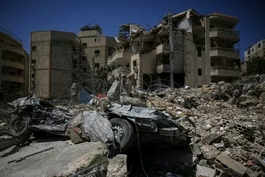
Israel agrees Lebanon ceasefire as U.S. pushes for deal
Video has Closed Captions
Israel agrees to 10-day ceasefire in Lebanon as U.S. pushes for broader peace deal (4m 33s)

Tracking the Trump family’s deals, profits in his 2nd term
Video has Closed Captions
Tracking the Trump family’s business deals and profits in his 2nd term (8m 59s)
UN official warns Hormuz dispute disrupting food supply
Video has Closed Captions
UN official warns Strait of Hormuz dispute is disrupting global food supply (5m 35s)
Providing Support for PBS.org
Learn Moreabout PBS online sponsorship
- News and Public Affairs

FRONTLINE is investigative journalism that questions, explains and changes our world.
 New Episode
- News and Public Affairs

Today's top journalists discuss Washington's current political events and public affairs.
 New Episode
 New Episode
 New Episode

 New Episode
 New Episode
 New Episode
 New Episode
Support for PBS provided by:
Major corporate funding for the PBS News Hour is provided by BDO, BNSF, Consumer Cellular, American Cruise Lines, and Raymond James. Funding for the PBS NewsHour Weekend is provided by...