Vermont This Week
June 26, 2026
6/26/2026 | 26m 45sVideo has Closed Captions
Governor vetoes ‘soft opening’ for hospital pricing reforms
Governor vetoes ‘soft opening’ for hospital pricing reforms | Closures highlight vulnerability of independent pharmacies | State’s child sex abuse investigation teams face challenges | Moderator - Mitch Wertlieb; Calvin Cutler - WCAX; Olivia Gieger - VTDigger; Howard Weiss-Tisman - Vermont Public.
Problems playing video? | Closed Captioning Feedback
Problems playing video? | Closed Captioning Feedback
Vermont This Week is a local public television program presented by Vermont Public
Sponsored in part by Lintilhac Foundation and Milne Travel.
Support provided by:


Vermont This Week
June 26, 2026
6/26/2026 | 26m 45sVideo has Closed Captions
Governor vetoes ‘soft opening’ for hospital pricing reforms | Closures highlight vulnerability of independent pharmacies | State’s child sex abuse investigation teams face challenges | Moderator - Mitch Wertlieb; Calvin Cutler - WCAX; Olivia Gieger - VTDigger; Howard Weiss-Tisman - Vermont Public.
Problems playing video? | Closed Captioning Feedback
Where to Watch Vermont This Week
Vermont This Week is available to stream on pbs.org and the PBS app.
Support the crew
Help Mitch keep the conversations going as a member of Vermont Public. Join us today and support independent journalism.Providing Support for PBS.org
Learn Moreabout PBS online sponsorshipGovernor Phil Scott has vetoed Vermont lawmakers most notable attempt at health care reform this year, plus a spree of sudden closures, highlights the vulnerability of Vermont's independent pharmacies and a look at challenges facing the state's chil sex abuse investigation teams.
All that and more ahead on Vermont This Week.
From the Vermont Public Studio in Winooski.
This is Vermont This Week, made possible in part by the Lintilhac Foundation and Milne Travel.
Here's moderator Mitch Wertlieb.
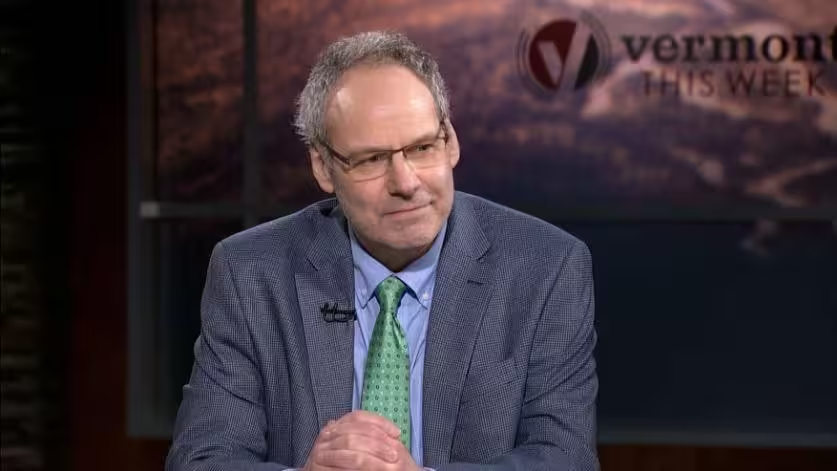
Hi, I'm Mitch Wertlieb It's Friday, June 26th, and with us on the panel today, we have Calvin Cutler from WCAX, Olivia Gieger from VTDigger.
And joining us remotely today, Howard Weiss-Tisman from Vermont Public.
Thank you all so much for being here today.
We're going to start with this very big story about health care.
Huge story in the state of Vermont.
Olivia Geiger.
Governor Phil Scott has vetoed, as we said at the top, what we're calling like a soft opening for for hospital pricing reforms.
This had something to do with what hospitals could charge per certain procedures.
What was the thing that Governor Scott vetoed here?
What would it have done extensively?
Right.
So to understand this.
I actually think it makes sense to start talking about a legislation passed last year which basically se this process, called reference based pricing, into effect for all payers across the state.
Basically, what this does is lower hospital prices to be based on a certain benchmark.
So usually it's a percentage of Medicare costs, for instance.
This has to go through a long rulemaking process and it's lots of bureaucracy to do that.
And this year they realized, oh, this might not actuall be ready for this coming year.
So lawmakers said, let's do this for two small insurance groups that are some of the most vulnerable.
So that's what this was, was really kind of jumping over those rulemaking processes.
What are those two small insurance groups that would be affected by this?
So those two are teachers or public school employees.
So there's this trickle down to taxpayers argument.
And peopl who buy their health insurance from Vermont Health Connect.
So people who lost those federal subsidies.
That's right.
Subsidies this year.
Well, those are you know, you mentioned there was a small but those are significant, too, because we know that a lot of health care costs rising in the state of Vermont are tied to education.
And we certainly know how expensive individual health care plans could be.
So what is the governor saying about why he then vetoed this?
What would have been kind of an experiment, I guess.
So one of the governor's main arguments is a fairness argument, where he is saying, in state statute, we have to distribute savings equitably across different insurance groups.
So he's saying, you know what?
We have act 68 from last year.
Let's wait for those processes to play out and make sure that these savings go into effect for everyone.
What he's saying and what the commissioner of the Department of Financial Regulation, who oversees insurance, has been saying to me is that the Green Mountain Care Board can still do a lo of these cost saving measures.
They can still set hospital revenues.
They can still set what the premium increases on those Vermont Health Connect plans are.
And so they're kind of saying, look, the Green Mountain Care Board has show no hesitancy to rein in costs.
They can do it again this year.
Let them do that and let this rule making process go into effect.
So it's just a bit of a sharper tool to have this reference based pricing.
It's like using gardening shears instead of an exact knife.
Interesting.
That's a good analogy.
And Calvin Cutler, you've been covering this as well.
I'm a little curious as to why.
Because what this sounds like is, is to say, let's see if this works with these two groups, these two cohorts.
But the governor has said no to that.
Wasn't he going to have an executive order?
Perhaps we were hearing something about that come down about health care.
We have not seen anything at this time that we're taping this show.
We haven't seen anything.
It's interesting.
I mean, the scuttlebutt has been that there's some executive order coming down about affordability and about health care.
I don't know exactly what it is, so we'll have to see exactly what that is.
But I mean, I've talked about it so many times on this show that health care, prices, health care, affordability, sustainability, is it a real tipping point.
And this is something that's bleeding into school and municipal budgets, taking a huge impact on taxpayers.
And what really kind of makes me think a little bit too.
I mean, if you think about I think it was act 167, was it a few years ago, sort of the hospital sustainability, you know, and the law that was hanging there, I mean, reference based pricing was a key recommendation of the Oliver Wyman report a few years ago.
So my question is sort of, you know, is this going to bring us to where we need to be without reference based pricing?
So in the wake of the governor's veto.
So we'll have to see.
It's just very curious because without trying this particular experiment and without an executive order, again, to this point, we don't know if that's coming.
We're not sure where thing stand with health care reform.
Olivia, I know that you were you were kind of expecting that executive order to come down on health care.
Did you have any expectations about what could be contained in that?
Yeah, I have some thoughts, mostly because in the governor's veto letter, he said, I want to push forward some things through this bill that his administration introduced in January, called each 585.
And that was this huge grab bag type bill where there were so many different things in it.
So the one that I think got a lot of attention and we could really expect to see in this executive order, I think, or just in some executive action is around association plans, which is basically this pre Affordable Car Act idea that small businesses can pull together to give their employees a bigger pool for insurance and kind of circumventing that Affordable Care Act marketplace route.
But there's so much in this bill that it's not worth going through all of it, but there's a lot of other stuff that really bogged down committee testimony.
And that's why this bill ultimately just died in committee, because it one of the senators on the committee was like there was just far too much that everything was a bit half baked for them to really sink their teeth into every single aspect of this.
There were some stuff about changing insurance premiums based off of age, and there was a governor appointee on the Blue Cross Blue Shield board, and that was really controversial.
And just all this conversation around billing outside of the hospital versus in the hospital and how that's different.
And I mean, you can just look at this laundry list of stuff and there's there's so much in there that I think we could really expect to see a number of things.
Well, how are lawmakers then reacting to the governor's veto of these pricing reform efforts?
Well, it depends on which lawmakers a lot of of Democratic lawmakers I've talked to who were pretty staunch supporters of both S1 90, that reference based pricing bill.
And and a lot of people were in favor of aspects of 585 are really angry.
Senator Jenny Lyons, who sits on the health care committee and kind of leads that committee and championed this reference based pricing bill.
She said she was dumbfounded.
Really, it's it's pretty I think a lot of people are pretty astonished that this was this, this bill that the administration was pretty in favor of up until the very end of the session.
And it sailed through the Senate pretty easily until the end.
I think a lot of critics of the governor have said this is kind of par for the course of the style that the governor sometimes has during the legislative session.
I know Becca Ballard had said this.
Jill has said this basically where the governor does not raise and his team will be in the room throughout the conversation.
His cabinet will be there helping craft the bill or weigh in on the bill.
And critics of the governor's style here say he swoops in at the last minute with the veto.
You know, by my count, I think that there's this is the governor's 64th, 63rd, 64th veto, which is three time as many as the previous record holder, Governor Howard Dean.
That's, of course, in part of that is because we've had a Democratic supermajority, a Democratic majority.
But certainly, you know, the governor has been in the minority basically his entire political career.
But that said, though, there are critics of sort of the last minute veto, so to speak, to be clear, there's no veto session scheduled for this at this point.
They did not very briefly, Calvin, before we move on, and we will be watching for any executive order again that may come down.
If you're watching this, you know, tonight and it's happened already.
We apologize.
We're taping in the afternoon.
Have Republican lawmakers been any kinder to Scott's veto of this?
You know, I haven't actually spoken to any individually or I mean, I' imagine that they are a little bit more aligned with the governor.
I'll, you know, phone in a friend here to Olivia.
Sort of what what the reactions been from from Republicans.
But no, I haven't specifically talked with any of the governor's allies on this, but I'd imagine that they are also lockstep with the governor on this in his veto.
Have you heard anything, Olivia?
Yeah.
I haven't been able to talk to any Republican lawmakers since the veto.
But if you watch a lot of the testimony in the floor debate at the very end of the session, there was a nearly like Partizan vote against this bill in the House.
And so at the very end of the session, a lot of Republican lawmakers were similarly hesitant about what this bill would actually do.
Interesting.
We're going to b following the story, for sure, so there'll be updates coming.
Howard Weiss, let me turn to you now because this is also health care related, but this is dealing with a story you wrote about for Vermont's pharmacies.
And there were some independent pharmacies in Vermont, and they are struggling.
There have been some closures now of independent pharmacies.
What is the problem here, and what effect does this having on folks in Vermont who depend on prescriptions and need their local pharmacies?
Yeah, sure.
So three pharmacies closed down last month in Ludlow, Springfield, and quickly they were owned by a company at a Rutland Smile and Steve's Pharmacy.
And they are their flagship pharmacy in Rutland is still open, but they closed these three pharmacies and it brought attention to this national pricing system and don't want to get too many eyes glazed over.
But there are these companies which are known as pharmacy benefit managers and they're kind of middlemen.
They work between the insurance companies, the pharmacies and the drug companies and they were initially set up to actually bring down the cost of pharmaceuticals and also to help get pharmaceuticals, you know, around the country, into rural areas, etc.. In the 90s, a lot of there was a lot of consolidation.
Today, there were three companies that control about 80% of the market.
And the way that their pricing structure goes, it the pharmacists and the independent pharmacies are just in really tough shape.
These PBMs dictate what they can charge.
They dictate how much money the insurance company is going to get.
And it just puts pharmacies in really tough shape.
During my reporting, Vermont has lost about a third of its pharmacies in the past 20 years.
Vermont has some of the worst access to pharmacies in the country were in the band five or top five, however you look at that.
So it kind of goes to the conversation that we were just having.
I think that the American health care system is just broken.
It's just in really, really bad shape.
And constantly we're talking on this show and we're writing about and all the other reporters are writing about.
Vermont is doing its best to try to, you know, patch up the system thinking of the person put in their fingers in the dike.
And it's just we don't want to bump people out but it's just a losing battle.
There has to be federal changes.
And that includes these pharmacy benefit managers.
Vermont passed a law in 2024 to try to rein in some of these companies.
A lot of states are trying to take action, but it's really an uphill battle.
These are huge companies.
The Department of Financial Regulation, I think as two people working on this, going against these multinational conglomerates with hundreds of lawyers.
So it's pretty tough.
It's it's a pretty uphill battle to try to get your arms around this.
This sounds to me, Howard like it's a microcosm of that.
Like you said, the bigger problem, the consolidation, these smaller companies, only three of these now of these PBMs setting these price problems.
This is we're seeing this with insurance companies.
We're seeing this in media.
There are fewer and fewer entities now controlling these things.
And it's having an effect on to trickle down.
But it's having a huge effect.
Now the other problem too is when these independent pharmacies close in Vermont, it makes it harder for folks to to they have to drive the far distances.
Right.
We're a rural state.
Isn' that part of the problem, too?
Yeah, that's a big problem.
And what's really interesting, again, when we make a connectio to all of the other challenges in the health care system, we're losing our our primary physicians.
They're getting older.
Hospitals we know are struggling.
Wait times are increasing at hospitals.
So a lot of people are saying no.
For a lot of people, pharmacies are kind of where people interact with the health care system.
They go there more than they see their doctor.
They go there more than the hospital.
And so if you have someone who's who's, you know, maybe older, who maybe can't get around much, and now instead of driving ten minutes, they have to drive 40 minutes to get this medicine that, you know, it's pretty much saving their lives, saving their life.
It's a it's a really it's a tough situation.
And again, not to bring, you know, the focus on the American health care system.
But the problem in so many of these stories that we talk about is that money is at the center of it, instead of well-being and instead of health.
And so many of our challenges and problems are tied to that.
Howard, you had one of the gentlemen you quoted in your article.
He was, I think, being diplomatic about it, but he was saying what you're saying.
He said, nothing is going to change here.
He said, Vermont is doing what he can.
He seemed to be supportive of state efforts, but he was saying that unless something happens at the federal level, and what he was referring to, I think is massive changes to the way we deliver health care system in this country.
This is not sustainable.
Is that what you gleaned from your conversation with him?
Absolutely.
And I think we can say the same thing about hospitals and primary physicians and so many of the challenges in our health care system.
Absolutely.
All right, Howard, thank you for the update on that story.
And we'll be following that, of course, as well as we continue to talk about health care.
Calvin Cutler, I want to turn to you now.
You wrote about you did a story on here.
It's disturbing, but it's also really, really important.
The state's child sex abuse investigation teams are facing challenges.
This was set up.
Take us back to around 2008 when there was a horrific story in Vermont, the Brooke Bennett murder.
This this investigation team was set up.
What is the problem now as opposed to 20 years ago when it was first set up?
Yeah, I mean, a lot of longtime watchers and listeners of this program will remember back in 2008, there is a really tragic case where a 12 year old Brooke Bennett was kidnaped, raped and then murdered by what turned out to be her uncle.
I believe he got the death penalty, and that sparked a ton of soul searching within the legislature, within civic society, of how did we allow this to happen?
How did this slip through?
And Senator Dick Sears was in the Judiciary Committee at the time, and he basically said, we need to make sure that we are bringing all of the relevant parties to the table and that there is seamless communication.
And so we passed broad reforms back in 2009, which basically sets up a system where you have DCF caseworkers, law enforcement, state prosecutors, victims, advocates and others all sitting around the table, kind of like with the accountability court we've been talking about, to try to make sure that, you know, child sex offenders are either, you know, arrested, prosecuted, taken away, that type of thing.
And so this has been a very effective model over the last 20 years.
But in recent years, and for this model to work, all of the puzzle pieces have to fit together correctly.
And everybody plays a really key role in this model being successful.
But what's happened in recent years, you know, there's two key components of it.
So there's the law enforcement side.
We've been talking a lot about staffing issues in Burlington and I mean departments really across the country.
It's a national issue.
Corrections, all sorts of corrections.
Bingo.
Exactly.
So there are fewer police departments, have fewer officers to lend to these special investigative units or CEUs is what they're called.
So they have fewer officers to lend their time to investigate these cases.
The caseload hasn't changed at all.
Meanwhile, you have victims advocates, and they are the ones, basically that work with the child, hold their hand in the courtroom, interview the kid, you know, to make sure that they are getting the right story, to make sure that they can secure a prosecution.
And you have victims advocates who the funding gets super wonky.
And I don't want to bore you with it, but for a number of reasons, they've been fla funded over the last 15 years.
You know, they've been able to maintain staffing, they've been able to maintain their services, but demands have only gone up.
I mean, we talk about stress on the household from violence, wealt inequality, the opioid crisis.
There's a lot of confounding factors that have really sort of piled on to our system of justice.
And that also, you know, part of that is child abuse as well.
And so you have these two pieces of the puzzle really has some questioning, you know, if something were to happen, you know, would we have the right response.
Again, these are very heinous, very sensitive, very tough cases.
And these people do amazing work.
And really I mean, this is very challenging work because this is kids.
We're dealing with some of the most difficult cases to prosecute for that very reason.
You're dealing with children, you're dealing with emotional trauma.
It's very tough.
So what can be done then?
Kelvin?
What are folks saying as far as raising the red flag about this to say what do they need I guess, yeah, I mean, from the victims advocates perspective, they're saying we need funding.
We need money.
The legislature has I mean, even did step up this year, I think gave them $150,000.
But a lot of their funding stream comes from either local donations and local communities, or from white collar crimes that are prosecuted by the federal DOJ, think Volkswagen Settlement or Purdue Pharma, things like that.
And that is a very volatile summit, depending on what the administration is and who's in charge and who's in the white House or the DOJ.
So again, I mean, it's they're really sort of sitting there holding the bag saying, you know, this is work that is not going to stop anytime soon.
And we need more predictable funding because staff burnout is a real thing for some of these victims advocates.
They are on average, there is budget documents I saw from the session that say each caseworker is working about 600 cases at any time.
So, I mean, it's really the resources are stretched thin.
Briefly, Calvin, I have to ask because you mentioned the up down nature of this.
Were we seeing more funding coming from the federal level during the Biden administration than we were from the first Trump administration, maybe this Trump administration?
Yeah, it's a good question.
It does ebb and flow.
And it depends.
I mean, like the Biden administration really went hard on like antitrust violations and things like that.
So there definitely has been like during the first Trump administration, there was it as much Biden it was a little more Trump 2.0, not as much.
There is a little bit of a lag though.
So like during like Trump won, like we were getting or during the Biden administration, like, you know, if there's a little bit of a delay things.
Yeah, take time to count.
It really does also depend on on the federal, you know, who's in the white House and how that plays out.
So the politics of it is also interlinked as well.
Really important story.
And I appreciate you bringing that to our attention.
Howard West has been I remember many years ago, speaking with a young reporter from the Bennington Banner about Vermont Yankee.
There was a time this was the biggest story in Vermont.
It seemed everybody was talking about the decommissioning story was huge.
What is happening now so many years later in 2026, energy Development Company is now leasing the Vermont Yankee property.
Who are they?
What are they going to do with it?
Yeah, so that caught a lot of people's attention.
A new nuclear reactor in Vermont.
But I have to correct you, Mitch.
Brattleboro reformer.
Oh, I'm so sorry.
Yes, of course, that's where Yankee was.
I knew you'd correct me that I was just testing you.
Yeah.
So, yeah.
Long story.
Vermon used to have a nuclear reactor for folks that don't know which are down in 2014.
And the the owner of the the reactor at the time, Entergy, had a decommissioning fund of about $600 million.
When the plant closed down, people thought it was going to take like 30 years to tear down the old reactor, get rid of the waste, etc.
A company, a demolition company, saw that pile of $600 million and said we could do that quicker and cheaper and make a bunch of money doing it.
So this company, North Star, has been working since 2017.
By all accounts, they've been doing a great job.
They have a great relationship with the state, they have a great relationship with the town of Vernon.
But throughout the process, North Star said that the people of Vernon were going to have a hand in what happens on this site, and it has turned out that North Star has signed a lease with this other company called Power Transitions.
That's a Texas based company.
And what Power Transitions does is they buy old nuclear and cold reactors and they try to develop them.
They are into on data centers.
They are into battery storage, large scale battery storage.
And they're also working on these things that are called smears, which are small modular reactors.
There are no smears in the United States right now.
It's a new technology.
And these folks from Power Transition have been meeting with the state, meeting with the Department of Public Service and floating a few ideas.
They say that they are mainly interested in these battery storage.
Now, compared to a nuclear reactor, a battery storage might sound better, but these battery storage facilities als have been known to catch fire.
There are 50 plus spent nuclear fuel canisters at BYU, so you have to wonder if a facility that might catch fire is a good idea to put in near nuclear waste.
And any of these projects are years, years down the line.
They are going to have to be permitted.
They are going to have to go through state permit, local permits, federal permits, if it's a nuclear reactor.
But yeah, it's a big story.
It's a big story in Vernon.
It's a big story for Vermont.
I'll say very quickly, the interest in this property is tha there is the switchyard there.
So there's very important expensive electrical infrastructure there.
So there's a lot of people interested in what happens at the former V site.
And as you said, Mitch, we've been I've been talking about Vermont Yankee for 20 plus years.
And the story was on Keeps on Giving.
Appreciate that update Howard, thanks so much, Olivia.
I understan you recently went to Dartmouth and found us something about a pollen counting device.
What's going on there?
Yeah, this is just a bit of fun, fun news that you can check out in the next few days on on the website.
I was on the roof of Dartmouth-Hitchcock, where they have this really wonky contraption that filters pollen from the air.
It's the only of its kind in New England, so I'll leave it at that as a little teaser.
Listen, there's a lot of people who were affected by pollen.
Yours truly included.
I'm going to be looking for that story.
Vermont's longest serving speaker of the House, Ralph Wright, passed away last week at the age of 91.
Now, the Bennington Democrat was elected to the House in 1978.
He served as speaker under three successive governors from 1985 to 1994.
Wright's tenure in the state House was marked by a number of accomplishments, including a 1992 bill that expanded hate crimes and discrimination protections for LGBTQ plus Vermonters.
A bill the lawmaker wrote, stands as one of my proudest memories, he said.
And I know Calvin Cutler.
You know, you've been covering Ralph, right?
And, you know, just kind of a legend in Vermont politics passing away at the age of 91.
Yeah, totally.
I mean, a huge impac on the state of Vermont policy wise and legislation, a huge impact on the building and just the culture with within the state House.
I mean, I know a lot of speakers, Mitzi Johnson, Jill Crow.
I mean, there's, you know, Shap Smith, there's so many that you you talk to them about, like, you know, what is the transition of the gavel look like from one generation to the next, right.
And each speaker, it's tough to put into words, but there's only 50 House speakers at any time in the United States.
And it's a real fascinating.
And there's a real there's a real culture to it.
There's a real, you know, legacy to it.
And he had a huge impact.
And certainly a lot of people at the state House still to this day still talk about him and his impact.
So it's it's really fascinating.
Well said, Calvin, thank you.
And that's where we're going to have to leave it for this week.
I want to thank our panel so much today, Calvin Cutler from WCR, Olivia Jaeger from digger.
And joining us from Oatley, Howard Wise Tasman from Vermont Public.
Thank you all so very much.
I'm Mitch Lieb, and thanks for watching and listening.
And we'll be right here next week for Vermont this week.
Join us.
 New Episode
- News and Public Affairs

Top journalists deliver compelling original analysis of the hour's headlines.

- News and Public Affairs

FRONTLINE is investigative journalism that questions, explains and changes our world.



 New Episode
 New Episode



 New Episode
Support for PBS provided by:
Vermont This Week is a local public television program presented by Vermont Public
Sponsored in part by Lintilhac Foundation and Milne Travel.