Vermont This Week
June 19, 2026
6/19/2026 | 26m 46sVideo has Closed Captions
Juneteenth Special
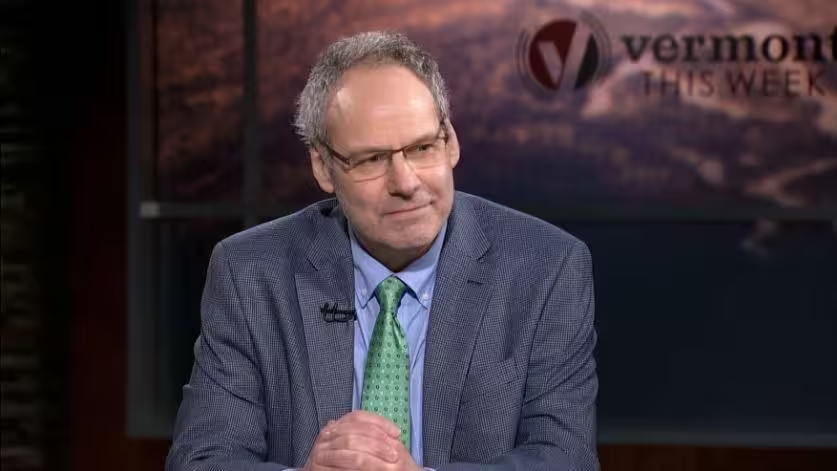
Juneteenth Special | Moderator - Mikaela Lefrak; Roy V. Hill II - Faith and Community Leader; Christian Berry - Communications and Community Engagement Manager, REIB Burlington; Thomas Renner - Mayor of Winooski.
Problems playing video? | Closed Captioning Feedback
Problems playing video? | Closed Captioning Feedback
Vermont This Week is a local public television program presented by Vermont Public
Sponsored in part by Lintilhac Foundation and Milne Travel.
Support provided by:


Vermont This Week
June 19, 2026
6/19/2026 | 26m 46sVideo has Closed Captions
Juneteenth Special | Moderator - Mikaela Lefrak; Roy V. Hill II - Faith and Community Leader; Christian Berry - Communications and Community Engagement Manager, REIB Burlington; Thomas Renner - Mayor of Winooski.
Problems playing video? | Closed Captioning Feedback
Where to Watch Vermont This Week
Vermont This Week is available to stream on pbs.org and the PBS app.
Support the crew
Help Mitch keep the conversations going as a member of Vermont Public. Join us today and support independent journalism.Providing Support for PBS.org
Learn Moreabout PBS online sponsorshipOn a special edition of Vermont this week, we commemorate the Juneteenth holiday with a conversation centered on the experiences of black Vermonters.
From the Vermont Public Studio in Winooski.
This is Vermont this week, made possible in part by the Lintilhac Foundation and Milne Travel.
Hi, I'm Mikaela Lefrak in for Mitch Wertlieb.
Thanks for being with us for this special edition of Vermont this week, honoring the Juneteenth holiday.
It marks the date that some of the last enslaved people in the Confederacy received word that they were free.
Juneteenth became an official Vermont state holiday in 2008 and a federal holiday in 2021.
Today, we're joined by community leaders from around our state.
We'll reflect on Juneteenth historical roots and connect it to issues that we still face today.
Our panelists are Roy V. Hill, the second, a faith and community leader from Fairfax and a Vermont resident of 40 years.
Roy, welcome.
Thank you.
We also have Christian Berry with us, the communications and community engagement manager for Burlington's Office of Racial Equity, Inclusion and Belonging.
Welcome.
And Thomas Renner, the mayor of Winooski.
All right, Roy, you were part of the push to make Juneteenth a state recognized holiday in the 2000.
Juneteenth has the distinction of being the newest federal holiday in the United States, so it might still feel relatively new and novel to some members of our audience.
How did you grow up commemorating this holiday?
When did it become an important part of your life?
First, I'll say thank you to you and colleagues for this program, this day and the colleagues here around the table to answer you more directly.
I knew absolutely nothing about Juneteenth prior to 2000 2000 doctor Ron Myers, who basically was the power and the intelligence about June's teeth, his legacy, etc., called me out of the blue blue for me and said, how about Juneteenth in Vermont?
And do you think it would be a state receptive to moving towards a having a Vermont Juneteenth Day?
And secondly, the ultimate goal is to make it a federal holiday?
My response, along with my wife, was, what is Juneteenth?
Why are you calling me?
And secondly, why are you calling?
How did you get my number?
And so from there on with that education, I felt the need because again, we're looking at truth, the reality of who we are as a nation.
And again, the pushback which has and continues, whether it was with the Native Americans, are with us to say no to a reality that we don't like or does not look like us, or we hide in a closet like people talk about Thomas Jefferson, I guess.
But they say nothing about his abuse of Sarah Hemming, Sally Hemings.
So that's how it started.
And Christian, you have been in Vermont for about 30 years.
You and Roy go way back.
You've worked in the Burlington Office of Racial Equity, Inclusion and Belonging since 2023.
Burlington puts on a Juneteenth event every year for the last few years.
How have you seen community awareness and interest in this holiday change over your time in city government?
Yeah, and again, thank you for having me.
And so I would say that the community, I think year after year have been more engaged.
I think in 2021 when it became a federal holiday, I think a lot of people, even people of color, didn't really know what Juneteenth was.
And so we've seen that evolution in that shift of people coming out and really taking this on as a holiday that they are wanting to celebrate and wanting to acknowledge doing more about the learning and the history of the event.
So there's an educational piece that goes along with that, but it really has become a community event which feels really great and really like welcoming in terms of coming into the city.
Yeah.
And was it a holiday that you grew up celebrating or did so would call you out of the blue like with Roy?
No one called me like a blue.
So I'm originally from Tennessee, but I've been in Vermont for 30 years, and some of that time was before Vermont recognized the Juneteenth holiday.
And so my familiarity with it was probably in the mid like 20 tens, and certainly being more engaged and involved as I've been working in the city.
Mayor Renner Winooski has a duty celebration this week.
We're recording this conversation prior to the big events.
What do you all have going on this year?
We have once again.
And you know, to your point, this celebration has grown in Winooski.
The first year that we did it, there was an amazing turnout, but the second year it was it was truly moving to see how many people came back for that event.
So this year, I'm really excited to see how many more people were going to have.
And we just try to celebrate black culture.
So we've got food, we have different businesses.
We have different activities.
All right.
In Rotary Park.
So right in the center of town so that everybody can see that we are celebrating Juneteenth, which I think is part of this.
Right.
We need to celebrate it very openly so that people know that we're celebrating it again.
There's a lot of learning.
People still have to do so, celebrating it right in the center of town.
As part of that learning, I think there is a major learning component to Juneteenth, including a continual learning for people who are organizing these events.
Roy, I know you're a lifelong learner and someone very interested in history and thinking about Juneteenth this year in particular, as the United States celebrates the its 250th anniversary of the signing of the Declaration of Independence, I wonder if there are any parts of this holiday, the Juneteenth holiday, that feel particularly relevant to you right now, particularly important for us to celebrate or commemorate.
To a degree, an important degree.
I think looking at the whole of Juneteenth is to recognize we are overcomers in that context, not only in terms of black Americans, but in terms of who we are as one family in America, the United States.
That's the word united.
So as we look at the uniting and our gifts and our power, then we can, if you will, muscle or shoulder through a lot of resistance that comes at people and at education, we find that education funding is being cut as a small example and more and more in terms of embracing each other as a person who desires to who DD deserves, deserves respect.
And that is something that Juneteenth, through its legacy today, talks about.
Because when we, my wife and I in particular, start talking to the legislators, start talking to governors and other leaders about Juneteenth, then their eyes were open and there was a momentum that supported that.
So here again, I think that Juneteenth is saying we're overcome as a people.
We can advance together.
The boogie bare of that spiritual negativity or nastiness that will tell you something to the contrary is not necessarily so.
And what a nice place to have something like this to take off and go forth.
The state itself speaks to release from the negative abolitionist ism, if you will, is part of our blood and stream.
And the lady, the women leaders who have systematically stepped forward.
So I say, join the wagon.
Let's go for it.
Well said.
One thing I just want to say that you made me think of is how few people actually know that black Americans fought to free ourselves so that that for the honor of the declaration.
Right.
So many people who were enslaved or had just recently been freed, fought against the British so that we could have this country and the deep thing that that means to me, just these people who were quite literally owned, still saw the importance of what we were all trying to accomplish back then.
As a footnote to what you just saying and looking at the Civil War as well as the two and a half year, quote, release of black Americans there in Texas.
A from Vermont, where we had something like back there in those days, 1800s, something like 700 black people living in Vermont and 166 of them went and fought in the Civil War.
And finally here in terms of General Granger going into Texas with the order.
There were black veterans who made that possible prior to that, the Texas resistance, and was such that that resistance was such that it was not possible to move in and bring about that change, liberation, change.
But when the black soldiers, black veterans joined that troop and went into that reality becomes something that they could hold, touched and others be inspired by something.
Can I just please and just something that we you know, when we were thinking about the tagline and the theme for this year's Juneteenth celebration, you know, it starts with freedom, right?
And then we lean into, well, yesterday's legacy.
And we're talking about legacy, and that is history that we do not want to forget and that we certainly want to honor.
And then today's promise, like what was promised to us as as you're saying in these United States, and then tomorrow's hope, like looking at our youth and and looking at what this country, what what country do we want them to inherit?
And so as we're thinking about this this week in celebration, that's really what we were kind of toying with around the table in the rib.
And so that's how we landed on the theme, because it's really important to acknowledge where we came from, understand where we are, and then really look to where we're going.
If I was in church behind that, I'd say Amen.
Christian Juneteenth organizing often falls under the purview of Dei professionals diversity, equity and inclusion.
And there's been quite the pendulum swing under Donald Trump's second administration around Dei initiatives.
They've been targeted.
The president has has characterized them as discriminatory and pulled federal funding from places and programs that are doing overt Dei work.
And I wonder if those changes at the federal level have affected your work in Burlington's REIB office, either specifically about Juneteenth programing or just more broadly?
So I would say, fortunately, we work with the city of Burlington, and Mayor Mulvaney Stanek has been really intentional about making sure that our office is not relying on federal funding.
So all of our funding is city funding.
Now, certainly, there's an impact across other city departments who have lost funding or have had to maneuver or change language in terms of like any applications they're submitting.
But we are very fortunate that we get to continue this work.
I mean, our office is still racial equity, inclusion and belonging.
And so there's a real commitment to leaning into that because we feel like that's really significantly important for the history of this country to to always keep that front and center.
And Mayor Renner, same question to you about your work in.
Yeah, I mean, thankfully we haven't seen any any huge setbacks and that we've seen other setbacks on this federal administration.
But we are much smaller city.
We don't actually have the benefit of having the office that you oversee in our city.
So a lot of that work falls on me and falls on our city manager.
But, you know, thankfully, I will say nothing has come to me from the city manager.
That has been a direct implication of the equity work that we do try to do in Winooski.
And Roy, as a community elder.
Now, I imagine you have seen the the pendulum of public opinion sway back and forth many times over the years on conversations such as the one that we're having right now about Dei work, diversity, equity and inclusion.
And I'm wondering if you might have any any wisdom to share with people who are feeling a bit of of of, you know, the they're feeling the starkness of the change between the former presidential administrations change relative to the president Trump's negative feelings towards diversity, equity and inclusion work, pulling back federal funding from programs that focus specifically on Dei initiatives.
Many people run from the truth, especially in the political arena, when personal or grandiose in terms of money and materialism drive their policies more so than truth, and being concerned about the population at large.
Let me share a small example.
Years ago, the the years ago, two Vermont governors, Governor Hoff, introduced me to a previous governor, Simon, I think was his name, and I outlined some concerns on one hand and what I felt would be positive change on the other.
And I sent him a monograph.
He read it and wrote back and said, I see what you're talking.
It included some ugly stuff that was still happening here in the state.
All right.
So he wrote back and said, I see what you're saying, but I disagree.
That has not been my experience.
So we can talk more about this later.
I'm going on vacation.
Well, he came back from his vacation and shortly thereafter he became president of UVM.
I shortly thereafter received the requests for him to meet with me.
I wasn't at the university at that time, so I'm going.
What's this about?
So I went and he said, thanks for meeting with me.
He says, I called you in to apologize.
I called you in two because since I've been on this campus, I've seen more and I've learned more, and I have a better understanding of who my quote neighbors really are, there are some issues that we have to we have to address.
And he said.
May I have a copy of that again?
Because you sent it to me and I put it in file 13 or whatever the sweater is.
Okay.
So I'm saying that that change is progressive.
And as we progressive, we see where there's more change that is needed and where we can help make a difference.
So systematically that we see that change occurring.
We see I think that was more than just happenstance, that for the first time, Vermont had a woman, a governor.
I think that for the first time we see that Burlington, Vermont, has a woman mayor.
And as many people say, as goes Burlington, so goes the state of Vermont, which so goes the world.
Amen.
Amen.
I was going to inject New England in there, but so is the world.
So I see that coming.
And also we see what we do landing on the shoulders of youngsters who also bringing about change in a positive, more inviting and inclusive behavior.
We find some teachers who are still stuck in the students themselves are moving beyond the teachers in the classroom, especially with some principals and some superintendents.
Here again, I made a reference to materialism and to money, and six figures and a number of them have circle those in higher positions and policymaking position and circle the wagons around their zip codes and their salary.
And the students are saying, wait a minute, you're being paid to educate us so that when we move into the world, we are part of a world community, some 8 billion people, and we have to be able to dialog and be marketable and care.
And whether it's medicine or education or research or that's enough.
Thank you for that.
I'm glad you brought up that that continuing education, which is something I wanted to talk with you about, Mayor Renner, because we often talk about Juneteenth as a holiday honoring the history of Black Americans in the United States, but more specifically, it focuses on the history of people who are forcibly brought across the ocean and their descendants.
Winooski is the most racially diverse municipality in the state, but a lot of residents of Winooski are new Americans from African countries.
And I wonder if you have seen those Winooski residents engage in Juneteenth events, or if there is, if you see it as an opportunity for a coming together of those communities.
Yeah, I love that you just said that because that's what it is.
It's an opportunity of coming together.
I mean, I find we've all kind of touched on a lot of people actually don't know what Juneteenth is about.
Yeah.
So it's something that we all need to be working on to educate people.
But in what has been amazing is I think there's a general understanding at least, that this is a holiday that celebrates black people and black excellence, and everybody wants to come together for that, whether they are Nepali and just arrived to Winooski a couple of years ago, whether they are a black person who moved here from the South and deeply understands what that means.
Everybody's coming together around that mission.
So we've just got to do the work of making sure people really understand why Juneteenth is so important.
I mean, it's when slaves were freed.
It just shows you so much about what happened in our country at that time, that there were still slaves who were not freed when they were supposed to be.
So the more we can keep saying that to people and having these celebrations, people come and they say, well, what is this all about?
And that's even right.
There is our opportunity to teach people about Juneteenth.
Yeah, yeah.
It seems like.
Yeah.
Similar to what you were just saying.
We in Burlington, we have a very strong new American population as well.
And we actually in the rib just welcomed last year members of our Trusted Community Voices team members who were part of our office and are now in the Rib.
But those are our bridges to the new American communities.
And having the conversation around what Juneteenth is was a new conversation for them.
And those were adults.
I think our youth are a little bit more engaged.
We have a lot of youth performers who are coming out for Juneteenth to participate in the activities and to be performers on, like, our stage, and they're really excited about those opportunities.
But, you know, we just have to take the opportunities as they arise to continue that education and to talk about why this holiday is important for everyone to recognize and celebrate.
Exactly.
For everyone.
I remember somebody once was like, oh, I can't go to that.
I'm not black.
Exactly.
And I was like, no, that's why you need to be there.
We're welcoming you in.
Yes.
And we do.
We have a strong community of folks who come out from all kinds of backgrounds and lived experiences, and that's a beautiful thing.
So yeah, Roy, I wonder if you've had conversations like that with friends and neighbors when you've talked to them about Juneteenth and your push to get it recognized as a state holiday, and now that it's a federal holiday, have you had people come to you and say, I can't be a part of that because I'm white, but I like the idea.
I hope you have fun.
Yes, on different levels here, for example, we lifted up Juneteenth in Fairfax and we will have our fourth year recognition of the holiday itself.
But initially, when Black Lives Matter and Juneteenth became part of the dialog, there was pushback of a sort what is this?
Why?
And at the moment, as I said, we are about to engage this week, the fourth year of Juneteenth activity and intergenerational people show up.
I'm reminded prior to this that when we were pulling, pulling, organizing and getting ready to kick off Juneteenth here with with the first statewide conference which took place, was hosted on the Saint Michael's campus.
But there was a. Back to, I think, elementary school or, yes, elementary or high school.
A woman who was a friend of Lucy Samara, Lucy's husband, used to be dean of students at Saint Michael's College, but he wasn't involved.
But I'm just saying, one of her friends had heard about Juneteenth, and Lucy was walking out Church Street and someone started screaming her name.
Lucy, Lucy.
And she turned around and it was her friend.
And her friend came up white as Lucy and said, what's this Juneteenth stuff?
I know everything about black people, so this has to be a hoax.
And it was like, and, you know, Lucy was was almost speechless because she had known this person all these years but did not know that this person, her friend howls this kind of thinking, how is this kind of ignorance?
And so, you know, Lucy, being kind and educated and thoughtful and diplomatic, handles her friends with new education and hopefully a mind switch.
So, yes, to answer your question, that that kind of thinking does still unfortunately exist.
Yeah.
Juneteenth is one day out of the year, and I'm so glad it's brought us together to have this conversation.
But, Christian, I wonder how you think about bringing forth into the rest of the year some of the the spirit of Juneteenth that you are working to center in Burlington this coming weekend.
So I think in that same realm of bringing people together and making space for people to engage in conversation, we're going to be doing a lot of community engagement initiatives throughout the next year.
So going into neighborhoods and community spaces where people are and engaging them across multiple different kinds of conversations, but making sure that we're, you know, it's maintaining and in some cases, building relationships with people.
So it's not just this one time of year that we come together, but how are we carrying that through line across the next year or years?
And that takes real intentionality, and it takes a real commitment, and it takes being where the people are listening to folks and just continuing that work of the inclusivity and the belonging.
Mayor, what do you think?
I love all of that.
Yeah, I think that there there's so much still truly that has to be done.
You know, I black people are American history.
American history is black people's history, especially in this country.
You know, the white House was built by black people.
Black Wall Street was bombed by the government.
These are things that a lot of people don't know.
So it's not just Juneteenth we have to educate people about.
It's black history that we have to we have to teach people.
Yeah.
Well, I'm so thankful to each of you for coming on today, being part of this conversation with me.
That does it, though, for Vermont this week.
Thank you so much to our panel.
Roy V Hill, the second Christian Barry and Thomas Renner.
Thank you so much for watching and listening.
And we will see you next week.
 New Episode
- News and Public Affairs

Top journalists deliver compelling original analysis of the hour's headlines.

- News and Public Affairs

FRONTLINE is investigative journalism that questions, explains and changes our world.



 New Episode
 New Episode



 New Episode
Support for PBS provided by:
Vermont This Week is a local public television program presented by Vermont Public
Sponsored in part by Lintilhac Foundation and Milne Travel.