Vermont This Week
July 3, 2026
7/3/2026 | 26m 48sVideo has Closed Captions
Community Journalism Special
Community Journalism Special| Moderator - Mitch Wertlieb; Cassandra Hemenway - The Bridge; Paul Fixx - The Hardwick Gazette; John McCright - Addison County Independent.
Problems playing video? | Closed Captioning Feedback
Problems playing video? | Closed Captioning Feedback
Vermont This Week is a local public television program presented by Vermont Public
Sponsored in part by Lintilhac Foundation and Milne Travel.
Support provided by:


Vermont This Week
July 3, 2026
7/3/2026 | 26m 48sVideo has Closed Captions
Community Journalism Special| Moderator - Mitch Wertlieb; Cassandra Hemenway - The Bridge; Paul Fixx - The Hardwick Gazette; John McCright - Addison County Independent.
Problems playing video? | Closed Captioning Feedback
Where to Watch Vermont This Week
Vermont This Week is available to stream on pbs.org and the PBS app.
Support the crew
Help Mitch keep the conversations going as a member of Vermont Public. Join us today and support independent journalism.Providing Support for PBS.org
Learn Moreabout PBS online sponsorshipA special edition of Vermont This week we explore the impact of hyperlocal publications and the important role community journalism plays in the state.
From the Vermont public Studio in Winooski, this is Vermont this week made possible in part by the Lintilhac Foundation and Milne Travel.
Here's moderator Mitch Wertlieb.
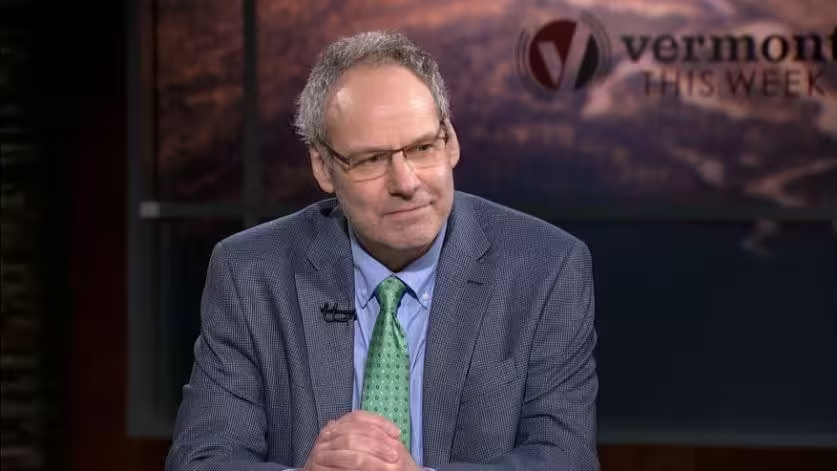
Hi, I'm Mitch Wertlieb It's Friday, July 3rd, and with us on the panel today, we have Cassandra Hemenway, editor in chief at the Bridge, Paul Fixx, editor at the Hardwick Gazette, and John McRight, news editor at the Addison County Independent.
Thank you all so much for being here.
I cannot tell you how excited I am about today's show.
We've been meaning to speak with folks that we have not spoken to before who do small community newspaper work.
You bring journalism to the people of Vermont.
So thank you all for being here.
Really appreciate this.
Let's start by introducing folks who may not be aware of who you are, what you do about your publications, and what's happening.
So let me start with you, Paul Fixx your publication.
Tell us about it.
The areas of the state that you serve and how long you've been operating.
Yeah, the Hardwick is that is been around for 137 years since 1889.
We cover 11 towns around Hardwick from Craftsbury in the north to Plainfield in the south, from Wilkin in the west to Stannard, Walden and Cabot in the east.
Fantastic.
And how long has the paper been in operation?
Well, the paper for 137 years, but always as a non as a nonprofit where the group I'm with took over since December of 2004, 2000 and 2003, I guess 2000.
Yeah.
So this is two and a half years as a nonprofit now.
Fantastic.
John.
Right.
Tell us about your paper and again, who you serve and how long it's been operating.
We are called the Addison County Independent.
So we serve all 23 towns of Addison County.
We also go into Brandon, which is in Rutland County, and we also cover Huntington.
And you'll score a little bit because they're in our state Senate district.
We don't cover them much, but they also we cover them.
The paper was founded in 1946, about a year after the Middlebury Register went out of business, which had been around for more than 100 years, and it kind of picked up there.
Angelo Lynn, the current owner, bought the paper in 1983, made it very good, hired me and he bought a. Rival paper in the mid 90s.
So we had we were twice a week paper for a while.
We were a broadsheet on Thursdays and a tabloid on Mondays.
In the pandemic, advertising went away and we had to get rid of the tabloid.
So we only once a week now.
But that's plenty of work.
We still, we have one week bigger paper rather than twice a week to two small papers.
And the best thing is you stayed operating during that time where we're going to get into some of that again, about some of the challenges that you all face.
Cassandra Hemingway, tell us about the bridge.
The bridge is we actually published twice a month in print, and we're posting on our website all through the week.
We cover central Vermont with a focus on Montpelier.
We're the only newspaper that's actually local news in Montpelier.
So unlike a lot of the other news organizations around, were not really in the state House.
But we are in the city council and the school boards and talking to people who live in town.
But we also cover barre in the surrounding rural towns that are circle around Montpelier and and Barre.
And how long has the bridge been around?
We were founded in 93, so about 32 years, and Paul mentioned nonprofit.
We're also a nonprofit.
It's been about three years since we became a federal 503.
And amazingly, you all have some sort of connection to the Hardwick Gazette?
Yes.
How is that possible?
Paul, obviously you're the editor of the Hardwick Gazette, but.
But, John and Cassandra, how does this work?
You both work there?
I worked there from 91 to 93 as a reporter, as my first reporting job.
And then Cassandra followed me.
Yep.
And is this something that's common in Vermont?
Because everybody's, you know, it's a small state and people sort of in professions, you mix around and you end up doing the same job.
Sometimes it feels like it to me.
I keep running into people I've crossed paths with.
At the Hardwick Gazette and Gallery, Galloway, who founded digger and started the guest on this show.
Yeah, Tommy Gardner, who's the editor in chief of the Vermont News Group, the a group of local news, and in Lamoille County.
Yeah, he he was a reporter at the Hardwick.
Is that there's but a lot of I think a lot of the folks in the news industry around here got their start at weekly news in general.
We all just like the the pace and what we do.
We lead newspapers too, and there's only so many places you can go.
You can't go to to New York and do this kind of work.
You do it here in Vermont.
And so, you know, we go to the bridge or we go to the Gazette or we go to the independent.
Is it all local for you?
In other words, are you all Vermonters?
Did you come to the state, Paul?
Me ask you?
I came to the state 35 years ago after a completely different career and back in the, what, 2011 1213?
I sold ads for the Gazette in between other work and when we went nonprofit, the staff said, you want Paul on the board?
And then Paul made the mistake of saying, I'll be the editor, thinking I was going to find some other paper to produce our paper.
And two and a half years later, we're doing it ourselves.
35 years in the state of Vermont.
Pretty good.
Any local ties here for the two of you or.
I grew up in Iowa, but my wife went to high school in Middlebury, and we were looking for a move, and we moved to Middlebury, where her family still lived.
Cassandra, I grew up in Massachusetts and moved here in 94 for the job at the Gazette and fell in love with Vermont, and then later found out I have ancestral ties here.
I have a great great grandfather who's from.
I'm not remembering the town, but who who's from Vermont and some other family that actually had ties to Hardwick.
I didn't know that when I got here, but yeah, my.
Oh, that's.
Roots are in one state south of us.
Serendipity, though.
I like that.
You know, a lot of statewide publications, they focus on bigger issues, denser population centers in Vermont, let's say, but more rural, rural and communities rely on these hyper local publications to inform them about what's happening in the state.
Paul, let me start with you.
How important is this deep local expertise and credibility to the communities that you serve?
I think it's really important.
Of course, or I wouldn't be here.
The the perspective we're able to give from seeing select boards in 11 towns and school boards in 11 towns.
We're in four counties.
I think one of the things we are able to do is to inform a select board and say, Woodbury, what's happening in Craftsbury?
And I think whether the select board itself or the residents say, hey, they're trying that up there with local democracy or this Freedom and Unity committee in Craftsbury.
Can we do that here?
Can we figure out how to bring more people to our town meeting, for example?
Do you see those kind of connections Paul's talking about to John?
I mean, that's amazing to me.
And it's not just the the freedom and unity ones.
There's also like, oh, they hired this person to put their roads in or, you know, they're having this issue with dogs or in this, the school.
So but when you said that, Paul, I thought that's exactly what I do, is I try to look for when I'm deciding what is going to go on the front of the paper, for instance, I think, well, this is a small town doing this, but I bet the other small there are 3 or 4 other small towns that probably have the same issue.
Sometimes even ask the reporter, give these three people calls.
You can get them in the paper to just to try to because because they have the same issues.
And the more information that gets passed around, the better the people are served.
Right.
I mean, that's what we're ultimately talking about here, I would think.
Cassandra, let me ask you this because you're all editors here at this table, but you need reporters to do the work.
How do you.
I guess especially these days, journalism is not let's struggling a bill, let's say.
How do you get young people, especially into this profession.
How do you go about reaching reporters to work for the bridge?
I haven't had any problem having reporters want to work for us young reporters fresh out of college.
The problem on our end is having the revenue generated in order to pay them, and even taking it one step further in order to pay them market rates so they can live on what they're paid.
So a lot of our reporting comes from freelance reporters.
We have a several of our board members, our experienced journalist who provide content to us for free.
And we just hired our first half time reporter since I came to the bridge in 2021.
Well, that's good news.
You said halftime report halftime.
We haven't quite got the revenue up so that we can do a full time, but that's the goal.
We want to have a full time reporter, but we're starting with halftime and we hired one of the people have been freelancing for us for a couple of years, but you're still able to produce a twice monthly news publication, again, concentrating on what's happening not necessarily in the statehouse, but right in the city of Montpelier, Barre, etc.. One thing I found over the years is that we we are a community newspaper, so we actually depend on the community to provide the news a lot.
I have local correspondents in several towns.
I'd love to get something more every week.
Just write down 4 or 5 things that happen in their town.
Send it in.
We put in Lincoln News and say, this is what it is.
I also have people just call me up and say, why don't you do a story about that?
I said, I don't have a reporter to do that.
Why don't you write the story?
I give them the same editorial review that I would give my reporters.
Sometimes I even give them direction.
Like, you know, you forgot to talk to this person.
People do still send in a lot of news and a lot of photographs as well, which that's important for people to to read about their neighbors also just to see their neighbors.
Yeah, that sounds incredibly vital.
And I'm really glad to hear that you have willing participants.
That's the big thing.
I mean, obviously you've got to do some fact checking the stuff they send you and everything.
But yeah, it's great to know that people want to to help out and get the news out there in their communities.
Paul Fix, let me ask you this.
This is kind of floating on what Cassandra was talking about, paying reporters.
You know, we talk about on this show a lot, the the very high price of living in Vermont.
This is not an easy state to live in these days.
How do you keep the lights on?
Essentially at the hard work is that.
Well, that's an interesting question.
And and we're entirely contribution and advertising based at this point, which at this this year we we're holding our own unlike the two previous years.
We have a half time reporter as well.
If you look at our front page this week, she has two stories.
I have one often I have two stories, she has one.
And so it's this explains why the two people at the at the table here are Hardwick is that emeriti or alumni?
Alumni.
The the reporter now came to us from Castleton looking for a summer internship and then went and to Johnson State where she she worked with a professor who had been a Hardwick as that person.
We also use interns from the UVM Community News Service.
We use content from digger, which is often has a statewide focus.
So we'll reach out to contact people locally, either to use their story as a sidebar to add some breadth, or to use our story as a sidebar to localize what they do.
So there are a lot of ways we do the same thing John and Cassandra do.
We have we have freelancers.
We have community people who from different communities in the area.
So and I wanted to say photographs are a really interesting and critical thing.
And I've just been realizing lately I spend almost as much time writing and editing captions for the photos to tell the story as I do editing a story.
And we in particular, I think you look at papers around the country and they'll put a photo in and say, Vermont cow, and we want to know who's farm that cows at and what's the cows name?
Breeding is helpful to because people like to know if it's a jersey or not.
And if we put people in and we can see their face, we're going to go find out who that is or not put it in.
And I think that's what local journalism is all about, is really being solid about what we're putting in and not just randomly putting.
And I imagine that your readers would expect that kind of detail as well, and that kind of, you know, boring, down to like, we don't know, just not just the cow who's cow, where is it located, etc.. Cassandra Hemingway, let me ask you about the funding mechanism.
How does the bridge survive and thrive?
Sure.
Well, similar to the hard work itself.
We have ad revenue that has been declining over the years, but we also have our largest revenue sources, individual donations, and we have some large donors as well, and grants.
And we're continually looking at how we can, you know, add new products, if you will, or provide new services that make us more attractive for sponsorships or community support.
But we do find we have a lot of community support.
We live in a community that really values having a local newspaper, and they show it, they show it with their donations and you can't walk through this probably happens to the two of you as well.
You can't walk through downtown, get a cup of coffee.
Yeah.
And then, you know, the first thing, this is almost like a joke at the bridge.
If they find when they either see us or learn who we are.
It's always, oh, I love the bridge, which I sound like I'm bragging, but it's true.
There's a lot of love for this little local paper in Vermont.
Nice.
Not that they don't tell you how much they hate you if they hate you.
Oh, we find ourselves.
I recently put magnetic signs on the sides of my car doors that say, Hardwick is ET and a former editor owner publisher.
The Gazette said, do you really want to do that?
People are going to throw eggs at you.
And I've been doing it now for six months and I have no excuse.
No eggs?
No, no, no baseball bats.
Everybody seems to appreciate the work we do, and I think we're all careful.
We're not going to hold back if something serious is going on.
We've talked about embezzlement and name names, but people people know it's real.
And we get some calls saying, could you take my name out?
Because I was involved in this Palestinian-Israeli issue and it's heating up, and then we have something serious to talk about, but I want to just rip off of that a little of this, okay.
That I think part of the love that we're experiencing in, in the, you know, it's not the only thing, but is that this moment that we're in historically around journalism, where I think you're probably aware that the rebuild local news and muckraker did this journalism index where they looked at the number of journalists in the US, and we're down 81% of what they call local journalism equivalents, meaning I think that means reporters or freelancers, 7.8 per local local journalists per 100,000 people in the nation.
So newspapers are dying and closing all the time.
Our numbers look really good in Vermont, comparatively.
According to the they're index in Vermont, there's 19.1 journalists per 100,000.
But keep in mind that some of those are people who aren't paid.
Some of those are one person newsrooms or 2 or 3 person newsrooms.
So, you know, when you talked about how it seems pretty vibrant here it is.
And we also are right at a cusp where we don't figure this out.
We don't have a deep bench at all at our local and each of our outlets, but also across the state.
Well, this is the thing that I'm so curious about.
You're really touching on this here, John.
Let me ask you this question because I don't I always try to avoid saying that Vermont is an exceptional place.
Look, I love Vermont.
I've chosen to live here.
I'm sure we all agree on that, too.
But there's a danger in saying like, oh, we're different than every place else.
However, I'm looking at these papers.
I'm hearing what you're saying about the support you have in the community.
Is Vermont better situated?
Do you think, John McRae than some other states in avoiding things like news deserts?
It could be because of the rural nature and people depend on each other.
To some degree, it's also once you start living here and interacting with the community.
And what we do is build community.
So once you start doing that, you start to like who you're with and you want to support that.
We also have not been shy about reaching out and just asking for money like you guys have to.
We're no thing about that or about that to media just a little bit.
But you know, we're unlike you guys.
We have paid subscribers, which is great.
I mean, we print 5 or 6, 5 to 6000 actual hard copies every, every week, and half of them go to subscribers and half of them go to newsstands and a lot of them on the newsstands.
But we couldn't make it just on subscriptions and advertising, as everyone knows, has gone down.
Just people that don't advertise anymore or they advertise online or I don't know what.
Or the big box stores have taken away so many small businesses.
So last year we started the Aspen Community Trust, which is a nonprofit, but it's separate from the newspaper.
You know, our owners had thought about doing it as a newspaper thing.
And it's not it's actually a nonprofit board that has community members on it.
It's got two members of the independent, but six members outside the independent, and people can give money to the trust and get a tax break off of it, or they can write off their taxes and then the trust decides where it goes.
So far, the independent is the only one who applied for money.
But we can't do anything.
We can't do anything with it.
We can't apply and say, oh, we want to hire new ad persons like that's not part of the trust mission.
Want to improve reporting?
Want to improve on a particular issue, want to support distribution.
It'll go for that.
So that's giving a play for people in the in the community who really like the news and really like the publication to support us and also get a little break themselves.
You know, the way people consume news these days is so different.
You know, I guess in back in the old days, it was easy print to paper.
People pick it up, they read it.
There are so many different ways to consume news.
Now, do you see that though?
There's an opportunity maybe to reach people.
What opportunities do you think are there?
Let me start with you, Paul.
We've we've done a lot of things to reach out into the community.
Most recently, two Mondays ago, we held a forum with a woman named Susan Clark who's written a book.
You've had her on here, maybe not recently, but in the last five years or so.
Sure.
Wrote and wrote books, slow democracy and all those in favor, I think.
And in our area towns are looking at moving to Australian ballot to provide more equity to people who maybe shut ins or work or whatever.
And Hardwick recently had a petition vote for that, and the the special town meeting decided to create a study committee rather than make a decision.
Greensboro just Tuesday had a vote and they decided against Australian ballot.
But we brought Susan Clark to talk for three hours.
We provided a meal, which we thought.
Gave a good sense of of what a meeting should be like.
We offered childcare and there was a great discussion as well.
Attended this event.
100 people on ten days notice.
That's not bad.
I call that really good.
Yeah.
And and then at Greensboro Town meeting, where there were 178 people voted in the first round of paper balloting.
The Gazette was mentioned.
I was mentioned once because that was mentioned several times.
Susan Clark was mentioned.
So I feel like we we moved the needle on having these discussions and teaching people some background to help them understand that the I won't go into detail.
Well, that sounds to me like people are paying attention, and that's really gratifying to hear.
Let me ask you this because Sandra Hemingway, because you touched on something with the statistics about the number of journalists in the country at this point.
Another statistic I found kind of depressing.
There was a Gallup poll recently showing that just 28% of U.S.
adults have a, quote, great deal or fair amount of trust in mass media outlets.
I'm wondering if you have any trust issues with your hyperlocal publications, or do you have an advantage in that to people trust their local journalists more?
Such a good question, and I'm really glad you asked it, because I think about it a lot.
I think for the most part, we do have a lot of trust in the community.
People know us.
We walk down the street, they recognize us.
They know that when we are publishing the news that there's a chance they either know the person who wrote the news or they know that it's an actual reporter.
So that's for most of what we do.
But we're also posting our stories online, and we're posting them on Facebook and other social media outlets.
And all of a sudden, we're in that world of social media where, you know, I'm I'm deleting and reporting half a dozen profiles that comment on our stories every week because they're fake, they're bots.
So we're running into once we get our stories out into the into the interwebs, as they say, that's where the trust erodes.
And it's not because our community doesn't trust us.
It's because there are people are just angrier and more divisive, and there's forces that are funding these bots that are intentionally causing division through comments on, you know, every tiny little post that goes up on social media.
Go ahead.
I think we have an advantage over other publications, the independent Vermont media, because we don't just cover divisive issues.
We also cover, you know, sports, high school sports.
And we have a coloring contest with the kids in the paper.
And we have a community forums where people come and talk to each other, and we have legislative reports where the legislators can come in and say whatever they want, and we put it in the paper so they people pick up the independent, they see a broad range of their community, and if they disagree with something, they can disagree with it.
But they know the rest of the community is still there too.
Whereas if you're more of a niche, special specialty publication and you just want to get people fired up about, you know, pro or anti-Trump, you're going to have a limited utility to people, to your readers.
But we try to serve a readers in a lot of different facets.
We talked about being real, real reporting on real news by real people and distinguish ourselves from the blogosphere and the podcasting sphere by saying we're willing, not just willing, but we write our For the Record column every week, maybe not every week, saying what we got wrong.
And that doesn't happen very many places on the internet.
So we see that as a real distinction, is that we want to know where we are, where we're wrong, and we'll fix it.
I'm really glad you mentioned that, Paul, because I wondered, Cassandra, when you were mentioning before about, you know, the the people in your community, they know you, they know the reporters, etc.
that's great.
But it also puts more pressure on you, right?
You got to get it right because, you know, somebody you might see in the grocery store the next day, you say, hey, you got that part wrong.
Exactly right.
Exactly right.
You know that you're going to look that person in the eyes at some point.
And it also really levels out any even slight temptation to skip any steps along the way.
As you're reporting, you've got to make sure if you're going to report on something that might cause a big kerfuffle in the community, every single fact is accurate because everybody in the town kind of knows some aspect of it already.
That's why they teach the younger reporters, too, is like, you're part of the community, so act like it, because sometimes they come in and they want to be, you know, they won't be shooting from the hip.
It's like you've got to have some responsibility.
It's a great learning experience for them.
I can't believe we only have less than a minute left here.
I could talk to you folks all day long.
We'll have you back for sure.
Very briefly.
Optimistic.
How are you feeling about the future of journalism here in Vermont?
Paul Fix, let me start with you very quickly.
I'm very excited.
We have local people who joined our News Match campaign that's funded by funds from out of state.
In our last year's end of year campaign, we we made half of what it takes to run for an entire year.
John, I'm optimistic.
As long as we can get it to live in Vermont, I think we're going to have we always want people to work here.
Cassandra, last, last bit to you, super optimistic, not only because of the groundswell of support from the community for local news, but because local news outlets are collaborating through the Vermont Journalism Coalition and other outlets.
And and we're helping each other out.
That is great to hear.
We have to leave it there.
Thank you so much for our panel today.
Cassandra Hemingway, editor in chief at the Bridge, Paul Fixx, editor at the Hardwick Gazette.
And John McCright, news editor at the Addison County Independent.
I'm Mitch Wertlieb.
Thanks for watching.
We'll see you next week on Vermont this week.
 New Episode
- News and Public Affairs

Top journalists deliver compelling original analysis of the hour's headlines.
 New Episode
- News and Public Affairs

FRONTLINE is investigative journalism that questions, explains and changes our world.
 New Episode
 New Episode
 New Episode
 New Episode
 New Episode
 New Episode
 New Episode
 New Episode
Support for PBS provided by:
Vermont This Week is a local public television program presented by Vermont Public
Sponsored in part by Lintilhac Foundation and Milne Travel.