Vermont This Week
July 24, 2026
7/24/2026 | 26m 46sVideo has Closed Captions
2026 Primaries | Green Mountain State Poll | Regulating short-term rentals in Vermont
2026 Primaries| Green Mountain State Poll | Regulating short-term rentals in Vermont | Moderator - Mitch Wertlieb; Mark Johnson - WCAX; Shaun Robinson - VTDigger; Aaron Calvin - Seven Days.
Problems playing video? | Closed Captioning Feedback
Problems playing video? | Closed Captioning Feedback
Vermont This Week is a local public television program presented by Vermont Public
Sponsored in part by Lintilhac Foundation and Milne Travel.
Support provided by:


Vermont This Week
July 24, 2026
7/24/2026 | 26m 46sVideo has Closed Captions
2026 Primaries| Green Mountain State Poll | Regulating short-term rentals in Vermont | Moderator - Mitch Wertlieb; Mark Johnson - WCAX; Shaun Robinson - VTDigger; Aaron Calvin - Seven Days.
Problems playing video? | Closed Captioning Feedback
Where to Watch Vermont This Week
Vermont This Week is available to stream on pbs.org and the PBS app.
Support the crew
Help Mitch keep the conversations going as a member of Vermont Public. Join us today and support independent journalism.Providing Support for PBS.org
Learn Moreabout PBS online sponsorshipWith the state's primary election rapidly approaching, the Democratic candidates for governor attempt to galvanize voters.
We beat Phil Scott once, and we have to do it again, folks, because, look, if you can't afford to live in Vermont, it is time for a new approach.
I think in this.
Moment, many of us are feeling scared and uncertain about the future.
And so we look to leaders not just for answers, but for permission to believe that change is possible.
Plus, what new poll numbers tell us about how those races are shaping up, and look at how short term rentals are regulated in Vermont.
All that and more ahead on Vermont this week.
From the Vermont Public Studio in Winooski.
This is Vermont This Week, made possible in part by the Lintilhac Foundation and Milne Travel.
Here's moderator Mitch Wertlieb.
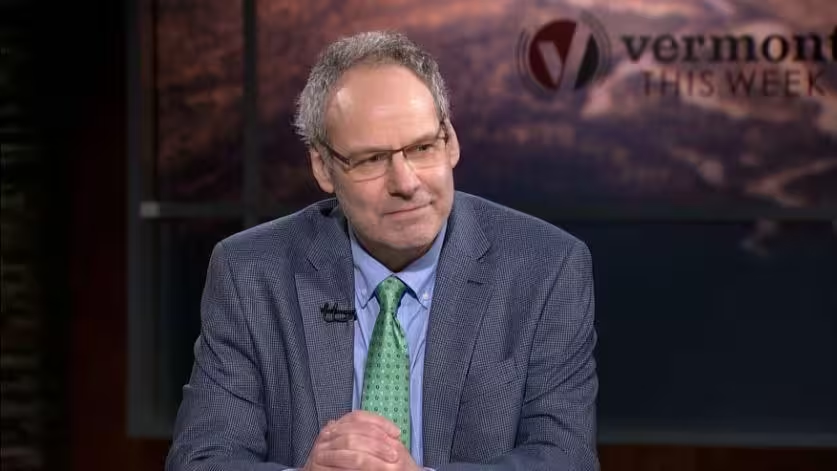
Hi, I'm Mitch Wertlieb.
It's Friday, July 24th, and with us on the panel today, we have Mark Johnson from WCAX, Shaun Robinson from VTDigger and Aaron Calvin from Seven Days.
I want to thank you all so much for being here.
We're going to dig into some politics on the show today for for much of it.
And that is because we have a primary fast approaching August 11th.
The primary for the Democratic candidates for governor, for lieutenant governor.
Really interesting.
You know, as we all know at this table, Governor Phil Scott has been enjoying high popularity.
He has been a multi term governor in Vermont.
We'll get into some of the numbers that show a little bit of a slip there.
But let's talk first Shaun Robinson about these candidates for governor Ali Richards, who a lot of folks know from the Let's Grow Kids campaign, and a relative newcomer, Amanda Janu, are sort of duking it out here to see who will take on Governor Scott.
What is the challenge for these candidates as you see it right now?
Well, I think the challenge is part of what you just said at the top there, which is how long Governor Phil Scott has been in office and how much support he's built up over the decade that he's had the job.
We know that Phil Scott has long enjoyed a lot of support from Democrats, just like from Republicans, and he's won by ever increasing margins.
In the last few times he's run for reelection.
He's won every city and town in the state in 2022 and 2024.
So the challenge is, you know, how do Democrats rally around a candidate who can appeal, you know, not just to the left wing of the party, but to the entire party and to Democrats who have supported this moderate governor for a long time to.
And Mark Johnson.
Another challenge they have is how to differentiate themselves from each other.
Ali Richards, Amanda Janu, I know you've spoken with both of these candidates.
What are they?
How are they trying to differentiate themselves for Democratic primary voters?
Well, and I would go back and I had one thing to what Shaun said.
I think one of their biggest challenges is getting known.
I mean, we inside baseball here may know who Ali Richards is.
Amanda Janu is kind of a newcomer.
But, you know, as we'll talk about in the poll numbers, the the the number of people that don't know them is enormous.
So that I think is probably the biggest challenge there.
You know, this is a really interesting dynamic that's going on.
And I think it's it's sort of a microcosm what's going on here in Vermont with the man that, you know, and Allie Richards of what's going on nationally.
You know, we've seen Bernie Sanders and AOC going out.
We've seen in New York.
You know, I think the Democratic Party is trying to figure out where they're going to go.
You know, are they going to go with the progressives?
Are they going to stay sort of more in the middle?
Even the grand planter race in Maine is a is a dynamic there.
You know, setting aside the problems that he ran into that made him drop out, but, you know, he defeated or is on the verge of defeating, you know, a long time centrist governor in Maine.
So I think what's going on here, and I think it's pretty well encapsulated with these two candidates.
Amanda Janu is clearly appealing to the more progressive side of the party.
And you've got Allie Richards, who's trying to navigate that channel where she keeps the progressives interested in her but doesn't go too far so that when she gets into the general election that she hasn't taken positions, that she's then got to walk back.
You know, I listened to the debate that that you folks had here in Vermont public yesterday, and it was very interesting when they were talking about taxes to fund the universal primary health care that Amanda Janu wants to do.
You know, Ali Richards was like, I'm not so sure about this.
And I thought that was a really smart political move on her part to say, I'm not ready to commit to that.
It would be very easy to do that in a primary, but if she wins, you know, then she'd have to live with the consequences of having said that.
So you brought up the Vermont public debate.
I want to play a bit of tape from that.
And this is the Democratic candidates you were just discussing, Mark, talking about their differences on housing.
Let's take a listen.
I think the reality is that we need to take a multi-pronged approach to housing right now.
One is we really need to limit private equity and large corporate ownership of the housing stock.
We need to increase taxation on second homes, luxury estates, Airbnbs.
ET cetera.
To actually reduce the property tax burden for residential Vermonters and to invest more in permanent affordable housing like housing trusts, co-ops and providing more support for first time homebuyers, first time home builders, and for working families to renovate their own homes.
I think it is incumbent on the governor to explain why this is a top priority.
So I have a kitchen sink approach to housing.
Everything we've got make it easier to build and cheaper to build and buy and rent.
Sales tax holiday on building materials templates for local zoning changes.
Technical assistance at the right place at the right time, including with funding to allow folks to use all the programs we have like the chip model and all these wonderful things that allow folks to build.
And absolutely a second home tax to put that revenue in and change behavior to keep our investment in our housing.
Okay.
For those of you listening on the radio, that second voice, the one we just heard was Ali Richards.
The first voice we heard was Amanda Janu, Shaun Robinson.
You know, I'm wondering, listening to those clips there.
Are you.
Are you hearing anything radically different in their approaches to housing?
Is there a way they can differentiate themselves for voters on this issue?
Well, I think to what Mark was just saying, you heard Ali reference a couple of specific, you know, like state programs, like you heard Chip mentioned.
That's something that came out of the statehouse.
It's, you know, a program she'd be familiar with from the time that she's spent in the lobbying circles there.
I think at the top of Amanda's remarks, you heard her talk about things that you might hear from Bernie Sanders, right?
Talking about these big, bold, progressive ideas, talking about this big systemic change.
So I do think it sounded a little bit different.
And the way they talked about taxation, like Mark said, has been different as well.
I want to show a graphic.
Now, if these two candidates were going up against Governor Phil Scott in the general election, and you can see there that if Scott was going up against Ali Richards, he would at this point have a 43% margin.
Again, these are estimates over 35% for Ali Richards, 44% to 33% for Amanda Janu.
Mark Johnson, those numbers are all surprising to you.
You see anything there that looks curious?
Well, I mean, they're pretty close to one another.
I think really, I just got to believe that Phil Scott would much rather run against Amanda Janu.
I think he could really differentiate himself from her much more easily.
You know, Ali Richards has got this program that the child care program that she was able to get through.
You know, that's a that's a huge deal for her.
If she were to run against Phil Scott.
And so, you know I don't really I'm not totally surprised by those numbers.
But as we'll get to you know, the governor's popularity is is certainly not what it used to be though.
You know, we talked about this so many times in this program when you're in the 60% as a multi term governor, I mean, that's just incredible because time is usually not in your favor.
So but I guess I would say if I were Phil Scott, I'd be watching those numbers and thinking which of these two would I rather run against.
And I think you would rather run against somebody who's more progressive.
Very interesting.
Let's take a look at some other numbers on this graph.
And there's something very curious at the top here.
These are decisions that voters either approve or disapprove of when it comes to Governor Phil Scott.
You can look there right at the top.
It says that 16% of those polled approve of his handling of education.
But then it says handling of education is a disapproval level of 20%.
I don't know how to make sense of those numbers.
Shaun Robinson to you.
Well, I mean, I guess I would note that this is showing that more people are disapproving of his handling of education than who are approving.
And we know that the governor was, you know, all in on the idea of forcing school consolidation for most of the legislative session.
He and his administration ultimately changed course at the end, when they realized that it was not going to be politically popular.
Both of the Democratic women who were talking about have been very clear that they also oppose forced consolidation as an education policy.
So, yeah, I think it shows that the governor has maybe lost some credibility on the education issue, but still really closely divided.
Well.
I would I would add to that, that I think that it's not really well defined.
I mean, I would I would say that the approval that he gets on education is that people are really upset about high property taxes, and I think they are happy to see him addressing the issue of taxation and what it's costing all of us to live here in Vermont.
And then I think that so that's he's focusing on the cost of education that people are approving of that.
But I think this whole mandatory consolidation is is the source of that, as Shaun said.
And that, you know, I think he read the tea leaves even before the University of New Hampshire did, which is why he basically bailed on it at the end of the session.
So I don't think that's a surprise.
But, you know, when people look at these polls, you know, it's not it's not really fleshed out the way maybe it should be.
Yeah.
I mean, sometimes the nitty gritty information you're talking about, the details are not evident when they put these out.
I also think it speaks to just how confusing and complex education is as an issue, that the governor can have a high approval here.
Go ahead.
Well, I mean, I think Governor Scott sort of put himself in this situation.
He broke the Democratic supermajority in this biennium, and he had more support in the House, in the Senate.
And at the end of the day, you know, even people who aren't following the news very closely might look around and say, are things better is, you know, my private property tax is better as my the cost of health care better.
It's not.
So who's to blame?
The person in charge.
It's going to be very interesting as we get to the general.
Of course we'll be discussing these things again.
Let's talk about the Democratic candidates for lieutenant governor.
Now, one name again, if you follow these sorts of things, will be familiar.
Molly Gray is running again.
She's had the job before.
Ryan McClaren is challenging.
And Esther Charleston, who actually ran for governor in the last election cycle, is now running for lieutenant governor.
Again, we are coming down here, Shaun Robinson, to to name recognition.
Is this what these candidates have going for them?
What can those who don't have the kind of recognition that Molly Gray has do?
Yeah, I think we are coming down to name recognition.
I also think in this race there's a lot of overlap in, in the policies that each of these three folks, you know, that they support.
If they're pretty similar policy wise, I would say I think the the differences that I've seen have been in the way they talk about their past experience that they bring to the job.
Molly Gray obviously has been the lieutenant governor before.
She's worked kind of directly pushing back against some of the Trump administration's changes to immigration and asylum policy since she left office.
Brian McLaren has talked a lot about his tenure working as a top aide to U.S.
Senator Peter Welch.
So again, on the front lines, kind of on the federal government level, he's talked a lot about his work supporting federal funding for different infrastructure projects around the state.
Folks might be familiar with the earmark process or congressionally directed spending.
So like new dental clinic that would be funded by the federal appropriations bill.
So he's talked about that in the extra Charleston.
You know, she talks a lot about her experience as an educational consultant.
She says she's brought people together to have really hard conversations.
And she also, as you mentioned, has that experience running a statewide campaign, albeit not a successful one.
She lost handily to the governor, but she did, you know, get out there around the state and has a lot of experience talking to folks.
It's interesting you mentioned policy because as we all know, there isn't a whole lot for the lieutenant governor to actually do in that job.
And it's an important job.
You're working with the governor.
And to that point, here are what the here's what the candidates for lieutenant governor had to say about working with the governor.
Let's play a clip.
What I think is unique about this moment is that we see the Trump administration coming for the state, often on all sorts of fronts, from voting rights to attacking our new neighbors to taking our health insurance.
And I'm uniquely place as a human rights lawyer and advocate, former assistant attorney general, someone who's been working with our new neighbors refugees for the last three years in a very close and deep way to be able to be a point of reference, a point of expertise for the governor, and figuring out how the office can be used to help protect the fundamental rights of every single Vermonter, every single day.
I have spent ten years of my life working for Senator Welch and trying to serve Vermonters.
That means working directly with the state of Vermont.
The governor has been the governor of that entire time, and we have worked closely on things like flood recovery, on things like immigration reform, on things like getting our veterans V.A.
coverage for cancers caused by their service overseas.
Like all of those things are not Partizan anyone that called their office.
We weren't asking who you voted for, who you supported for governor.
We were just trying to get things done.
And I just I won't do that with anyone who's in that office.
Once you're elected, especially statewide, you represent everybody.
And so for me, I would walk in and make sure that I have an open door policy that we're meeting, that we're in communication, that I amplify when constituents are communicating things with me that are an issue and that I don't agree with, but also highlighting what I do agree with.
And that work is what I've been doing for the last 15 years.
Okay, that last voice we heard was Esther Charleston.
Before that, we heard from Ryan McLaren and the first voice we heard was Molly Gray.
So, you know, I'm listening to that clip.
They're saying, you know, this is why I would work well with the governor, Mark Johnson.
Is that something that you think Democratic voters want to hear from their lieutenant governor candidate, or do they really, not really care if there's a close working relationship with the governor?
I mean, Phil Scott was a was a Republican lieutenant governor and worked perfectly well with Democratic governors.
But, you know, I want to actually go back to the question you were asking Shaw.
I mean, this is definitely all about name recognition.
I actually thought the U.N.
poll a month ago that had Ryan McLaren at 7%.
I thought, you know, there must be a glitch in the poll.
But he was only at 11% this next time around.
And, you know, he's basically saying what his own problem is, which is that he's been working behind the scenes.
You know, Molly Gray has been out there out front.
I mean, you know, for better or for worse, she was well known not only for being the lieutenant governor, but running for Congress.
And that was, you know, somewhat controversial.
People thought felt that she was, you know, moving a little too quickly to try to get into Washington.
But she's she's a name that everybody knows.
What's actually more important in that poll is how all three of those candidates, even Ryan McLaren at 11%, Esther Charleston, not a whole lot more.
They all would be John Rogers, who's the incumbent.
And I mean, there's a if I'm John Rogers, I'm looking at that poll going, oh my gosh, I am in deep, serious trouble.
And, you know, the fact of the matter is he looks like he's going to be a one termer who really only one because he ran against the, you know, a deeply flawed candidate.
And David Zuckerman two years ago.
So I mean, I would feel pretty safe today to say, you know, Molly Gray is going to be the lieutenant governor again.
As a bullet prediction for Mark Johnson.
But, you know, you seem to be vacuumed up there because the numbers are you're right, are not looking great right now for John Rogers.
Let's take a look at we have another graphic about from this poll why people are supporting their preferred candidates.
And if you take a look at the Democratic governor, most people say I'm looking at the policies more than past experience or politics or ideology.
For lieutenant governor, it's past experience.
So again, Molly Gray would seem to have a leg up there.
And as we take a look, we should mention, you know, the race for the U.S.
House.
Of course, Becca Ballot is very popular incumbent at this point.
She's facing two challengers for the Republican that will invite other for the Republican primary in Gerald Malloy and Mark Castor.
You know, and folks care about politics or ideology when it comes to those GOP, U.S.
House races, you know, policies here.
Shaun Robinson, anything surprises you about that as as far as what people are looking for from their potential Democratic governor candidate.
From their governor candidate.
Yeah, I think yeah.
I mean, the I think Mark talked about property taxes before.
I think you could argue that our last couple elections in Vermont have been about property taxes and the cost of living.
Affordability is the buzz word nationally.
Phil Scott has, you know, spent a lot of his political capital saying, like, I'm the guy who is fighting against new taxes, against new fees to make Vermont more affordable.
The line I've heard from the Democratic Party, particularly this year going into the primary, has been, well, it's been ten years of Phil Scott, and Vermont is not any less affordable.
And in fact, they say it's more unaffordable.
Now, the governor, to that point, when we've asked him at his press conferences, says, okay, well, you know, there's been a Democratic majority in the legislature.
You control the purse strings.
So, you know, they're going to go back and forth at each other over that.
But I think that this question of who really has has the not just the plan, but also the willingness to tackle this affordability challenge is going to be important.
Well, it's interesting.
Let's not forget about the 800 pound elephant in the room, which is Donald Trump.
I mean, people who are Democrats are very upset in this country.
So when you're looking at candidates, even if they're running for governor, even though Phil Scott has not been deeply aligned with Donald Trump, I mean, people are the crowds that show up for Bernie and AOC, you know, the election of Monday.
I mean, people who are Democrats are hungry for change.
And you've got Amanda Janu, who has kind of come out of nowhere but has got presence.
She's talking big ideas.
The other thing is that all of these candidates are really talking about, if you were to poll Vermonters what the three big issues are that they want, you know, it's taxes, it's health care, you know, and, and education reform.
So, you know, and I think they're wisely talking about those right issues.
But, you know, there's a lot of backlash here to what's going on nationally I would argue.
Yeah.
And we've seen that too when it comes to immigration, the Ice raid back in March, there are so many issues that folks right here in Vermont are looking at on a much larger scale.
I'll also note very quickly, before we move on from this, that again, we mentioned at the top, you know, Governor Phil Scott is still enjoying some high polling ratings here in the state of Vermont.
But it has dipped a little bit.
And I think, Shaun, to your point, you know, you were saying that he was very popular in talking about that supermajority that Democrats had, but that's gone now.
There's not a supermajority anymore.
He can't keep leaning on that.
And the questions about affordability in Vermont and all those things are going to keep cropping up, I think more as we head to the general housing is such a big issue.
It's one of the things that is a huge problem in the state of Vermont.
Aaron Calvin, you wrote a fascinating piece with Hannah Bassett in Seven Days about regulating short term rentals in Vermont, which didn't immediately seem to be like a huge problem.
But you looked at communities in Stowe, Burlington, Woodstock and Ludlow.
Let's talk first about Stowe, where folks are concerned about short term rentals, even to the point where now they're putting caps on that.
Is that right?
Yeah.
On Wednesday evening, their select board unanimously passed.
This changed their short term rental ordinance, capping the number of short term rentals in Stowe at 850.
Right now, because there was a sort of a panic rush to get ahead of this cap.
People who don't really even have any intention of of using their properties as short term rentals rush to register their properties that swelled the the short term rental registry to about 1600.
Why are they doing that just even if they're not intending to rent out their property?
Well, many of them might be second homeowners.
They might not be on the ground.
So they're taking advice from their real estate agents who are telling them, if you want to preserve the ability to do this, you've got to get in on this now.
Well, but that's exactly the concern that certain people who rent their homes out in Stowe to be able to afford the high property taxes and high costs of living in Stowe, where the median home value is $1 million, you know, say that they rely on that to do this, and no one's going to stop them from continuing to do this, but they can't sell their home now and say you can use it to generate short term rental profit, because they can't guarantee that.
Now, the other argument that's being made about capping these properties is that there are folks who work in Stowe.
You know, it's a resort community, the folks who work in those hotels and their restaurants, they can't really afford to live there in many cases.
Right.
Yeah.
This is an issue that Stowe has been wrestling with since the pandemic kind of brought this surge in in home buying.
And Airbnb, you know, has allowed people to turn what might have been residential homes into, you know, vehicles for profit.
And it's, you know, it's sort of shutting out people who might be able to to live and work in Stowe, who might not have as much means as, as most of the people who live in Stowe.
And it has led to a lot of issues with being able to for employers, being able to find people to work like, you know, the high profile example of this is a skinny pancake.
Closed their location in Stowe last fall.
The owner, Benji Adler, cited the fact that, you know, it was just impossible for him to maintain a reliable workforce.
Now it's a little bit different in a place like Burlington, right, where there's already a pretty low incidence of people using these, these sort of second homes for renting out and things like that.
Right.
I think the issue in Burlington is that even though the number of short term rentals constitutes less than 2% of the housing stock, you know that that's still meaningful in a town in a city like Burlington where, you know, the cost of living is so high and the housing demand is, is is there's so much housing demand and such little supply that, you know, that the leadership at the time felt that they needed to to take these measures to institute a strict residency requirement.
And in order to to do that, and also saw an opportunity to bolster the affordable housing in the in the city by adding new taxes to it.
Now, you know, short term rental owners, at least one that I talked to said he uses his short term rental to subsidize the long term rentals that he's running.
And, you know, sort of bemoans the fact that Burlington, which is, you know, trying to make up for lost Canadian tourism and stuff like that, isn't trying to allow short term rentals to bolster their tourism economy more.
But as we're only just seeing the housing supply in Chittenden County is starting to fall a little bit, you know, it's still quite pressing, you know, to keep units available for long term renters.
Yeah.
But so how is somebody who is not allowed to use it as an Airbnb in Stowe?
They're going to have to rent that.
I mean, presumably the idea is that then somebody could rent that home, but they're going to have to charge so much for rent in order to cover what the property taxes are.
I mean, it seems like the real problem is that, you know, the cost of real estate, the cost of a home.
I mean, it's just exploded.
So I'm not really sure how that would help.
Yeah.
I mean, it's interesting the short term rental debate has gotten a lot of attention because for one thing, there is the Vermont Short Term Rental Alliance, which is the local short term rental industry lobby, and Airbnb have both gotten involved on the ground in Stowe to try to push back on these proposed regulations to no real effect, but they've been effective at generating a lot of controversy around it.
But really, it's just one aspect of this broader plan that Stowe is trying to implement to, you know, designate affordable housing and build more affordable housing in the town and sort of try to set aside, you know, on purpose, a set of their housing stock that could reasonably be afforded by a hospitality industry worker or somebody who's even like the Housing Needs Assessment in Stowe published last year, found that even high paid professionals, like lawyers, have a hard time affording real estate in the snow.
So, you know, they're taking a page out of Burlington's book.
They at the town meeting day, they passed are they approved a new housing revitalization fund that would would put more money towards affordable housing.
And Aaron, I'm sorry, we're going to have to leave it there, but I urge you to read that article in seven days.
It's comprehensive on the housing crunch.
We'll have to leave it there.
This week, our panelists, Mark Johnson from WCAX, Shaun Robinson from VTDigger, and Aaron Calvin from Seven Days.
Thank you so much for being here.
I'm Mitch Wertlieb, see you next week for Vermont this week.
 New Episode
- News and Public Affairs

Top journalists deliver compelling original analysis of the hour's headlines.

- News and Public Affairs

FRONTLINE is investigative journalism that questions, explains and changes our world.



 New Episode
 New Episode



 New Episode
Support for PBS provided by:
Vermont This Week is a local public television program presented by Vermont Public
Sponsored in part by Lintilhac Foundation and Milne Travel.