Vermont This Week
July 17, 2026
7/17/2026 | 26m 46sVideo has Closed Captions
No exit: Inside a botched ICE raid in Vermont | Chittenden County State’s Attorney race
No exit: Inside a botched ICE raid in Vermont | Chittenden County State’s Attorney race | State of Vermont's prisons | Moderator - Mitch Wertlieb; Liam Elder-Connors - Vermont Public; Colin Flanders - Seven Days; Mikaela Lefrak - Vermont Public.
Problems playing video? | Closed Captioning Feedback
Problems playing video? | Closed Captioning Feedback
Vermont This Week is a local public television program presented by Vermont Public
Sponsored in part by Lintilhac Foundation and Milne Travel.
Support provided by:


Vermont This Week
July 17, 2026
7/17/2026 | 26m 46sVideo has Closed Captions
No exit: Inside a botched ICE raid in Vermont | Chittenden County State’s Attorney race | State of Vermont's prisons | Moderator - Mitch Wertlieb; Liam Elder-Connors - Vermont Public; Colin Flanders - Seven Days; Mikaela Lefrak - Vermont Public.
Problems playing video? | Closed Captioning Feedback
Where to Watch Vermont This Week
Vermont This Week is available to stream on pbs.org and the PBS app.
Support the crew
Help Mitch keep the conversations going as a member of Vermont Public. Join us today and support independent journalism.Providing Support for PBS.org
Learn Moreabout PBS online sponsorshipThis week, the inside story of a botched ice raid in Vermont.
It's not going to go well for us.
It's going to all focus on us.
And we're doing we're we're not supposed to be collaborating with Ice.
Plus, a heated race for county's top prosecutor and a look at the state of Vermont's prisons.
All that and more ahead on Vermont this week.
From the Vermont public studio in Winooski.
This is Vermont this week, made possible in part by the Lintilhac Foundation and Milne Travel.
Here's moderator Mitch Wertlieb.
Hi, I'm Mitch Wertlieb.
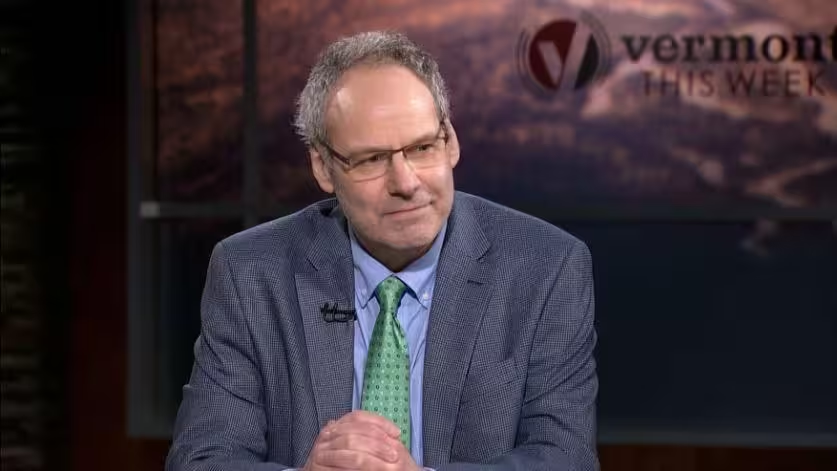
It's Friday, July 17th, and with us on the panel today, we have Liam Elder-Connors from Vermont Public, Colin Flanders from Seven Days, and Mikaela Lefrak from Vermont Public.
And I want to thank you all so much for being here.
We're going to start really talking about some astonishing video that's been produced by the Vermont Public News team.
This deals with the raid, an ice raid back in March in South Burlington.
Lionel Connors this came from literally hundreds of hours of video footage, right?
More than 130 hours distilled down to about half an hour to show kind of a narrative track of what happened that day.
You narrated this piece.
It's quite astonishing, everybody to watch it, even though it's tough to watch.
And I want to let people know too.
If you are going to watch this, there's a lot of violence involved in this.
There's some very rough language, as you might imagine.
Let's start by talking about what happened at the beginning of this raid, the early morning hours.
I guess South Burlington Police were the first on the scene in addition to the Ice agents, right?
Yeah.
That's right.
They had gotten reports that there was a crash.
So South Burlington Police were going to to check it out.
And I think what's valuable about the video that we produced and all the body camera footage that came out, is it helps us understand a little bit more about the decision making process by state and local police during this, this chaotic scene that unfolded over the course of the day.
And so, you know, when more than 130 hours of body camera footage came out at the Vermont public newsroom, we looked at that and said, you know, we want to try to understand more of what happened and how we got from just South Burlington Police responding to this car crash, which had resulted because Ice had been chasing a man to, you know, street clashes where an Ice Swat team is throwing flash bangs and spraying protesters with chemical irritants.
So we're trying to track that in the video.
Yeah.
And it really comes out.
So you had body cam footage.
There was some reporter footage from cell phones.
Even an anonymous video was sent to Vermont public.
Right.
And that comes towards the end of the video here.
So there's an astonishing amount of video evidence.
Let's start by showing a clip here.
And this is, I think, South Burlington Police sort of asking amongst themselves and Ice agents like, what is the overall plan here?
What is the plan?
We're getting the warrant.
We're going to enforce the law.
We're going to take those.
At what point does it become not worth it for?
One person in my management says it's not.
It's two people.
Number one okay.
He hit our guys today.
And I think you would feel the same way.
Your guys.
I'm just asking a question.
I mean, I'm just asking the question.
Very frustrating.
No, I'm not on their side.
I'm just trying to make sure that doesn't escalate.
That's all.
You guys make sure that's great too, right?
Liam Connors, who was the gentleman who who was saying, I'm just asking questions.
I'm asking you a question of that Ice agent.
What was going on there?
Right.
So that is Deputy South Burlington Police Chief Shawn Briscoe, who was on scene for most of the day.
And he's talking to the ice supervisor on the scene, and another Ice agent who I believe had come in from New Hampshire.
And what sort of what's remarkable about that scene is.
That's right.
After there had been sort of the first physical confrontation between protesters who are trying to prevent ice from entering this House and, and Ice agents.
And Briscoe is asking the Ice agents, as we saw, like, what are they doing here?
And what that really shows is, I think, how dug in ice was that they were determined to to carry out this operation no matter what, even at the opposition or the sort of questions from the local police on the scene.
Yeah.
And I think it was pretty striking to right at the end here where the Ice agent says to Briscoe, well, you guys will help us make sure that this doesn't escalate.
I mean, I know the local police were feeling a lot of that pressure, but even the Ice agents are putting that on local police, meaning make sure you guys keep the peace, which is kind of a it's a shocking thing for them to be asking where the main agitators here.
And I think in your video, in the very beginning, you start to see those questions, the seeds of doubt in the local police about the priorities of the Ice agents, where chasing somebody through the busy Dorset street in the middle of the school day.
And it's pretty clear from the start that the Ice agents have, like you said, they get very dug in and they don't move the entire day.
You know, then it goes on and then the next bit of clip we're going to show here, it sort of speaks to what Colin is saying here about this idea that the local police involved, South Burlington Police, Burlington Police will eventually come on the scene, but Vermont State Police then were called in to.
They seem to know that this is a recipe for disaster.
Let's take a look at this other clip.
They're going to toss anybody out of their way.
They're not from Vermont.
They're not going to care about anything.
So we all know that.
So we're thinking we're going to have to possibly intervene to get people off the house front and rear, to give them an avenue to execute to one.
It's not going to go well for us.
It's going to all focus on us.
We're doing we're we're not supposed to be collaborating.
So Liam, again, I find that astonishing.
The Vermont State Police understand what's going on here.
They don't want to be collaborating with Ice.
I think that's pretty clear.
But at the same time, they are there.
Why are they there?
And they know they have a job to do?
Well, I think, you know, some I think important context to remember about in March.
This is not too long after we'd seen massive protests in Minneapolis, where Ice agents had shot and killed two U.S.
citizens.
And so, fresh on everyone's mind, I mean, I was I was there on scene for some of that day, was what happened in Minneapolis and wondering if this scene in South Burlington was going to escalate to that level as well.
And so I think police were very aware of that and were concerned that if they didn't do something to intervene, which could possibly include helping facilitate ICE's operation, that Ice was going to was going to carry it out anyways.
And that's what they had gotten word that Ice was going to go into that house no matter what, and potentially used their own Swat team who would come in and use force to move those protesters.
And I think state and local police were very concerned with the level of force that Ice would use.
And I think in that same huddle, I don't think we had it in that footage there talks about that, how, you know, Ice is going to come in no matter what.
And they're not from Vermont and they're going to use more force.
That's the lieutenant you're mentioning from Vermont State Police.
Lozier.
Yeah.
Corey.
Leutnant Corey, lodger who was on the scene?
Yeah.
You know, I don't know what you all felt watching that video as well.
I've seen it three times now, and it strikes me that you can feel the intensity ramp up, because a kind of mob mentality takes hold in situations like this.
It's extremely emotional.
The protesters are they're trying to, you know, they they feel they're defending their fellow Vermonters.
Liam should not be lost here.
That as all this chaos is going on, the Ice agents, they're not even sure they have the right person they're seeking in the house.
Correct?
Yeah.
And that's something that was very interesting to to learn.
When we looked at this footage earlier, one of the Ice agents right off the bat tells the South Burlington Police officer responding to the scene that, you know, you know, this is who we're looking for, but it doesn't really matter if it's him or not because, you know, to them.
They've already broken, broken the law.
They've they've assaulted a federal officer.
And they're going to they're going to take them no matter what.
But as it turns out, they they enter the house.
They don't find the gentleman that they're looking for.
Arrests were made of.
I believe there were three people or four people in the house.
There was a teenager and three other people.
Yeah.
The three adults that were in the house were arrested.
The 18 year old was not.
He was left in the house.
But none of those three people that were arrested were the were named in the warrant that Ice got to enter the house, which I think sort of speaks to the whole situation.
The person that Ice was looking for was never in the house, was never in the car.
Yet all of this unfolded anyways.
Yeah, and it's happening over hours and hours of time.
This began in the morning.
Then we're getting into the, you know, early afternoon, the late afternoon hours into the evening.
Then it becomes apparent that there's another problem, because when the people are extracted from the house, put it in a car.
Protesters don't want the car to leave.
There's people in the road, Vermont State Police, that are wondering, how are we going to disperse these people?
Let's take another look at a clip here.
They're just.
Starting to grab on to us.
Start pulling.
In again.
It's we have to either use OC, we have to use something.
It will be playing field.
While we're asking for.
We're at a crossroads.
We have.
We can't walk away right now.
No we're not.
We don't.
Have enough physical force here to move that crowd, so we have to use other tools.
To our school.
What are we saying?
Everybody is saying no gas.
Might as well be Ice agents.
You're here helping them.
There's just so much going on there.
Liam.
There was a mention of using OC.
What is.
What is that?
That'd be pepper spray.
So I think one of the things that was fascinating about this, doing this work and reporting and going through the footage and I said, should say we had a team of people that went through all 130 hours of plus of this footage, myself included.
So we watched a lot of a lot, a lot of the footage to to make this video.
But that state police and local police on scene and state police wanted there were on the ground there, wanted to use chemical agents to disperse the crowd, and they were getting a command from people that weren't on scene from higher ups saying, don't do this.
And I found that to be a very interesting and illuminating part of this work was that there was a request on the ground to do this, but that was not granted.
And so I think sort of speaks to the concern about the optics, potentially of the situation.
And we don't get we don't know where that directive was coming from, not to use the chemical agents.
Somewhat higher up in law enforcement agency, but who made that order?
Not sure.
You know, eventually flash bombs were used.
These were deployed by ice.
There were some things used.
Pepper spray came into to all of this.
I want to ask you both Colin and Michaela, you know, and not having worked on this particular video, what did you come away with it from?
Because I didn't work on this video either, but I found it extremely difficult to watch and yet very important to watch.
What were some of your takeaways?
Yeah, I mean, I think my takeaway is something that I felt from the very beginning, based on the other reporting that we've seen, and it really hones it with this video, was just the sheer reluctance of the local police to be involved in this in any regard.
And you can see it, I think, in these little intimate huddles where South Burlington Police has one.
There's the video that we just saw, Vermont State Police, where they're recognizing that this we're in a terrible spot here.
We don't want to be here.
And they are not gearing up for a fight.
They are not they are not enthusiastically jumping in on this.
And at every turn, I think they really are making a calculation.
How do we get out of here without somebody getting seriously hurt?
And miraculously, I know there was some minor injuries, but miraculously, nobody was killed in this incident.
And I think it my takeaway is like how closely that could have turned at any moment.
This really could have devolved even worse.
And it's hard to imagine seeing those scenes.
But I just I don't know, for me, it's just I had a lot of empathy for the police officers in this case who were put in an impossible position.
And Mikhail LeFrak, you know, you have interviewed so many of these officials before in Vermont edition.
I know you've talked to Jennifer Morris and others.
What was your takeaway?
And seeing some of these people you recognize having to deal with the situation?
I mean, honestly, the thing that I keep thinking about is a conversation I had with with John Murad, who's the head of Vermont's Department of Corrections this week.
He used to be the chief of police in Burlington, and he told us that the Department of Corrections is currently housing 15 detainees, federal immigration detainees in their state prisons.
We don't know a lot of their stories.
It's because of the the body cam footage, the number of local police that were at this event, the number of protesters that showed up that brought that police and that we we have this detailed account of what happened that day and what Ice was trying and in many ways failed to do.
But there's a lot of other people who are detained right here in Vermont where we don't have those stories.
That's such an important point that I want to ask you more about that conversation with John Murad in just a moment.
You know, finally, I just want to say, like looking at this, Colin, to your point, I don't see how anybody could watch this video objectively and not come away with one very distinct conclusion that this this is a failure from the top.
Federal agents are being sent to places like Vermont, like Minneapolis.
We are talking at a time not too long removed from when someone was shot and killed in the state of Maine.
Again, a person they thought was someone else, not the person they were looking for.
That person is dead.
It happened in Houston.
This is a failure from the federal level, and states like ours are being put upon with local officials having to deal with these situations.
Like you said, those cops of the Vermont State Police, South Burlington Police certainly did, clearly did not want to be put in this position.
Yeah.
I mean, I'm not going to put this very eloquently, but it was stupid.
The whole thing was stupid.
It never should have happened.
And it's become clearer and clearer and clearer.
And you watched this video and you just think how many lives were put at risk for, for just a completely botched operation.
I mean, it's it is kind of mind boggling when you put it all together and just think that it never should have happened.
And that's why this video is ultimately so important and why I appreciate your work on this so much.
And our entire Vermont public news team.
If you want to check out the full video again, it's about half an hour.
It's at Vermont Public.
Let's move on to another situation here, because stemming from that botched ice raid, there are going to be some decisions that need to be made from the state's attorney in Vermont about whether or not to prosecute some of the protesters.
Colin Flanders, you wrote an article recently about the incumbent, Sarah George, who is facing a challenge from Bram chronicled.
And there are very different philosophies here from the two of them, right?
Yeah.
That's right.
And I think just for starters, a lot of people don't fully understand what the state's attorney is.
The way that I've come to kind of describe it is, I think if you're watching Law and Order the first 30 minutes or we're trying to figure out the guy who did it, now we found him.
We go to the prosecutor and we say, here's the evidence.
And they say, listen, we need more.
You got to go back.
That's Sarah George.
Sarah George is a state's attorney or the district attorney in another place.
It's the person who decides whether to charge a crime, what to charge it with, and advocates in front of a judge for a resolution.
And I think often these positions in Vermont go overlooked, but not in Chittenden County.
It's a very political position, and in particular because of the situation we've been seeing in Burlington in recent years, where public safety is top of mind for a lot of people.
We see public drug use, we see a lot of visible homelessness.
And so all eyes are on this race.
And there are two very different philosophies.
Sarah George is very much of the ilk of the quote unquote, progressive prosecutor, someone who believes that the system as it stands right now is inequitable, that it too often punishes, punishes poor people, that it is filled with racial inequities and that we imprison way too many people.
And so, Sarah George has been over the last decade, trying to dismantle that system from within.
And some of her main policies try to get at some of those things.
So, for example, she does not ask to hold people on cash bail, which is a practice that can disproportionately impact people of color and people who are poor.
Bram Chronic Feld wants to do do away with some of those policies.
Bram wants to very much return to the office, being an advocate for the community.
And that means, in Bram's mind, taking a look at the impact for everybody, for businesses, for victims and for the offenders.
And I think that it's pretty fair to say Bram is a lot closer to the sort of prosecutor we'd imagine a little more tough on crime.
But Bram is walking a bit of a tightrope, trying to also talk up restorative justice in these other alternative programs.
And the race has really come down to, I think, how much patience does the public have in some of these experiments that we're seeing?
And I think Sarah George is making the case that just stick with it.
We're really seeing change here.
That's what I was going to ask you, Liam, because you've covered Sarah George for for quite a while now.
You know, her policies.
Is that her message to voters like, give this a little more time for my approach to work?
Yeah.
And I'm actually I've covered this race as well.
And I covered the last her last reelection, which there was a challenger in the Democratic primary.
It was very, very similar dynamics that played out as well.
But when I talked with her this week about this race, she said that, you know, there's been a lot of challenges in in the community in Chittenden County, especially since the pandemic, a court backlog, there was a spike in violent crime and gun violence and homicides in around the time of her last reelection.
And so she focused on on those serious crimes.
And most of those have been resolved.
And the attention is now turning to some of these smaller quality of life issues that have been very prevalent.
So public drug use, retail theft and things like that.
And she's saying they're making progress on that and that she has the experience and has spent the time here, that she should stay the course and kind of see these things through and wrap up her time since since she is the one that has the experience.
And, you know, Bram chronicled obviously is arguing that he could come in and take care of this a lot faster.
But to the point of I think one thing I keep reminding myself is this is a Democratic primary, this isn't the general election.
And so in terms of how Bram is presenting himself to voters, that's different than a general election.
And I think he is certainly walking a tight line between not wanting to say I'm a tough on crime prosecutor and still supporting some reform and sort of progressive measures because you're dealing with a voting bloc in the Democratic primary that is going to be more liberal than your general election.
So the dynamic of the race is also, I think, changed by that.
Yeah, yeah.
And I think for both of them, their challenge is to dispel these caricatured versions of themselves.
I think for Sarah, it's this idea that she just doesn't prosecute crimes, that she doesn't want to lock anybody up.
She wants to give everyone a get out of jail free card.
And for Bram, I think it's the idea that he's just to lock him up and throw away the key kind of guy.
And and the challenge is getting through, getting some of the nuance out there to people and to Liam's point.
Yeah, you're dealing with a relatively more liberal block, and you're trying to make the case that I would hold them more accountable, but also be compassionate.
And it's a lot of it's a tough message, a. Lot of plates spinning in one time, for sure.
Know this really is the law and order show Colin Flanders, because we also have a new state police commander that you've been writing about.
Tell us about Sean Lone.
Yeah.
Sean Lone is a longtime Vermont State Police veteran, started with the department about 20 years ago, worked his way up through the ranks and is now replacing Matthew Birmingham.
And I talked to Sean on the phone and he he's really excited about the position.
He thinks he wants to focus, continue the focus on proactive policing, which is sort of this buzzword.
We hear about a lot more on the local side, but in his mind, it means taking a look at a stretch of highway that might have a high death rate in figuring out what are some things we can do to prevent crimes from happening versus just responding?
I think, like any state official right now, his big challenge will probably be just maintaining a staff, recruiting, retaining troopers.
The state police, like every other agency around the country, has been dealing with a lot of vacancies.
And also, I mean, who knows?
As we've just seen at any moment, a big incident could pop up and now Sean Lone would be the guy.
I can't imagine staffing issues being any kind of a problem.
For example, the Department of Corrections, Michaela LeFrak, and of course, I am being facetious here.
It's a very serious problem.
You spoke with John Muret, as we were mentioning before.
What was he telling you about the problems of the doc?
Yeah, these numbers are pretty shocking and they don't come out of nowhere.
Staffing has been a major issue at the Department of Corrections for for years now, especially in the last five years, is the number of of inmates at Vermont prisons has has ticked up really since 2021.
But a couple of the numbers that he shared with me.
So the average vacancy rate among security staff.
So that's correctional officers one and two.
It's about 20% across the six prisons in Vermont.
It's much higher at certain facilities.
Northern State Correctional Facility in Newport, they have a more than 35% vacancy rate.
And that can lead to a whole host of issues, including lockdowns due to a shortage of staff and overtime hours.
That's a big one.
Commissioner Murad emphasized that their usage of overtime has gone down 92,000 hours of overtime for correctional officers last year this time, compared to 80,000 this year.
Forced overtime, where they basically make you stay an extra four hours on top of a 12 hour shift that's gone from 2500 hours this time last year to 369 hours.
So just having a 16 hour shift.
A 16 hour shift.
Yeah.
And we had somebody call in a correctional officer at a facility in southern Vermont saying, yeah, I'm just getting off my second overtime shift in a row.
I have lots of colleagues who are quitting.
Morale is very, very low.
And that's the reality right now.
I mean, what can be done about this?
You can increase pay, but again, that's not going to help somebody who's having to work a 16 hour shift in a prison, which is not an easy job.
Right.
And Commissioner Murad is no stranger to staffing shortages.
He faced a parallel issue when he was the chief of police in Burlington, as they were trying to hire police officers there.
He has a different set of tools available to him at the Department of Corrections.
He really emphasized.
We do pay a very, very competitive salary.
It's a living wage.
But yeah, at a certain point, there's no amount you can pay to get somebody to do 16 hour shift after 16 hour shift.
There's also a 50% turnover rate in new staff, which is really concerning, he said.
They've created a new position, a facility staff experience coordinator, to really focus on those new correctional officers.
So they're doing doing what they can, he says.
But it's not something that's going to get fixed overnight, especially in a state that just doesn't have a huge population of people who are looking for work.
Yeah, that's what I was wondering to, you know, who's going to fill these jobs.
You know, it's astonishing.
But it was a very good conversation.
Folks can find that at Vermont Public.
Colin Flanders, I wanted to ask you briefly about this lawsuit that the attorney general has filed over an investigation into an artificial intelligence video.
Pretty nasty one at that, too.
Yeah.
So this is people probably remember a month ago or so, there was a AI video depicting Representative Becca Balan in some unflattering statements in kind of playing up her opponent.
So this lawsuit is actually from the creator of that video who, shortly after putting it up online, got a letter from the attorney General's office saying that you are now under investigation for potentially violating Vermont's Vermont's AI law.
And this is a law we passed earlier this year that seeks to target deceptive media that is involving political campaigns and tries to get at what we've seen elsewhere, like those deepfake videos, the idea that we're going to be we're going to be creating fake advertisements that could sway an election.
The 18 year old Colin loved this story because I really love the media ethics angle.
It's just it's a fascinating argument.
Essentially, they're making the case that the law is unconstitutional because it is content based and is trying to silence someone for what is protected speech.
Weren't they arguing it was satire?
Yeah, I mean, it's pretty clearly satire.
Becca gets picked up by a backhoe and dropped into a dumpster, which I don't think anyone is going to think is real, but it's also unsavory.
And I think a lot of people don't think that it has a place in our politics.
So it's a fascinating case.
We'll be following it.
I'm really interested to see where it goes.
Yeah, I can read that article in seven days.
Michaela, I want to end here with you because we are talking about all these issues coming up, primaries, big elections coming up.
Vermont Edition is going to be carrying some live coverage.
What can you tell us about the debates coming up?
Yeah, we are we have two debates coming up next week on Tuesday are the Democratic candidates for lieutenant governor, Thursday the Democratic candidates for governor.
We're also taping interviews, some of which we've already aired with the two Democratic candidates for state auditor.
And we're speaking with the Republican congressional candidates running to try to challenge Becca Ballot.
That's Mark Kirsten and Gerald Malloy.
And you'll be able to hear those the week after next.
Full comprehension, comprehensive coverage, a very, very important stuff.
So do check that out.
I want to thank our panel today so much.
It's been a great discussion with Liam Elder-Connors from Vermont Public, Colin Flanders from seven days and Mikaela Lefrak from Vermont Public.
I'm Mitch Wertlieb, thank you so very much for watching.
Hope you'll join us again next Friday right here for Vermont this week.
 New Episode
- News and Public Affairs

Top journalists deliver compelling original analysis of the hour's headlines.
 New Episode
- News and Public Affairs

Today's top journalists discuss Washington's current political events and public affairs.



 New Episode
 New Episode
 New Episode

 New Episode
 New Episode
Support for PBS provided by:
Vermont This Week is a local public television program presented by Vermont Public
Sponsored in part by Lintilhac Foundation and Milne Travel.