Vermont This Week
January 2, 2026
12/30/2025 | 35m 16sVideo has Closed Captions
2026 Legislative Preview
On a special edition of Vermont This Week, we’re getting ready for the start of the new legislative session - speaking with some key lawmakers tackling the tough issues facing the state in the new biennium.
Problems playing video? | Closed Captioning Feedback
Problems playing video? | Closed Captioning Feedback
Vermont This Week is a local public television program presented by Vermont Public
Sponsored in part by Lintilhac Foundation and Milne Travel.
Support provided by:


Vermont This Week
January 2, 2026
12/30/2025 | 35m 16sVideo has Closed Captions
On a special edition of Vermont This Week, we’re getting ready for the start of the new legislative session - speaking with some key lawmakers tackling the tough issues facing the state in the new biennium.
Problems playing video? | Closed Captioning Feedback
How to Watch Vermont This Week
Vermont This Week is available to stream on pbs.org and the free PBS App, available on iPhone, Apple TV, Android TV, Android smartphones, Amazon Fire TV, Amazon Fire Tablet, Roku, Samsung Smart TV, and Vizio.
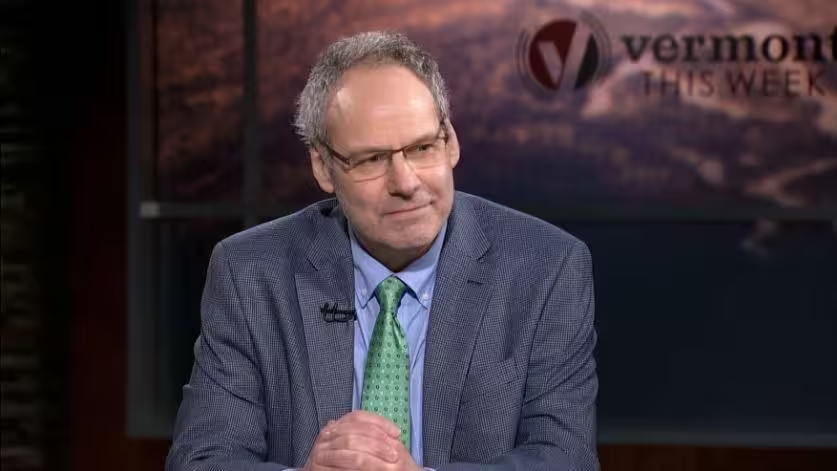
Support the crew
Help Mitch keep the conversations going as a member of Vermont Public. Join us today and support independent journalism.Providing Support for PBS.org
Learn Moreabout PBS online sponsorshipTonight on a special edition of Vermont This Week, we're getting ready for the start of the new legislative session, speaking with some key lawmakers tackling the tough issues facing the state in the new biennium.
We've discussed a lot of these issues over the past year with our rotating panelists of reporters.
Education reform, housing and health care, to name a few of the big ones.
And now we'll hear from some of the legislators dealing with these topics in Montpelier.
As we head into the new year.
That's coming up next on Vermont this week.
From the Vermont Public Studio in Winooski.
This is Vermont this week, made possible in part by the Lintilhac Foundation and Milne Travel.
Here's moderator Mitch Wertlieb.
Good evening everyone.
I'm Mitch Wertlieb.
It's Friday, January 2nd.
Happy New Year.
And joining me on the panel today, we have Jill Krowinski, Democratic state representative from the Chittenden 16 district and the current speaker of the House.
Also, Ashley Bartley, Republican state representative from the Franklin one district and vice chair of the House Committee on General and Housing.
And Scott Beck, Republican state senator from Caledonia County and the current Senate Minority Leader.
We also have with us Phil Baruth, Democrat progressive senator from the Chittenden Central District and the current president pro tem of the Senate.
Thank you all so much for braving some tough weather and difficult driving conditions to get to our studio in Winooski for this special program.
The episode you're watching, by the way, or listening to, was taped earlier this week, and we realized that all the topics we'll try to get to tonight could carry a single program on their own, because they're all so all encompassing to Vermonters.
But we will do our best to get to as much as we can in the time that we have.
So let's start with the topic that was voted number one by our reporters as the most important story of the past year, certainly one that's going to play a big role in 2026 as well.
That, of course, is education reform.
And Phil, I want to start with you.
We know that there was a big redistricting task force that was set up, and the idea here was to look at making new maps for Vermont, consolidating some districts, looking for ways to to save money.
Obviously, you helped select some of these lawmakers who are going to sit on this task force, but they came back and they said, you know what?
Making mandatory consolidations of districts is not a great idea.
They want more time to study this.
As far as I know, both you and the House speaker are for the redistricting.
But if that is the case, then why disregard what your own task force is saying about, you know, stepping back from this a little bit?
Sure.
Well, what I would say is we often put together study committees or task forces that don't go where we think they're going to go, and that's a fact of legislative life.
What I would say is that whether you like what that task force did or don't like it, none of it would trigger act 73, which was the main way that we were going to control spending.
So without that trigger, we add another six months or a year before we're controlling education costs.
What that means is property taxpayers are still going to be under the gun, unless we do something additional.
So, my take away from their work is that it might be useful in this way or that, but it leaves us with the clock ticking much more loudly than it was before.
So I will be proposing, what amounts to a cap on education growth in spending for the next two years.
And my reason for doing that is that the cost containment measures and act 73 not being triggered won't save us.
And we're going to continue to spend money to buy the rate down.
I want to make sure I'm understanding all of this.
It is complex.
And you'll Kominsky.
Let me ask you, things like ideas like funding reform, taxes on second homes.
Can any of those things happen without having these maps redone?
I think that we need to have a comprehensive approach, and how we ensure that our kids are getting the best education at a price Vermonters can afford.
And we know that we have many different components that are moving from minimum classroom size to the to the different funding formulas.
I think that until we get back in the building and start hearing testimony, we, you know, we can't say we're going to move on this or do that.
It's really important that we take a deep dive into the task force report and look at different map options that are out there.
We'll also looking at how we how we fund, education in a fair way.
But I think it's safe to say right now there's agreement that we have to do something that our kids aren't getting a fair education, and that the way we're funding it is just isn't working anymore.
So we are going to be committed to tackling that when we get back in the building next month.
Okay.
Scott Beck, I know that you were definitely in favor of having some mandatory redistricting done.
You know, the way you're looking at this, the governor was very critical, of this task force saying they failed in their mission.
I mean, do you do you agree with him on that?
Do you think that something has to be done now?
I do agree that the task force failed in its mission.
I mean, 180 legislators and the administration agreed that what we needed, to start this start in January was a set of maps, proposals to to begin the conversation and, a small group of individuals that ended up on that task force decided that they did not want to produce that, that map.
So I think that I think the task force did fail.
The question, I think is what do we do going forward?
I think redistricting can look it can look very differently.
In different areas of the state, different approaches.
It could even be an organic approach with some guidelines and with some rails.
And I think that's what we'll have to sort out come January and February.
All right.
See, that's interesting to me because one of the things I was wondering about was, and let me ask you this, Joe, you know, convincing the rank and file to perhaps approve these new maps.
I mean, I think that's something you'd probably like to do.
The task force themselves.
One of the things I think they were saying was, there is no guarantee that if we redraw the maps, that that's actually going to save money.
I mean, what are they basing that on?
Well, I think that's why it's so important for us to all be in the building together, looking at all the data that the task force used at the Agency of Education has.
I think it's it's hard when we have these really tough conversations and when we're not in the building together, and we need to make sure that we have a strong foundation of the, of the data that we're using, that everyone agrees this is the data that we're using, and this is how it will inform the choices that we make.
And I think it is really critical that the direction we go in has to look at merging.
It has to look at scale, and it has to look at outcomes for kids.
And so again, you know, we've already been talking about holding joint hearings with our education committees.
When we get back in the building to make sure that we're hitting the ground running.
So is this merging of some kind inevitable in some way?
Well, I think people should remember that in act 73, the cost containment was the foundation formula.
It was a way for Montpelier to set a limit on the growth in spending.
The governor, and his team insisted on mapping and redistricting to get to the foundation formula, and we agreed with that as a as a joint approach.
If the mapping is not going to happen or it's not going to happen nearly as quickly as we thought.
We're going to need some other cost containment measure.
So in the Senate, I'll be introducing a bill that will put a two year cap in the growth and spending.
And my hope is that that will give us the breathing room to do what the speaker was talking about, which is to post redistricting task force.
Where are we?
What makes sense?
What will the governor accept?
What can the Republican Party and the Progressive Party and the Democratic Party agree on?
And we'll go from there.
Okay.
Ashley Bartley, let me ask you this question.
I want to bring this back to where we are right now.
The plan for this year is, you know, we're looking at again, another another buy down.
Like what happened last year, $118 million was spent last year to make sure that property taxes weren't so incredibly burdensome on Vermonters.
We were looking at a 12% property tax hike this year.
There's going to be another $75 million now taken from the general fund, I guess.
That's the governor's approach for now, just dealing with this as a crisis for now.
Are you on board with the governor's approach this year?
I don't think we have a whole lot of options.
I think unfortunately, we're in a situation where we're robbing Peter to pay Paul.
I could tell you five other places I would love to spend that money, specifically in the housing realm, as we are facing record levels of homelessness.
And unfortunately, we have an education system that is not working, that are our taxpayers cannot afford and just really isn't benefiting our children any longer.
And so it's where is the crisis and how do we collaborate and work together to say, pinpoint what needs to be done?
I think we heard it last year.
And at the ballot box is that Vermonters need reprieve.
They need support to put food on their table, to put gas in their cars.
And we really need to focus on affordability.
And I think this is a way that we can say, we hear you and we just cannot allow continue to allow double digit increases every year in property taxes.
I want to ask you another question, specifically Ashley Bartley about housing in a moment, but I want to just throw this out to our other, our guests today.
This immediate approach, the $75 million buy down.
Is this something that just has to happen?
Making the best of a bad situation?
In a word, yes.
I don't see any possibility that we leave without 75 million more going to buy down rates.
But that's the first step.
That's only about a third of what we're looking at in terms of the need.
So when the governor says, 75 million, he's talking about money that we put aside, in the event that the federal government pulled back on various spending, grants and streams of money for the state.
So that money is there.
75.
But the governor's made clear he wants to come back for more to cushion it, much more for taxpayers.
I could support that.
And I did last year, but I don't want to support it.
If we've got act 73 plus an additional year, an additional uncertainty in terms of when we get to spending, which is why I know I'm sounding like a bit of a broken record, but I want to cap the growth and spending early in the session that will give us, the frame and the, the, the pause to readjust and figure out our path to, to soon to ask Scott Beck if Republican leadership would be down with that plan.
Back to your cap.
I think I think, Senator Birthright are on the same page here.
Is that, you know, the tax increases that are being proposed are not acceptable, especially on top of the ones we've had for the last 3 or 4 years.
To get to the rate down to where Vermonters are going to be able to survive.
It's going to take a combination of, by down, and it's also going to take a combination of, districts spending less.
I mean, there's I mean, the districts are projecting to spend $135 million more this year than last year.
And that is just, it's a percentage increase.
That's far beyond every other fund in, in state government, and we just can't sustain it.
Yeah, we're going to get to some of those things that are dealing with health care related to that, to Joe Kerwin.
Yeah, absolutely.
I think that there's agreement that there needs to be some sort of buy down on this amount.
This is a starting point, though.
We don't know what it will look like at the end of session.
And I think we have to be thinking about this in the context of all the other pressures that we are feeling on budgets.
You know, I'm hearing from my constituents about health care costs, about the cost of heating, about I mean, it's just goes on and on.
We just lost a bunch of section eight housing vouchers.
Vermonters are hurting in so many different ways.
And so I think we have to be very open and transparent about if we use this money for a buy down, that doesn't mean that just goes away next year, that that that piles on each other.
And so I think we just have to show some fiscal responsibility and ensuring that the plan that we put into place, doesn't really hurt us the following year because following years out, we're going to have less money from the feds.
So we just have to be thinking about it in the bigger context of all the other pressures we're facing.
Yeah, and the federal pressures are immense as well.
Ashley Bartley, that brings me back to you.
I want to talk a little bit more about housing.
Here is something you specialize in.
Home prices have eased up a little bit.
But affordable housing as you mentioned, really hard to come by in the state of Vermont.
Do you think that we need more permitting reform?
What would that look like if you agree with that approach?
Yeah, I absolutely think we need more permitting reform.
We always say there's no silver bullet to fix.
The housing crisis in Vermont is as beautiful and as wonderful as it is is.
It's not special.
There are almost every other, state in the nation is facing a housing crisis.
We do have act 250 that came in in the 1960s that really curbed our ability to develop and grow.
And at the time, act 250 really was working towards, you know, supplementing the growth that we were experiencing in record numbers.
And that was great.
It was a solution then.
But fast forward 50 years.
It's not the solution we need.
And we're it's now causing issues and we're facing consequences from that legislation.
And so now we've looked I say I would say in the last 5 to 10 years, we've spent a lot of money in housing and ensuring that Vermonters are housed, that we have the appropriate inventory, which we know we don't.
And so what else can be done?
Because money is not the silver bullet.
It doesn't solve everything.
And so permitting reform is something I think that we can look at.
So if you have a developer, there's so much duplication in permitting.
So, you know, you're permitting for an hour.
So agency of natural resources of wastewater, it's all practically the same application.
But a developer is paying hundreds of thousands of dollars to get through this permitting and then to have it appeals.
So the appeals process is also stunting.
Growth.
And I think when we look at it, we want to keep Vermont the way that it has been, and we want to keep it.
We want, you know, our green mountains, our clean, our clean lakes.
But there's a way that we can have stable development and growth in a way, in places that we want.
And that's what we saw in act 181 where we're we're setting boundaries and saying, this is where we have growth already.
This is where the capacity is.
But let's look at how we can change, permitting.
Well, one of those approaches that I, that I've heard, some talk of now is to have the land use review board, give itself the authority to review challenges to certain projects.
So you're cutting out some of that process that you were talking about.
Do you think that's a good idea?
I you know, I think there's a lot of merit to that idea.
I think there's more conversations that need to happen.
And I think once we're all in the building, we're going to be able to kind of come together.
One of the things that I've probably complained about at nauseum is that things feel really siloed in the building at times, and specifically housing all of these issues we're talking about today education, housing, health care, they all kind of center around the same thing, work for us.
We so not one thing is going to fix them.
But if one is alleviated, the other is going to feel a little bit better.
So I think when we're looking at the land use review board and all sitting down saying, can we make this work?
I know that there are concerns about having another quasi governmental board oversee this, but we know what's working or what isn't working right now.
And is this a way that we can possibly move forward?
I think it's a great avenue to explore.
One of the things, though, that Jill Krowinski was mentioning was, you know, loss of the section eight, vouchers.
The homelessness problem in Vermont is it's kind of terrifying.
I mean, we have the second highest rate, I believe, in the country, of homelessness in a state.
But that that also gets very high marks for trying to house people.
So there's a, you know, a strange contradiction there.
But I wonder what you think we should do about, you know, this particular issue of homelessness.
I mean, how do we approach that so that people aren't left out in the coldest months of the year?
Right.
Well, first of all, this has been an issue that we've cared deeply about in the state House.
We know that there's pressure out there with the different cities and towns trying to find their own solutions.
While we as a state, find a way to modernize our emergency housing programs.
And, last legislative session, we passed a bill that the governor vetoed.
So now we're coming back to the table to say, what are some of the components of this bill for, shelters, to community supports to help create a better, more, of, you know, of a program that can withstand time right now?
It's not going to get any better.
We know with more federal cuts, we're going to see more and more people, losing access to housing.
And and so it is absolutely critical that we look at this again this session.
I hope the governor will join us in finding, a path forward that is sustainable, that houses people, and that gets them on track to get the services that they need to be successful.
What about the future of the motel voucher program?
Let me throw that out to you first.
Phil and Scott, I'd like you to to acknowledge that as well, because right now it's thrown back to where it was before.
Yes.
And I think the administration would like permanent shelters, rather than motels.
And the question is, how do we get there quickly enough?
So we have poured a lot of money into shelters.
And you've seen improvements, from that revenue stream.
But what I would say is we're, we're not alone in this.
This is a nationwide problem.
Housing is a nationwide problem.
So you mentioned the statistic that we are, per capita, we're we're near the top of the list.
There's no one in the state House that doesn't take that very, very seriously.
We have disagreed with the administration about how quickly to curtail the hotel motel program.
And we've have sent them, I think, over the last couple of years, 3 or 4 different bills that were vetoed because the governor would prefer that that, program be ramped down and then eventually returned to what it was pre-COVID.
People need to remember that this was all ramped up during Covid because of public health concerns and the spread of the virus.
Right.
So we are we are struggling as a state, as are other states, to figure out what do you do when the federal government's revenue stream, which allowed everybody to be in a hotel room, statewide?
When that disappears, what do you do in the face of hundreds of millions of dollars of additional need?
We've been trying to, ramp that spending down, but at a rate that would allow communities and shelters to pick up the slack.
Scott Beck, what do you feel about the governor's, feelings on on the motel voucher program?
I think that returning to the, the pre-COVID is is what we want to want to do, but we also have to acknowledge that that doesn't solve the whole problem.
Yeah.
And we do need to have a permanent shelters in this state.
We need to have increased number.
The even really concerns me.
I was talking to my Community Action Agency person.
The other just the other day, they're seeing a wave of elderly people that are showing up at shelters.
These are people that maybe are even homeowners, but can't afford their their taxes and their energy and their health care.
They've already given up on a car long ago.
And so I think we really need to keep an eye on that population and figure out how we're going to wrap them into a permanent solution, because they really are most vulnerable, especially if they've exited the workforce either voluntarily or they're at the end of their, their life as far as their working life.
So we really need to keep our eyes on that, that demographic, I think.
Yeah.
Please.
Phil, could I just return to the general act 250 housing?
Absolutely.
So I think people know act 250 is our landmark, protection for the environment.
And in Vermont, it has been, I think, demonized to a certain extent over the last 10 or 15 years.
It does a lot to protect our state and not have it look the way other states do with billboards and, you know, unregulated development.
So we trade on that in our tourist industry.
It's very important that we remain, you know, a pristine environment.
Now, if you go back over the last 3 or 4 years, we've put out three bills that were compromises on how to thoughtfully reform act.
250.
And I know probably the speaker would tell you the same.
I have mediated in real time between my chair of housing and my chair of natural resources and environment, and we have agreed on compromises at every stage.
And that's allowed us to put out major bills that have overhauled act 250, in ways that have gotten plaudits around the spectrum from people who support the environment, but also housing advocates.
So, what I would just suggest is that the administration and the governor in his state of state likes to come in and act as though those three bills were never passed.
Those compromises were never reached, and that we're doing nothing on act 250.
What we've done in the last three years on act 250 is more reform than anybody thought possible, and it should be given.
It's time to work.
There is one idea I've heard about in the wake of federal cuts, we've discussed this a little bit, alluded to it.
Local public housing providers are coming to the state.
They're asking for cash to pay for housing vouchers.
That would help people who can't afford the market rate rents.
It is a tight budget year, as we know that.
Is this a priority?
Is is something that you could see happening.
Ashley Bartley, let me ask you that question about it.
About that I would say housing and all capacity is a priority.
That said, is we're not sure how we're going to pay for it.
So earlier, I think it was November, October, November, both Senate and House, housing committees came together, had a hearing where these advocates came and said, is there a way that we can say, okay, we know where the federal federal government is going to come, where we're seeing all of these cuts?
How can we ensure, that Vermonters that our state takes care of its own?
And so I earlier today had a meeting with my chair.
I know the Senate's also working hard on it is it's really where we have to get back into the building and make sure that we're moving forward in a way that will work and sustain Vermonters.
So I absolutely think that finding solutions is is a priority.
One common theme that I'm sensing here, is that everyone is sort of eager to get back into the building and start to have having these discussions.
I mean, the more you can all get Republicans and Democrats on the same page, there's no longer a supermajority for Democrats now.
There's not going to be automatic overriding of vetoes.
It kind of forces you all to work together a little bit more.
Right?
Absolutely.
And I was just going to piggyback on what Ashley was talking about when we talk about the budget.
So this year coming in, our, House and Senate Appropriations Committee leaders have been looking at a way to approach the budget process differently this year to really dig into the weeds, because the reality is, with so many federal funding cuts, and taking a really close look at how our economy is doing to make sure that when we when we're looking at the budget, we're not just looking at a spreadsheet, okay, you're asking for more here in less here.
We're asking, are these programs giving us the results that we intended, or are they making a difference in Vermonters lives?
And if they're not, then let's change course.
Or if they are, let's lean into it.
And I think with that bigger, sort of frame of what's working and what's not working, well, help us make these decisions, because housing is a priority, and we want to make sure that we have funding for it.
But we also want to make sure that government's working for the people, and we're getting the results that we intended.
And if we need to cut in some places to fund others, you know, those are the tough decisions that we will be making this session.
And to Phil Baruth point, I think you don't want to throw the baby out with the bathwater.
Act 250 was put in place for a reason.
Actually, you were referring to this to keep Vermont's environment clean because tourism is so important here.
The health of Lake Champlain is just one example.
If the lake goes to stays in serious trouble.
So there is that balance, that mean that the housing crisis is so acute right now, I think it can be easy to look at that and say, well, we just got to build, build, build.
But there does have to be that consideration about the environment and keeping Vermont.
And back to our original topic of education and buying the rate down.
The fact that we're buying the rate down on the order of 100 million or 100 and 20 million or 200 million this year, that means that when Chris Donnelly and and other housing advocates come in and they say, can we find a revenue stream, a reliable revenue stream for housing, it's very, very difficult.
And, you know, in the sense that we all want, I think, a solution to all the problems and we wish we had the money for all of them.
We don't.
And so the one thing that I think we can do is ask our districts, 119 of them, to go back to the drawing board and limit their spending to a certain, percentage of growth that will allow us credibly to say to how housing advocates, we can give you this much more, for instance.
Okay, I wish topics got easier, but they don't.
Let's move on to health care.
Lawmakers have given the Agency of Human Services until 2028 to deliver a plan for hospital transformation.
We know that a lot of hospitals in Vermont, especially the small rural ones, are really facing a lot of trouble.
The health care system is in crisis now.
I think we can all agree on that.
Changes are coming to Medicaid at the federal level.
Probably going to make things worse.
Phil Baruth, let me ask you, do you think lawmakers can or should speed up the process for hospital reform?
And yet, if yes, how how do you do that?
Well, the Green Mountain Care Board, I think has been doing a phenomenal job.
They've they've been advocating for lower, rates of growth in our, in our hospitals.
I also think that we've got, one large network that seems to be doing very well, and we've got smaller hospitals that are not doing quite as well.
There was a sharing agreement last year that allowed some of the profits that the network was experiencing to make its way to those, to those smaller hospitals.
You're talking about the UVM Health Network, the largest in the state?
Yes.
Yes.
So I think that process can work itself out, but we also put in place something called reference based pricing, and that will be coming online this coming year.
That will help a little bit.
But we have a federal government that is now not just not helping us on this issue, but that is antagonistic and will be coming for federal funding that we're used to counting on.
So, at this point, it's a black box.
What will the health care system look like once the big beautiful bill kicks in?
Let me ask you about this, because then one of the other problems that we're facing regarding health care is health insurance.
The state's largest health insurer, Blue Cross Blue Shield, reported losses of more than $62 million in 2024.
They are seeing premium increases for customers.
It has to be a reality so they can stay solvent.
Already, Vermonters are finding it very difficult to purchase health insurance.
It's putting a strain on pocketbooks.
What can legislators do to alleviate this problem?
Well, I do think a lot of the legislation we passed last year that's coming into effect now is is slowly helping.
And we're going to start seeing the impacts we saw.
The increase in, teachers health care, not as high as we thought it would be.
I think that's in part because of the work that we did last session.
We did work around lowering prescription drug costs and giving the Green Mountain Care Board more tools to help hospitals.
And in my conversations, as I go across the state, talking with the different hospitals and learning more about the challenges that Blue Cross Blue Shield are facing and others, is that it's a scale.
It's just so much it's so similar to the conversation we're having around education.
How can the hospital share services more?
How can we scale?
How can we lean on this hospital doing these services really well and this hospital doing this and having better coordination?
And the hospitals are a little tied in that way.
So that is one of the, bills will be looking at this session is how can we help them, better coordinate and share services across the state.
And I think we're going to be coming back to some of the legislation that we passed to say this, you know, is reference based pricing.
Is that on the right timeline?
Do we how are how are things being implemented as well as, a grant that we are anticipating getting from the federal government?
And how does that tie into our work on stabilizing our health care system?
So a lot of to be determined, but, we are waiting to hear back, on a grant that could be helpful as well.
So a lot of moving pieces.
But obviously health care is going to be a big topic of conversation.
It is for sure.
And you know Scott Beck Blue Cross Blue Shield it's it kind of important I mean yeah we they've got us to say the least.
I mean nobody it's weird to say, oh I feel sorry for the big insurance company, but you know, give us an idea of what would happen if they were not being able to operate in the state of Vermont.
Oh, I mean, I don't even want to think about that.
I mean, let me just piggyback on something that a speaker said here.
Cooperation, which absolutely needs to happen.
And it is happening amongst hospitals around the state.
But I think the other key word here, which I think is the missing piece, is competition.
Whether you're talking about the health insurance marketplace or, delivery of procedures in hospitals, we don't have enough competition in the state to drive down some of these, procedures.
And we're seeing we saw this last, last session, you know, the difference between a procedure in a private provider versus a New Hampshire hospital versus a Vermont hospital versus, UVM medical center.
And we need we've lost competition in our medical, landscape, and we need to get that back.
It may seem like a small thing, but one of the things we talked about on this show, maybe a couple of weeks ago, was, northwest for, Medical Center up in Saint Albans.
Now they are getting more of a budget to at least advertise their services a little bit more.
So saying, like, you know, if the procedure is going to cost you a lot of money at UVM Medical Center.
Hey, we can do that same procedure for less.
Is that at least something?
Ashley Bartley do you think could help a little bit?
Yes.
So northwestern, is up in my neck of the woods and it's something that they're really working on.
And I believe they've already started to see some of the changes.
I know with our, birthing center that closed, which was absolutely heartbreaking.
They're seeing more, individuals come from, from there.
So I think absolutely having that flexibility to advertise.
And really, it's about education.
I think sometimes someone says, a doctor says you need this procedure.
You're not thinking, okay, where should I get it?
Where can I get it as fast as I can?
And now we're at kind of a precipice where we need to say, where can I find it and where can it be affordable?
Yeah.
Can I just jump in?
I'm please to.
And talking about competition and some of the challenges around birthing centers.
We did pass a bill to allow freestanding birthing centers in Vermont that will hopefully help fill the gap in some areas where we see hospitals losing those centers.
And so we are keeping a close eye on that to see if we can make some progress there and ensuring that those services are available, because those are absolutely critical for our state.
You know, this this topic is is so big and it affects so many people, not just here in Vermont, obviously all around the country.
I do have to wonder, and I'm throwing this out there like a minute left to go so very quickly.
And I apologize for this.
Is there ever a world in which things get so bad that Vermont has to reconsider something that former Governor Peter, someone brought up at one point, which is a universal health care system in Vermont.
Go around the table, Ashley Bartley, every possibility here.
I think everything is always a possibility.
I think when we have these big decisions, we have to look at every option that we have.
I'm not sure that's the right decision to make for our state.
But of course, that we have to have that conversation.
Okay.
Phil Baruth, I would just say we have been in terms of the conversation about this, we have not been waiting for that doomsday scenario.
We have Bernie Sanders, who has been out there for Medicare for all, for what, 20 years now?
Yeah.
I think that's the way to go.
I would hope that we wouldn't wait for the collapse of the entire system.
We we will have a different administration in place, and hopefully, cooler heads will prevail.
Scott.
That Chuck Kominsky very quickly.
I, I don't think that, a Vermont universal health care system is feasible.
I do think a federal one is feasible.
And I think people should really be talking about interesting.
Jill Krowinski I think everything's on the table, and we have to do what makes sense.
That's fiscally responsible.
And I think that, having these conversations of, in every crisis, there's an opportunity.
And what that looks like totally makes sense.
But we have to remember that we're not going to have partners probably in DC.
And so that's a big consideration when it comes to these policies.
Okay.
I want to thank you all so very much for taking the time before the new session starts to come and talk to us about these really complex issues.
Jill Krowinksi, Scott Beck, Phil Baruth and Ashley Bartley, thank you so much for the time.
I'm Mitch Wertlieb and I hope you'll join us again next week for Vermont.
This week.

- News and Public Affairs

Top journalists deliver compelling original analysis of the hour's headlines.

- News and Public Affairs

FRONTLINE is investigative journalism that questions, explains and changes our world.











Support for PBS provided by:
Vermont This Week is a local public television program presented by Vermont Public
Sponsored in part by Lintilhac Foundation and Milne Travel.