Vermont This Week
January 23, 2026
1/23/2026 | 26m 46sVideo has Closed Captions
State revenue projections unchanged, but uncertainty looms | $115M property tax buydown
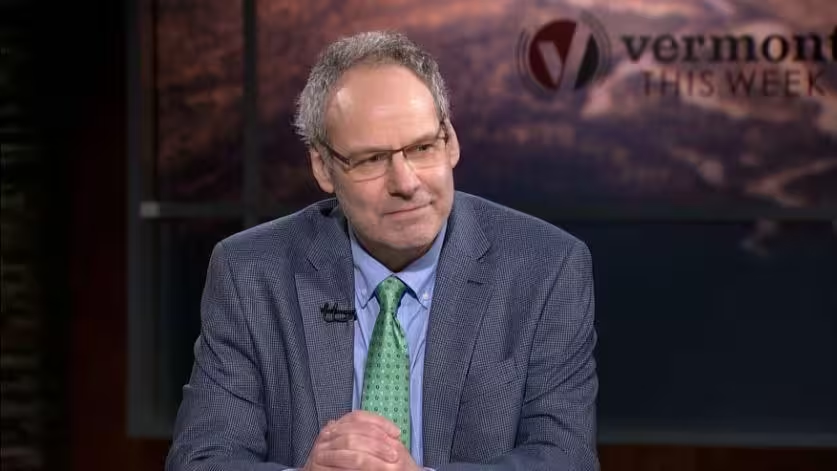
State revenue projections unchanged, but uncertainty looms | $115M property tax buydown | Calls for Farm Security Fund renewed after 2025 drought | Moderator - Mitch Wertlieb; Peter Hirschfeld - Vermont Public; Austyn Gaffney - VTDigger; Mark Johnson - WCAX.
Problems playing video? | Closed Captioning Feedback
Problems playing video? | Closed Captioning Feedback
Vermont This Week is a local public television program presented by Vermont Public
Sponsored in part by Lintilhac Foundation and Milne Travel.
Support provided by:


Vermont This Week
January 23, 2026
1/23/2026 | 26m 46sVideo has Closed Captions
State revenue projections unchanged, but uncertainty looms | $115M property tax buydown | Calls for Farm Security Fund renewed after 2025 drought | Moderator - Mitch Wertlieb; Peter Hirschfeld - Vermont Public; Austyn Gaffney - VTDigger; Mark Johnson - WCAX.
Problems playing video? | Closed Captioning Feedback
How to Watch Vermont This Week
Vermont This Week is available to stream on pbs.org and the free PBS App, available on iPhone, Apple TV, Android TV, Android smartphones, Amazon Fire TV, Amazon Fire Tablet, Roku, Samsung Smart TV, and Vizio.
Support the crew
Help Mitch keep the conversations going as a member of Vermont Public. Join us today and support independent journalism.Providing Support for PBS.org
Learn Moreabout PBS online sponsorshipMontpelier braces for a tight budget year as uncertainty over federal funding persists.
Plus, state leaders in general funds to buy down property taxes again, and farmers look to the legislature for help as they contend with devastating impacts of drought.
All that and more ahead on Vermont This Week.
From the Vermont Public studio in Winooski.
This is Vermont This Week, made possible in part by the Lintilhac Foundation and Milne Travel.
Here's moderator Mitch Wertlieb.
Thanks everyone for joining us today.
I'm Mitch Wertlieb.
It's Friday, January 23rd.
And today on the panel with us, we have Mark Johnson from WCAX, Austyn Gaffney from VTDigger.
And joining us remotely today, Peter Hirschfeld from Vermont Public.
Thank you all so much for being here.
And we're going to start with the big news, of course, this week that, the the budget address was given by Governor Phil Scott, Pete Hirschfeld, of course, you were there attending and listening to everything.
And I guess the good news is that state revenue projections have been unchanged from July.
No downgrade of projected revenue coming to the state of Vermont.
However, a lot of uncertainty.
And everyone is saying it's going to be a tight budget year.
How can those two things be the same at once?
You know, actually, there technically was a downgrade.
And administration officials say that's notable.
It wasn't a statistically significant downgrade.
But, the general fund is forecast to get $9 million less in revenue in fiscal year 27 than the previous estimate.
And administration officials say that's the first time since 2017 that Vermont has seen a downgrade.
And it sort of signals for a lot of people the potential that Vermont might encounter economic headwinds after this, period of historic revenue growth that it's enjoyed over the past half decade or so.
Governor Scott made very clear, lawmakers, the budget that you're going to be putting together this year, the budget that I'm presenting to you is going to be a lot different than the one that you're used to precisely because of that revenue situation.
And as we've seen, state spending go from 6.5 ish billion dollars five years ago to over $9 billion today, he he made it very clear those days of that sort of rapid growth are over.
And he's proposing about a $9.4 billion budget.
Is that right?
Yeah.
That's right.
And that's about a 3% spending increase over this year's $9.1 billion budget.
Does not have the laundry list of one time initiatives using one time money that we've seen in previous years, and the decisions that lawmakers have about what they're going to spend money on.
And more importantly, in some cases, what they're not going to be able to spend money on are going to be a lot more difficult this year.
Mark Johnson, what did you think about the sort of the tenor of the speech, what the governor was saying?
Any surprises there for you?
Well, a couple of surprises.
I mean, that number that Peter cited is just incredible.
I mean, the growth in the state budget just in the past five years, you know, I was thinking, wow, you know, $9 billion.
And I think what's really significant and important about that is about a third of the money comes from the feds.
And given what's going on down in Washington these days, with cutbacks being made down there, and I think another huge factor is that we don't have Pat Leahy anymore sitting down in Washington as the chair of the Appropriations Committee.
You know, in these kind of situations in the past, he was able to get these earmarks or bills passed, you know, slide a million a year, a couple of million there.
And, you know, Vermont doesn't have him sitting down there anymore.
So I really think, you know, I watch the speech and I thought, wow, what a challenge here.
You know, you've got a governor who, you know, nobody wants to see taxes raised.
And, you know, times are tight for everybody.
We've got this, you know, huge health care crisis going on with an awful lot of people losing their health insurance.
You know, people are really struggling out there.
And at the same time, there are all these demands out there.
And the inflation numbers in the past five years have been 20 to 25%.
So even without doing anything else, the cost of goods and services has just gone up.
So you know, and then the other thing that struck me is that I heard a lot of people after the speech, you know, Senator Philip Booth came up with this idea of trying to cap education spending.
But, you know, there was a lot of well, that's not really what we want to hear.
This is Band Aid.
And I thought to myself, well, you know, you got to try something, you know, particularly on this education proposal.
Clearly what we're doing now doesn't seem to be really working.
I mean, the costs in education, which is, you know, another third of the budget, you're 28% of the budget.
So, you know, this is a Rubik's Cube that seems like it's going to be a real challenge to figure out.
That's a good way of describing it, like a Rubik's Cube.
And we're nowhere near getting all the sides to, you know, match up the way they should be.
You know, I want to sort of, riff off of what Marc was just saying there, especially about that, a proposed education spending cap bill that, the pro tem is floating there.
What are the specifics of that?
Apparently, Governor Phil Scott is on board with it.
He likes Bruce idea on this right?
He does like silver.
It's idea, I think, in part because a lot of lawmakers are beginning to come to grips with the fact that this historic education reform law that they passed last year is not going to be taking effect nearly as quickly as they hoped, if at all.
Frankly, depending on how the conversation over forced mergers for school districts goes this year.
And so that has increased the urgency for, shorter term cost containment mechanism.
What Phil Berreth is proposing is called an allowable spending growth cap.
And it would.
The impact would be different district to district.
If you're a low spending district, you could spend as much as 9% more in the following year's budget.
If you're a high spending district, your allowable growth could be capped at 2%.
There are a lot of people in the education community that say history has proven that these sorts of mechanisms do not work, that they lead to perverse incentives that can actually compel districts to increase spending beyond what they would spend anyway.
But there's near unanimity in Montpelier right now that the spending problem in education is one that needs to be addressed.
Now, and what that solution looks like is going to be the subject of a lot of hand-wringing over the next few weeks and months.
Yeah, it certainly is going to be.
To Mark's point, when we're talking about the tax issue and what people can afford, property taxes.
We know we've talked about it so much on this program.
We have to talk about it again today.
Is a big issue.
What, we're doing what we're seeing now, $150 million in a property tax buy down.
That's just to get the property taxes from 12% to about 6%.
But, Mark, when we're talking about what you were saying, like a third of the budget, you know, federal money, we just don't know what's going to happen with that money.
Right.
So what are we looking at here?
What are some of the risks that are associated with that?
Well, you know, you don't know on any given day what's going to happen.
So in the past at least when the feds made cutbacks, you could plan on it.
But, you know, really you can wake up tomorrow morning and Congress and the president could decide they're going to flatline X, Y, or Z. So you know, this 70 million I think it is that they've put aside for that.
Boy, that just seems really dicey that that's going to be enough to be providing any sort of a, any sort of a buffer.
You know, I mean, these are could be anything from, you know, school lunch programs, Snap benefits.
I mean, you know, the list kind of just goes on and on.
I mean, you know, I think the big one is the, the what were the health care subsidies?
I mean, when you've got people that are, you know, working people that were paying $800 a month in premiums, which is still a lot, and now that's going to go to $1,700 a month.
I mean, that's that's just breathtaking.
And there doesn't seem to be any further discussion about changing that.
So, you know, the the federal government is just this wild card in all of this.
That is completely undependable, $70 million that Mark Johnson was just mentioning there, that's been set aside for the loss of potential federal funding.
Right.
But here's what I'm wondering about.
We're already spending the $115 million this year to buy down the property tax burden that happened last year, as well, billions of dollars, to buy down that again.
Eventually this money's going to run out, right?
I mean, where is that $70 billion coming from?
Is there money beyond that?
What do we know about that?
So, there is no money beyond that.
$70 million as of right now.
There are other reserve funds that the legislature could theoretically dip into, but those are sort of break glass in case of emergency, reserves.
And this is why there is some real consternation among Democratic lawmakers to use this $115 million that Phil Scott is talking about, to buy down property tax bills for a couple reasons.
Hey, this federal issue we're talking about where who knows what might happen and what sort of, capacity Vermont might need to offset that.
But this 12% on average increase in property tax bills that Vermonters are going to see this year if the legislature does nothing, half of that 6% is because lawmakers use one time money to buy down property tax bills last year.
If they do that again, if they do what the governor is proposing, then what you're looking at during next year's property taxes is a built in 12% increase, because that one time money will not be there anymore to buy down those rates.
And so, you know, lawmakers are contending with the urgency of this immediate problem and understanding that if they act in the only obvious way that they have, they stand to make things a whole lot worse in the future.
It's really just pushing the problem further and further down the road every year.
You know, I was wondering why the governor put that proposal out now, as opposed to waiting a little bit and trying to, you know, turn up the heat.
On his education reform proposal.
It's fascinating to me, too, Mark.
You would think that one possible strategy politically would be let Vermonters feel the full force of these property tax increases, assume that they're going to blame the Democratic legislature for it.
And voila, maybe you've got a Republican majority in the Senate next year and a far slimmer majority in the House.
Right.
I think what is also true, is that there are more and more Vermonters who are getting to a point where they literally cannot afford to pay their property taxes.
Right.
And a concern that you're going to start to see delinquencies and, I think there's a sense that the financial, cost to taxpayers is just so far beyond what many of them can afford, that you sort of have to do this.
Yeah.
And if you did what you're talking about in the political situation, let's say that blame did go towards the Democratic lawmakers in that sort of worst case, 12% property tax scenario.
Eventually, the Republican Party would have to come up with a solution right?
I mean, the voters are not going to be able to just say, okay, you know, that you've gotta come up with the solution one way or the other.
Yeah.
And as it turns out, achieving or ensuring short term reduction in the rise of growth in education spending, it's hard to do it in ways that don't become draconian for certain school districts in the system that we have right now.
And, there's real fears that a arbitrary mandatory cap on spending, is going to do things to districts that they might not be able to recover from.
Simultaneously, they've got to do something about the cost of education.
So so their choices are really limited.
Yeah.
All right.
The governor drill down on some other topics as well.
Austyn Gaffney, one of the things he was talking about was pushing back against the Global Warming Solutions Act.
And he actually brought up something that we haven't heard about in a while.
Sort of pushing the idea of nuclear energy again.
Right?
Yeah.
So he touched on energy affordability also in his budget address, which has been an issue in Vermont for a while.
Vermont has one of the nation's highest energy burdens in the country, which means a lot of people spend a lot of their income on electricity.
So what he is proposing is actually, a bill that would change what is called the renewable Energy standard to a clean energy standard.
So instead of forcing the state to make meet a requirement of 100% renewable energy by 2030 or 2035, depending on what utility you are, the clean energy standard would include zero emissions types of energy, which would include nuclear.
Yeah.
So one of those things about emissions that that brings up the, the transportation fund as well, Pete.
Right.
And we're looking at a bit of a shortfall there.
That's another concern.
Yes, a real concern and one that lawmakers have been worried about for years, but feel like the time is coming when they're going to have to reckon with it.
There's a $33 million deficit in next year's transportation fund.
Phil Scott is proposing resolving that by, redirecting $10 million in purchase and use revenue that currently goes from the transportation fund to the education fund.
Of course, that means you're taking it from the education fund, which only adds to the property tax pressure that we just spent so much time talking about.
The rest of that deficit will be resolved with internal savings at the agency of transportation that involve the elimination of 31 jobs there, 19 of which are currently filled.
So those are people that would be losing the jobs that they have right now.
There are there's sort of a building chorus in the legislature that the transportation fund requires a more structural solution that involves looking at the revenue side, i.e.
the gas tax, which will Scott made very clear he's not interested in even considering, I think there's a real chance that that perhaps not this year.
But maybe next year you begin to see possibly a bipartisan coalition of people saying, look, we're not going to be able to solve this problem in our transportation fund if we don't, rectify the imbalance between revenues and costs.
And in order to do that, we're going to have to raise taxes.
Well, there's another potential issue here, and it's one that everybody can relate to in the state of Vermont.
Austyn Gaffney, you were writing about this in Vtdigger, and that was last year's devastating droughts for farmers.
Now, they would love to see a reserve fund created, which would bring about how much money to to farmers.
Again, this would be money coming, I'm assuming, from the state to help farmers out.
Yeah, it's called a farm security fund.
They pushed it last year, after two years of floods.
They've pushed it again this year after last year's drought, certain advocacy groups like Nofa VTi will say that, you know, 20 million is the minimum that farmers would need.
Other groups, the minimum other groups are saying, you know, 1 million is all that the state can afford.
So this year, we know that the droughts cost at least $15.9 million for farmers, according to a preliminary state survey.
So that is basically equal to what both the 2023 and 2024 floods also cost the state.
Would this be money that would be, available for farmers annually if this went through the idea is that it would be an annual appropriation.
But, whether or not that will be passed as an annual appropriation would remain to be seen, something like, oh, yeah, go ahead, Mark, this is a classic case where if Senator Leahy were down there, he would be carving out money.
And, you know, when you have a federal budget as opposed to the state budget, a couple of million here, a couple of million there.
And, you know, Bob's your uncle.
Yeah.
You make it sound so easy.
But, you know, again, you're just dealing with a much larger, larger pool of money, you know, I mean, what they're talking about here in Vermont, you know, one of the things getting back to the governor's speech that I was a little surprised you didn't talk about.
There is no mention of tourism and this challenge that's going on with so many fewer Canadians coming down.
And I thought, you know, it might have made sense for him to acknowledge that, give a head nod to that, and maybe there's an effort somewhere there to try to boost that because they're there really, when you come down to it, are very few big sources of new revenue or additional revenue.
And that that seem to be one area that was, could have could have been touched on.
Yeah.
I want to talk about another area to that, the governor did not talk about in the speech.
But first, getting back to to the the Drought Fund here.
Austyn Gaffney, there was something interesting in that proposal, which was was to remove the word climate, from that.
Why?
Yeah, there was an amendment added to this proposal recently, to change exchange the word climate for weather.
And a lot of the references within the bill.
One of the state's lawyers said the reason for that was just to basically avoid controversy once this bill, goes back to the Senate.
You know, I think it's one of the first signals we're having in Vermont of this kind of climate denial language.
I have not been here as long as you all have to know whether or not this has been something that's happened in the past.
But this is the first time I've seen that kind of language, removed from a bill.
Peter.
Mark, I want you to talk about that for a second, because I understand wanting to avoid that word on a federal level.
We all know how the Trump administration feels about climate change.
Thinks it's a hoax.
Why here at the state level?
I think you just answered the question.
I think that if you're looking to get federal help for something like that, you want to remove that language.
It's a little bit like the whole, you know, diversity, equity and inclusion.
You don't want to be included in that.
If you have anything that you want to get in education or in any other area.
Yeah.
But there's been no evidence that that placating the Trump administration on things like this is going to get you any favor.
Well, and, you know, Phil Scott, touched on that right at the top of his speech this week.
He said, you know, no amount of rhetoric is going to change what's going to happen out of Washington.
You know, on the other hand, a little bit of rhetoric can also signal to at least people here in Vermont that you are acknowledging the problem.
It may not change anything, but, you know, so Scott has come under a fair amount of criticism.
Pete, correct me if I'm wrong here.
You know, of not pushing back hard enough sometimes when the feds are doing what they're doing.
So, you know, I that really stood out to me this week right off the top of this speech for him to say, you know, anything we say here in Vermont isn't going to change what the feds do.
It.
And rhetoric does change things from time to time, right?
We we just celebrated, the birthday of Martin Luther King Jr this week.
And, I think it's hard to argue that that his rhetoric didn't lead to material change in the course of this country.
Phil Scott has resisted since the beginning of the second Trump term, a more aggressive, and hostile approach to things that he's seen from Washington that he acknowledges he disagrees with.
And there are a lot of Vermonters.
There was a, press conference in the state House this week where lawmakers were just expressing confusion and exasperation that he wouldn't have used either his state of the state address or his budget address to at least mention what's going on as it relates to immigration enforcement in Vermont and the rest of the country.
Obviously, he's come to the conclusion that that's not the most strategic tack to take right now.
Well, what's going on in the state of Minnesota, of course, has captured national attention.
There's talk of a kind of general strike there over what has happened with some of the incidents with Ice in that state.
Ice is now going to the state of Maine.
You know, we don't know what's going to happen here eventually.
But we do know, Austyn Gaffney, that there were some, protests planned for this weekend about an ice facility in Williston.
What can you tell us about that?
Yeah.
So there are two ice facilities in Williston.
They're less than two miles from each other across highway two.
They've been the target of, anti ice activism for since November.
They're both in charge of one is in charge of investigations with surveillance.
The other hosts, the national tip line, for ice.
So while there has been noise demonstrations, there's been banner dropped.
There's been marches.
Not much has changed about the work that happens inside those facilities, but the town of Williston has taken, basically a symbolic stand this week.
The town select board on Tuesday passed a resolution that says they oppose the, enforcement and surveillance actions of Ice.
That is the first town that we know of in the state of Vermont to have passed such a resolution.
But that resolution is now being passed, amongst towns.
So we'll see if it, gets picked up anywhere else.
And they did that knowing that it's symbolic.
They know that there's no actual real teeth there.
But, you know, maybe to Pete's point and to Mark's point, you know, that does that rhetoric maybe matters, at least to town officials in Williston?
Yeah, exactly.
There is no teeth, as you said, to this kind of resolution, but I think it is addressing sort of the activism and the frustration that a lot of Vermonters have had, with actions by Ice, both on a national level and with their presence in the state.
I think it will be really interesting to watch what happens with I think it's called Operation Catch and Release in Maine, and see how some of those impacts could trickle down here to Vermont.
So I think it remains to be seen what kind of actions the state takes, but I think, these kind of more local, symbolic actions really mean a lot to the people in the town, even if there's no, change that springs from it.
And I'll go ahead.
Mark mentioned Martin Luther King, and I know we're going to talk about Bernie Sanders in a moment.
And all I could think of when you talk about, you know, does rhetoric matter?
I think Bernie Sanders would argue quite strongly that rhetoric matters.
You know, hidden talking about the wealth gap, the inequality in this country, you know, the complete corruption of the electoral system, the, you know, losing Citizens United and how campaigns are funded, you know, the disastrous state of the for profit health care industry in this country.
I think he would argue quite strenuously that, you know, rhetoric matters a heck of a lot.
Yeah.
And we're going to be seeing a lot of these issues, you know, come to the fore sooner rather than later.
The ice facilities in Williston, Austyn very, very quickly.
These are data gathering facilities.
What are they doing there.
What are people protesting.
Yeah, largely, as we understand it, they are data gathering facilities.
So there is one on Industrial Avenue in the white Cat Business Park, as far as we understand, that is, again, investigating, online surveillance.
So looking at open source information and now I think digging more into social media in October, there was a work order for that facility, hiring about a dozen more people.
So it's been there for a while.
And what we know is that it is expanding.
The other facility on Harvest Lane again, functions as basically a national tip line while doing other actions.
And again, it has been there, before the second Trump administration came into office.
And Pete Hirschfeld, to your point that you were making before, were there sort of rumblings that you were hearing after the governor's speech about him not mentioning Ice enforcement, about him not mentioning, some of the things that are happening nationally?
Yeah, certainly.
There are people in the state House and around Vermont, that are looking for him to make a more forceful stand against the administration, much like he did.
We should know during the first Trump administration.
Right?
I mean, Jill Scott was somebody who was calling on the president to resign at one point or to have Congress remove him.
So, there there are a lot of lawmakers and Vermonters who wish they were hearing more of that tone from him now.
Yeah.
And I'm just wondering if the reason he's not doing that is, again, thinking that some of that federal money is going to be needed.
So we have to sort of make sure we're, you know, not pressing the wrong buttons in that way.
But, Mark, as you were saying, that is not proven to be any kind of a salve at this.
Well, I mean, you know, I understand the logic of what do you say to which is you keep yourself off the radar.
I mean, you know, the louder you are, the harsher the penalty seems to be.
Yeah, but we're going to have to be, we're going to have a lot of these problems again, coming to the fore in the next few months.
So we'll see what happens there.
Mark, you were mentioning, Bernie Sanders and I know that on your podcast, 802 news, you recently spoke with Dan Chazen, who wrote a, a new book about Bernie.
It's called, Bernie in Burlington.
Is that right?
Bernie for Bernie for Burlington, which was the first slogan that he had when he won the mayoral race in 1981.
This is a really fascinating book.
It's part memoir of Dan, who grew up in Burlington, who was nine years old when Bernie was first elected in 1981.
But it really, I think, is the most comprehensive book that traces Bernie's, you know, initial arrival in Vermont, 1964, and then again in 1968.
He was Dan was able to get interviews with some people.
It's just incredible.
He spent an awful lot of time with Bernie's, older brother Larry.
Some real insiders in, in Burlington that really none of us had talked to that the kind of depth that he has.
And I think, you know, he's a poet, but he may have gotten more out of these sources than a journalist showing up in saying, hi, I'm from the Washington Post.
Check it out on the 802 news podcast.
I want to thank our panel so much.
Today we have Mark Johnson with us from Wcax and Pete Hirschfeld remotely from Montpelier from Vermont Public and Austyn Gaffney with VTDigger.
I'm Mitch Wertieb, go Patriots.
I think that a win by three this weekend.
I hope you'll join us again next week for Vermont This Week.

- News and Public Affairs

Top journalists deliver compelling original analysis of the hour's headlines.

- News and Public Affairs

FRONTLINE is investigative journalism that questions, explains and changes our world.










Support for PBS provided by:
Vermont This Week is a local public television program presented by Vermont Public
Sponsored in part by Lintilhac Foundation and Milne Travel.