Vermont This Week
January 16, 2025
1/16/2026 | 26m 45sVideo has Closed Captions
Vermonters encouraged to look for other healthcare options | New plan for VT homelessness would end
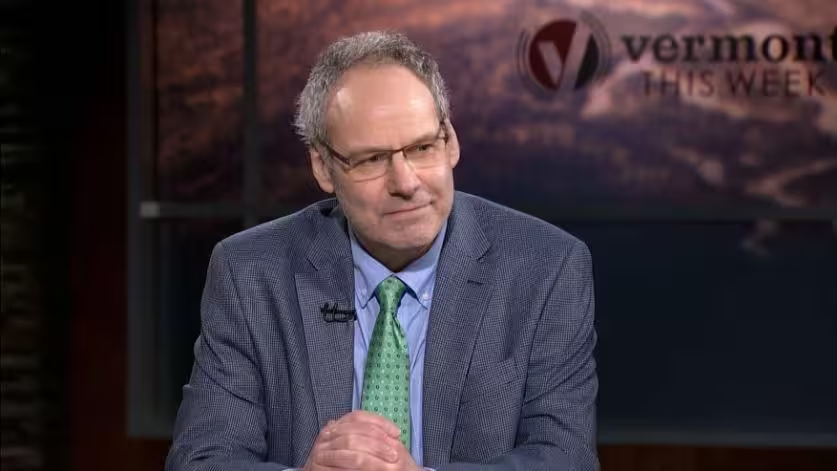
Vermonters encouraged to look for other healthcare options | New plan for VT homelessness would end | Housing infrastructure program kicks off this month | Moderator - Mitch Wertlieb; Carly Berlin - Vermont Public/VTDigger; Colin Flanders - Seven Days; Calvin Cutler - WCAX.
Problems playing video? | Closed Captioning Feedback
Problems playing video? | Closed Captioning Feedback
Vermont This Week is a local public television program presented by Vermont Public
Sponsored in part by Lintilhac Foundation and Milne Travel.
Support provided by:


Vermont This Week
January 16, 2025
1/16/2026 | 26m 45sVideo has Closed Captions
Vermonters encouraged to look for other healthcare options | New plan for VT homelessness would end | Housing infrastructure program kicks off this month | Moderator - Mitch Wertlieb; Carly Berlin - Vermont Public/VTDigger; Colin Flanders - Seven Days; Calvin Cutler - WCAX.
Problems playing video? | Closed Captioning Feedback
How to Watch Vermont This Week
Vermont This Week is available to stream on pbs.org and the free PBS App, available on iPhone, Apple TV, Android TV, Android smartphones, Amazon Fire TV, Amazon Fire Tablet, Roku, Samsung Smart TV, and Vizio.
Support the crew
Help Mitch keep the conversations going as a member of Vermont Public. Join us today and support independent journalism.Providing Support for PBS.org
Learn Moreabout PBS online sponsorshipThe state's largest health insurer is urging Vermonters to avoid its largest hospital, and instead shop around for more affordable treatment.
Plus, a new plan to help unhoused Vermonters and ends the use of motel rooms.
And Governor Phil Scott tapped two veteran prosecutors to fill seats on the Vermont Supreme Court.
All that and more ahead on Vermont This Week.
From the Vermont Public studio in Winooski.
This is Vermont This Week, made possible in part by the Lintilhac Foundation and Milne Travel.
Here's moderator Mitch Wertlieb.
Good evening everyone.
I'm Mitch Wertlieb.
It's Friday, January 16th, and joining us on the panel today, we have Colin Flanders from Seven Days, Calvin Cutler from Wcax and Carly Berlin with Vermont Public and Vtdigger.
Thank you all so much for being here today.
Really appreciate it.
Colin, I want to start with you because, it's really interesting.
We've been covering this story about health care, throughout Vermont for a while now.
And a couple weeks ago, we were talking about, Northwestern Medical Center in Saint all been sort of getting the word out about, hey, we've got cheaper health care options for you.
And now it looks like Vermont's largest insurer, BCBS, is following that lead.
What are they saying?
Why are they saying it?
Yeah.
So what they're saying is, everybody in this state has a role to play in lowering health care costs, and that includes patients themselves, but they're really trying to get across here is that individual decisions about where you choose to get care, have a long term impact on the premium rates that we pay.
And as everybody knows, Vermont's premium rates are the highest in the country.
Blue Cross Blue Shield says a big reason for that is that our hospital prices are so expensive, and so many people are getting care in hospitals that don't need to be getting care there.
And so what they're encouraging people to do is treat health care like any other commodity and shop around.
Look for the best price.
Use these online price comparison tools and figure out where can I go, even if it's maybe a 20 minute extra drive and save $4,000?
And the challenge for people is that they don't always see those savings themselves, especially after you hit your deductible.
The price to you, it doesn't really matter.
But in the aggregate, it does.
And so they're trying to encourage people.
Think of yourself as part of a system, and you could really make a difference.
Blue Cross Blue Shield though has a vested interest in this too.
I mean, they're not doing this necessarily out of just the goodness of their own hearts.
It's hurting their bottom line as well.
When folks take the more expensive options.
Right.
Of course.
Yeah.
And the whole system is connected.
I mean, Blue Cross has been on the brink of insolvency for a couple of years now, and they are looking for everything that they can do to make sure that they can continue to pay out the claims.
So yeah, Blue Cross does have a vested interest in this.
But as the state as a whole has a vested interest in Blue Cross staying around.
And so, everyone needs needs to contribute.
According to Blue Cross.
Is it a little weird to ask people to shop around for their own health care the way they would to buy a car or buy a house?
I mean, this seems bizarre to me.
Yeah, I mean, it's a little ludicrous if you think, try to tell somebody having a heart attack, figure out where you want to go.
I mean, but there are.
The researchers estimated that upwards of 40% of health care services are shoppable.
And think of things like, an MRI and a swollen knee, an X-ray, even basic lab work.
And it is pretty remarkable the price differences that you can see for these same services across the board.
I will add to right before we started to tape this, I just got an email from somebody who read my story on this and said, it's not just price, it's I can often get in a lot quicker at one of the open MRI places around here, and I can park right next to the door.
And if you have to think a lot of people, I think the hospital is an intimidating place.
She she was saying, I don't have to go down all those hallways on the elevators and all that.
I mean, there is an ease and access and, the challenge is that not a lot of people know these exist and know how to get there.
Yeah.
So I think it's it's fascinating, too, because you think of, you know, the next few years where we're heading health care, I'm sure calling you, you know, reported on the Rural Health Transformation Fund.
We're going to have a lot of money coming to the state of Vermont.
You know, to sort of shore up our rural health care system.
This money's coming from Congress.
Of course, part of the intention there is also to help remove some of the care that's being delivered in hospitals, bring it to primary care, bring it to clinics, bring it to places elsewhere.
So this sort of works in conjunction with that as well of like let's try to remove care from the hospital setting, which as you correctly pointed out, is the most expensive.
And can we deliver it in a tertiary or another sort of setting which is cheaper?
So it is interesting how those can go hand in hand.
And I've been fascinated too, because I've been covering this for a while.
BlueCross and insurers in general have often had a somewhat tenuous relationship with these smaller, independent providers, and now they are working together in a way that I think is unique.
And if you ask some of the independent practices, they say it's about time we've been around.
We've been saying that we're here ready to provide these services.
And I think it'll be interesting to see if we actually see a shift in patient choices.
How does the new CEO of UVM Health Network, this is the largest hospital that BCBS is talking about here.
How does he feel about this?
And I should say, who are we talking about here?
Yeah, yeah.
So, Stephen Leffler was serving as interim CEO at the UVM health.
They have since dropped the network.
It is just UVM health now, but I'm still going to call them the network.
They, named him their permanent CEO.
And this is a notable shift.
I mean, UVM Health Network has been facing a lot of pressure over the last few years.
Questions about whether they're actually delivering on the promise of providing more efficient and, cheaper health care.
And I think state regulators really took a look this year at the relationship between the health network's Vermont hospitals and New York hospitals, which tend to lose money.
And they were pointing out that this doesn't really seem to be bringing much benefit here.
So Stephen Leffler is coming in now, and trying to make make the case that he's going to do a little bit of a change of direction here.
We're going to be sending more decision making closer to the bedside, which is how he's putting it.
But really, what that means is more decision making at the local hospitals who know what they need and know how that they can operate more efficiently.
And this is occurring in the broader context of this hospital transformation process that Vermont is undergoing, where hospitals are being asked to come up with plans to make themselves more sustainable, including potential cuts to services.
And so it be really interesting to see if the network can continue to keep a bit more of a hands off approach or if it it starts to make some of those decisions once the rubber hits the road.
And he has been the interim CEO.
Right.
And now he's just been named on a permanent basis.
That's right.
Yeah.
He just took over.
Yeah.
Fascinating stuff.
Thank you for the update on that call.
And I really appreciate it.
I want to, shift now, Carly Berlin to this what seems like an exciting new plan to not end homelessness in Vermont, but at least alleviate the problem.
We know that's a huge problem in the state of Vermont.
How would this new plan, and the use of motel rooms.
Exactly.
So this is a two year bipartisan bill that was introduced last week.
What it would do is ramp down the use of motel rooms as emergency shelter in Vermont over these next two years, and at the same time, ramp up funding for more traditional community based shelters, transitional housing, even converting motels into apartments, things like that.
And Governor Phil Scott is all for that.
I know he was not happy about the motel voucher program.
That's true.
And we're going to have to see, you know, there's a lot of devil and the devil's in the details with anything like this.
It's really early, right.
This would ramp down the use of motels to about 400 rooms next year.
We're at about 1200 right now and then.
And the use of motels totally in fiscal year 2028 with some check backs to see if we've actually built up the rest of the capacity in the system.
Like that's the question, right?
Whether it's actually realistic to have enough shelter and housing options for people, outside of motels in this pretty tight time frame.
What are housing advocates saying about that?
You know, we're seeing some skepticism about this.
You know, there there are pieces in this bill that really kind of focus on the accountability for for clients, for individuals that would do things like set time limits for how long people can stay in shelter, in transitional housing, you know, have engagement requirements for, for getting services.
And there's also a quite controversial piece here.
This bill would create a dedicated program to cover relocation expenses for people to travel outside of Vermont who have family ties elsewhere.
There's this kind of renewed focus on the issue of people who are from out of state experiencing homelessness and coming to Vermont to to use benefit programs.
So there's a lot of of scrutiny over whether this is really a worthwhile use of, of state funds.
And it's, it's an idea with a long history to.
Yeah, certainly.
I mean, we were talking right before the show started, you know, people that think back to the 1980s, there was an initiative, an initiative that came out of Burlington called Westward Ho!
It was sort of thought up, by a few business owners in town, really, to try to curb panhandling back on Church Street back in the late 80s, that there was a huge outcry and there was a really big push back on, on the idea of Westward Ho!
And it went absolutely nowhere.
I think maybe 1 or 2 people got got bus tickets.
But it does say something, though, that this is like a provision that's now in this bill.
It's a bipartisan bill.
And, you know, the situation in terms of homelessness and sort of the need and the dire need out there is a lot different, I should say, back from when it was then.
So we don't know exactly how it's going to be received within the legislature.
But we know, you know, we can expect there to be some significant pushback and concern on it.
You know, as we'll have to see exactly where it goes.
But we've seen this movie before.
And, Carly, I just want to make sure I've got this right.
This would be, again, for people that do have relatives ties of people in other states.
That's how it's envisioned now.
And the way that this is written, it would be totally voluntary.
Yeah.
Yep, yep.
That's important to to know.
Thank you for that.
And again, the motel voucher program that started during Covid, right?
I mean, was at, you know, it existed before, but the program was greatly expanded during the pandemic because we got all of this federal Covid cash that said, you know, let's allow people who are homeless to have their own space and not be packed into shelters together.
At the same time, we saw just skyrocketing levels of homelessness, and housing insecurity.
And we've, you know, then seen this perennial fight in the legislature over the last few years over how to wind down this really dramatic expansion and this program.
And it still exists.
And we're going to have to see this year if this is this is a path forward that people can agree on.
And I think, you know, Carly mentioned right off the top, this is a two year bridge to get us to what was envisioned in 91.
That was that bill, that basically, community action, service providers like, community Capstone, Action in Central Vermont or CVO in Chittenden County.
They would then take over sort of administering services.
And, you know, the governor, though, vetoed that bill.
And there was also really dire concern, from some shelter providers as well, that felt like they were completely shut out of that conversation.
So again, this is a two year bridge to get to where we were with age 91.
A lot can change before then, but that bill also, as envisioned, that framework was also kind of controversial.
So again, we'll just have to see.
Okay, let's stick with housing for a moment because there's an infrastructure program, Carly, that is kicking off this month.
What is it and how is it going to work.
So this is the Community Housing Infrastructure program or Chip.
It was kind of the the marquee housing legislation passed last year.
The idea of this is it's basically a smaller scale version of a program that's existed in Vermont for a long time.
That's test tax increment financing.
The way that works is the future property tax revenue from housing, gets used to pay back the debt for the infrastructure build out that was needed to get that new housing, the stuff you need to build, like, I don't know, sewers and things that, you know, getting the dirt out of the sidewalks, roads, all of that kind of basic ground level work that needs to happen for a home to be built in the first place.
So Chip is a maybe smaller version of TV.
It's a little more hones in a little more on on smaller projects.
Exactly.
So if you think of Tiff is really geared towards a larger district and a downtown, we're sitting here in the studio and when you ski, Winooski has had a tiff Burlington, Saint Albans, larger cities and towns.
The idea of Chip is that it's really using that same kind of taxing instrument.
But at the level of one property of one housing project.
And the idea for lawmakers last year was, you know, let's let's create a similar tool that's accessible to smaller towns.
And we're now going to have to see if if they take if they bite on it.
The program is opening up this month.
There has so far been a lot of interest.
I wrote about, a project in Saint Albans, actually, and one in Fairhaven.
You know, it'll be interesting.
And six months to a year from now to write the story of of, you know, how how is this really going so far?
We're really just at the starting point.
I mean, the need is there though, right?
I mean, we keep talking about housing and how important it is.
And even if these are just, you know, one unit, two units, it feels like there is the need at least.
Absolutely.
And we're going to have to see if, you know, smaller if this truly is accessible to smaller towns for that, you know, those really those smaller projects that can, make a real difference that are spread out.
The there's it takes a lot of administrative capacity to, to kind of work out these sorts of development agreements.
And there's been, funding and support for kind of trying to help smaller towns actually realize the gains from Chip.
And we're just going to have to to see if it if it makes a real difference.
One more question on this Curly Berlin.
I know there's been a little bit of pushback from some Democratic lawmakers who are they have some concerns.
What are those concerns?
Yeah.
So there were concerns, you know, before this bill ultimately passed last year about, whether, you know, if if a project were to happen anyway, without this kind of tax increment financing instrument, whether there would be that would result in foregone tax revenue to the education fund, which is, of course, a huge focus for the legislature.
There was a lot of back and forth about, you know, what kinds of guardrails to put on this.
You know, lawmakers ultimately landed somewhere, somewhere in the middle.
Yeah.
So that's that's where the question I always wonder about that, though, is how would you deter how do you make that determination whether a project would have gone through without Tiff fortune?
Yeah, it's I mean, you know, something that comes up a lot when we talk about economic development, whether it's, you know, veggie this comes up or, or, Chip, you know, state auditor Doug Hoffer, this is something that he's talked a lot about is the, the but for test because, you know, these are these are decisions that, I mean, I don't have access to the books or the, you know, the balance sheet of developers or how their pencils or how their projects are penciling out, you know, but so that's been that the criticism.
But, I mean, you ask any, any developer or anybody that's involved in home construction or development costs are up, labor is down.
It's very challenging to get these projects to pencil out.
And so they're hoping hoping this can be one more tool.
But but the but for though is has certainly been a real concern and it's something that we just see come up in in economic development spaces from time time to time.
Yeah.
And we'll see where this goes.
Like you said, six months to a year from now.
See if anyone's taken advantage of of the chip program.
Comments.
Landers, I want to turn back to you for a story about, the rod Supreme Court.
There were two vacancies.
Governor Phil Scott has appointed two names that I guess people who were familiar with all of this sort of thing would recognize.
Who are they?
Yeah.
So both of these people have ties to President Trump, and I think one is more proud of that tie than the other.
So the first one is Christina Nolan.
She was named to serve as Vermont's lone U.S.
attorney during Trump's first term, and she served four years before resigning, as is typical in transition of power.
And then the other one is Michael Drescher, who has been a career bureaucrat serving at the same office that Christina Nolan was once leading.
And he has served as second in command up until recently when he took over following the resignation of the Biden appointed U.S.
attorney.
Drescher served for about 300 days in that position, recently stepped back to his normal position, has since resigned.
But he during that time had to carry out a lot of directives from Trump 2.0.
And now he's facing some criticism in the legislature as they're vetting his candidacy.
These are both prosecutors.
They, they have that background.
So is there, you know, that pushback that you're talking about, what is Drescher said about that as far as the criticism?
Yeah.
So the main criticism has been that Drescher was on the front lines of some of these very controversial decisions to pursue immigration enforcement against some high profile people.
I think a lot of people remember the most elementary case, he spent about 16 days, in jail after he was arrested at a what was purported to be a citizenship interview.
Drescher had to go in front of the court and make, what I think I can objectively say were some pretty dubious arguments, on behalf of the government, on why Madali posed a risk to US foreign, U.S security, which was what the government was saying.
Drescher has said that, essentially he was doing his job, but also that he was trying to protect some of the people who worked under him.
We've been seeing in other parts of the country, prosecutors, resigning in the face of what they feel are some controversial directives that they don't agree with.
I think Drescher is making the case that if he were to step down, somebody else was going to have to come up behind him.
These are some people who are in the earlier stages of their careers, and we're going to have to be, making that same choice.
And so I think he is sort of making the case that, I was taking a bit of a bullet here, and I will take that, I did, yeah, I need it did what I needed to do.
But he has definitely it is a question of whether, lawmakers are going to be receptive to that argument.
Okay.
I appreciate the update on that story.
Calvin Cutler, I want to turn back to you for a little bit of politics here.
You know, the upcoming, elections may or may not be interesting, depending on who you talk to.
But a couple of names for the lieutenant governor's race have hopped in.
At least one is very familiar.
Maybe one name that is maybe not so familiar.
Certainly.
We've talked about Molly Gray, former lieutenant governor, throwing her name back into the, the ring, wanting to, make a bid for lieutenant governor this week.
We also heard Ryan McLaren.
He is a lifelong Vermonter.
He's from the Northeast Kingdom.
He served on school boards.
He was in the AmeriCorps.
He really got his start in politics during the Shumlin administration.
And for the last decade or so, nine years or so, he's worked as a senior advisor to Congressman and Senator Peter Welch.
So a lot of what he's been doing is sort of behind the scenes working with constituents, traveling the state.
But he has a very, you know, broad grasp of the issues.
And he says the challenges that Vermonters are facing.
And it's interesting.
He brings a pretty compelling, life story.
Back in 2017, he was in a horrific ski accident at mad River Glen, suffered a spinal cord injury which, left him permanently paralyzed.
Now he has been working through that injury, and he really credits this as part of his life story to be able to overcome and work through that.
And really, that's shaped in many ways.
You know, his family life, his personal life and his pursuit of politics and public service.
So like Molly Gray, he said in saying that he was running to, you know, make the state a more affordable, more accessible place housing, health care, affordability, being some of his top priorities.
And, you know, I think it's on its face, you know, Molly Gray, you know, of course, she's been working with the Afghan alliance for the last few years.
So she's certainly been staying in the mix, really certainly familiar with a lot of these issues.
But I think it's going to be fascinating to see this race play out.
Certainly Molly Gray has a very large donor base.
She had a lot of supporters from Senator Patrick Leahy and, you know, sort of Leahy world, if you will.
But Ryan McLaren brings a lot of firepower and a lot of support from Senator Welch and his supporters and their political connections.
So I think this is going to be a really fascinating race to see again.
The devil is going to be in the details of these two candidates, what policies they support, what like where are the differentiations between them?
But this could be one of the more interesting statewide races given right now we're not seeing any movement, at the top of the ticket, no prominent Democrat is, stepping forward to challenge Governor Phil Scott.
So we can do a whole show on that, but but certainly though, there there is, this is going to be a really interesting race, I think.
Yeah, it sounds like you're saying it's going to be pretty competitive, I think.
So, I mean, you know, Molly Gray, as I said, she she has the name recognition, but she's also a fundamentally different politician than she was a couple of years ago.
Her work with the Afghan alliance, you know, seeing, the US government pull the rug out from some of our allies has also really shaped her and her message.
And you know who how she thinks and feels about the world.
So I think we've got to really competitive candidates here, vying for the Democratic primary.
We have not yet seen a challenger come forward.
Against John Rogers, the incumbent.
Whoever wins the primary, of course, will have to go up against him.
But but certainly it's going to be an interesting one.
And of course, John Rogers was able to defeat David Zuckerman, long time lieutenant governor.
And, he's not made any announcement about whether he might get back into that race or not yet.
I think a lot of eyes, you know, there's a lot of eyes on Scott, but also Zuckerman.
What are his plans?
I think he's another big, big question mark out there, too, so we'll have to see.
Yeah, I have a feeling we'll be talking about this again.
Well, season heats up.
Colin Flanders, very sad story.
From 2023.
You've been updating this in seven days.
No, bail has been issued.
No bail relief for a man that was accused in a Rutland police officer's death.
Can you give us a synopsis of of what happened in this case and some of the criticism that came to Rutland Police as well?
Yeah.
So there has been a flurry of developments in this case that up until, about a month ago, was just proceeding along as expected.
The defense attorney in the case representing Tate Reagan, who is a 22 year old, man who was accused of crashing his truck into, a cruiser driven by a 19 year old police trainee, killing her.
The defense attorney recently discovered that there was an internal affairs report produced taking a look at the crash.
And the conclusion was pretty unequivocal that the chase never should have happened, that there were egregious mistakes across the board on everyone who was on duty that day.
And all of those put both the public and this very fresh, very young recruit at risk and ultimately costing her her life.
And so the defense attorney, one, was shocked to learn that this report, even existed.
He had been asking through discovery of all of the documents that he needed.
It turns out that the police chief had received this report sometime early last year, and then sat on it for months without telling anybody, without even giving it to the state prosecutors who had been asking if you have any reports like this, we need them.
And he told us at seven days that he did that because he was afraid of jeopardizing the case against this guy who killed one of his officers, who's essentially admitting that he was making a conscious choice.
That did not sit well with state prosecutors, who immediately issued what's known as a Brady letter, essentially flagging him as being untrustworthy, as an untrustworthy witness and someone that they would not put on the stand.
And that can effectively end someone's career.
A few days before that happened, the police chief announced that he would be retiring in March.
He has not said why.
The timing is a little coincidental.
And yeah, so now we're trying to see the most recent update was that, the defense attorney was pointing to this report, among some other things, and saying that my client should not be in jail while this case plays out.
The judge was not receptive to that.
And I think there is some legal maneuvering where when you consider bail, you have to take the state's argument at face value.
You don't really consider some of the mitigating factors.
And so this will come when this comes to trial.
If it does, we'll be hearing a lot more about some of those issues.
Well, thank you so much for that update.
I really appreciate that.
Calvin Cutler, if you live in central Vermont and you were going to your mailbox looking for mail.
Yeah.
We'll be waiting for you.
You're certainly going to be waiting.
I mean, this is one on there.
It's a perennial issue we seem to come back to, even though Montpelier is, you know, has a post office following the floods.
You know, the delivery issues are still persisting.
I was at the Berlin Mall.
If you walk up next to five below, there is this little inconspicuous store.
You go there five days a week.
People will be lined up physically going, searching for their mail, searching for the packages.
And it's because, like a lot of things, there's just staffing.
I mean, there's so many roads, especially in Middlesex.
People lived on long dirt roads.
It's tough to get the staffing, the hours, etcetera to, to, you know, have consistent mail.
And, you know, in a state with an aging demographic, people rely on medications they rely on.
If you have a business that you run out of your house, you need to send things.
There's a lot of ripple effects.
And so certainly, you know, I was talking with people in that line.
Some of them were waiting three, four weeks and they haven't had any mail.
And as of right now, it doesn't look like the situation is going to get better.
USPS says that they're trying to switch staff around and host, job fairs as well.
But again, you know, it's a function of an aging demographic and a tough job.
And, you know, we'll we'll have to see where it goes.
But it's not just in central Vermont.
We're hearing these reports from Franklin County, Chittenden County as well.
We'll have to see.
And a reminder that physical mail still matters to people.
Like you said, medications, important things come through.
So the update on that, finally, this is going to sound like I'm making fun of the story.
I am not, there is a, legislator in Montpelier named Troy Hedrick, an independent from Burlington, who wants to create a ten member panel that would investigate UFO sightings or unexplained aerial phenomena.
This would be something where if you see something in the Vermont sky at night, you don't know what it is, there would be a ten member panel that would take a look into this.
I could go around the table and ask my guests here whether they believe in alien life.
I think I will, Carley.
You know, I've been reading more speculative fiction lately.
I'd like to believe a little bit Calvin Cutler.
Why not?
Sure.
Why not.
And Colin Flanders looks like we're out of time.
I want at least one traditional journalistic coverage.
Thank you so much to our panel.
Colin Flanders from seven days, Calvin Cutler and Carly Berlin with Vtdigger and Vermont public.
I'm Mitch Wortley.
We'll see you again next Friday for Vermont this week.
Thanks so much for tuning in.
And.

- News and Public Affairs

Top journalists deliver compelling original analysis of the hour's headlines.

- News and Public Affairs

FRONTLINE is investigative journalism that questions, explains and changes our world.











Support for PBS provided by:
Vermont This Week is a local public television program presented by Vermont Public
Sponsored in part by Lintilhac Foundation and Milne Travel.