Vermont This Week
February 6, 2026
2/6/2026 | 26m 46sVideo has Closed Captions
Senate confirms Vt. Supreme Court nominees
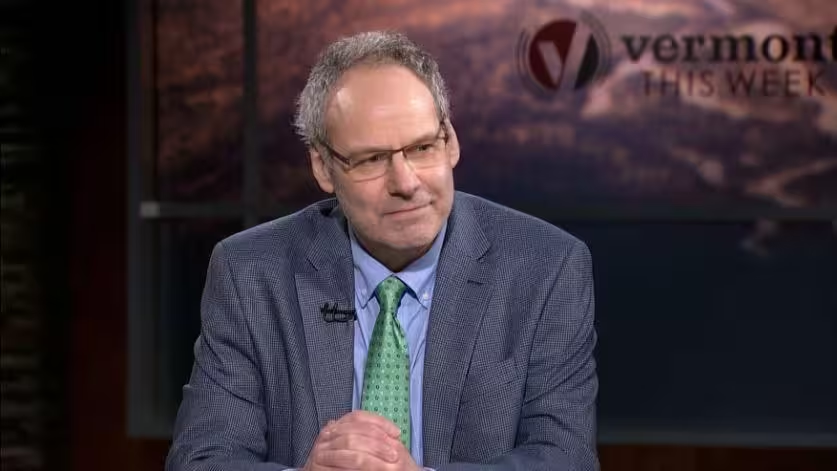
Senate confirms Vt. Supreme Court nominees | Pro Tem eyes state funds for potential future policing costs | Wrongful death lawsuit filed against RRMC | Moderator - Mitch Wertlieb; Lola Duffort - Vermont Public; Calvin Cutler - WCAX; Shaun Robinson - VTDigger.
Problems playing video? | Closed Captioning Feedback
Problems playing video? | Closed Captioning Feedback
Vermont This Week is a local public television program presented by Vermont Public
Sponsored in part by Lintilhac Foundation and Milne Travel.
Support provided by:


Vermont This Week
February 6, 2026
2/6/2026 | 26m 46sVideo has Closed Captions
Senate confirms Vt. Supreme Court nominees | Pro Tem eyes state funds for potential future policing costs | Wrongful death lawsuit filed against RRMC | Moderator - Mitch Wertlieb; Lola Duffort - Vermont Public; Calvin Cutler - WCAX; Shaun Robinson - VTDigger.
Problems playing video? | Closed Captioning Feedback
How to Watch Vermont This Week
Vermont This Week is available to stream on pbs.org and the free PBS App, available on iPhone, Apple TV, Android TV, Android smartphones, Amazon Fire TV, Amazon Fire Tablet, Roku, Samsung Smart TV, and Vizio.
Support the crew
Help Mitch keep the conversations going as a member of Vermont Public. Join us today and support independent journalism.Providing Support for PBS.org
Learn Moreabout PBS online sponsorshipLieutenant Governor John Rogers cast a tie breaking vote in the Senate to elevate a controversial nominee to Vermont's highest court, hanging Michael Dresser, a public servant with a long record of absolute integrity.
Out to dry because his job forced him to take an unpopular position, would send a chilling message.
At one point, it's the argument of I was just doing my job.
No longer acceptable.
Plus, the Senate pro tem proposes state funding to cover public safety costs should widespread anti ice protests break out in Vermont.
And the story behind a wrongful death lawsuit filed against Rutland Regional Medical Center.
All that and more ahead on Vermont this week.
From the Vermont Public studio in Winooski.
This is Vermont This Week, made possible in part by the Lintilhac Foundation and Milne Travel.
Here's moderator Mitch Wertlieb.
Thanks for joining us on Vermont This Week.
It's Friday, February 6th.
I'm Mitch Wertlieb with us on the panel today.
We have Lola Duffort from Vermont Public, Calvin Cutler from WCAX, and Shaun Robinson from VTDigger.
Thank you all so much for being here today.
All right.
We're going to start in, with a story that we teased there at the top.
The Senate has confirmed two Vermont Supreme Court nominee is not without some controversy.
Calvin Cutler, needed a tie breaking vote from the lieutenant governor.
What happened there?
And why was there a kerfuffle over these people who were.
Yeah, it's a kerfuffle is right.
I mean, procedurally, this was fascinating and potentially historic.
Of course, there was Christina Nolan, former federal prosecutor, Michael Drescher, former acting U.S.
attorney as well.
They were, of course, nominated by the governor for the Supreme Court.
And coming out of committee.
So Christina Nolan, her, I believe she, passed on the floor 23 to 7.
But there was some concern and some controversy.
I think we've talked about it with Michael Drescher and sort of his role in shepherding through high profile Trump immigration cases against motion.
Badawi and roommate.
So who's Turk?
Really?
Two national flashpoints in the immigration debate.
But coming out of the Judiciary Committee, you know, Drescher, was voted down in committee, but they but Senate President Pro Tem Phil Ruth wanted the full Senate to vote on this because, you know, this is a watershed moment, and it is historic in terms of Supreme Court nominees.
So then they advanced Drescher to the full Senate.
By a vote of 3 to 2 to not recommend him.
So no recommendation, not up up recommendation, not a down vote.
Just advancing without a recommendation.
And certainly, you know, that really reverberated on the floor.
And there was some confusion among some lawmakers.
Senate President pro tem or excuse me, Majority Leader Keisha from Hinsdale, you know, would call a recess at one point, you know, because of the confusion of which way should they be voting?
You know, do they recommend him?
Do they not, traditionally, you know, however, committee, you know, recommend somebody or favorably or unfavorably, that's sort of a signal as to here's how you should be voting on this bill.
So in the end, though, you know, it was a tie vote 15 to 15.
Two Democrats sided with, the Republicans and Lieutenant Governor John Rogers cast the tie breaking vote.
First time, there's been a tie breaking vote since 2019.
And I think I mean, I haven't been able to find whether this has ever happened on any sort of gubernatorial appointee.
So really interesting, a lot of controversy.
And the two Democrats, you said, who did vote for Drescher, one of them was making the point that, you know, at first he said, I wasn't going to vote for Drescher because of what you talked about, Calvin, where he went after, you know, these high profile immigration cases.
But in talking to Drescher, he said, that was my job.
And if I had, let's say, resigned in protest because I don't agree with these Trump administration policies.
His point was somebody from the Trump administration, perhaps, who would not have any kind of moral qualms, would have come in and made things worse.
Is that right?
Exactly.
And that was one of the arguments that Michael Drescher even made to the committee.
This is why I stayed in my job, because if I had just resigned somebody else, maybe more punitive or more aligned with the Trump administration, would be appointed to the position and would, you know, carry on with these cases and maybe even take on more cases.
And yet, one of his subordinates, right, what his arguments was like, he was very upfront that he did not like these cases.
Now he's being upfront that he did not like these cases.
But he said like, I did not want to pin this on someone under me.
Right.
I was going to do this, and take it off.
Let me take the hit.
But you know, that has not landed.
Well, among specifically the Democratic base, right.
Who, in Vermont right now are on hyper alert.
Given what is happening at the national stage, but also here locally.
Right.
We haven't seen a surge of ice activity here, but ice is here, and, is detaining people.
And there's a couple of updates we're going to have on on that in just a moment.
Actually, Sean Robinson, you were making the point before we came on air.
Actually, that was very interesting to about the choices the governor made to, the not the actual nominees themselves.
He could have chosen, I guess, a number of different people for this position.
But, tell us about the people that he did choose and whether there's any controversy over that.
Yeah.
That's right.
I mean, I think it's definitely worth remembering that, you know, there's, you know, it's a panel of judges on the Supreme Court, right?
So there's superior court judges in the state, right, who could have been picked for this.
But these are two prosecutors, folks on the other side of the bench.
Right.
And it's two folks who directly served under Trump.
So I think there was a lot of discussion during the debate on the floor about, you know, is this a political process?
Is this not a political process?
Right.
Judiciary?
Is it a political is it not?
And I think that, you know, the decision to pick these two nominees, it does seem quite political.
Yeah.
And it's interesting because, you know, that was part of the rationale that the lieutenant governor gave for the tie breaking vote.
And the governor followed up with an interview with us talking about, you know, the way that the process works right now.
As you mentioned, the governor could have chosen other candidates.
He chose these two prosecutors.
But the governor said the judicial nominating board, which is a body that basically vets and approves and sends a recommendation, is a tool for these candidates.
They approved both of these, both Nolan and Drescher.
And so from the governor and lieutenant Governor John Rodgers's point, perspective, you know, this should have been a nonpartisan issue.
This should, you know, they should have listened to the advice of the judicial nominating board.
But certainly at the same time, to Lola's point, when, you know, you have legislators that are hearing, I mean, getting hundreds of emails from from constituents.
You know, one, lawmaker told me they were getting just as many if not more than they did back during the clean heat standard.
Wow.
Yeah.
So, I mean, this really has resonated and touched a nerve with a lot of the Democratic base.
And so you've got lawmakers that are also hearing from their constituents.
So it's balancing, you know, you've got the judicial nominating committee says this advanced them.
But then your voters are saying this.
I mean, it's it's a really it's a pickle.
And after all this, we still have no U.S.
attorney in Vermont, right?
Just wanted to briefly mention that, too.
Yeah.
That's right.
Getting to Lola's point that that she made about, you know, we have not seen the major ice surge here in Vermont that we saw in places like Minnesota recently in Maine, however, Sean Robinson, there is this move now.
The president pro tem, Phil Baruch, is suggesting that there be some state funds set aside to, I guess, pay for public safety costs.
Should there be a huge Ice presence here, should there be massive protests in Vermont?
Where does that money come from?
Is there any potential difficulty with that idea?
Yeah.
That's right.
Let me back up a little bit to give some of the context to.
Then I'll get to the news, I promise.
So bear with me.
So we got some.
So last year in the budget that, lawmakers passed for the current fiscal year, for 2026 fiscal year, they set aside a pot of $50 million from what was, at the time, surplus access, state revenue, and the purpose of that money being set aside was to be able to respond to federal funding cuts that we all were anticipating happening.
Right.
And obviously, time has passed since then.
That is certainly come to pass.
Of that $50 million pot of money, folks will probably remember, a little bit of it has been used.
About a fifth has been used, in last fall, when we had the long federal government shutdown, the state used six or about $6.5 million of that money to make sure that folks who continue getting, food assistance for the first half of November, and they also spent a little bit of money to the Vermont food Bank at the same time to help make sure they could fill a possible increase in need at that point.
So now fast forward to this week, right?
We've got quite a bit of that $50 million pot of money left.
And, the Senate pro tem, Phil Bruce, he's, put language forward saying, you know, let's prescribe kind of a very specific, you know, potential, I should say very potential use for some of this money be set aside, in the current budget bill and what that language says is, you know, if, the state or if local governments incur, you know, extraordinary or kind of like extra costs from having to provide public safety services and maybe police, maybe it's fire, maybe it's EMS, during a large demonstration, kind of in response to a federal immigration surge, you know, let's use some of this money to help make those, local governments or make the state whole, or at least try to plug some of that gap.
And it is a real, challenge that we've seen at the local level in Minneapolis.
Actually, I was taking a look in the city of Minneapolis, has some information out publicly about, the cost of police overtime that they had to pay, at the beginning of January or at some point in January when, you know, the demonstrations against the Operation Metro surge that were in full swing and it was about, $2 million and police overtime for a four day window in January was what they had to pay four days in overtime.
Yeah, in police overtime.
And of course, that's Minneapolis, right.
And it'd be a smaller scale here in Vermont.
But, you know, the point stands.
Right.
So that's that's the intent of of the language.
Yeah.
How did that go over.
Any ideas on how that went.
Yeah.
I mean, it's being discussed in the Senate Appropriations Committee this week.
The reason it's coming up now is that we are in the process, the budget adjustment process.
For folks who aren't in statehouse world all the time.
Right.
That's the kind of, midyear process of tuning up state spending halfway through the fiscal year, to kind of align with current fiscal realities.
And right now, the budget adjustment bill for the 2026 fiscal year is in the Senate Appropriations Committee.
That's where, you know, Bruce sits on that committee.
That's why the language is coming up there.
When he brought it up, at the beginning of the week, I was in the room.
It didn't seem like there was any immediate, opposition to it.
I can't speak right at this moment for, you know, the status of it.
I'm sitting here.
Oh, I wish I wasn't on the committee room right now.
I might be if I was there, but we'll get you back to the real work.
Exactly.
Just a few minutes.
Don't worry about it.
But thank you for the update on that one.
Lola, before I want to turn to you for a story that, is resonating with a lot of people for some very disturbing reasons.
There's a wrongful death lawsuit that's been filed against the Rutten Regional Medical Center for an incident that happened last year.
I don't know how much of the detail you want to get into, but if I have this right after listening to your story, there was a gentleman who was being treated for leukemia.
He went into Rutland Regional.
He was then going to be discharged.
He did not want to leave.
Right.
And things escalated from there.
What happened?
Yeah.
That's correct.
This was about a man named Jody Pidgeon.
He was hospitalized for two days after first showing up with a nosebleed.
That, wouldn't stop, which is a common side effect, of leukemia.
And, Yeah.
Didn't want to leave when they decided to discharge him.
Wasn't leaving.
And so the hospital at some point decided that the correct, course of action here would be to, issue a no trespass order against their patient and call the police.
And the police did come.
And, the police, you know, I reviewed body cam footage, that was provided to me by his, family's lawyer.
The police, you know, physically lifted this man forcibly out of a wheelchair that he was sitting in, kind of slumped over at the hospital entrance, and, like, half walked, half dragged him to his car, which was covered in snow.
This was February.
He got in the car and, actually, his car was covered in snow when police walked away from it.
And eventually, apparently the Rutland Regional Security Guard took pity on him and at least shoveled the snow off of his windshield.
He starts to drive away immediately, crashes into the car next to him, apparently crashes into another car, and then he's barely out of the parking lot when he drives into a snowbank, which I think says something about the state he was in when, the hospital, called police to put him in that car.
He's taken back to the hospital in an ambulance.
And the EMT who transported him there would later tell police, according to an investigation report, I got to take a look at that.
Staff were taking a really long time to try and save this man's life.
And that because he was worried that ER staff wouldn't do it, he started hooking him up to monitoring equipment.
All the alarms started to sound.
Eventually they did try and intubate, but he died.
It was too late.
So, you know, I'll have to interrupt here and ask a question that seems dumb on the face of it.
Because of what you have, everything you described, described, was there any indication that he was being belligerent at all in a physical or in a verbal way that would have led, the officials at Rutland Regional to call the cops and say, you got to get out of here.
Yeah.
Thanks for that question, because that is something that happens a lot in ERS.
Sure.
We've heard about a lot of our workers who have come under assault, and I did not see any evidence of that in the footage that I reviewed in the police report that was written about, you know, the both the trespassing call and then also the investigation report.
So I saw no evidence of that, when a police detective asked the nurse, sort of, you know, what happened in the moments leading up to, him being trespassed?
The nurse complained that he, had his problems.
Were behavioral, and then the detective follow up and said, what do you mean by that?
And, according to the report that I read, the response that she got was, well, he was asking staff to do things he could do himself.
Well, we've been getting a lot of response to that story.
I urge people to go read it or listen to it.
Vermont public.org.
We have to move on to another story related to health care.
Loyola and, Governor Phil Scott has come up with a, I guess, a mostly deregulatory plan for dealing with health care.
In the future.
What are some of the things the governor is proposing?
Yeah.
So surprising the governor, Phil Scott, would, turn to deregulation as a policy tool.
But, you know.
That's right.
So for a while now, Democrats have been complaining and saying, hey, where's the governor's plan for health care?
And now we have it.
And it is a mostly but moderately deregulatory plan, health insurance in Vermont, if you have it is really good.
If you can afford it, if you can afford it.
But if you can afford it and if you can get over whatever the deductible is, it covers a lot.
It's it's pretty comprehensive.
It's good.
Right.
And his argument is we've kind of made the product a little too good.
And that's part of why it's so expensive.
And so, you know, he's, offered a few kind of lightly deregulatory things.
Probably really, well known part of our health care system is that you, insurance companies cannot, charge you more or less based on whether or not you're old or young.
Right?
Old people cost more money.
More health problems in general.
Not every but, you know, as a demographic, but in Vermont, insurance companies are not allowed to factor that in.
We are one of only two states that does this, actually.
So we are very unique.
People have argued that it's not we're not just doing this because we're nice and generous.
We're also doing this because we just have a really old and sick pool anyways.
So you wouldn't get that much bang for your buck for if you change this.
But, you know, he's making this argument that we should allow, insurers to, you know, put on a modest price differential of 5% price differential based on that and that, this would allow insurers to give young people a better deal, which might push more young people into the pool, make the pool healthier, make everyone's premiums, you know, take a little bit of pressure off hearing a lot of skepticism.
So that was my next question.
How does that how does that go over?
You know, I must say, Democrats, are playing nice with Phil Scott in a way that they weren't necessarily before.
They're being very diplomatic.
They're hearing about, their parts of the bill he's put forward that they actually do kind of like, there's for example, it would put political appointees on, the board of our largest insurer, and people in Montpelier like the idea of having a little bit more, governmental oversight.
But, you know, I'm hearing a lot of skepticism, from Democrats about the more deregulatory aspects of his plan, but they're also not dismissing out, dismissing it out of hand.
Yeah, well, we're going to have to see where how that all plays out.
Health care obviously, is going to be a huge issue in the coming months and years.
Calvin Cutler, I want to turn to you for a story that in, in a way, is kind of related to health care here.
Totally.
You know, the Scott administration is seeking, a change to snap this supplemental nutrition program that would have a junk food waiver.
It's the idea is right to get people not to use.
There's not benefits for food.
It's not good for them.
Right?
Right.
Exactly.
I mean, this has been floated before.
We've talked about this for many years.
Here in Vermont.
We have three squares.
Vermont.
That's our our program.
And right now there's not a ton of restrictions on it.
Right.
And so the federal government basically the Trump administration, has sort of as part of the Rural Health Transformation Fund, which is to Vermont, we actually did pretty well in our application.
We're getting $1 billion, about a little less than $1 billion over the next five years.
As part of building that application, we also submitted a waiver request to or we're building a waiver request to the federal government to basically place restrictions on what items people can buy at the grocery store.
You know, we don't know exactly what items yet because, you know, there's still there could be tax implications, you know, revenue, that type of thing.
So the idea though is to, to help people, you know, eat healthier and have, you know, more, or, you know, less junk food in their diet.
Sure.
But, you know, it's interesting once you sort of game it out and talk about what are the implications here.
You know, a lot of anti-hunger advocates are already raising concern about this.
You know, number one, there's the idea of limiting choices for Vermonters and, you know, all of that.
But the second point kind of gets to the retail side of things without getting too wonky.
I don't work in a grocery store, but, you know, your items are coded a certain way.
So when you take your, your, you know, check in at the grocery store, you know, it scans and, you know, so if they were to place restrictions on certain items, the retailers across the state would have to go into all of their codes and say, you know, yes, we can have these.
No, we can't have these.
And in other states, according to Hunger Free Vermont, that's sort of really challenging.
Rollout, or implementation challenges, like in Idaho, for instance.
It was said that you can buy a Snickers bar, but you can't buy a granola bar that has chocolate chips in it.
So it's like how what's the implementation going to look like?
And, and also, you know, are like 16 year old kids that are working at the grocery store going to help people put that back on the shelf.
So yeah.
Yeah.
And also, I mean, it folks like Hunger Free Vermont have pointed out that, like, there are actually quite a few restrictions already in place.
There are that are a pain in the neck for, grocers already.
But, you know, like you can't buy booze.
But also, you know what you can't buy if you're on snap, you cannot buy a hot rotisserie chicken.
Why not?
Because it's hot food.
Now.
You can buy it the next day if it's cold, but you can't buy it if it's hot.
I didn't know that.
That's really interesting.
Yes, they know that.
And so they're saying we already micromanage the way that poor people eat.
There is no research to back up that this will actually make them eat healthier.
Right.
And so what we're doing is we're putting more complicated rules into a system that is already complicated and annoying to administer, and the net effect will just be to shame poor people.
It will not make them healthier.
It will not, you know, and on top of it, like our grocers don't want this.
So what are we doing?
And I'll mention 1 in 10 Vermonters are on Snap benefits.
A huge portion of our state receives some sort of federal assistance for helping at the grocery store.
So, I mean, it's a real.
We'll see.
I mean, it's a well-intended policy.
We'll see where it goes.
We're still a long way from this being rolled out.
We have to build the application, take plenty of testimony.
We'll see kind of where this ends up.
But we're one of, I think, 17 or 18 states that are pursuing this.
It's fascinating to me when because the intention is good, as you've said, everyone you know eat healthier, but it's all the details that come with that and how difficult that can be to implement.
Have to move on to another story.
And we're just updating this because we mentioned it in last week's show.
It's a very difficult story to handle.
When you read about the details, the Windsor County sheriff, is now, the the governor, Phil Scott, is calling on him to resign.
He's facing stalking and obstruction of justice charges.
This has to do with a very difficult story where apparently he was paying some women to watch sex act.
And, then when he, they were losing contact with them where they would not, have contact with him after he began to stalk them.
This is a gentleman named Ryan Palmer.
He still is in the job as the Windsor County sheriff.
I don't know if anyone has any updates on that potential story.
Well, I mean, I think it's worth underlining that right now we have two sitting sheriffs in Vermont.
Two of our 14 sheriffs in Vermont do not have law enforcement certifications because they have been stripped of those law enforcement certifications by the Vermont Justice Training Council.
Because of misconduct.
Right.
So we have two sitting sheriffs who cannot perform the basic functions of their job, because the regulatory body that oversees them has said we don't think you should, but they still get to be in their positions because we have, you know, through some quirk of our Constitution, like, you cannot get rid of a sheriff, except through impeachment.
It's the only way, right?
Which we the legislator tried to do that with the other sheriff Logue was talking about John Rossmore up in Franklin County.
And it was a really drawn out process that also coincided with, you know, possible impeachment of the Franklin County state's Attorney.
And, you know, this is from a couple of years ago now.
But, yeah, there's to your point, there's almost no remedy in the state to hold some of these folks accountable.
Short of voters, you know, voting them out if they run for reelection and the impeachment process, then when it happened here was it was convoluted.
It was much of it was a black box that was closed to the public.
It was really hard for journalists to get information about it.
So, yeah, and I'm not hearing any calls or any broad, let's make pushes for reforms, for more accountability or constitutional amendment or anything at the state House.
So just sort of the latest county official that's been sort of wrapped up in controversy didn't really mind terribly if didn't last 90s we move on to something a little lighter?
Great.
Okay, here we go.
No objections.
We will.
Short Robinson, there is a new specialty.
Vermont Green FC license plates been proposed.
Yeah.
That's right.
The treasurer's office and Vermont Green FC, they've teamed up to propose, a new, specialty plate.
Sort of like the folks know.
The conservation plates.
The loon plates?
Oh, there's one up on the screen, the limb plate, you know, or the, So this one, in addition to showing support for the team, they'd also be diverting, a portion of the state revenue from folks paying the extra money for the plate to a new special fund that would fund, outdoor recreation and environmental resiliency, environmental justice work.
It's not a done deal yet, so fans should not get that excited yet.
There's a bill proposed and it needs to go through the process still, but yeah.
Okay.
And, finally, I hope folks will tune in to our new sports show, Sports Report.
This Monday.
We're going to be talking with more Vermonters who are taking part in the Olympics.
Those, of course, have started.
There's a little game called the Super Bowl this weekend.
Very quickly.
Who's going to win Charlie Robinson?
Oh, gosh.
I was born in Washington state.
So I'll say the Seahawks.
Okay.
Do you even know who's playing Calvin?
Not really, but I'm excited for the buffalo wings.
Great.
And Lola Duffort.
I also do not great folks.
The New England Patriots.
We're going to win by four.
The football fan here, I guess.
Watch Mitchs show.
Thank you so much.
Well, we're going to be talking about on Monday.
Thanks to Lola Duffort from Vermont Public, Calvin Cutler, WCAX, and Shaun Robinson VTDigger.
Hope you join us next Friday for Vermont This week.

- News and Public Affairs

Top journalists deliver compelling original analysis of the hour's headlines.

- News and Public Affairs

FRONTLINE is investigative journalism that questions, explains and changes our world.











Support for PBS provided by:
Vermont This Week is a local public television program presented by Vermont Public
Sponsored in part by Lintilhac Foundation and Milne Travel.