Vermont This Week
February 27, 2026
2/27/2026 | 26m 47sVideo has Closed Captions
Future of Act 73 in jeopardy | New property tax analysis | Town Meeting Day preview
Future of Act 73 in jeopardy | New property tax analysis | Town Meeting Day preview | Moderator - Mitch Wertlieb; Peter Hirschfeld - Vermont Public; Hannah Bassett - Seven Days; Mark Johnson - WCAX.
Problems playing video? | Closed Captioning Feedback
Problems playing video? | Closed Captioning Feedback
Vermont This Week is a local public television program presented by Vermont Public
Sponsored in part by Lintilhac Foundation and Milne Travel.
Support provided by:


Vermont This Week
February 27, 2026
2/27/2026 | 26m 47sVideo has Closed Captions
Future of Act 73 in jeopardy | New property tax analysis | Town Meeting Day preview | Moderator - Mitch Wertlieb; Peter Hirschfeld - Vermont Public; Hannah Bassett - Seven Days; Mark Johnson - WCAX.
Problems playing video? | Closed Captioning Feedback
How to Watch Vermont This Week
Vermont This Week is available to stream on pbs.org and the free PBS App, available on iPhone, Apple TV, Android TV, Android smartphones, Amazon Fire TV, Amazon Fire Tablet, Roku, Samsung Smart TV, and Vizio.
Support the crew
Help Mitch keep the conversations going as a member of Vermont Public. Join us today and support independent journalism.Providing Support for PBS.org
Learn Moreabout PBS online sponsorshipIn Montpelier, deep division threatens progress on act 73.
Plus, a new analysis examines what will happen to property tax bills over the next three years if lawmakers do nothing and look ahead to Town meeting day.
All that and more ahead on Vermont this week.
From the Vermont Public studio in Winooski, this is Vermont This Week, made possible in part by the Lintilhac Foundation and Milne Travel.
Here's moderator Mitch Wertlieb.
Thanks for joining us.
I'm Mitch Wertlieb.
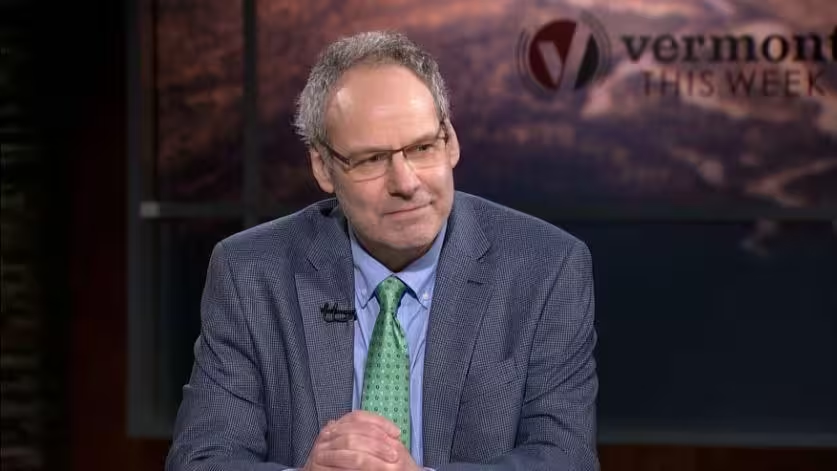
It's Friday, February 27th, and with us on the panel today, we have Mark Johnson from WCAX and Hannah Bassett from Seven Days.
And joining us remotely today, Peter Hirschfeld from Vermont Public.
Thank you all so much for being here.
Peter, so I want to start with you because you have some, new information regarding, act 73, which is, of course, Vermont's education overhaul law.
This could change so many things about the way education is funded in Vermont.
And, apparently there are some problems with getting this either off the ground or maybe happening at all.
What can you tell us?
Well, let's talk about the new information that you referenced first, Mitch.
And this is, an analysis put together for the speaker of the House, Joe Kerwin.
Ski by the legislature's joint fiscal office.
That tries to look at, okay, what's going to happen to property taxes over the next three fiscal years if lawmakers do nothing?
Now, this analysis, it acknowledges that that's, in some ways an unfair cast, a bold number, because there's a lot of variables that you can't really stake out yet.
But if you look at historical data, if you look at where things are headed, the analysis finds that Vermonters would be on the hook cumulatively for, more than $600 million more in property taxes over the next three years.
And they're paying right now.
It also finds that if they wanted to keep, annual percent increases in property tax bills to 5%, then they would need to come up with $450 million in one time money over the next three years in order to make that happen.
You've heard a lot about how they're coming up with one time money this year to try to buy down the rate.
So it just sort of puts into perspective for lawmakers the scale of the issue.
And I think that analysis is in many ways designed to sort of, put some needed momentum behind a push for education reform that is that is floundering right now.
And to be clear, Pete, what you're saying is those numbers you put out which sound pretty scary, $600 million more in property taxes, etc.
that's if lawmakers do nothing.
Yeah.
And that's cumulatively Mitch.
So that's not saying that the that it's three years from now, property taxes would be $600 million higher.
It would mean that over the course of the next three years, that would be the total additional property tax obligation.
So what does this mean for act 73 moving forward?
Well, there are deep philosophical divides within the legislature over what the future of Vermont education system should be.
Those divides center on whether you should be forcing districts to merge.
There are a lot of people that are opposed to that.
They feel like if you have larger districts with decentralized boards that are further away from the communities they represent, that means local towns are going to lose control over one of their most treasured assets, which is their schools.
There's also a real thorny issue when it comes to school choice, and there are a lot of lawmakers that have concerns about taxpayer dollars flowing to private institutions, i.e., independent schools and lawmakers on both sides of that debate feel like this moment, the this big generational debate over, over 73 and education reform, is that is they want to use that to settle this debate once and for all, as close to their favor as they can.
This seems very convoluted with town meeting.
They just have had a week away.
Mark Johnson I mean, what do voters you need to know going in?
And how is this all everything teachers told us.
How is that going to affect things?
Well, that's a good question.
You know, I've been wondering, you look at state wide and it's a little under 5% increase in terms of everybody's cumulative budgets.
But, you know, two years ago was when there was the big tax revolt.
And you know, I'm just wondering what the temperature is.
Usually it's about a 90% approval rate for school budgets.
You know, 5% isn't that much.
But, you know, picking up from what Pete said, you keep looking at, there's going out and out and out every year.
And you know, what point did taxpayers say?
Again, enough is enough.
And I was really struck by Governor Phil Scott saying that and coming out with this and saying, you know, I'm not going to vote for my school budget in, in Berlin.
I mean, and I thought, well, that's an interesting message they send out.
And, you know, the other thing, talking about the Joint Fiscal office, I was looking at a couple of their reports before I came over here.
It is staggering how anemic the projected growth is in all of state government revenue over the next three years.
And considering how much money goes into the education funding, it's you know, it's not just property taxes.
I think that's about two thirds of it or maybe a little less than that.
But, you know, the state is depending on an awful lot of money coming in from other sources.
And if you really then look underneath those numbers, you know, the numbers for tourism, which is one of the three legs of the the Vermont Economic stool.
And and then you look at the entries in, northern Vermont, you know, and the people coming from Canada, I mean, that's, you know, the growth that they're looking at over the next three years.
It's like, you know, 2% a year or 3% a year that's barely keeping up with inflation.
And, you know, you mentioned Governor Scott saying he's not going to vote for his own, district's school budget.
I think he was saying that it didn't even have to do with his own school budget, was kind of a message sending to other school districts.
Right.
Well, you know, when the governor says who is a generally considered to be a pretty mild mannered, not and inflammatory person, say he's not going to vote for the budget.
Boy, that, you know, that sends a signal, I think, well, yeah.
Go ahead.
Peter.
I'll so, you know, the rubber is going to have to hit the road at some point soon here if lawmakers are going to make this education reform plan happen, as they envisioned when they passed this law last year.
Coming back from town, meeting there, there's an environment, potentially where most school budgets go through.
We have a high success rate.
And a lot of lawmakers who are feeling skeptical about act 73 might read that as, a referendum on whether whether or not to do all these force consolidations that that their constituents are telling them not to do.
If a lot of budgets go down, however, then I think we see people, flash back to 2020 for Democrats, specifically when voter disaffection over rising education costs and their effect on property taxes compel otherwise skeptical and reluctant lawmakers to say, hey, I don't love this.
It's not politically popular back home, but we got to do something.
But what about this threat that the governor issued early on that he wasn't going to approve the budget unless there was some forward activity on it?
73 is that is that just not is that a shallow threat or.
No, I don't, I don't it is I can tell you this, it is not a hollow threat.
The administration is ready to follow through on that ultimatum, and lawmakers are taking it seriously.
And it is absolutely, absolutely figuring into their strategic strategic calculus about how to move forward on this.
The reality is, you cannot compel these bodies to do something that they are unable to do.
Right.
And so whether or not that tactic is going to ultimately deliver the reform plan that he wants, is anything but certain.
And of that, you wrote this fascinating story, a couple of weeks ago in seven days about the power of committee chairs, in Vermont.
And, you know, we're seeing this play out a little bit in what, Pete and Mark have been talking about here with a lot of the push and pull in the education, debate.
What can you tell us about, sort of the divisions maybe, happening between the House and Senate and what these committee chairs, how much power they really hold?
Well, a lot of people might think that some of the most influential decisions to be watching in the state legislature would be happening on the House or Senate floor, and that's where those consequential policy shaping decisions are occurring.
But really, the legislators who I spoke with, the advocates, the folks who really know how these processes work, said those decisions are happening more so in these committee rooms.
That's where the policy is being shaped.
And for the education reforms that we're discussing right now, how act 73 might be implemented, a lot of what might, put these policies into fruition.
Those discussions are happening right now in the, education committees in the House and the Senate for example.
And the leaders of those committees have a lot of, influence over what voices come into those rooms.
Who is able to testify?
What, bills might specifically be taken up for consideration.
Now, on the House side, Peter Conlin was chosen, appointed by, House Speaker John Krasinski.
Right.
But on the Senate side, and this is something I didn't realize until I read your article, there is something called The Committee on Committees.
Right.
Which you got to love that, they chose, set budgets, to head that part.
But there was some controversy around around, Seth.
Right.
Because of his background.
What can you tell us about that?
That's right.
So the Committee on Committees is a panel of three people.
They're the, the group that selects the, all the committee chairs in the Senate.
Senator bond card selection was more notable in that, comparative to the House where Senate where Representative Conlin was the, returning chair for the House Education Committee.
Senator Bongarts had not served on the Senate Education Committee before.
So it was a relatively unusual move by the Committee on committees by this group to choose someone who had not been on that committee before, let alone, a chair or vice chair to serve in this very influential role in a year when we all knew that education would be one of the top issues before the legislature, and Senator Bongarts happens to have, known, background as being someone who's spoken out very strongly in support of independent schools.
He himself was chair of, Bernie Burton, one of Vermont's independent schools.
So, he comes into this with a kind of unknown perspective.
Every every legislator brings their own perspective.
Representative Condon brings his own perspective.
As someone who's been a strong advocate for public schools as well, but it was a very, notable choice for the Committee on Committees to choose Senator Bond cards in that way for this, education forward session, for sure.
And, people should really check out that article to find out about just how much power is wielded in these very important positions.
Pete Hirschfeld, I'm wondering, to Hannah's point here, is there some, contention between the House, vision for what they would like to see with education reform and the Senate, version?
Yeah.
In in those differences, are coming into starker contrast as we speak.
Mitch, the house has a framework that would use mandatory consolidation.
They would force school districts to merge into entities of, you know, 1000 to 4000, with the vast majority being being 2 to 3000 students.
They're looking about, you know, 25 to 30 districts.
They also have a framework that would, effectively eliminate school choice in the 90 plus communities that have it in Vermont right now, down in the Senate, meanwhile, we're seeing a proposal begin to take shape that, looks at voluntary mergers as the path forward, at least for a couple of years.
They said, we've heard from communities they want to let this happen organically.
And we want to give them a chance to do that also.
And very notably, it would maintain choice in the communities that have it.
Now, those are two incredibly polar positions, that, are going to be extremely difficult to find a middle ground on.
Mark Johnson.
The other thing I wonder about with town meeting day so close, you know, we don't know what the state revenues are going to be until the end of the session.
So I'm just wondering how voters can make informed decisions going in voting on these kind of things when they really just don't know the effects can have on property taxes, etc.?
Yeah.
Which is where I think this idea that, with the budgets are going up, being under 5% might really be valuable.
You know, I know a lot of communities did a lot of work to get them to that point.
You know inflation's what, two and a half 3%.
But you're right I mean we're not going to know until the end of the year with the with the revenues are statewide.
You know, it's a huge factor because that's going to play into how much money can come from the general fund to augment the property taxes, to buy down this rate, which has to happen.
I mean, you can't possibly try to be doing this based solely on property taxes, and nor have we been doing it that way.
So it is it's a guessing game.
We'll have to keep our eye on that.
Of course.
Go ahead.
Pete.
Yeah, I'm just going to say, you know, this is the tension for voters, right?
They go to town meeting day.
They see that their school board has worked incredibly hard to come up with a responsible budget that's only going up by 4.2%.
And yet that might result in a ten plus percent increase in local property tax obligations.
This is the system that lawmakers say it's time to put an end to and come up with something saner, more efficient, more effective.
Whenever you try to disentangle a system of that size, though, that has so much emotional attachment among Vermonters, it's a lot more difficult to to do well on, you know, Hannah's colleague Allison Novak wrote, I thought this really great piece just talking about the declining enrollment.
I mean, we're now down to 73,000 students.
It was close to 100,000.
Not that long ago.
You know, this whole idea of voluntary closures, I just don't really understand how that's going to happen.
I mean, every community wants to keep their own school.
You know, I'm not advocating one way or the other, but it just seems as though, you know, I'm reminded a little bit of the base closure commission that was set up years and years ago to try to figure out where to close military bases.
Every community wanted to keep theirs.
There are huge economic engines.
Everybody wants to keep their small school.
And then you run into this other problem where if you want to attract young families to come into your community, why are you going to move your family into a community where the school is really far away?
But something's got to give there?
Yeah, I mean, one of the things that Allison pointed out in that article you were referring to is that there are there are three things that everybody sort of looks for with this, debate when you're talking about schools, you can either have, you know, reasonable property tax rates, good Holly, high quality education or lots of local schools with lots of local control.
And the person she was talking to, one of the superintendent, pointed out, you can have two of those, you can't have all three.
And that seems to be the intractable, intractable problem here.
Yeah.
And when you have an intractable problem, I mean, you know, maybe you can comment on this.
You know, generally nothing happens.
You know, the path of least resistance is to make no change, but simply existing divided government, right.
We have a Republican governor.
We have a Democratic legislature.
Often when you're talking about transformation of this scale, you need two branches rowing in the same direction.
There is, a surprising amount of collaboration going on between the Scott administration and Democratic leaders in the House and Senate right now.
But they do come at this in some respects, in, in some significantly different ways that could complicate this.
What about how the governor sees these things as he, you know, been a strong proponent of one strategy or another?
He is very much letting this play out.
He wants to see the House and the Senate sort of work things out.
He wants to be served almost as a mediator between the different camps within the legislature.
It it's similar to the role that that the governor played last year when he sort of helped the House and Senate come together on something.
I think he's hoping that that he can play that role again.
The decisions that the legislature is going to have to make this year, however, are going to be far more difficult and consequential than the ones that they made last year.
Anything else related to Town Meeting Day that is caught your interest that you're going to be looking for?
Mark Johnson?
Well, I've been, spending a lot of time, talking about Burlington.
And, you know, I'm really fascinated to see what's going to happen in Burlington.
You know, there's a there's a, about an average increase there.
But, you know, again, this is an awful lot of money.
And the city also has a pretty significant for the third year in a row, budget gap on the city side, too.
You know, people are just feeling a lot of pressure out there.
The cost of everything seems to be going up.
And, you know, I was really interested in talking to the mayor that, you know, she's saying that the Grand List in Burlington is only grown 1%.
I found that kind of surprising.
She's now talking about perhaps having, you know, school taxes.
There's an income sensitivity factor to it that is not true on town and city taxes.
And she floated this idea when I talked to her of, you know, maybe someday down the road.
We've got to consider that as a, as a proposal to.
So there's a five cent on the tax rate increase proposed in Burlington, but it's a 10 to $12 million gap, which, you know, it doesn't sound like much in the numbers.
We've been talking about statewide education.
But that's a significant amount in Burlington.
So again be interesting to see what happens with that.
And by the way, you had a very long conversation with the mayor of Burlington about this.
Right.
Very comprehensive.
Right?
Yeah, I was on the 802 on the 802.
That's right.
Absolutely.
Yeah.
No, it's you really discussed a lot of things, and we want to find out what's going on in the Queen city.
They should check that out.
I want to make mention to that, Rutland, this is really interesting.
They're having an all right in election for mayor.
The governor has come out in support of Tom Donahue in that one, but, I cannot recall maybe among the panel here.
Has there ever been an all right in election?
In Rutland before?
I'm getting shaking heads here from all our panels.
It just seems kind of remarkable to me.
So that's something that, we should be watching out for in town meeting day as well.
And that's, of course, happening next week.
What turned our attention now to another story, that you wrote about with our colleague Lowell de for Pete Hirschfeld?
It's kind of mind boggling.
We've heard at this point about Turning Point USA because of the assassination of Charlie Kirk, who was behind this.
This is a conservative movement.
They were having a, an event headliner who raised a lot of questions, speaking in Barry, what are the general ramifications of this?
You can tell us about it.
So Hank Poitras, better known as Planet Hank, is a content creator who is based in Brattleboro, who has thousands of followers who who stream his, coverage of local police interactions.
Poitras says a scanner, he's often the first on the scene, and he's got this sort of, down and dirty first person account of watch what happens when police respond.
He has also begun to make considerable inroads into both local and statewide politics.
He is was elected chair of the Windham County GOP and in October, obviously, his his star has risen high enough that a group like Turning Point USA asked him to come give a keynote address to to the young people that started that chapter.
The controversy is about Hank Fortress is social media history.
He has said some objectively horrific, misogynistic and racist things online, that social media history is catching up to him.
And a lot of prominent Vermont Republicans are very much looking to now distance themselves and the party from from this up and comer distanced themselves.
But, when we look at the head of Vermont's Republican Party, Paul Diem, I mean, they're they're not you know, he was saying I would appear on his podcast.
He kind of decried some of those comments, right, but didn't completely distance himself from this.
This person.
Yeah.
You know, there are people in the Republican Party who say, look for solution to a guy like this is that you marginalize them entirely.
You basically pretend like they don't exist, isolate them, and, and just make them go away.
There are others that feel like, in order to counter whatever, whatever influence a person like this has, you need to be able to engage with them so that you can reach the same audience that they're reaching and provide them with a different kind of perspective, a narrative than they might be hearing if they were just listening to somebody like Hank Patrisse.
So, there are a lot of people that that feel like the, latter argument is, is some, some weak sauce and that there's really only one way to handle situations like this.
But it is a dilemma that, the GOP is dealing with right now, you know, and the governor was critical of him.
But I, too, was struck by that comment by Paul Dahm, who is the state Republican Party chair, who, you know, didn't wind up showing up for this event that this guy was talking about.
I mean, this stuff he's saying is just absolutely off the charts in an era where the level of outrage is now become a pretty high bar.
And, you know, for him to say that this is the only way that he can reach that audience, I thought to myself, why spend your time trying to reach that audience?
And all I could think about is, you know, people like former Governor Jim Douglas and, you know, Richard Snelling, you know, God rest his soul.
And, you know, where is the Republican Party?
I mean, Phil Scott's got this 70% approval rating.
But really, I mean, the bench is pretty shallow.
And, you know, where is the growth and the and the increase in membership of people that are reasonable and moderates.
And wow, we haven't seen a lot of those words in recent times.
And obviously this is affecting, not just Paulding, but Barry, representative two has been caught up in this controversy, right?
Yeah.
Representative Michael Bolton was another speaker at this, turning point USA event.
Club America, its, youth chapter of Turning Point USA.
He is a, school board chair in Barry.
Leading up to this event, when it became known that he would be one of the speakers, he faced public criticism for his participation from community members.
He's not running for reelection for the school board.
So coming to town meeting day, no longer will be that conflict in question.
But having spoken with Representative Boutte and I know that he was on the fence about participating, sharing this, stage with, Planet Hank, he ultimately decided to participate, thinking was that because of what Mark was saying about, you know, let's reach the audience and I if I don't speak somebody else will was that I think his, his thoughts were more, if I, if I'm not there, this will be the only voice.
This will be more of the voice.
That's, filling this space.
So, perhaps almost more to, offer an alternative.
But I think it goes to show that there's this real grappling within the Republican Party about how to, deal with this very, extreme voice within their ranks.
Yeah.
I mean, it's because, again, to Mark's point, to Pete's point, some of the things that were said, we're not saying them here.
We don't want to.
They truly were objectively horrific.
And I don't think that it's something that any Republican Party anywhere should want to be even, closely associated with, even in a tangential way.
And yet we're starting to see it creep a little bit into Vermont politics, which, you know, seems unfortunate on the face of it.
But, you know, we'll have to see if there's any ramifications down the line.
How Paul Dean reacts to this, moving forward and whether this, planet hate person makes any more of these comments that could get the party into some trouble.
We have just about a minute left here, and I do want to tell you about an event that is happening tomorrow in Middlebury.
Addison County by Park and Town Hall Theater are putting on a Lunar New Year celebration.
And it's all free, open to the public.
Everything is free.
Admission starts 11:00 in the morning, goes to four in the afternoon.
And, one of the features is a showing of the K-pop Demon Hunters film with an all Sing-Along, presentation.
So they're encouraging you to get into your costumes.
Pete, I think you've got your your roomy K-pop costume ready for this, right?
I know all the word, so I'll be singing right along.
Absolutely.
Mark, I hope you're going to show up in your Zoe costume.
I'm hoping for Pete taking photos because.
And sharing those.
And, Hannah, you've got to be a huge K-pop Demon Hunters fan, too, right?
You know, I can't speak to that one.
I had a feeling you might say that.
That's okay.
And I want to thank our panel this week so much for being here with us today.
Mark Johnson from W-c-i-a zero two podcast, Pete Herzfeld, Vermont Public and had a blast from seven days.
I'm Mitch, please join us next Friday for Vermont this week.
Have a great week.
In the meantime.

- News and Public Affairs

Top journalists deliver compelling original analysis of the hour's headlines.

- News and Public Affairs

FRONTLINE is investigative journalism that questions, explains and changes our world.











Support for PBS provided by:
Vermont This Week is a local public television program presented by Vermont Public
Sponsored in part by Lintilhac Foundation and Milne Travel.