Vermont This Week
February 20, 2026
2/20/2026 | 26m 46sVideo has Closed Captions
Vermont's school enrollment rapidly declining | Chittenden County's 'accountability court'
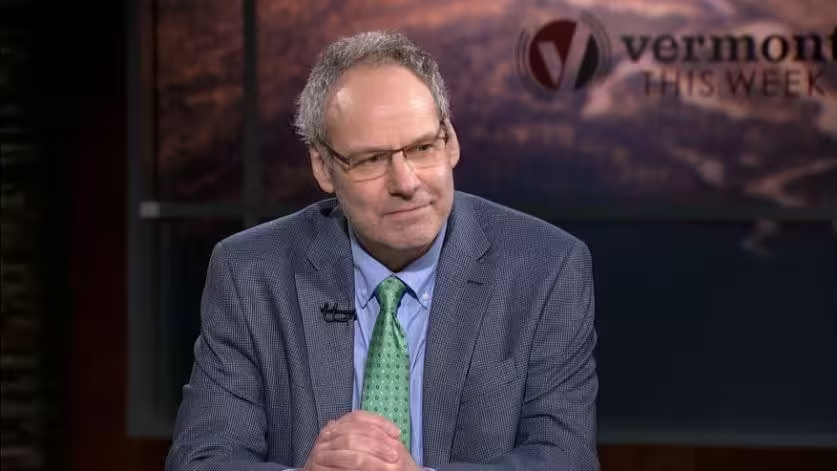
Vermont’s school enrollment rapidly declining | Lawmakers propose differing school redistricting maps | Chittenden County's 'accountability court' | Burlington mayor announces preparations in case of ICE surge | Moderator - Mitch Wertlieb; Liam Elder-Connors - Vermont Public; Alison Novak - Seven Days; Calvin Cutler - WCAX.
Problems playing video? | Closed Captioning Feedback
Problems playing video? | Closed Captioning Feedback
Vermont This Week is a local public television program presented by Vermont Public
Sponsored in part by Lintilhac Foundation and Milne Travel.
Support provided by:


Vermont This Week
February 20, 2026
2/20/2026 | 26m 46sVideo has Closed Captions
Vermont’s school enrollment rapidly declining | Lawmakers propose differing school redistricting maps | Chittenden County's 'accountability court' | Burlington mayor announces preparations in case of ICE surge | Moderator - Mitch Wertlieb; Liam Elder-Connors - Vermont Public; Alison Novak - Seven Days; Calvin Cutler - WCAX.
Problems playing video? | Closed Captioning Feedback
How to Watch Vermont This Week
Vermont This Week is available to stream on pbs.org and the free PBS App, available on iPhone, Apple TV, Android TV, Android smartphones, Amazon Fire TV, Amazon Fire Tablet, Roku, Samsung Smart TV, and Vizio.
Support the crew
Help Mitch keep the conversations going as a member of Vermont Public. Join us today and support independent journalism.Providing Support for PBS.org
Learn Moreabout PBS online sponsorshipSchools across Vermont face rapidly declining enrollment reality communities and lawmakers alike grapple with as the state's education overhaul efforts continue.
Plus, Chittenden County's Accountability court is being hailed as a success.
What has it accomplished?
And Burlington's mayor announces preparations in the event of an ice surge in the Queen city.
All that and more ahead on Vermont this week.
From the Vermont public studio in Winooski.
This is Vermont this week, made possible in part by the Lintilhac Foundation and Milne Travel.
Here's moderator Mitch Wertlieb.
Thanks so much for joining us.
I'm Mitch Wertlieb.
It's Friday, February 20th and with us on the panel today we have Alison Novak from Seven Days, Calvin Cutler from WCAX and Liam Elder-Connors from Vermont Public.
Thank you all so much for being here today.
Before we get to our top story, we're going to start with a little bit of, breaking news.
Vtdigger is reporting that today on the Senate floor, it was announced by the pro tem of the Senate, Philip Roth, that he will not seek reelection.
He said he is going to retire.
This is some pretty big news.
Calvin Cutler just sort of put this in perspective for us.
What does this mean?
That Philip Roth will not be seeking reelection?
I mean, it's huge news, Mitch.
And there's so many implications to this.
You know, there's the immediate what is this going to mean for some of the big priorities this year, like education reform and housing?
You know, we know that the, Senator Bharath has largely been sort of going along with this framework of what Governor Phil Scott would like with redistricting and the like, you know, what is that going to mean for the trajectory of the education reform conversation?
There is, you know, what is it going to mean for leadership in the Senate?
What is it going to be the power dynamic between the Democratic majority?
Are there other people that are going to be sort of lining up trying to, fill in the pro tem position next year if Democrats still maintain a majority?
And then there's also the electoral piece of this.
You know, we've already had, I think, two people of that I know of have thrown their name into the hat in Chittenden Central.
Are we going to see more high profile progressives or Democrats throw their name into the race and then central?
There's a lot that we still don't know.
But I mean, certainly this is going to have a really big effect on policies coming out of the Senate and sort of the tone and tenor heading into the second half of the legislative session after Crossover Day and of course, all of this, something that, Phil and everyone was dealing with was education reform, as you were just mentioning, Kelvin.
And, you know, to that point, Alison Novak, you wrote this really comprehensive story in seven days that is shining a light on a really big problem that Vermont has right now.
And that is the decline in school enrollment, not just in rural areas, but all across the state.
One example you gave at the top of your story is that, in northeast Addison County 25 years ago, you had some 2000 students today, fewer than 1200.
Yeah.
So, yeah, I kind of dug into the data to look at, declining enrollment across the state.
I think that's a, you know, people always talk about declining enrollment as a major issue.
But like, what I was looking to do is kind of talk about what that really means, on the ground for school districts.
So, you know, one of the things I was surprised to find is I think we often think about declining enrollment as a rural problem, a small school's problem.
But when you look at Burlington, the most populous, you know, area of the state, Burlington has lost 1 in 6 students in the last 20 years.
So we've seen, Burlington has seen a pretty steep decline in students.
And, you know, I think some of the factors leading to the, decline in enrollment differ from community to community.
But, you know, when it comes to kind of our demographics in Vermont, we have the lowest birthrate dead last in the country.
We have we're the second oldest state or second or third all the state in the country.
We don't have a lot of young people, and we don't have affordable housing for young families, which is something that a lot of the superintendents I talked to spoke about, especially in Burlington, that there's just not affordable housing for, families to live in.
And Burlington also in particular, I think the lack of immigrants in recent years has made a pretty big, impact, not the biggest impact, but that has been a factor and why they've seen a decline in enrollment.
So a lot of different factors.
But I do think when you kind of look at our demographic decline, what I've heard from multiple people, including a Middlebury professor who studies, demographics, is this is it, you know, going to go away anytime soon?
This is a problem that our state is going to have to contend with going forward.
And, you know, I think we should be planning for it.
You know, that Middlebury professor that you're talking about, was quoted in the article as sort of describing the effort to to change this trajectory as trying to move a big ship.
It's a huge vessel.
It's hard to move.
It's going to take some time.
Right?
Yeah.
And I think right now what's happening is that local school districts are trying to kind of contend with the issues brought about by declining enrollment.
For example, in Washington Central, they just tried to close two elementary schools to consolidate from five elementary schools into three elementary schools.
The reason was, is because they've been losing students at a very rapid rate.
And they just they realize they can't, you know, afford to run a school system with so many small schools.
Now, that vote had to be put to the local towns, Kalis and Worcester and those townspeople voted against the closure.
So now we're left with a school district that has budgeted for three elementary schools because they kind of budgeted on the assumption that they would close two schools, and now they're having to spread thin the budget that they have prepared to support five schools.
And it's going to mean, you know, part time librarians, part time nurses and schools.
And, you know, I think it is going to affect the quality of education.
And so in the absence of a statewide framework, a state where statewide vision or plan, it's every community for themselves.
There is a gentleman you spoke with in this article is the, Mount Abrahim superintendent of Schools, Patrick Ryan.
I believe his name was.
Yes.
This to me was fascinating because he laid it out this way.
He said, look, there are three things when we talk about schools here.
You can have high quality education.
You can have reasonable property tax rates or and you can have small districts with small schools and local control, but you can't have all three.
You can have two of those three, right?
Yes.
Pick two.
But you can't have all three.
And I think that is really kind of crystallizes what this is all about.
We're trying to run a system that is very expensive.
It's very expensive to have a lot of little districts and a lot of little schools, and we don't want our property taxes to rise.
But something's got to give here because we can't have it all come in these reform efforts.
I mean, what what are legislators looking at here?
What's the big challenge?
You know, I think if you look at the high level, it looks, you know, the past few weeks heading into the session, it looked like, you know, the governor, the speaker and the pro tem were really all kind of on the same page of like, hey, you know, the governor, of course, laid down that ultimatum.
I'm not letting you guys go home until we pass some sort of map framework that goes along with act 46 or 7673.
Sorry, not great with Menino.
And so it looked like everybody was on the same page, but really as the committees and as we were talking about before we went on the air here, you know, there's been the conversation has been anything but clear as to whether rank and file Republicans and Democrats agree with the framework that was passed under, the education reforms.
And so heading into crossover, heading into sort of the latter half of the session here in the second year of the biennium, I mean, it is anything but clear whether people are still committed to this framework.
You know, we're talking about, you know, maybe one there's a proposal in the Senate, education to, you know, cut down to maybe 10 or 13 districts with maybe more to come.
There's a proposal for a single statewide district.
The house is also been sort of struggling and working through their, their, their, you know, own map, I think, which was 20 something districts.
I mean, it's going to take a lot of, of wrangling and a lot of backroom sort of huddling between the governor, the speaker, and the pro tem.
But then there's the other question of now we have Phil Berreth, who is not running again.
And so what does that mean for the trajectory of these reform talks?
I mean, again, it's I hate to keep saying it's anything but but clear.
But I mean, Alison did a great job of just laying out what are the stakes here.
And as we know, property taxes are continuing to rise.
Town Meeting Day is going to be coming up.
And also, you know, there was a assessment that was, educational assessment that was issued earlier this week as well, that showed that, you know, test scores and students academic performance.
Still, there is improvements that can be made.
So it's a real pickle.
So where are we now, at least with the maps.
And what do we know about that?
Because there are so many.
There's coven was pointing out so many different, ideas about this.
I mean, the governor was talking about five districts.
So many more or less.
Yeah.
And so the governor also has kind of issued an ultimatum saying that he will not approve a budget unless maps are drawn.
Right.
And so, in terms of the education reform, we have to have the maps before then we're able to kind of address the funding formula, this new foundation formula that was going hand in hand.
And I mean, I totally agree with Calvin that like when you look at what's happening in House education and Senate education, it is completely unclear how this is going to all shake out.
There seems to be really no coordination between the House and Senate.
I thought there would be maybe more this year, because last year there wasn't a lot of coordination and that led to kind of, at the end of the session, a real scramble to kind of reconcile their two bills.
And, that ultimately led to act 73 being passed.
But, you know, when I'm looking at what's happening in Senate education, they want to preserve supervisory unions.
At least Senator Bogart's the head of Senate education is trying to preserve supervisory unions.
There is another plan from Senator Heffernan to have, like a single, single school district in Vermont and have universal choice for all students, in house.
Ed Peter Conlin, the chair of House education, has introduced a bill for 27 school districts and no supervisory unions, and his committee seems kind of unsure.
A lot of people are raising objections to his map.
So I think right now it feels like they're really scrambling to figure out if there can be any consensus.
And if there isn't, what happens?
We don't know.
We're kind of watching to see, but it does feel like everyone, the legislators are kind of all over the place at this point.
I mean, it's a tough problem.
You've got schools that can fit X number of kids and not enough kids to fill those schools.
Did I hear you right that we have the most the highest declining birth rate in the country, in the state of Vermont?
We do.
So how do you fix that problem?
I mean, you need kids to fill these schools.
Yeah.
And I think another thing that has come up over and over again is money for school construction, which kind of seems counterintuitive given that we're losing students.
But, you know, we need facilities and we need like, if we're going to combine several high schools, we probably do need to do some building and some renovation of existing facilities.
And where is the money going to come from for that?
I think there's people trying to figure that out in the legislature, but no clear path for how we would fund school construction.
Okay, well, we solve that problem.
I serious, these are these are really intractable problems.
It seems at this point.
But I really urge folks to check out the article that you wrote, Alison, because it is very comprehensive and it kind of lays out all of these very thorny issues and what legislators are dealing with here.
Let's move on to what we mentioned at the top, Chittenden County's accountability court.
The email to Connors.
You've been covering this for a while now.
There are some successes with this.
Remind us again what is the accountability court, designed to do?
So back in the fall, Governor Phil Scott announced he was launching this special docket and appointing a special prosecutor to oversee it.
And it was really focused on a lot of concerns about quality of life issues and crime in Burlington, Vermont's largest city.
And the docket was essentially just for people who had five or more open cases.
And so it was really for what, what a lot of people have, termed repeat offenders.
So people who are sort of cycling in and out who were maybe picking up a lot of charges while they were waiting for cases to be adjudicated because of this large court backlog that we have, not just in Chittenden County, but around the state.
And so the idea was by focusing on this group of individuals, by having a prosecutor focusing on them, defense attorneys, and actually bringing social service organizations into the courtroom to connect people to services.
Because for a lot of these individuals, issues of substance abuse, homelessness, mental health, a lot of those are underlying issues that, result in some of the criminal behavior that they're accused of.
And so the docket was really meant to just hone in on this and try to pour in extra resources to resolve those cases.
And, by and large, everyone who's worked on that docket in Chittenden County has said it was successful after the three month pilot program.
Some of the numbers from that, 78% of the cases that were in the docket were resolved by the end of the three months.
Wow.
And there were 900, cases in there.
So that's fairly significant.
It's pretty significant.
And I think it, you know, speaks to the focusing of resources.
You know, if you wanted to break it down, the sentences you had 21 people, who got prison time about a third or so were given community supervision sentences.
So things like probation.
So that is sort of if you would look at those dispositions, where they landed.
The big question for me now is whether or not this is going to be sustained long term.
Chittenden County State's Attorney Sarah George plans to keep this going to some degree, though it'll be once a week as opposed to five days a week.
And, you know, there's just going to be a little bit less resources devoted to this now.
So we'll be able to kind of keep up this model that everyone it says works really well, because you've got social service organizations directly in there, lowering the barriers for people to get access to those services.
And that does go a long way.
Especially when I was talking to defense attorneys and public defenders who often are trying to almost work as social workers.
Now, which is a big change in the courts.
Well, I appreciate the update on that.
And I know that Calvin Cutler, you've been covering this story as well.
And Liam mentioned Sarah George, the county state's Attorney.
She did have did have some concerns regarding this program when it comes to mental health.
Let's hear what she had to say about it.
The Department of Mental Health, refusing to engage in an order non-hospitalized session on someone with 25 pending cases because that person doesn't want to engage in services.
And so then we're forced to dismiss 25 cases with 25 victims is not the answer.
Calvin Cutler, in your discussions with Sarah George about this, what is she, what is she getting out there with these 25 cases?
So she's talking about what many over the years have sort of described as a perceived gap between the criminal justice and the mental health system, where people are either deemed not competent or not mentally fit to stand trial.
But also they can't get the health care and the mental health care that they need, you know, in, in state law in Vermont, to receive treatment, it's mostly voluntary.
You know, it's it's really up to the individual to seek out those services.
And she's talking about, you know, sort of this, this relationship between like state prosecutors and the Department of Mental Health and trying to place people and basically under state law, people have to be held in the least restrictive setting possible.
Because that's the way it is.
And also, we have a history of this.
There's also certainly concerns about historically institutionalization, concerns about civil liberties and the like.
That's also part of this conversation.
But really what what happens in practice is, you know, people are either released back into the community and, they're paired with a plan or they don't have access to those mental health resources.
And there are people that that have fallen through the cracks.
And there's been in recent years, there's been some high profile, homicide cases that have also sort of dealt with this or been sort of part of this.
But, you know, what we have right now is sort of this, this gap between the criminal justice and the mental health system.
For years, we've talked about, what's known as a forensic facility.
Somewhere we can housed people, you know, where they can become competent to stand trial.
And these people are accused of crimes and involved in the criminal justice system.
But even then, there's the question of, you know, where do you put people?
How do you fund it?
You know, what does this mean for for victims advocates and victims of crimes?
What does this mean for, you know, these individuals receiving these services?
I mean, it gets really, really tricky very quickly.
And it's been I think, Sarah George mentioned, that, there's about seven, I believe cases that they were not able that she said basically these people probably will be back in the accountability court, in the near future.
We will see these people in court because they just aren't getting the services that they need.
So it's a real it's a tough nut to crack.
Does she want more involvement from the Department of Mental Health?
Is that one of her?
Yeah, that's what it sounds like.
And and you can also weigh in tier two because, you know, you steeped in this work.
But my understanding is that, you know, the Department of Mental Health, they have to sign off on, you know, somebody subscribing to a certain treatment plan and.
Right now, as the system as it stands, state prosecutors, whether that be Sarah George or elsewhere in the state, they don't have a lot of visibility into, you know, the treatment plan and to what, conditions people have to adhere to and what kinds of care and mental health that they receive in the community or not.
And some, some people aren't getting that treatment.
And that's sort of the gap between the criminal justice and the mental health system.
It's a little bit of a black box.
And that's a lot of prosecutors have raised concerns over the years, like Calvin said, that they don't necessarily know if someone's put on an order, if not hospitalization, which means they're supposed to get services.
It's not a hospitalization order.
So they're not being treated.
They're not held in a facility.
They're getting treatment in the community, which is often what happens.
And then but the prosecutors don't have any insight or they're not able to see whether or not a person's following that, those orders essentially.
So the accountability court didn't necessarily address those concerns.
And it's just been a long standing, debate and trying to figure out how to how to deal with that.
Lee, to Congress, let me stick with you, because we have an update on a story that was pretty high profile when it happened.
This has to do with the deportation case against Motion medley.
What's the update on that there?
So, an immigration court judge, dismissed this case, kind of on a technicality, actually, it was that the federal government failed to authenticate a memo from Secretary of State Marco Rubio that was kind of underlying the government's case of why Muslim a daily should be deported.
The memo essentially said that, my daughter's pro-Palestinian activism, threatened U.S.
foreign policy goals.
And so he should be, removed from the country because of that.
But, the judge ruled that the memo wasn't authenticated, and so the case was dismissed.
That doesn't mean that, Maddow is out of the woods yet, though, the government could refile the case.
They can also appeal the judge's order.
So there's still you know, this is not completely settled yet, but certainly, was a big moment and a big win for from a daily who was held in a Vermont prison for two weeks after he was detained by immigration authorities last year.
Now, looking at what could happen in Burlington, the mayor of Burlington, a man, Mulvaney Stanek, is preparing for a possible, ice surge like we saw in Minnesota, like we saw in Maine.
Certainly there are Ice agents, too.
They're doing work here already.
Here's what she had to say about being prepared.
Should Ice do a bigger surge?
This is about preparation.
This is about transparency.
To me, this is an important expression to not be quiet, to not, to be under the radar about what we're doing quietly behind the scenes, but to be strategically verbal locally, so that those members of our community hear strongly that this mayor and tonight the city council stand right beside them.
So, Liam Oconnors two questions.
What is she referring to?
What the Burlington City Council has done here.
And is there any truth to what they did?
Yeah.
So the City council, approved a resolution.
It was called the ice out resolution, essentially, saying, you know, criticizing what I was doing, saying, you know, no, no, we don't approve of any of these immigration enforcement actions that we're seeing around the country.
And what the mayor was talking about was earlier on, that same day as a city council meeting, she signed an executive order, essentially, laying out preparations and steps the city would take in case there was a possible surge of federal immigration enforcement in the city.
We should note that there's no indication that there's a surge happening in Burlington or going to happen in Vermont.
But obviously, we've seen that happen in other parts of the country, and places don't necessarily get a huge amount of warning.
So a lot of this is just early preparation.
And I will say to I mean, I think we're now on day six, seven of a DHS government shutdown at the federal level over these issues.
The Trump administration clearly has seen what was happening in Minnesota as as a problem.
And so, you know, there's a debate that's happening right now of what reforms can be made to Ice and DHS, if any.
There's several bills at the state House about this, about, you know, Ice and law enforcement wearing masks and where and where can they go and can they not go?
So a lot is happening sort of in the political realm in this in Washington.
A lot of that, I think, is going to trickle down into, you know, what we see here.
But what to Liam's point, I mean, this is really just to sort of broadcast and make make sure that, you know, if something were to happen, you know, here's the policy of Burlington.
Yeah.
I think to sort of I think to me, the biggest sort of things in that executive order are just sort of reiterating the role of Burlington's local law enforcement, their local police department, reiterating that they are a fair and impartial policing policy, which is modeled after the statewide policy, says that police officers do not aid in federal civil immigration enforcement actions.
And it also kind of lays out that Burlington Police officers, while they are not going to impede what they're saying, are lawful federal, actions, they would respond to scenes of immigration enforcement and to to document what's happening and to just sort of have material for review in case there were any reports of unlawful actions.
So observing, documenting, being present but not impeding in any of these law enforcement, federal law enforcement activities.
Yeah.
And it sounds like, the mayor's messages also going out to Berlin, Tony, and saying, look, you know, we want you to know that we're aware of this and letting you know we're doing what we can to to the extent that they can.
Yeah.
And they've been doing this since, the beginning of the, the second Trump administration.
But obviously it's taken a higher, profile, given what's happened in the last couple of weeks and months.
Thank you for that update.
Now, with the 2026 campaign season just around the corner, Vermont lawmakers are taking a step to regulate the use of artificial intelligence in political advertising.
The Senate Wednesday gave final approval to a bill that requires candidates in political groups to disclose the deceptive use of AI in ads.
Calvin Cutler, what's in this bill?
And, you know, if the governor's expected to sign it?
Yeah.
It's interesting.
This is a bill that started last session.
Now it's moved over to the Senate.
Basically, it would require that candidates disclose 90 days before an election of, you know, whether they used artificial intelligence, generative AI in, in an ad, you know, of course, we're seeing I mean, you go on Twitter, you go on Facebook.
I mean, I slop is pervasive in the political arena, and this is the state trying to get ahead of that.
There were concerns last session when it passed through the House about First Amendment, sort of, you know, freedom of speech, concerns.
But this bill has several carve outs.
There's a carve out for satire as well.
And also, you know, so they're hoping that basically would be able to, avoid any sort of lawsuit.
We've had a number of states move forward with these types of bills.
It sounds like this is something potentially.
I don't think the governor's been asked about it, but, I think that is a important carve out that potentially could, could earn his support.
But so, yeah, I mean, basically this is just sort of they're moving forward with this bill and it would go into effect before this election.
It would.
Okay.
That's an important point.
Thank you for that.
Now, this week, the legislature also elected the next leader of the Vermont National Guard, U.S.
Air Force Brigadier General Hank Harter.
Lawmakers overwhelmingly chose harder to serve as adjutant general following a contested race between two high ranking guard members.
Harder inherits leadership of a 3000 member Army National Guard and 1000 member Air National Guard, whose two year term will begin on March 1st.
Now we're going to finish up here with just a reminder that Vermont is kicking butt in the Olympics.
We've got at least five medals, actually seven if you count in.
The gold medal won by Mikaela Shiffrin, who of course, trained at Burke Academy, and, Jesse Diggins, who trained at Stratton Mountain School.
She won a bronze medal.
It's just been fantastic to see so many back forand this, this young gentleman, if you saw him do the big air, I know if any of you saw that incredible.
Won the silver medal with that.
And I just want to let folks know that coming up Monday on the Sports Report, we have an interview with Ryan Cochrane.
Seagull, who won silver, his second silver, in the super-G.
And it's just a wonderful conversation, with that, that, gentleman who, of course, is from Stark's bureau.
So we hope you'll tune in for the Sports Report on Monday to talk about the Olympics.
And don't forget to watch if it's the men U.S.
hockey, which I hope it is.
Canada versus U.S.
for the gold final on Monday.
Sunday morning.
That's going to be an amazing one, too.
You can tell I'm excited about the sports that's going to do it for Vermont this week.
I want to thank our panel so much, Alison Novak from seven days, Kelvin Cutler from Wcax and Liam Elder Connors from Vermont.
Public Eye, Mitch Wortley, thank you so much for watching.
We'll see you next Friday on Vermont this week.

- News and Public Affairs

Top journalists deliver compelling original analysis of the hour's headlines.

- News and Public Affairs

FRONTLINE is investigative journalism that questions, explains and changes our world.












Support for PBS provided by:
Vermont This Week is a local public television program presented by Vermont Public
Sponsored in part by Lintilhac Foundation and Milne Travel.