
Corey Feist JD, MBA; Noel Maurer; Jose Lozano
3/28/2026 | 27m 38sVideo has Closed Captions
Corey Feist JD, MBA; Noel Maurer; Jose Lozano
Corey Feist, CEO of Dr. Lorna Breen Heroes’ Foundation, talks about how they protect the mental health of healthcare workers. Noel Maurer, Professor at George Washington University & author, examines the Panama canal’s role during World War I. Jose Lozano, Executive VP, Chief Growth Officer, Hackensack Meridian Health, talks about the significant of the FIFA World Cup coming to NJ.
Problems playing video? | Closed Captioning Feedback
Problems playing video? | Closed Captioning Feedback
Think Tank with Steve Adubato is a local public television program presented by NJ PBS
Corey Feist JD, MBA; Noel Maurer; Jose Lozano
3/28/2026 | 27m 38sVideo has Closed Captions
Corey Feist, CEO of Dr. Lorna Breen Heroes’ Foundation, talks about how they protect the mental health of healthcare workers. Noel Maurer, Professor at George Washington University & author, examines the Panama canal’s role during World War I. Jose Lozano, Executive VP, Chief Growth Officer, Hackensack Meridian Health, talks about the significant of the FIFA World Cup coming to NJ.
Problems playing video? | Closed Captioning Feedback
How to Watch Think Tank with Steve Adubato
Think Tank with Steve Adubato is available to stream on pbs.org and the free PBS App, available on iPhone, Apple TV, Android TV, Android smartphones, Amazon Fire TV, Amazon Fire Tablet, Roku, Samsung Smart TV, and Vizio.
Providing Support for PBS.org
Learn Moreabout PBS online sponsorship- [Narrator] Funding for this edition of Think Tank with Steve Adubato has been provided by Johnson & Johnson.
NJ Transit.
Your ride to the world’s game.
South Jersey Industries.
The parent company of South Jersey Gas, and Elizabethtown gas.
Newark Board of Education.
PSEG Foundation.
EJI, Excellence in Medicine Awards.
A New Jersey health foundation program.
Horizon Blue Cross Blue Shield of New Jersey.
The Port Authority of New York and New Jersey.
Moving the region through air, land, rail, and sea.
And by Robert Wood Johnson Foundation.
Working to create a future where health is no longer a privilege, but a right.
Promotional support provided by BestofNJ.com.
All New Jersey in one place.
And by NJBIZ.
Providing business news for New Jersey for more than 30 years, online, in print, and in person.
[MOTIVATIONAL MUSIC] - Hi everyone, Steve Adubato.
We kick off the program with an important conversation with Corey Feist, who's co-founder and CEO of the Dr.
Lorna Breen Heroes' Foundation.
Corey, great to have you with us.
- Thanks for having me, Steve.
Great to be with you today.
- You got it.
Tell everyone who Dr.
Lorna Breen was and why her legacy matters so much.
- Dr.
Lorna Breen was an emergency medicine physician and physician leader in New York City who died by suicide at the peak of the pandemic in April of 2020.
Lorna cared as fiercely about her patients as she did her colleagues and their wellbeing, and was struck with a singular mental health episode because she was overwhelmed by what she saw in the emergency room at the peak of the pandemic.
She was so overwhelmed by that we had to medically evacuate her out of Manhattan and get her first and only mental health treatment of her whole life.
When she started to recover from that treatment, then she talked about the stigma around getting mental health treatment and how that would burden and actually impede her ability to be a doctor, the only thing she's ever wanted to do for her whole life.
Lorna took her life on April 26th, 2020 and thrust her story and our family and now our foundation into a national spotlight where we are envisioning this future where systems care for health workers as fiercely as healthcare workers care for others, and we're really trying to redesign that from the inside out.
But Lorna was really the symbol for many in the country of health workers need to be taken care of.
They care for others so deeply, it's time we look at them and say, "We care about you too," and that's what our foundation has been doing since the summer of 2020 when we began it.
- And, Corey, your family connection to Dr.
Breen, describe it.
- I'm married to her little sister Jennifer.
So Lorna was my sister-in-law, Lorna was the crazy aunt to eight nieces and nephews, including two of my kids, - As I read about Dr.
Breen, loved snowboarding, hanging out with her eight nieces and nephews, as you said, appeared to love life and be committed to her work, particularly during the horrific period, you gotta realize, if she took her own life in April 26th, 2020, that means the pandemic was raging at that point.
We talk so much when we've done programming around suicide, looking for signs, but were there any?
- No, not really, Steve.
I mean, well, let me take you back.
So this happened in about a three to four week time.
So Lorna was getting her MBA at Cornell, she was at the top of her game, she had never had a mental health episode in her life, but she contracted COVID and it knocked her down.
And then she did what so many firefighters on 9/11 did, which is run back into that burning building.
And Lorna was just completely depleted.
So in the retrospect, retrospectoscope, if you will, you could say we should have never allowed a health worker who is in that fragile estate to go back into the healthcare delivery.
And that was really the singular thing that was the root cause of starting this whole thing to begin with.
And then when you add to that the stigma that healthcare workers uniquely have and the penalties that they carry for just doing anything about their mental health, if and when they need it, those are the kind of things that we look at at the foundation and say, "This is a completely preventable issue for healthcare workers, we just need to allow them to be human, as opposed to heralding them as heroes like we did for so many months and years in the pandemic."
- Do you believe Dr.
Breen was particularly worried that if she said something and acknowledged that she was struggling mentally, that she was at risk of losing her medical license?
- Yes, so she told us that as much, and I was a healthcare attorney at the time, and I was running a large medical group of physicians and other advanced healthcare workers at the University of Virginia in Charlottesville at the time, and it was something that I had never heard about.
And when we finally got her mental health treatment, Steve, she said, "Now that I've obtained mental health treatment, my hospital credentials, my ability to work in a hospital is now compromised and my license to practice is at risk."
And what I would just quickly tell you is that this is one of three drivers of suicide among health workers.
Just a few years ago, the American Hospital Association published their first ever suicide prevention guide, and it lists this issue as the first one.
And it is something that we are working to change in New Jersey right now, we've changed these licensing questions now in 37 states across the country and in over 630 hospitals.
We got 10% of the hospitals, we've got another 90% of the way to go, including 100% of the hospitals in New Jersey that we're working with right now.
- You're a not-for-profit as we are a not-for-profit media company.
Your funding comes from where?
We'll put up the website right now.
- Yeah, we've been funded by individuals, by grants, by foundations, we've been supported by Johnson and Johnson and many other organizations who have a deep commitment to taking care of health workers.
And so that's how we are funded, yeah.
- Final word to all of us who've been patients, family members of patients who have been served so well by healthcare professionals, what can and should the rest of us who are so dependent upon extraordinary physicians like Dr.
Breen, what could and should we be doing?
Got a minute left.
- Yeah, recognize that health workers in the United States have the worst mental health of any worker class in the United States.
The CDC and NIOSH published a report about this two years ago.
- NIOSH is an acronym for?
- The National Institute for Occupational Safety.
- Okay.
- They identified that about 50% of the workforce is burnt out, about 50% of them intend to leave, and violence and threats among health workers is up to historic levels.
So every individual just, A, needs to be aware that their workforce is at an incredibly fragile state and to treat them like humans and to check in on them when they're asking you as a patient, "Steve, how are you doing?"
Take a pause and say, "Actually, how are you doing?
Are you taking care of yourself?
What can we do as patients to support you?"
I think that would go a incredibly long way, and it's something that every person has the ability to do from coast to coast.
- Corey, thank you.
We appreciate it.
- Thank you, yeah.
- You've made a difference.
- Thank you so much.
- That's Corey Feist, who's the co-founder and CEO of the Dr.
Lorna Breen Heroes' Foundation.
We'll be right back.
- To watch more Think Tank with Steve Adubato, find us online and follow us on social media.
- We are joined by Professor Noel Maurer, who is in fact Professor of International Affairs at the George Washington University in Washington DC.
Author of "The Big Ditch: How America Took, Built, Ran, and Ultimately Gave Away the Panama Canal".
Professor, great to have you with us.
- Thank you, great to be here.
- Okay, first of all, "The Big Ditch", where the heck did that title come from?
- That's the nickname for the canal, but couldn't resist the pun because the US did give it back.
- Explain to folks how and why did we give it back?
- So the short version is the US possession of the Panama Canal was causing a huge public relations problem both in Panama and across Latin America.
And the economic benefits to the United States from the canal had almost disappeared.
So you have all these presidents trying to actually get rid of it from Eisenhower onwards.
The thing is, is it's.
- Hold on one second.
After, one second, Professor, was it after World War II that the value of the Panama Canal was dramatically less than what it was?
- That's correct.
Basically what happened.
- So they're trying to give it away.
To who?
- You got it.
But it's incredibly unpopular within the United States as you can imagine.
So it's a huge political lift and no one manages to do it until Jimmy Carter decides to set his presidency basically on fire in order to push the Panama Canal Treaty through the Senate.
- What year does Jimmy Carter do that?
- 1977, and it's a huge issue.
I'm a seven-year-old kid living in Brooklyn, and I knew this was happening, and that's not because of the economic importance of the Panama Canal.
- Did Carter take a lot of heat for it?
- He took a huge amount of heat for it.
In fact, three senators lost their job.
One of the senators invited his wife down to the floor when he voted to ratify the treaty and said, why don't you come and watch me lose my seat, honey?
- What I'm trying to understand, Professor, why was it so unpopular to give away the Panama Canal if the Panama Canal connecting the Atlantic and Pacific Oceans?
It's a narrow passage there, the isthmus, if you will, of Panama, shortening the trip by 8,000 miles.
- If it was much less valuable than during wartime, then why was it so unpopular to give it away?
- National pride, it's a symbol.
It's one of the great American achievements.
This is the 1970s, you're coming out of the Vietnam War.
You've got all of these worries about the Soviet Union and American decline, and this becomes a symbol.
The only reason Carter manages to get it through is the politics from a modern standpoint, from 2026, look really bizarre because the right is split.
You actually have Ronald Reagan arguing against giving the canal back, and you have John Wayne and William F. Buckley arguing in favor of giving it back.
- Hold on one second.
William F. Buckley, the iconic and important conservative who, for those of us connected to public broadcasting know that "Firing Line", that Margaret Hoover currently anchors, would not be "Firing Line" were it not for the late, great Buckley.
Here's the question.
Why was John Wayne involved?
- John Wayne knew the dictator of Panama, Omar Torrijos.
And was convinced that it was a bad idea.
- So John, the late, great John Wayne, right?
- Conservative, movie star, big Republican.
He's friends with what?
- Omar Torrijos is an interesting guy, but he, for all reports is he's a charmer.
He rides horses, he loves cowboy movies.
He can be pro-American except when he's not.
And he does an amazing job of charming people and saying, look, I don't like communists.
You don't like communists.
Having the Panama Canal, this American territory sit in the middle of Panama, is causing massive problems for the US image in Latin America and in Panama.
I have to reign back popular demonstrations and popular anger.
So why don't you just give it back?
It's not, it's actually losing you money at this point.
- By the way, connect, go to our website, SteveAdubato.org.
Look at our series, "Remember Them" that Jacqui Tricarico and I do together.
We actually did a feature on Major General George Washington Goethals.
Okay, otherwise, the "Gah-thals", we call it the "Gah-thals" Bridge or the Goethals.
Don't even go there.
We had a military historian.
We were debating six different ways to say his name, Goethals.
But is there a New Jersey connection to the Panama Canal and is that connection through Goethals?
- Yes, there's two actually.
And it's through, I grew up in Brooklyn, so I say "Gah-thals".
Goethals.
- Wait a minute.
Hold on.
- The state engineer of... - Are you saying that how you say the name depends upon where you're from, what borough you're from, or whether you're from Jersey?
- Where you're, if you're from Jersey and New York, you say "Gah-thals".
- Okay, go ahead.
- If you're in the rest of the United States or Belgium, you would say something more like Goethals.
- Got it.
Goethals was born and raised in Brooklyn.
So while we don't have recordings of him, I'm willing to bet he said his name the way you and I do.
- Okay, so he's an important figure in the region, in the country, and in the world.
- And he becomes state engineer of New Jersey after the Panama Canal.
After running our logistics efforts in World War I. He also becomes one of the first consulting engineers with the Port Authority when it's founded.
- So are you saying that that Goethals' work in connection with the Panama Canal helped establish his reputation as an extraordinary engineer and leader and manager?
- Correct.
That's exactly right.
- What percentage of Americans do you think have any idea about what the Panama Canal was, the big ditch, why it was, and why it didn't then matter much anymore?
- I think of the latter part, why it didn't matter anymore.
I think almost nobody knows that.
That's an abstruse point for economic historians like myself to dig up and calculate.
On the other hand, the Panama Canal, given that President Trump made such- - Yeah.
- A Huge deal about it makes me think it still resonates with a large chunk of the American people.
- But what does Trump want?
Does he wanna name it the Trump Canal?
What does he wanna do?
- It's not clear.
In theory he wants to take it back.
- For what?
For what strategic reason?
- Two reasons that I can think of.
That there's some evidence in favor of both.
One is the Panamanians are now running the canal.
- Okay.
- And they've raised rates to very high levels, and no one cared when that was affecting Chinese ships exporting manufactured goods to us.
Right?
- Yeah.
- Who cares?
- Who cares?
- But in the last few years, the United States has become a major LNG, liquified natural gas exporter, and those cargoes are moving in the other direction through the canal to Asia.
So high prices and some problems where the canal's actually been shut for a while due to low water levels, forcing our cargoes to go all the long way around, around the Cape of Good Hope to Asia, which raises the price of liquified natural gas by maybe 25%.
- Are you saying President Trump may have a point here?
- Yeah, he might, actually, yes.
- This is something we're gonna look into deeper and first of all, thank you for putting the Panama Canal in context.
This is Professor Noel Maurer, who is a Professor of International Affairs at George Washington University.
Author of "The Big Ditch: How America Took, Built, Ran, and Ultimately Gave Away the Panama Canal".
Professor, thank you so much for joining us.
We appreciate it.
- Thank you so much, it was great.
- You got it.
Stay with us, we'll be right back.
- To watch more Think Tank with Steve Adubato, find us online and follow us on social media.
- Recently on our sister series, "Lessons in Leadership," my colleague Mary Gamba and I sat down and spoke with Jose Lazano, who is Executive Vice President, Chief Growth Officer, Hackensack Meridian Health, who was part of the team that helped bring the FIFA World Cup to New Jersey, both up in the Meadowlands and also down South Jersey by Philadelphia.
Jose has been a key player in that initiative, "The World Cup matters," big time from an economic and other perspectives.
This is that conversation Mary and I had with Jose Lozano.
- Good to see you, Jose.
- Great to see you, Steve.
- Mary, you know what I wanna start with?
- Oh, I knew you- - I did not grow up as a soccer fan.
By the way, we have new partners at New Jersey Transit.
You notice this ball, right, Jose?
You know it?
- I know it well.
It's in my car right now.
(panelists chuckle) - So listen, someone might ask, wait a minute, Jose Lazano, Hackensack Meridian Health, why are you talking about the FIFA World Cup coming to the Meadowlands and also South Jersey as well?
Explain to folks, Jose, the role that you have been playing, the key role to get the World Cup here with a group of terrific professionals committed to that effort, which was multi-year in the process.
- That's right.
Yeah, that's right.
It was a multi-year journey in order to get, to showcase what New Jersey and the New York region can really bring and host these games.
We did it several years back in which, when I was in the leadership role at Choose New Jersey, in combination with our counterparts in New York and the governor's office and the mayor's office and all of the major stakeholders in the area, we showcased on why we should be hosting and it was absolutely one of the most rewarding experiences to see that.
We were awarded it about a year or so ago, and we're about a hundred and some odd days before we actually get to actually host it.
What's really cool is now Hackensack Meridian Health is the hometown hospital for the host committee and we'll be actually providing the medical services.
So it's great to see you kind of circular.
- Before Mary jumps in, talk to folks about the economic, the potential economic impact of the World Cup being here.
- Yeah, we had estimated that the region itself will garner, it was well over a billion dollars of economic growth from the local eateries to the hotels, to the transportation.
We're gonna have millions of fans that will be entering the US for the games and we have games all the way across the country, but you're going all the way from Massachusetts down into the New York area and down to the Philadelphia area.
And so many of the fan base will be in the northeast.
And we're hoping that New Jersey ends up becoming their home as they travel to games.
- And before Mary jumps in, just log onto our website SteveAdubato.org because we're doing a whole range of programs leading up to the World Cup here and also after as well, trying to understand the economic impact, the cultural impact, in fact the impact of soccer becoming more popular in the region as well.
Go ahead, Mary.
- Talk about the journey, right?
I mean, as someone that lives here seeing the advertisements, and by the time this airs, it's gonna be full blown, but how many years in the making was it and what leadership and partnerships needed to happen in order to bring this huge main stage event to this region?
- Yeah, so it started originally under the Chris Christie administration was the initial initial patch and expressing interest in cities that wanted to potentially host.
And then the last eight years under the Murphy administration, right in the smack middle of COVID, is when we started to actually negotiate what those could be and how and why we should be able to host it.
And it was actually, again, it was a remarkable experience to have FIFA come into the New Jersey, New York area.
We highlighted everything that we could actually bring and you know, we were smack in the middle of COVID and there were moments wondering, will travel bans ever be lifted?
And what that world could look like by the time the 2026 games were actually started, and the one thing that we highlighted was if no one was ever able to travel, in New Jersey, there would be a fan base for any team that actually made the finals, just because of our thick diversity.
And we found that every major community around the world is actually represented here in New Jersey.
And I think that stuck with the FIFA folks.
- You know, a follow up to that, Jose, you and I talk about partnership, collaboration, and I'll tie it to the word trust.
It is very difficult to trust others, different organizations with different agendas, sometimes competing with each other in certain areas, to trust each other enough to partner together, to be vulnerable and to realize that you are stronger, I'll get off my soapbox, stronger together than you can ever be alone.
How the heck do you sell that as a leader?
- You know, it was challenging.
There were moments where even we questioned, could we all put our guards down to actually highlight who we were as a region.
And this was one of the first times that New York and New Jersey really teamed up together in one room in non-competition and saying, "We need them as much as they needed us."
And so we- - Hold on, Jose, are you implying that New York and New Jersey compete on some level?
I hadn't heard that.
- Well, you know what, they're just a little urban portion outside of New Jersey, is how we usually reflect that.
- Right, New York, New Jersey, how the heck did you come together?
- We came together in a really fascinating way and given how much leadership changes have actually happened in New York, I mean, think about New York is up to their third governor and their third mayor in this entire journey that we have gone through this entire process.
And every single one of them has been an absolute partner in ensuring that the games are actually a regional games.
Now they're gonna be hosted in New Jersey, but we do know that many of the fan festival, many of the activities, the hoteling will happen in New York, but there are gonna be dozens and countless activities that will actually happen in New Jersey.
- Before Mary jumps back in, I mentioned the soccer ball, New Jersey Transit, not to turn this into a commercial to disclose New Jersey trends.
It is a new underwriter of our programming, logistics of moving people around.
Critically important, correct, Jose?
- Oh, absolutely.
I mean, these games, many of the folks that are gonna be coming into this region are not gonna be self-driving.
And so they're gonna be utilizing and really relying on mass transit.
And that is something that this region is by far the best in the country.
- Mary, I know you love hockey first, but you're getting into soccer more.
Final question for Jose.
- I'm getting, or do we have to call it football, if we're going with the true FIFA, (chuckles)- - We should be calling it football for the next 200 days, we really should be calling it football.
- Okay, all right, go ahead, Mary.
Football.
- Football.
- European style.
- So the appeal of football coming here, and as Steve mentioned, yes, New Jersey Transit is a new underwriter and we're gonna be talking a lot about the way finding, getting people here and there, but we're also gonna be talking about kindness and courtesy.
And in this region, let's face it, New Jersey, New York, we're not known for being, you know, I was born and raised here, the kindest people in the world.
What message do you have for all of our viewers watching today?
I mean, for all of us, there's gonna be more traffic, more people coming, whether you're going to the games or not, we are going to feel that impact.
Talk a little bit about what that kindness and that courtesy should look like from all of us that are gonna be receiving these gifts of having these wonderful people coming from other countries.
- Yeah, I think number one, patience is key to all of this.
There is going to be millions of folks into this community, into these areas in a season that normally does not attract that many folks.
Number two, while we're going through some interesting times in our country, in this world with geopolitics, I think for the very first time in the northeast we have the ability to show that all are welcome.
An, original pitch, you know, it's the irony of what it is today.
Our original pitch was, "Welcome World," and I do think the New York and the New Jersey area needs to live by what we originally had pitched, is that the entire world is actually welcome in our backyards and that we're absolutely looking just like if you invite 'em to your home, this is our home and we're opening it up and we just need to be a little bit more patient.
- Final point I wanna make is we're gonna be talking to the new Attorney General in the great state of New Jersey about the issue of human trafficking.
And you may ask, what does that have to do with the World Cup?
Well, when you have an event like this, and Jose knows it because he is been dealing with it and talking about it with his colleagues, human trafficking is an issue.
It was with the Super Bowl, when the Super Bowl was here.
It will potentially be with the World Cup and a FIFA World Cup.
And we're gonna be talking to law enforcement professionals and others who are engaged, involved in making sure that human trafficking is not the problem it has been in the past.
By the way, am I right about that, Jose?
Or is that hyperbole?
- No, no, no.
You are spot out right.
And actually Hackensack Meridian Health is actually serving as a leader and as a guiding point to many healthcare organizations around the country via FIFA and the host committees.
So our clinicians are putting a little bit of a playbook together for healthcare providers, are the signs of what they can see for human trafficking.
We actually will be hosting a symposium in the springtime just before the games, and we'll be providing materials all around the country to multiple host cities.
And so our clinicians have been really leading the way in Hackensack Meridian Health and it's an area we take absolutely serious.
- My friend, Jose Lozano, Executive Vice President, Chief Growth Officer at HMH, Hackensack Meridian Health.
Thank you Jose.
- Thank you.
- Thank you so much for watching.
See you next time.
- [Narrator] Think Tank with Steve Adubato is a production of the Caucus Educational Corporation.
Funding has been provided by Johnson & Johnson.
NJ Transit.
South Jersey Industries.
Newark Board of Education.
PSEG Foundation.
EJI, Excellence in Medicine Awards.
A New Jersey health foundation program.
Horizon Blue Cross Blue Shield of New Jersey.
The Port Authority of New York and New Jersey.
And by Robert Wood Johnson Foundation.
Promotional support provided by BestofNJ.com.
And by NJBIZ.
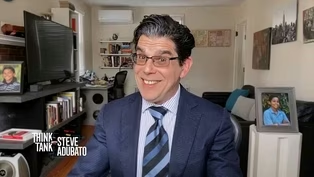
Author Noel Maurer talks the history behind The Panama Canal
Video has Closed Captions
Author Noel Maurer talks the history behind The Panama Canal (9m 25s)
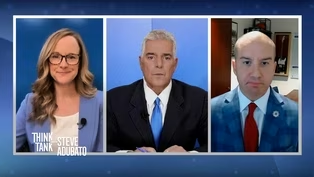
Hackensack Meridian Health and their role in FIFA World Cup
Video has Closed Captions
Hackensack Meridian Health and their role in FIFA World Cup (10m 47s)
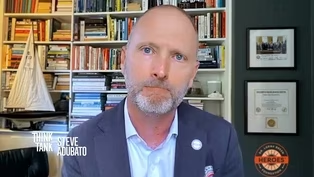
Protecting the mental health of our healthcare workers
Video has Closed Captions
Protecting the mental health of our healthcare workers (8m 6s)
Providing Support for PBS.org
Learn Moreabout PBS online sponsorship
- News and Public Affairs

Top journalists deliver compelling original analysis of the hour's headlines.

- News and Public Affairs

FRONTLINE is investigative journalism that questions, explains and changes our world.












Support for PBS provided by:
Think Tank with Steve Adubato is a local public television program presented by NJ PBS