Vermont This Week
August 7, 2026
8/7/2026 | 26m 49sVideo has Closed Captions
Debate over Burlington public safety intensifies | Preacher’s pitch for Poultney campus
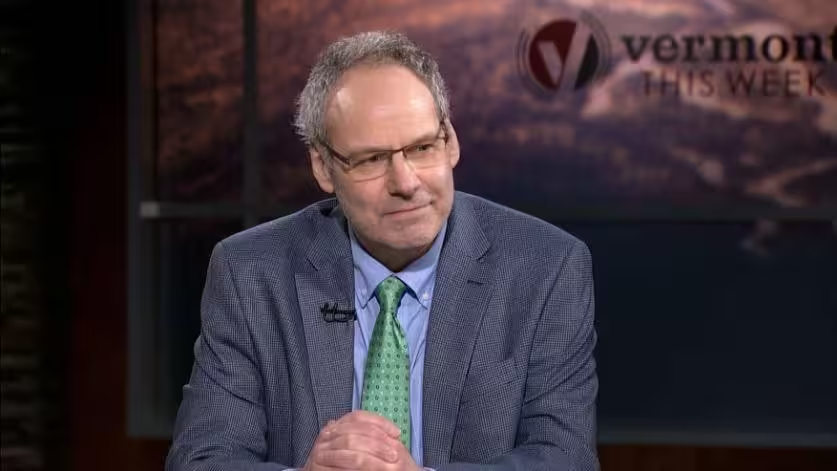
Debate over Burlington public safety intensifies | Juvenile justice reform | Preacher’s pitch for Poultney campus dwarfs his earlier work | Moderator - Mitch Wertlieb; Calvin Cutler - WCAX; Derek Brouwer - Vermont Public; Aaron Calvin - Seven Days.
Problems playing video? | Closed Captioning Feedback
Problems playing video? | Closed Captioning Feedback
Vermont This Week is a local public television program presented by Vermont Public
Sponsored in part by Lintilhac Foundation and Milne Travel.
Support provided by:


Vermont This Week
August 7, 2026
8/7/2026 | 26m 49sVideo has Closed Captions
Debate over Burlington public safety intensifies | Juvenile justice reform | Preacher’s pitch for Poultney campus dwarfs his earlier work | Moderator - Mitch Wertlieb; Calvin Cutler - WCAX; Derek Brouwer - Vermont Public; Aaron Calvin - Seven Days.
Problems playing video? | Closed Captioning Feedback
Where to Watch Vermont This Week
Vermont This Week is available to stream on pbs.org and the PBS app.
Support the crew
Help Mitch keep the conversations going as a member of Vermont Public. Join us today and support independent journalism.Providing Support for PBS.org
Learn Moreabout PBS online sponsorshipA new proposal sparks an impassioned debate over public safety in Burlington.
Didn't even ask any social services to work with you on this.
You didn't get the rest of your city council to work on this.
I said, I mean, this is not democracy.
Plus, the future of juvenile justice reform in Vermont faces uncertainty, and a Florida preacher's pitch for Appleton campus raises questions.
All that and more ahead on Vermont this week.
From the Vermont public studio in This is Vermont this week, made possible in part by the Lintilhac Foundation and Milne Travel.
Here's moderator Mitch Wertlieb.
It's Friday, August 7th, and with us on the panel today, we have Derek Brouwer from Vermont Public, Calvin Cutler from WCAX, and Aaron Calvin from Seven Days.
Thank you all so much for being here.
We are going to dive right into a big topic that we just sort of teased at the top there.
We have been here before.
There is debate in Vermont's largest city about public safety.
It's intensifying.
Let's start out by hearing from a couple of people who were there during a recent three hour public comment period on public safety in Burlington.
No one solutions enough, but more the same old the same just delays a better future for those in need.
For all of u that want our Burlington back.
I've read the Burlington forward resolution from front to back, and it's not perfect, but it offers some new solutions that can be added to some of the things we're doing that are working.
This is about not wanting to be uncomfortable and not wanting to see suffering on the street and I sympathize with that.
I. I am often uncomfortable and sad when I move through downtown Burlington.
I do not feel unsafe.
I spend a lot of time downtown.
I have never felt threatened by an unused person.
You know, folks who are watching or listening at home to those comments may see themselves reflected in some of those things, said there.
Aaron Calvin, you were at that three hour public comment period.
There was a resolution that was adopted.
Tell us about the resolution.
And tell us about some of the anger that you heard and what this is really all about.
Yeah.
So the Burlington Democrats have put forward a resolution that they're calling Burlington forward.
It's a wide ranging public safety resolution that mandates a lot of different things.
Most of it is geared towards, you know, asking the state and other towns to help Burlington with their homelessness and opioid addiction crisis, trying to find new ways to push people who are illegally camping on public land owned by the city and city parks, pushing them out of those areas and trying to thread this needle.
There's a lot of language about balancing compassion with this sort of nebulous idea of accountability, and it's an effort to, you know, try to do more to address the problems that everyone sees in Burlington's downtown without, you know, you know, seeming like they're coming down too hard and have insisted that it's not about criminalizing homeless people or locking people up.
As you know, the mayor and progressives have accused them of doing.
But it's difficult to get away from the idea that a lot of the proposals in this resolution would, you know, make people come in contact more with the system, they would probably be arrested more.
And Democrats have argued that doesn't necessarily mean that they'll be sent to prison.
They could go through a diversion program or something like that.
But, you know, at the end of the day, you know, progressives have tried to label this whole thing as Burlington backwards.
They're saying they're defending the mayor and saying that her more nuanced approaches are paying dividends.
And they cite some crime statistics, like the fact that violent crime in Burlington is down and they are really trying to, you know, sort of defend their process, which they say is working.
But for Burlington Democrats and especially their supporters in the business community and the Church Street business community, that change is not coming fast enough.
Yeah.
I mean, Calvin, you've covered a lot of this too.
You know, I'm wonderin about this idea of perception.
You know, you go to downtown Burlington, how much of this is who you are based on what you bring to the table and what you're seeing in Burlington?
You know, because this is sort of like I said, this is we've had we've been here before, but this issue is now exploding.
There's been a letter, an article in The Atlantic about this.
We can get into that a little bit.
But what is happening here in Burlington?
Perception versus reality.
Yeah.
I mean, it's a it's a great point.
And I think that's really what it boils down to.
You know, I mean, in some ways I think this is a little bit of a referendum on harm reduction as sort of a public health strategy.
I mean, you know, it's not just a strategy that the Mulvaney Stanek administration has embraced, but also during Miro Weinberg's administration, we also had the needle exchange and and harm reduction services.
And so here we are.
As you mentioned, we've been here before.
I think this is five, six summer now, really since the pandemic and the onset of fentanyl, we've got, you know, the lack of the downtown crowd coming for lunch because of remote work interest rates.
I mean, there's so many big, broad economic factors that are leading to this confluence of challenges that we're seeing in the downtown area.
And I think a lot of people are prescribing different causes for one versus the other.
So, I mean, it's so difficult to get at, I think part of, you know, from the business community's concern as well isn't necessaril just like the immediate, okay, what are we seeing this year in terms of revenues?
But it's that slow drip, the reputation factor.
Last year when I was back down on Cape Cod, somebody saw my my Vermont plates on my Mazda miata and they say, oh, Vermont.
How nice.
We've never been.
But we heard that Burlington.
There's a lot of needles.
And that's the kind of that's what some are really kind of concerned abou is the narrative getting away.
And but here We come again is okay.
We're covering it.
We're talking about it.
Does that perpetuate the narrative?
It's really challenging right.
Yeah.
The Atlantic piece kind of continue this sort of lurid fascination in the national media with Burlington, as you know, a city in the grips of its homelessness and opioid addiction struggles.
And, you know, this lefty city, you know, oh, look how they've been undone by their their lax attitude or their their inability to tackle this problem and the way that we think that they should or, you know, the Atlantic article was kind of a little bit of a hammer in search of a nail, right?
You know, sort of group Burlington into this other collection of large cities and sort of tried to make the point really hard that, you know, these harm reduction strategies just weren't working.
But when you look at the city's current strategy, harm reduction is, first of all, not a city strategy.
It's really run by nonprofits that are allowed to operate downtown, and they operate downtown because that's where their clientele is.
And you're exactly right.
This sort of recent wave of politicization of this issue has sort of broken apart.
What was formerly a bipartisan consensus around the importance of harm reduction and has, you know as I wrote about in seven days this week, has really sort of thrown into question the future of whether or not, you know, something that people normally thought of as a general public good in Burlington that like a needle exchange, you know, they might not be allowed to operate downtown anymore.
And it throws into question where, if ever this overdose prevention center will open.
And to be clear, the resolution, we're going to talk about that a little bit too.
One of the things in it, you know, has to deal with the needle exchange that they're sort of against that idea.
There was the group you mentioned, nonprofits, Aaron, you know, Food Not Bombs, which helps feed homeles people in downtown Burlington.
The resolution sort of goes after that group, too.
Derek Bauer, you've covered Burlington for many years.
You know about these issues.
And I know you read that Atlantic article.
We were talking a little bit about this before we came on air.
One of the things that you noted that's in this resolution is dealing with the encampments, homeless people, setting up camps.
What is one of the things in there?
What are they saying about that in the resolution that Democrats want to adopt?
Right.
Yeah, I mean, this i this is a sweeping resolution, as has been noted, and it's trying to project this sort of comprehensive, actionable plan.
And as such, it touches on on a lot of different dimensions of the problem.
But when I'm reading it, I'm really looking for, you know, what, what is new here and what is a restatement of either an old attitude or an existing policy?
And how far out are these new ideas?
So in other words, as as we've said that this has been a discussion in Burlington now for for 5 or 6 years at least in this intense way, but what new is being brought to the table with with this idea?
There are some changes that I that I think are notable around encampments here.
One is is a more aggressive as, as Aaron noted, a more aggressive approach to noticing and siting illegal tents.
This this progressive administration, for one, has in particular allowed people to camp down in this area of the waterfront called the urban reserve.
It's been sort of a less active enforcement zone in a way.
This resolution explicitly would would crack down on that.
And in the alternative.
So first, there are questions about the capacity of of the city staff to to actually carry this out to, to so aggressively go after tents.
As I spent, I spent close to a wee with the main person in charge with the team that does this in Burlington last year.
And, you know, and having seen it firsthand in that way, it does seem like you would need quite a bit more in terms of manpower to to make this.
I remember that story you did specifically when you were seven days, right?
Yeah, yeah.
And yeah, you noticed the problem there because who who is going to hand out those citations and do they want to be they worried about their own safety.
It brings up almost more issues when you start looking at that.
And they have not said where these encampments remove them, say from the waterfront.
They're not saying where they should go.
Right, right.
Yeah.
I mean, the whole challenge with, with the enforcement of encampments is that it's it's it's, as some people say, with, with some reservation, they call it a game of whack a mole because people have to sleep somewhere.
And so if and it's extremely common, if you notice a tent somewhere, they will move the tent 100 yards away.
So how do you deal with that phenomenon to make this expenditure of the additional resources worth?
It is a question.
I have.
One other thing that's worth noting, I think, is that the the resolution does call this this is a kind of a substantial change.
I think it calls for an area of, of sanctioned outdoor camping that in which that would be allowed.
The interesting thing about it, though, is that it it the resolution states all of the places where they don't think it's appropriate, but it does not say where it does not identify a location or a sector of the city where they d think it would be appropriate.
I also noticed, noticed in the list that they think this area should have access to to dumpsters and drinking water and things and social services, but it doesn't mention, for instance, transportation is one thing.
And so if you want to get this away from the center of the city, people are going to have to be able to take transport to their appointments.
Well, it's similar to their approach to wanting to add more permitting regulations to the opening of needle exchanges or the Overdose Prevention Center.
They don't want it to be downtown.
The needle exchange that was prominent in Burlington before Vermont CARES open their newest location on July 1st, was on Clark Street, run by the Howard Center.
And that's just a little bit north of Church Street.
So there's this, you know, they're very explicit about where they don't want these things to be.
But then that raises this question of, well, where should they go?
And nobody's nobody's volunteering that there's an interesting political component here to Calvin that I would love to ask you about, because this seems to me like the Democrats in Burlington against the progressives in Burlington, what is going on here?
Shouldn't these be a coalition that is fairly together on things in any other city, even statewide?
You look at versus progressives, and really there's not a ton of daylight between the policy.
But boy, you might you listen to that council meeting.
You'd think that this is, you know, the far right MAGA versus, you know, the far left progressives.
I mean really huge differentiation between, you know, the progressives and, and, and the Democrats on this.
Certainly the mayor has taken a lot of flak for this as well.
As I mentioned, though, a lot of these programs have been in existence during Miro Weinberger when he was in office.
And then, of course, there's the fifth floor, right.
Governor Phil Scott and sort of the state.
What is their involvement in this?
The governor had ordered Vermont State Police troops to go in police in downtown Burlington to.
They haven't made any arrests or any citations, but it's more so to create a sense of safety.
But the governor and the mayor also really haven't engaged one on one with this as well.
So, I mean, there's a lot o politics that's happening here starting tomorrow with the midterms.
The mayor was not told about the VSP coming.
Right.
That is correct.
And she was not pleased with that.
Yeah.
So there is this whole push and pull going on here.
It's just so interesting.
It's almost like a microcosm if you look, you know, Democrats and progressives as a whole searching for this identity as we see the primaries coming up.
And you know, who can beat Republicans in November?
All this stuff, it's sort of sort of playing out here in a smaller way.
Ultimately, I just want to ask around the roundtable real quick because we have other stuff we need to get to.
Did you think the Atlantic article which was written, by the way, by a former reporte for the Burlington Free Press, did you think it was fair to lump Burlington in with these other major cities, Vancouver, Seattle?
And to compare those problems?
Erin?
I mean, no, I don't really think so.
I struggle to think of any other city in America of 40,000 people that gets as much attention for its, you know, homelessness and opiate addiction crise as, as Burlington, even though all cities in America struggle with them to some degree.
And I think it has a lot to do with the politics, both how it's perceived nationally.
You know, people who don't live in Vermont know it as the city that that Bernie built, you know, kind of.
So it's it will eternally be a reflection of these leftist policies that he helped to sort of pioneer at the municipal level.
But I, I yeah, I guess I just, I just see it as mostly it's a lot of a question of politics.
And I think the important thing to remember at the end of the day is something that I think Democrats and progressives I've heard both agree on, which is that there are simply not enough resources being pushed towards this problem.
And both the Democrats and the progressives are calling for more help from the state, from neighboring towns, from the governor, from the legislature, because that's the simple reality on the ground, is that everybody wants to do more for the people they see suffering.
But there's just not enough homes, not enough beds, not enough shelter space to go around.
I mean, I think we're going to leave it there because I think you some that up actually quite beautifully.
Thank you for that.
It's just a fascinating thing to me to see our, you know, our biggest city in this state, but a small city nevertheless.
40,000 people get such national attention over this issue.
It's amazing.
Another issue that deals with crime and things related to that, Calvin Cutler, juvenile justice reform in Vermont.
We've been talking about a new facility since Woodside closed for a while.
Is there any movement on any of this?
What's going on?
Yeah.
So a couple of things happening here.
So DCF is moving forward with a new proposal, the Green Mountain Youth Center.
It's going to be located in South Burlington away from homes.
It's sort of an industrial park, kind o on the south side of the city.
They are moving forward with this.
We got the price tag.
It's about $27 million right now.
It's going to house teens up to age 18 that is moving forward.
We haven't heard a ton of pushback from the local community or the Development review board as of yet.
Those zoning issues abou is it a group home, is it not?
That has been settled.
So that is moving forward right now.
But we did hear during the Joint Justice Oversight Committee, DCF officials were talking with state lawmakers.
You know, there's been this slow burn about Raise the Age, which is sort of this these reforms, these sweeping reform that went into effect in 2018, which basically looked to raise the age of majority with nonviolent offenses, with the idea being that young people's brain development isn't complete until you're in your mid 20s.
And so people shouldn't be punished or have your name put out in the press for something, something stupid that you might have done when you're 17, 18, etc.. Those reforms were supposed to go forward, but we've been pausing them for the last 3 or 4 years.
DCF has said we don't have the right system, including the high end system of care, like a Woodside type of secure facility replacement.
But so again, the administration is asking for sort of a permanent pause until we can move forward with that.
But what was interesting is this facility is only going to house people up to age 18, right.
And so that kind of flies in the face, a little bit of the reforms that were implemented or came up with by Senator Dick Sears at the time.
And so there is a real question of whether these these sweeping first in the nation, criminal justice reforms for young people actually are going to move forward in any way, shape or form.
We might see this facility come to fruition in a few years.
I think they said 2 or 3 summers from now.
But in terms of the broader, you know, making sure nonviolent offenses are handled in family court, it's a rea still it's a big moving target and it's completely tied up with politics.
I mean, lots of Democrats in the legislature and progressives have said these reforms are working.
We have to keep moving forward with them.
It's taking a burden off of adult court, in criminal court.
You know, the the Scott administration has said it's not working.
DCF workers are stretched thin.
I mean, it's a real, real fascinating conundrum that we find ourselves in.
Reall appreciate the update on that.
And Derek Brower, I want you to update us on this story, because this is another thing that's been going on for a while now.
The campus in Poultney that has just sort of kind of sitting there, there's a preacher from Florida that has a pitch for this and a plan to do it.
But you've been writing about this.
Is it is this realistic?
What's going on here?
Yeah, yeah.
You know, it was it was several years ago now that I went down to Poultney and interviewed Raj Barta who is now selling the campus.
And I thought, you know, there couldn't be someone more eccentric than Raj to to take over the campus.
And somehow Raj has apparently found someone at least as eccentrically as he is.
This is Tommy Zito.
He's a he's an itinerant evangelical preacher from Florida who travels around the world basically preaching and specifically is interested in taking people into the streets to try to spread the word of of God and convert people in the streets.
He has shown up.
He was here for a week late last month to preview the campus, which he say he's buying from, from Bhakta, although the deal has not closed yet either and we don't know the price they agreed upon.
But the big question with him is, you know, he's announced grand visions that in a year's time he's going to have a new college there with a thousand students and a full curriculum.
And he's floated ideas of getting accredited in some capacity.
But would it be a religious college?
It would, yes, this would be.
That's the one thing that's very clear, as this would be an explicit evangelical college.
He sees it actually as spreading, as he referred to it in an interview with me, as a, as a way of multiplying himself to create more people, to spread the word.
But there are questions, you know, aside from whether or not that's a good idea.
I think there is.
There are questions about his capacity to to pull this off right now and that those questions, you know, have a lot of importance for the town of Poultney, which already has been waiting for some for for redevelopment on that campus and has heard promises before.
And, and so, you know, it's not clear to me that he has the money right now to actually start the school.
He says he has money to buy the campus, but we don't.
But he's he's activel fundraising to start a school.
And part of that is we were talking before the show.
I mean, he's gone on WCI seven days.
He's talked with Fox News, New York Post.
I mean, there is a little bit of a media blitz here to try to say, hey, you know, this evangelist is is converting this old, defunct Green Mountain College into a religious school.
And this guy, he's I mean, you see what he posts on social media?
He's got the ears of thousands and thousands of people, and I mean, dozens and dozens just showed up for that volunteer retreat, right, to fix up the college.
So I'm just wondering, like, you know, what is really aimed at and is somebody going to swoop in with the cash?
Well, in the the keys aren't in his hands yet, right?
Right.
No, no, he had to be off the campus after the end of the week.
In my interview with him, he he brought up himself all of the media attention that that his project is getting and seemed pleased by how intrigued these nationals are.
He also mentioned to me that he said, somebody wants to do a Netflix series.
On what he's doing, that he's picking between which documentary crew he wants to work with.
So, you know, certainly I think the attention is part of of his plan.
I will note, though, you mentioned seven days to I think he actually has not done an interview with seven days.
I was going to say, well, it's no, it's notable because Seven Days has bee asking some critical questions about what's going on at that campus.
And when I, I interviewed him once, some of his questions were unclear and I started doing more research.
So I went back to him with some more pointed questions about his finances.
And he he was repeatedly too busy to make time to answer those questions.
So I think he wants the media attention, but he's also being very careful about what kind of media attention he wants.
What about the people in Poultney?
How do they feel about all this?
I think there's some weariness.
There's more skepticism that I've seen this time around.
I think when when Raj came through, for one, he had had a track record.
He had he had a successful business in Vermont.
So I think there was more optimism at that time of his ability to execute on this.
And, and I think this time around there's much more of a wait and see.
And Tommy Zito is going to have to prove himself to the town of Poultney.
Yeah, we will have to wait and see.
Nothing is done yet.
As Aaron said, the keys have not been handed over.
Speaking of keys driving Calvin Cutler, why would the DMV want to rename its highway patrol to Vermont Highway Patrol?
They say they're going back to their roots back to 1919.
The DMV enforcement and safety wing was once called the Vermont Highway Patrol, then the Vermont State Police spin off or split off of that.
So it was announced this week that they are going to be becoming the Highway Patrol again.
And so what the DMV enforcement folks do, they do some traffic stops.
They do fraud investigations at the DMV, but mostly what they do is weighing trucks on some of these checkpoints and making sure that commercial vehicles are meeting regulations.
So they are now rebranding as the Vermont Highway Patrol, not relate to Super Troopers, by the way.
Oddly enough, it's Super Troopers, you know, and I was thinking of it.
Yeah.
I mean, that's what I think of when I hear from you.
But I lot of people do.
You look at the Facebook comments and the two number two comments that we got the most were, number one, what is this costing taxpayers?
Because it's their rebranding, all the trucks and the badges and the uniforms.
It's going to be about $50,000, which is a drop in the bucket for for a state budget.
But their roles and responsibilities are not changing at all.
It's the same staff.
They're not hiring anybody else.
You know, earlier this week, also Governor Phil Scott, we're asking him about it.
He floated sort of this idea that he had a few years ago about an agency of public safety, right, about different public safety organizations coming, playing different roles within, you know, the the new agency.
So that's not moving forward yet.
But like, again, I mean a lot of people are asking why why the rebrand.
So you'll you'll start to see instead of DMV enforcement trucks, they will start to say a highway patrol on the back.
All right.
So that's an update on that particular road, the Burlington's Champlain Parkway very briefly hour.
And that is opened.
This is a big deal now right.
It is.
It's been six decades in in the making.
It was originally planned as part of a super highway system that was going to smash right through the Burlington waterfront.
The Barge Canal Superfund site put a damper on those plans, and even before that, activists in the South End historically had not been happy about this idea.
It took decades and decades, and a lot of back and forth between city officials and activists and multiple mayoral administrations.
But you finally have a sign on, on I 189 that says you can take the Champlain Parkway.
It's a 25 mile per hour road.
It's kind of like a boulevard, and you can take it.
But it's official now.
It's a it's official.
That is great.
We have to say congratulations to the Vermont Green FC men, winners of the USL Championship.
For the second year in a row.
They beat the Flint City Bucks two one, in the final.
Not only that, they have not lost a game now for two straight seasons.
42 wins in a row.
Go green We're going to leave it there.
Thanks so much to our panel.
Today.
We had Derek Brouwer from Vermont Public, Calvin Cutler from WCAX and Aaron Calvin from Seven Days.
Thanks so much for watching.
I'll see you next week on Vermont this Week.
 New Episode
- News and Public Affairs

Top journalists deliver compelling original analysis of the hour's headlines.
 New Episode
- News and Public Affairs

Today's top journalists discuss Washington's current political events and public affairs.



 New Episode
 New Episode
 New Episode

 New Episode
 New Episode
Support for PBS provided by:
Vermont This Week is a local public television program presented by Vermont Public
Sponsored in part by Lintilhac Foundation and Milne Travel.