Vermont This Week
August 28, 2026
8/28/2026 | 27m 4sVideo has Closed Captions
Population size alone doesn’t explain Vermont’s housing shortage
Population size alone doesn’t explain Vermont's housing shortage | Corporate cash fuels some Vermont political campaigns | Vermont officials remedy state voter roll errors | Moderator - Mitch Wertlieb; Peter Hirschfeld - Vermont Public; Shaun Robinson - VTDigger; Carly Berlin - Vermont Public.
Problems playing video? | Closed Captioning Feedback
Problems playing video? | Closed Captioning Feedback
Vermont This Week is a local public television program presented by Vermont Public
Sponsored in part by Lintilhac Foundation and Milne Travel.
Support provided by:


Vermont This Week
August 28, 2026
8/28/2026 | 27m 4sVideo has Closed Captions
Population size alone doesn’t explain Vermont's housing shortage | Corporate cash fuels some Vermont political campaigns | Vermont officials remedy state voter roll errors | Moderator - Mitch Wertlieb; Peter Hirschfeld - Vermont Public; Shaun Robinson - VTDigger; Carly Berlin - Vermont Public.
Problems playing video? | Closed Captioning Feedback
Where to Watch Vermont This Week
Vermont This Week is available to stream on pbs.org and the PBS app.
Support the crew
Help Mitch keep the conversations going as a member of Vermont Public. Join us today and support independent journalism.Providing Support for PBS.org
Learn Moreabout PBS online sponsorshipThis week why Vermont's housing shortage can't be explained by population size alone, plus how corporate cash is fueling some statewide political campaigns and Vermont officials remedy errors in state voter rolls.
All that and more ahead on Vermont this week.
From the Vermont public Studio in Winooski.
This is Vermont This Week, made possible in part by the Lintilhac Foundation and Milne Travel.
Here's moderator Mitch Wertlieb.
Liebe.
Im Mitch Wertlieb.
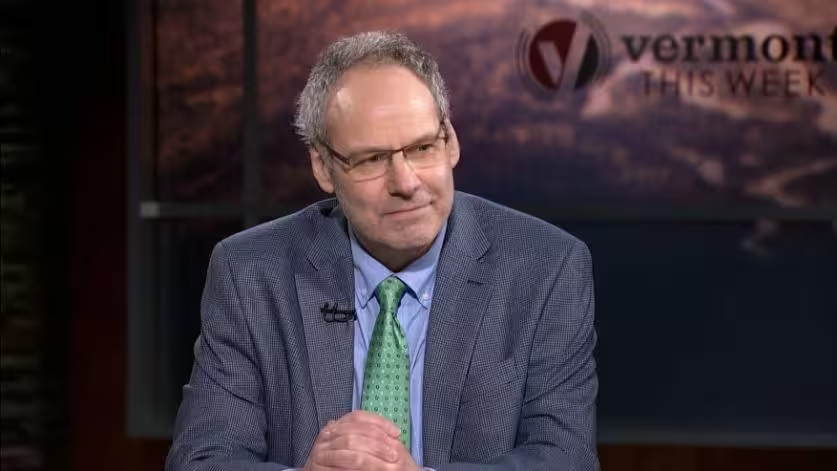
It's Friday, August 28th, and with us on the panel today, we have Pete Hirschfeld from Vermont Public, Shaun Robinson from VTDigger, and Carly Berlin from Vermont Public.
Thanks so much, all of you for being here today.
We're going to dive in with this really interesting story about housing Vermont's housing crunch, Carly Berlin.
This absolutely fascinated me, reading your piece on this, because when I talk to folks outside of Vermont, I often say, hey, you know, we're dealing with a housing crunch, you know, just like you are in new Jersey or other places around the country.
And they say, what?
How could you be dealing with the housing crunch?
There's so few people in Vermont just build more houses.
What's the problem here?
But your article is all about how Vermont's population size doesn't explain this problem alone.
What are the factors contributing to all this here?
So you have to think of population and household size as two separate things.
So the number of people living in the state versus how they're composed in all of our houses.
Right.
And the average number of people living in each house in the state has been on a steady decline for decades.
We actually have the smallest average household size in the nation as of 2024, at 2.2 people.
So few reasons for this.
We're seeing a graphic on the screen here describing a lot.
Yes.
So you can really see that decline since 1970.
This is a national phenomenon, but it's particularly acute in Vermont as our population ages.
So if you're older, if you're, you know, 55 plus, you're more likely to live alone.
Your kids have moved out.
We also have people marrying later, choosing to live on their own, having fewer kids.
All of these reasons why we're taking up more houses, because there are fewer people living in each one.
And that means that there's more pressure on housing demand.
And so many other factors come into play here, too.
For example, let's say you've lived in a house that, you know, maybe when you had 3 or 4 kids in it, it was a big house.
It was right for you.
Then, like you said, the kids have moved out, etc.
maybe you bought that house to 20 or 30 years ago at a good mortgage rate, and you don't necessarily want to give that up now.
Right, exactly.
So one of the things I learned reporting on this story is that a lot of Vermonters are what's called over housed.
Right.
So we have 70% of households in the state are just 1 or 2 people.
70%.
70%.
So a big majority at the same time, the majority of our houses are large.
There are six.
There are three bedroom plus 60% of our homes.
So we have this mismatch where, you know, the the number of people living in each house doesn't really match the housing stock that we have.
Because, you know, when we were the era when we were building a lot was when there were more kids, families were bigger.
And that's just not true anymore.
And so you end up in this situation where you've got particularly older homeowners who are living in these houses with considerable extra space sometimes, and there are a lot of incentives for them to stay both economic, like perhaps, you know, you have a 3% mortgage rate that's, you know, sure is different than what you could get these days.
Housing prices are much higher.
And their emotional incentives to, you know, you this place feels like home.
These are my neighbors.
You know, there's a pride in home ownership.
There's, you know, a culture that encourages aging in place.
And then there's also just inertia.
It's hard to move, particularly as you get older.
Oh, I understand that one of the most stressful things in life is moving and packing up all that stuff.
I also imagine to maybe some of the way things are happening these days with the job market for kids that are going to be graduating college.
Maybe some of these folks think my kids may not be here now, but they may need to move back at some point.
Is that part of this too?
That's definitely true.
I think for a lot of people, you know, imagining giving up, you know, the family home where your kids could come back, whether it's to live with you or just stay with you on a visit is a is, you know, a tough thing to imagine.
What about what we can do about this curly?
Can we just build our way out of this?
You know, building more smaller units is a is a big piece of this.
So, you know, one of the really interesting statistics I learned working on this piece is that we have 55,000 more one and two person households than we do one and two bedroom homes.
So if you're an older homeowner in a larger house and you want to downsize, it is very hard to do that structurally.
In Vermont right now, the very few of those homes exist.
At the same time, you're competing with, you know, younger families, renters who are able to trade up into that starter home, like those smaller houses, would really fit the vast majority of households that we have in the state right now.
And there are so few of them.
So that's a piece of this.
Another piece of this is perhaps thinking about the buildings that we have in more creative ways, like we have a lot of property owners with extra space.
How can we be using those rooms to try to accommodate people who need their own units?
There are interesting things, like the Home Share program that's been around for a long time, where homeowners can rent out, you know, one of their rooms to to someone who who needs a rental.
We'll talk about the Vermont Housing Improvement Program in a minute, which is all about repurposing older buildings.
So there are, you know, there are ways beyond simply building a bunch of new apartments and homes.
But that has to be a piece of the strategy.
Also.
Let's talk a little bit about V-Chip, which is the Vermont Housing Improvement Program.
You just mentioned that Governor Scott was touting this the other day.
He says it's going to remain in place.
What exactly does this do?
And can this help deal with this housing shortage?
It's definitely a piece of it.
So this program, Vermont Housing Improvement Program, was started during Covid when we were awash in federal cash that our state leaders were putting towards housing.
The goal of, specifically, is to give relatively small scale grants to property owners to rehabilitate apartments that are vacant and rundown.
They need some extra love to get back into the housing stock.
There are also grants for building accessory dwelling units, like a granny flat in your backyard or some small scale apartment buildings.
You know, the this program had been funded with federal cash and had been getting these one time appropriations in the state budget each year since.
So what the governor was celebrating this week is lawmakers this past session gave this what's called base funding.
So there's this kind of expected, you know, certainty around having more of this, this grant money going forward.
We were talking about this, though before we came on air, that you were saying that some of the affordability caps in this program are starting to sunset.
Is there any concern for by affordable housing advocates for that?
Yeah there is.
So these grants were time bound.
So it's basically like, you know, property owners given money to rehab an apartment.
They have to rent it at an affordable rate for 5 to 10 years, depending on what the kind of funding award is.
Those first five year grants started to time out last year in 2025.
I asked officials about this this week, and they're saying, you know, in these exit surveys they're getting for property owners who have hit that mark there, you know, they would have the opportunity to to jack up rents if they wanted to write that, you know, I'm hearing is not happening yet, but it's certainly something to watch going.
Forward I'll keep an eye on.
Yeah, I urge people to go to Vermont public and check out that whole article.
It really explains it so well because it is a confusing thing.
But your article explains why we're dealing with this housing crunch.
I want to move on to the issue of corporate cash, which, you know, we just got through a primary season, Pete Herzfeld.
And it looks like, you know, there are some politicians that you were writing about who are taking corporate money.
Some have not.
Amanda mendez, who won the Democratic primary for governor, not taking corporate money.
US Governor Phil Scott about that.
What was his answer?
I asked Governor Scott if he would join Democratic gubernatorial nominee Amanda Janu and her pledge not to take money from corporations to her campaign.
And he said, no, I'll take money from anyone.
And that was a direct quote from the governor.
You know, there's there's growing disaffection in Vermont and across the country with opposed Citizens United landscape that has seen corporate entities and very wealthy Americans pouring literally billions of dollars over the course of several election cycles into elections.
What we're talking about here specifically, is direct corporate contributions to individual political campaigns.
You know, in the absence of serious campaign finance reform, some candidates, like Amanda Janu, like Molly Gray, are saying, I'm not going to wait for the law.
That tells me I can't accept these contributions.
I am going to voluntarily swear them off.
And so we did a campaign finance analysis to look at, okay, what role are corporate contributions actually playing in Vermont elections this year, and found that Republican Governor Phil Scott has taken in the most from from corporate contributors about $167,000.
Number two on that list is a Democrat attorney general, Charity Clark, who's taken in about $84,000.
The other statewide candidate that's taken in a meaningful some as lieutenant governor, John Rogers, also a Republican, about $45,000, I believe.
So Governor Phil Scott saying I'll take money from anybody.
I mean, that's sort of it sounds like a provocative quote there.
But I think his point was, just because I take money from PACs or corporations does not mean that I owe them anything, right?
Isn't that what he was telling you?
Exactly?
He said there's no quid pro quo.
Never in my life as a public servant have I altered my decision making in any way because of a corporate contribution or allowed undue influence peddling in my office.
Charity?
Clark said the same thing.
She said these donations in no way affect her decisions as the state's chief law enforcement officer.
What campaign finance watchdogs say is that very rarely are you going to see an out and out quid pro quo, right?
What you do have is an inevitable influence, by virtue of this exchange of money, that when corporations make these contributions, make no mistake, they are investments, investments that they are looking to get a return on.
And their hope is that by ingratiating themselves to these candidates, they are subconsciously or not going to have a certain kind of disposition towards them.
When it comes time for government regulation or enforcement actions.
And that's really the push from campaign finance reform hawks that, look, whether or not there's explicit bribery going on.
Something is happening that wouldn't otherwise happen because of this corporate influence.
Polls show that Americans don't like it.
Polls show that Americans think that corporations are gaining undue influence over political candidates because because of these contributions and people like Amanda genuine Molly Gray are saying, look, I don't want my supporters to even have to question whether or not these donations are affecting me.
And so I'm going to proactively take a pledge not to accept them.
So nobody has to guess about it.
It's such an interesting question, though.
It's a human nature thing, right?
We were talking about this before.
You know, if someone does something for you, your inclination is, well, maybe I should do something for them.
But in the case of I want to go back to charity, Clark, for a moment, you know, you had in your article, Pete, you were talking about one of the corporate entities that gave her money was T-Mobile.
Now, if they were looking for something in return, they didn't get it because they were a defendant in one of the suits that she was involved in.
Right.
And those suits predated Tebow making a contribution.
So that came after those suits were settled.
Yeah.
And you know, there are there are specific examples that Charity Clark points to.
She she, for instance, took a donation from Tyson Foods, the, the, you know, mega food giant earlier in her political career.
She later issued a sort of white paper criticizing the company for greenwashing, which is the practice of using sort of deceptive PR to to get environmentally destructive practices.
And then Tyson Foods gave her a contribution after that.
So she's saying, look, follow the through line.
If they gave me something before I took an action and then they gave me something after, obviously it's not affecting the way I handle my business as it relates to this company.
But, you know, there are lots of advocates out there that are convinced that the act of this exchange, in and of itself, poisons the well, as it were, in ways that have, you know, led to a system that, to a lot of folks at least, feels like it prioritizes the interest of wealthy people and corporations more than the average working class, working class Vermonter?
Yeah.
And I think to Pete's point in the Democratic primary for governor with the manager knew and Ally Richards, we did see it wasn't corporate money, but a pack come in right at the 11th hour and put a bunch of money in advertising into the race on Ally Richard's behalf.
And I should say that PAC wasn't directly associated with her campaign, but it was folks who supported her.
And I think I talked to some political analysts the week after the primary and they said, well, actually, I think that even though there was a lot of money going in on Ally Richards, we have supporters of Amanda Janu.
You know, folks might have gotten galvanized by this disaffection with money in politics that we see across the country.
And Amanda Janu took advantage of that.
She put out a press release and statements online about that infusion of money.
And I think it's fair to say that it might have galvanized some folks to support Amanda in the end.
Now, that's what's really interesting to me, because is there is that going to gain traction?
Because since Citizens United, which Pete was talking about, this money is flowing in from everywhere.
And as you were saying, Sean, sometimes it's not a direct contribution.
It's sort of fuzzy to figure out where it's all coming from and how it's getting there.
So our voters going to react to that, is it going to be the kind of thing where somebody who doesn't take this money is going to get elected?
It seems to me that's the only way that would change the system, if the legal system is not going to change.
Yeah, absolutely.
I mean, we have examples, most notably, I think Senator Bernie Sanders here in Vermont of like an official who've been pretty open about this on the national level.
So, you know, one of the reasons that charity Clark gave for accepting these corporate contributions was it's difficult as a female candidate to raise the sort of money you need to succeed at a statewide level.
And so this was part of her calculation.
She said, If I'm going to do this, if I'm going to shatter the glass ceiling, in her words and become Vermont's first woman attorney general, this is a route I need to go in order to have sufficient campaign funds to make that work.
You know, I think if voters want to see this system change, they're going to have to operate in ways that that lead candidates to a different calculation.
Right.
That that the consequences of accepting that money become more severe than the consequences of not having that funding for your campaign.
And I think a lot of folks in the Democratic base, at least, are trying to leverage their support in ways that encourage candidates to do that.
That's why November is going to be so very interesting for so many different reasons.
Sean Robinson, I want to ask you about this.
Another really interesting story, something to do with Vermont officials having to remedy state voter roll errors.
And this involves the Department of Motor Vehicles, which and I want to make sure I'm getting this right.
They had an automatic voter registration thing having to do with something that, you know, getting your license, but this did not work out.
Well, tell us what happened.
Yeah.
I mean, talk about big national political issues right now.
The sanctity and security of elections and voter rolls is right up there is the very top.
So you're right, folks, I think are probably familiar when you go to the DMV to renew your license or get a new license or something, you get the option to check to say if you want to be automatically registered to vote or not.
That's a law we've had in Vermont since 2016, I think.
And this issue with voter registration comes from that process.
So earlier this week, the governor and the secretary of state came out together and they said, look, you know, this is two, you know, politicians from two different parties standing side by side and saying, you know, not only are we on top of our game with election security in Vermont, but we're actually going to own up to making a mistake.
And the mistake that they talked about was, to your point, about 900 voters who at some point over the last decade mostly had gone to the DMV and said, I do not want to be automatically registered to vote, but through some sort of human error in the data entry or in the back end systems oversight that a number of them, you know, got inputted as having said, I do want to register to vote.
And then that information got transmitted over to the Secretary of state's office, who's obviously in charge of figuring out who can and can't vote.
I do think it's important to note that the Secretary of state told us that none of these folks actually cast a ballot.
One thing that was interesting, too, is that myself and other reporters were asking if of these 900 roughly folks, if any of them were ineligible to vote.
So if any of them were not U.S.
citizens, for instance, and they weren't able to tell us definitively yes or no on that question.
But the point stands, none of them did vote, apparently.
So if the question is, did it influence an election in Vermont?
No.
Yeah.
And I mean, it's lack of clarity like that, right?
In this underlying error itself that can become cannon fodder for people peddling in election conspiracy theories, for which there's no empirical data to support right now.
But it sort of underscores the precision and rigor that elections officials have to operate in, in this environment where they're already dealing with a host of issues related to legal challenges and, you know, threats in some instances from people that think that elections are being stolen and manipulated.
So, you know, to errors, human right.
And when you have lots of humans in a large organization running elections, you're going to have errors from time to time.
Phil Scott and Sarah Copeland hands obviously tried to choreograph a response to to settle any anxiety that that might produce.
But inevitably people are going to point to that when when they're trying to make the case that our elections are unfair.
I think it's pretty important, as you were saying, Sean, that you did have Sarah Copeland as the Democrat and Phil Scott, the Republican, together, saying, we've taken care of this, right.
I mean, that was really important because to Pete's point, if you don't get out ahead of this, it could become one of those things that somebody points to and says, oh, well, look what's happening in Vermont.
There's fraud going on or something to that effect.
Right, exactly.
And, you know, I think it's no coincidence that this is happening at the same time that we've seen, you know, persistent national rhetoric from the Trump administration, from Republicans in Congress about election security and questioning the the sanctity and the the legitimacy of mail in voting.
Folks will also remember that Vermont is currently in court with the Department of Justice about access to our state voter rolls.
The DOJ wants as much access as it can possibly get to personal information, to the digits of people's Social Security numbers, to their addresses.
And so that's something that we're currently fighting in court at the same time.
So a lot of resisting that to be clear.
Yeah.
We're not handing that information.
Yes.
To this point.
Yeah.
No I just yeah.
It's something to point out, I'm sure, as Sarah Copeland would say.
Also, let's talk about some politics at this point.
You know, Jill, I guess, raised some eyebrows when she said she was not going to run for reelection this year.
The House speaker so who's lined up?
Is somebody lined up now to take her place?
Pete.
Yes.
There was a, you know, a lot of intrigue and our insider Montpelier Circle about who was going to be the next speaker, obviously.
And there were a number of candidates.
People who have been there in a long time, been in the building for a long time, people who have served as chairs of different committees.
But pretty quickly after Essex Junction Representative Lori Houghton, who's a former chair of the House Health Care Committee and the current House majority leader, when she said I want this job, I'm going to be running for this job.
Almost everybody else dropped back and said, we're going to support Lori Houghton.
She's done a phenomenal job as House Majority leader, sort of bridging divides in a caucus that has a lot of different ideological viewpoints.
Lot of factions.
Yeah.
So so that's that's where things stood earlier this week since we ran a story on Houghton being the leading candidate and the person that most people think is going to emerge with that role.
There has been some buzz about the left wing of the caucus not wanting to see a coronation.
So we'll see.
We'll see if another candidate steps up.
Woodstock Representative Charlie Kimball has acknowledged that he thinks Lori Houghton has the votes to win, but he he is not withdrawn his candidacy for speaker.
So we're still many, many months away from January when this vote will officially happen.
We're months away from a general election whose results might influence the contours of this debate.
Yeah, and thought about that.
So a lot to go yet.
And we'll you know, people like me and Sean and Carly will be following this assiduously in the meantime.
Yeah.
And we're so glad that you are, because this is the insider stuff that you're talking about.
Getting back to the progressives here in Vermont.
It's really it's a. Little weird, the party.
That there's a candidate for treasurer running as a progressive, but not their candidate, John Robinson.
Yeah.
That's right.
This is a little bit of a weird situation.
So folks will know that, you know, in most election cycles, the Progressive Party here in Vermont doesn't nominate a full statewide slate of candidates in the way that the Democrats and more or less the Republicans do.
So this year in the primary, the progressives had two of their own candidates on the statewide ballot.
They had a candidate for Secretary of state, Rachel Shore, and a candidate for treasurer.
His name was Hampel.
Now in the lead up to the primary, the progressives had a statewide kind of leadership meeting where they voted to endorse or not endorse folks who were going to be running either in their own primary or in the Democratic primary.
And they decided not to endorse.
Zachary handles campaign, and I talked to me on the phone last week, and pretty quickly, by his own admission, he said, you know, I'm not necessarily a progressive.
He was described himself for a long time as a libertarian and a conservative.
He was involved in he founded a chapter, actually, of Young Americans for Liberty, which is a libertarian youth organization, when he was in college at Castleton.
And, you know, he says that his views have evolved a little bit since he was in college.
He's in his 30s now, but he certainly know kind of, you know, across the board, progressive in the way that I think voters would expect when they see a name on the ballot with Progressive Party after it.
How does he feel about his name being then on the progressive ballot?
I mean, obviously the party is not necessarily happy about it.
How does he feel?
Yeah, I mean, I think he he sees himself as a true third party candidate outside the traditional two party binary that we have in the US.
You know, I think it's a fair question like, well, you know, we have three major parties, right?
Legally in Vermont, including the progressive.
So is that a fair way to look at it?
You know, you can be the judge of that, I think.
But he he sees himself as, you know, taking this kind of outside, outside the box approach a little bit.
And, you know, to his credit, he did get the 500 plus signatures that you need to to get on the ballot as a statewide candidate in Vermont.
I think it's worth noting that he got 500 something signatures on his own.
But then in the Progressive Party primary, he got 280, I think, votes.
So that's kind of an interesting.
Yeah, that isn't interesting dynamic.
There are only 474 votes cast in the progressive primary.
Exactly, exactly.
He did get maybe close to a majority there.
No, I think yeah, he did exactly.
But I and I just raised the difference in numbers because it shows you that, you know, we the Progressive Party gets a very small number of folks voting in their primaries.
You know, compared to the Democrats and Republicans.
Okay, Sean, thank you so much for updating us on that story.
And we have this update on another piece of news we want to let you know about.
Vermont is set to receive $92.7 million from social media giant meta.
This is to settle claims that the company endangered children by intentionally creating addictive apps.
The payout is part of a landmark $17 billion settlement that matter reached with 47 states, the District of Columbia and U.S.
territories.
Now, in addition to the financial settlement, meta agreed to limit children's access to Instagram and Facebook through a variety of new features, including a two hour daily limit on the apps, blocking the use of apps at night, and stronger measures to verify the age of young users.
As with past settlement funds, the legislature and governor will decide how the money is spent.
Governor Phil Scott told WCAX this week that meta had an impact on kids.
This is a quote, and somehow we have to give back to the kids on quote.
And that's where we'll have to leave it for this week.
Our thanks to our panel.
Pete Hirschfeld from Vermont Public.
Shaun Robinson from VTDigger.
And Carly Berlin from Vermont Public, whose reporting is presented in partnership with VTDigger.
Thank you so much for watching and listening.
I'm Mitch Wertlieb.
See you next Friday right here for Vermont this week.
 New Episode
- News and Public Affairs

Top journalists deliver compelling original analysis of the hour's headlines.
 New Episode
- News and Public Affairs

Today's top journalists discuss Washington's current political events and public affairs.



 New Episode
 New Episode
 New Episode

 New Episode
 New Episode
Support for PBS provided by:
Vermont This Week is a local public television program presented by Vermont Public
Sponsored in part by Lintilhac Foundation and Milne Travel.