Vermont This Week
August 21, 2026
8/21/2026 | 26m 46sVideo has Closed Captions
Union fight over St. Albans dairy plant moves out of court
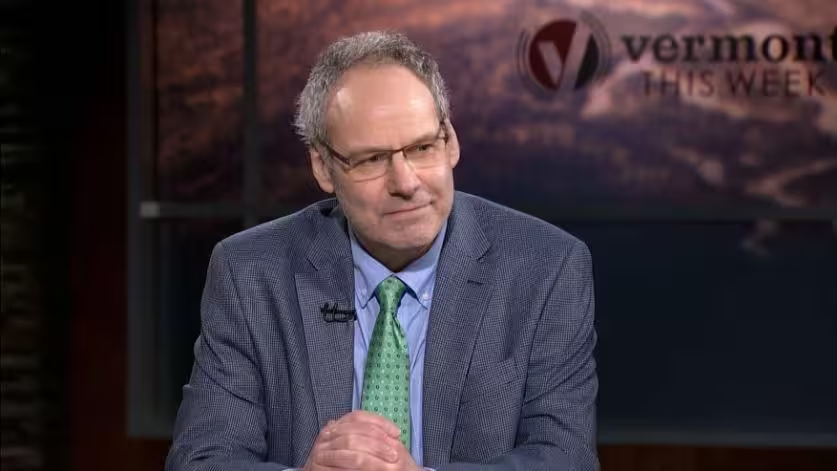
Union fight over St. Albans dairy plant moves out of court | Hospital bed, staff cuts at Vermont Psychiatric Care Hospital | Scott admin installs bird noise devices at Montpelier building | Moderator - Mitch Wertlieb; Liam Elder-Connors - Vermont Public; Calvin Cutler - WCAX; Olivia Gieger - VTDigger.
Problems playing video? | Closed Captioning Feedback
Problems playing video? | Closed Captioning Feedback
Vermont This Week is a local public television program presented by Vermont Public
Sponsored in part by Lintilhac Foundation and Milne Travel.
Support provided by:


Vermont This Week
August 21, 2026
8/21/2026 | 26m 46sVideo has Closed Captions
Union fight over St. Albans dairy plant moves out of court | Hospital bed, staff cuts at Vermont Psychiatric Care Hospital | Scott admin installs bird noise devices at Montpelier building | Moderator - Mitch Wertlieb; Liam Elder-Connors - Vermont Public; Calvin Cutler - WCAX; Olivia Gieger - VTDigger.
Problems playing video? | Closed Captioning Feedback
Where to Watch Vermont This Week
Vermont This Week is available to stream on pbs.org and the PBS app.
Support the crew
Help Mitch keep the conversations going as a member of Vermont Public. Join us today and support independent journalism.Providing Support for PBS.org
Learn Moreabout PBS online sponsorshipA dispute over the closure of a Saint Albans dairy plant brings Vermont's senior senator to the front lines.
My message today to DFA is do the right thing.
Reverse your decision.
The idol, the Saint Albans plant and creamery ensure the dairy farmers do not face yet another cost increase on their balance sheets in these tough times.
Protect Franklin County's agricultural community, plus hospital bed and staff cuts at the Vermont Psychiatric Care Hospital are raising concerns and why bird calls outside the governor's office or inflaming tensions.
All that and more ahead on Vermont this week.
From the Vermont public studio in Winooski.
This is Vermont this week, made possible in part by the Lintilhac Foundation and Milne Travel.
Here's moderator Mitch Wertlieb.
Hi, I'm Mitch Wertlieb.
It's Friday, August 21st.
And with us on the panel today, we have Liam Elder-Connors from Vermont Public.
Calvin Cutler from WCAX and Olivia Gieger from VTDigger.
Thank you all so much for being here.
We're going to dive in with the story that our senior senator, Bernie Sanders, was talking there at the top about Calvin Cutler.
DFA dairy plant is slated to close in Saint Albans.
This has been going on for about a year now.
And there were some really interesting things happening here.
The court was moved into this because there was a memo that was perhaps found that said that the plant was being closed for retaliation of a union, but we're not sure about that.
So take us back a little bit, give us the background and what's happening now.
Lot to unpack here, Mitch.
Basically, this plant is sort of an intermediary.
Farmers will send their milk here and it will be processed.
And sometimes they'll send it out to other places where it can be processed milk or cheese or other dairy products.
And it's a big employer in town.
It's about 80 jobs.
Last year there was a confluence of issues of surrounding wages and working conditions and overtime and things like that.
The union went on strike demanding better working conditions.
They came to a deal and they signed a deal with DFA, Dairy Farmers of America.
And so that's where we stood last year.
Recently, though, the I think it was this summer, the plant announced that they would be closing and say, this plant is no longer economically viable.
We need to ship our operations elsewhere.
And the union is saying, wait a minute.
What do you mean?
Like, we just penned a deal last year.
And so there was this bombshell lawsuit that came late last week, essentially saying that they're alleging that there was a janitor that was walking through one of the offices that allegedly found a note that's from people that worked at the plant and the executives basically saying, alleging that this plant was closing in retaliation to last year's strike.
And boy, has this really, you know, drawn a lot of criticism and ire and really speculation from people all over the state.
It's been described as if real, a smoking gun, because it would show that, yes, we were shutting down this plant, not for economic reasons, like they said, but because we're trying to keep the union officials out.
But what do we know about that, that memo.
What is the judge looked at?
What's happening?
Yeah.
I mean, so right now the judge has placed last I saw the judge has placed a stay or basically put a pause on closing this, this plant.
And so this is playing out in the courts right now.
There was I believe, the the plant manager did sign an affidavit saying that this letter was completely false.
It doesn't exist.
And DFA leadership has said the same as well.
But that really hasn't stopped.
I mean, we saw Senator Bernie Sanders, you know, during the August recess, came and spoke at the plant.
Amanda Janoo, Democratic nominee for governor.
She put out a statement supporting the union.
I should say Peter Welch and Becca Balint have as well.
So a lot of people are really, you know, piping up about this and saying, this is this is a real concern for for the community.
It follows, of course, there's been a number of dairy operation closures.
We had, I think Franklin Foods, there's been a number.
And this is just part of a larger pattern or larger, a larger trend that we've seen in the decline of dairy in Vermont, small mom and pop farms, as nationally, we have dairy prices that are set federally so that our pricing is out of our control.
And, you know, like with your local pharmacy, like with Vermont's craft beer industry or the national craft beer industry, dairy, I mean, we've seen this shift towards corporate consolidation into these massive mega national chains and that, you know, has really been a detriment to Vermont.
We've lost a lot of our herd over the last maybe ten, 15, 20 years.
And it's it's really spiraling.
I'll just say to you.
So the the latest on the the court sort of saga involving the closure of the plant.
The federal judge declined to extend the the temporary restraining order that had been put in place.
And so the plant is is still closed.
And the co-op has said that they have no intention to start disassembling the plant, which is, I think, one of the concerns that the union had, which is that they would start, they'd sell this plant off before all this sort of allegations were cleared up.
And so there's actually going to be an arbiter that is going to be examining the allegations, including allegedly this this memo, and taking a look at all of that.
So this is going to still be unfolding, though it's not going to be happening in the courtroom.
It'll be happening likely behind closed doors with this arbiter who will be working with both sides.
But the plant's not running right now.
It's obviously still not running, but not going to close down permanently at this point.
Is that what you know?
My understanding is it's it's it's not operating.
You know, the co-op is not going to be selling it off anytime soon while they work through this stuff.
So unclear exactly how long that will be, though.
You know, before we move on from this topic, I want to ask Calvin, because you were making this point, I think whether or not this memo turns out to be legitimate, and perhaps it's not, I think Bernie Sanders point, some other officials point, is that he doesn't want the plant closing.
In any case, whether or not there is this smoking gun thing.
Yeah, exactly.
I mean, and that's that's really what we're talking about here at the end of the day, is these are jobs, you know, Franklin County.
This is a real economically challenged time.
I mean, these are really important jobs.
Nobody wants these to go away.
And I mean, even Governor Phil Scott said, like, we need to support these jobs.
Like, it just would objectively be a bad thing if we lost these.
But in terms of what's the fix here more systemically?
Because as you know, as I was mentioning, we've seen dairy leave the state and commodity prices have declined.
And it's just been really it's been a challenge.
You know, I was talking with dairy farmers not really associated with this, but they were saying, you know, honestly, it'd be nice to have the legislature step up, potentially more tax breaks, potentially, you know, more deregulation for for some of the dairy farms and really trying to grow the herd because, you know, they as it was mentioned to me, you know, our system of small mom and pop dairy farms with the red barn and the silos, you know, our dairy system is designed for 1950, 60, 70, and it just can't compete in a global marketplace where, you know, there because you were saying before the show, I mean, there is still a huge demand for it, especially with this big protein buzz that we're seeing nationally.
So a lot of moving pieces here.
We'll see what happens with sort of the letter and the authenticity of it.
But yeah, it really this is the first time we've talked about dairy on this show for quite a long.
Been a while.
Yeah, you're right.
And we have to because as you were saying, we were talking about this before the show, the identity of Vermont, who was so tied up in this, the way people view the state here, outside of it, so much of that is so important.
We do need to move on to another story that affects everyone, not just here in Vermont, but around the country.
And this has to do with health care.
Let's start by hearing what Michelle Donnelly, the Washington County State's attorney, had to say about hospital bed and staff cuts at the Vermont Psychiatric Care Hospital.
Having that available right when it is needed is is crucial for both the health and safety of that patient and defendant, and also for the public safety, closing a facility or even a couple of beds and staffing at the highest level of care is really troubling, because it's going to have a trickle down effect about what's available at the mid and lower end of the care spectrum.
Okay, Olivia Geiger you have been writing about this in Digger.
What kind of cuts are we talking about here?
How serious is this?
Yeah, more more job cuts.
Here we are talking about three staff members at the Vermont Psychiatric Care Hospital in Berlin.
And the important thing to know about that hospital is it's state run.
It's run by the Department of Mental Health.
And so it's this interesting story about the state budget and how we fund these positions.
And that in the in the Department of Mental Health.
That's the where the biggest gaps in staffing are, is at this hospital.
It's really hard to find people who want to do this really hard job for some of our neediest, most acute mental health patients in the state.
And so it's kind of confounding to that.
There were these staff cuts.
I think there were 46 open positions when I wrote this story a few weeks ago.
I think there are 60 in total in the Department of Mental Health period.
So a large portion then, for sure.
Yeah.
And so along with these staffing cuts, there were there was the closure, the formal closure of four patient beds, which as you were saying earlier, Liam, I think is a small number, but it just goes it really underscores how few of these beds we have to begin with in this state.
And so now we have 21 beds at this hospital.
And the Department of Mental Health has told me that they've closed these beds just because they haven't been using them.
But the reason they haven't been using them is because they've needed they've shut them down.
So most of the time when they're operating, there are only 20, 21 beds open to begin with.
And so it's this sort of just confounding, sort of like chicken egg kind of situation.
It seems a bit odd.
It's a bit of a catch 22.
They're saying that they were closing, getting rid of those beds because they weren't using them, but then they were not using them, which is why they closed them.
Yeah.
And the same with the staff members who were lost, who lost their jobs like they were working when these beds were closed.
And so it's I think there's more to this story here that we just are not totally, totally getting.
And I think an interesting thing to to note is that because this is a state hospital, the state approves the budget for for the department and for the hospital.
And so I talked with Senator Andrew Perchlik, who chairs appropriations, who in March, a kind of okayed budget, saying, all right, if you want to balance the budget by cutting staff, cut some of those 46 open positions that are not filled anyways, don't cut remaining people or people who currently are in these jobs and said, okay, sounds great.
And so he was really upset to learn of this, and he wrote a letter to the commissioner of the Department of Mental Health saying, rescind this decision, follow the budget we approved earlier this spring.
And so there's was there reaction to that request?
It sounds like he was pointing out a real flaw there.
And they're thinking, certainly, I, I haven't heard the response yet.
And DHS declines to when I asked them to say more about that.
But I think the point here is that we certainly will learn more.
Yeah.
And I think, you know, broadly, like the mental health system, there are so many different levels to it.
And like you're saying, Olivia, this is some of the highest level of care.
So this is people who need to be in in a hospital.
It's an inpatient bed.
They're staying there and they're not going into the community.
And one of the ripple effects is that people might be getting stuck in the emergency room where they're going when they're in the midst of the their mental health crisis, and they might be waiting there potentially for as long as a day or longer at times.
And so that's some of the ripple effect we're seeing with fewer beds.
And the beds that are open are consistently full or very full.
And so I think it is really broadly thinking about the whole state system.
There's only six places that kind of offer this level of inpatient care around the state.
And so even just losing like a couple of beds has a huge ripple effect.
And then more people are going to emergency rooms and you report it about some issues that are emergency rooms where you have people who are in the midst of mental health crises and causing safety issues for staff that work there.
So it's a it's a large just sort of spirals out kind of situation.
Yeah, absolutely.
Yeah.
I think that this type of care really can respond to some of the biggest strain that our emergency rooms or communities are feeling, and having a space with clinicians who can really care for this really high level of, of mental health need is really, really crucial for, for the state of Vermont.
And yeah, it's there's just so many bottlenecks to getting people out of Ed's into inpatient care.
And it is a little counterintuitive.
I mean, you know, as you said, there's more to the story that we don't know.
But I mean, so, so often, you know, whether we're talking about the criminal justice system or Burlington or Montpelier or communities across the state that are dealing with this, you know, you'd think I mean, everybody that I talked to for the story as well as saying it just doesn't make any sense on its face.
We need more mental health treatment.
We need these beds.
We need it.
We need it.
And here we are closing them.
It's a really it's a little tough to wrap your mind around.
A lot of people that I talked to with as well were really baffled by it.
I wonder to Olivia Geiger in your reporting about this, and this may be a tough question, but is there something about mental health itself?
And, you know, we look at the hospital system, profitability, things like that.
You know, mental health care.
Maybe it doesn't fall under that sort of that umbrella.
It's not making the hospital money, that kind of thing.
Yeah.
It's it's strange to me because, I mean, if this were an independent hospital, it would be one thing.
But it's confusing because this is a state run hospital.
And so, so money isn't the same kind of issue that it is for like KVK down the road in Berlin.
So yeah, I think that that's why Senator Perch was particularly frustrated by this is because the state is is paying for these staffing positions.
And and I'll just add is I'm glad you mentioned your KVK.
I believe this comes was it last year or two years ago, they closed their inpatient mental health wing at KVK as part of the budget negotiation and kerfuffle that we saw a couple of years ago.
So this just compounds that issue.
Well, I would love to say that health news is getting better, but as we move on to our next story and I'm not making light of this because this is serious.
Olivia.
And you were writing about this.
Dartmouth-Hitchcock has telehealth services, which have proven, I think, wildly popular over the last few years since they were introduced.
But they are closing some of these services.
What are they closing and what's their reasoning behind that?
Yeah, here's another really confounding health story.
So Dartmouth-Hitchcock, at the end of last week confirmed that they are closing their tele ed and their tele ICU.
So broadly, those are two services that will connect hospitals or people in rural parts of the state with a clinician at DMRC in Lebanon, five Vermont hospitals rely on on one of these two services.
And of course, also so many Vermonters go to see in Lebanon right there, and they use this ICU in their own clinic.
I think a good example of this, of how we use this service line here in Vermont.
I talked to someone at Grace cottage, a really small critical access hospital in towns in Vermont.
There are no physicians in their emergency department.
They are entirely.
And it's not by design.
It's just it's really hard to hire physicians in these small hospitals in rural parts of the state.
And so they really rely on being able to press this button and have a clinician at Dartmouth come into their Ed and kind of make these clinical decisions with their nurse practitioners or their Pas, or sometimes even if it's a really high acuity case and all hands on deck or they're short staffed, somebody can just be in Lebanon taking notes, doing the documentation so that the nurse there doesn't have to be administering care and then doing notes.
And it it was a really a helpful service for them there in a grace cottage.
And they're pretty disappointed about the closure.
Why are they closing it down.
Well it is it comes down to money here which the feeling you might be saying that.
Yeah.
So I talk a lot and we talk a lot about the affordability problem in health care in Vermont.
Dartmouth Health is not not to similar story.
They in in May they reported that they were operating in a $63.5 million deficit.
And so that kind of kicked off this this review process of what expenses can we cut, where can we make changes to rein this budget in?
Like really similar story to the one we've been following at UVM, MC and UVM health.
And so this was kind of one of the first service lines that they said really isn't making that much money, and they can't continue it without any sort of outside injection of cash.
How much money it'll save by closing is a question that I have that they have not answered.
But yeah, this is just one of these first lines.
My other question is too I mean, wasn't telehealth one of the key strategies of was at 167, I think the hospital sort of transformation, like where do we deliver services and how and what frequency?
Because in theory, you know, you can save a lot of money this way for our small hospitals and keep them online.
And it's a great way to sort of access providers.
So I think this is it is, as you mentioned, right off the top of the story, it is a little counterintuitive.
Yeah.
You're so right, Calvin.
This is like this news came at the end of two weeks of hospital budget hearings here in Vermont, where all of these rural hospitals were saying telehealth is the answer for so many of these challenges.
Like UVM also has some telehealth services that people will rely on.
But it's a really important way to get specialists or clinicians into parts of the state that can't afford their own.
Yeah.
And very briefly, Olivia, as you were saying before we came on air, a lot of these officials, like at Grace cottage, for example, they were caught off guard by this.
Right?
I mean, this news only came down about a week ago.
Yeah, yeah, a week ago today.
And they basically learned as soon as, as soon as I did.
Well, I really appreciate the update on that.
Thank you.
You read about it in digger.
I want to move on to a story.
Now, if you were on the Front Porch Forum recently in Montpelier, you may have seen some messages about people hearing at least one person thought a distressed bird call.
They said if anybody else been hearing this near the historical society or, you know, or the governor's offices, and it turns out that it was not a bird in distress.
It was an electronic bird noise that was put out at this building for a very specific reason.
And this was to keep a lot of homeless people from sleeping on the steps of this building.
Let's hear what Brenda Siegel, executive director of and Homelessness Vermont, had to say about this strategy of trying to move people on.
The other solution it would be to make arrests.
And that's not what we're trying to do.
We're just trying to get people to act appropriately when they're in this community, the capital of the state, and and misusing some of the state resources and buildings.
They are outside, because this is the state policy that has been enacted, the thing that will keep our communities not just safe, but also so that not only do people not have to suffer, but people don't have to see suffering.
So much is if we keep people sheltered until they are permanently housed.
That solves both problems, and we really do need to make a commitment to that, because as soon as we start doing things that like tools to deter animals, to deter people, as soon as we start doing that, we have really turned a very bad corner.
Okay, that was Brenda Siegel.
That was Governor Phil Scott first talking about these noises here.
Very different views there Calvin Cutler of what's going to happen here.
What is going on here.
Yeah I mean really diverging strategies here from the Scott administration on the week that they ended the Vermont State Police patrols in downtown Burlington to in part address some of the quality of life issues and also make people feel more comfortable while the state police patrol is ending, we now have the news that this sort of bird noise is is being played from 4:11 p.m.
to 4 a.m.
at the Pavilion building, and what this was trying to do was address some of the the really concerning behavior.
I mean, people had reported needles, open drug use, people were defecating on the porch.
And so the administration and BGS brought in a porta potty that people could use and they put up signs.
Please be respectful of the space.
But still, I mean, somebody defecated in front of the porta potty.
And so it's just a confluence of issues here.
And so the administration put this, this bird call this automated bird noise to try to or to deflect people.
And we've seen this used in other states as well.
Normally it's, you know, at a strip mall or public spaces.
I remember them playing classical music on Church Street at one point to try to get kids to move on, that kind of thing.
Exactly.
But this is really hit a lot of people just as tone deaf, I think, is maybe what some in Montpelier have called it.
And really the concern is as well is like, okay, if people aren't sleeping on the porch, that's fine.
But then they're going to go to Montpelier City Hall, or they'll go somewhere else and it will fall on, you know, first responders and municipalities and nonprofits.
And it's not solving the issue.
Right?
I mean, it's the it's the concern that advocates have raised that you're just pushing the problem somewhere else, like you're moving it from the state office, from state office complex and buildings to somewhere else.
And to me, I think this is also just another reminder.
There's always been a lot of focus on these issues in Burlington, particularly with the state's attorney's race.
But obviously, Burlington is not the only town or the city in the state that is dealing with an increase in its homeless population and with drug use and a lot of these other kind of concerning issues as well.
And so, you know, it was a good reminder, I think, to to me, and I think to others that it's not just a solely Burlington issue.
There's actually a lot of a lot of those same issues exist around the state, and we don't have any easy solutions to them.
Totally.
And it is a little ironic that it's happening right here at the Pavilion building on the governor's front porch, because in part, you know, when we talk about the ramping up of the hotel motel program during Covid, using all that money and then sort of the evictions and sort of the winding down that we've seen.
I mean, that was a deliberate policy choice from both the legislature and the governor, right, to ramp it up and to ramp it down.
And so that's part of where we are is these were legislative policy decisions that are made.
And briefly, Calvin, this is going to continue as far as we know.
And do we know if it's quote unquote worked.
You know that's a great question.
You know we'll see if they keep keep it I mean I haven't heard it myself.
It goes from, as I said, 11 to 4.
And I don't know whether it's been successful or not.
Actually.
That's a great question, Mitch.
Well, we're going to find out, but I appreciate the update on it.
Liam.
Elder Connors, fascinating story you've written about before.
There was a Milton resident who has been denied, I guess he was a volunteer.
He's not getting his job back because he wrote, apparently a letter to some folks on the Milton board and they didn't like it.
Give us some background on this.
Yeah, it's an interesting free speech lawsuit.
So this Milton resident, Henry Bonds, has been a long time volunteer on several town committees.
And when he went to be reappointed to several of these committees last year, the board asked him to withdraw his application and come back to reapply.
And during the meeting, some of them, the board members, expressed some displeasure at getting an email that he had sent to state reps.
At the time, four of the five select board people on the Milton Select Board were also state representatives, so Henry Bond just had emailed them asking them not to roll back certain climate initiatives in the state.
And when he wasn't reappointed after being asked to withdraw his application, he's now filed a federal lawsuit alleging that his free speech rights were violated because he's being retaliated, allegedly retaliated against for speaking personal opinion to his state representatives, and then that they were then taking action because of what he said.
That's that's what the lawsuit alleges.
And some of these reps, though, did respond with written evidence saying, we didn't like what you said.
I mean, it was a said it in a public meeting telling me in the Select board meeting, so, you know, very early, this lawsuit just got filed this week, but certainly an interesting case.
Yeah, it's super interesting, you know, by free speech rights.
The only thing that struck me about this, Liam, was, you know, these are volunteer positions.
You'd think they'd want people on these boards, right?
They need people.
Yeah.
And in one case, Henry Bonds.
Actually, there wasn't someone to replace him, so he remained on the board for a little while longer after not getting reappointed until they found someone else to reappoint him.
So it wasn't they didn't have a ton of people looking for these positions either.
So, Liam, we're going to stick with you for the final few seconds here.
The Newport Pit, which you have reported on for so long, it's being sold now.
Is this the end of the story?
You know, they still have to build something there.
So I'm not going to go into my giant EB five spiel, but we'll come back when they start building something there which could happen in the next couple of years.
So story is not quite done yet.
It would be so nice if something went there that would help the people of Newport, because that was a really difficult.
We're going to have to leave it there.
I want to thank our panel so much, Liam Elder Connors from Vermont Public, Calvin Cutler from WCAX, and Olivia Geiger from VTDigger.
I'm Mitch Wertlieb.
Hope you'll join us next Friday for Vermont this week.
We'll see you right here.
 New Episode
- News and Public Affairs

Top journalists deliver compelling original analysis of the hour's headlines.
 New Episode
- News and Public Affairs

Today's top journalists discuss Washington's current political events and public affairs.



 New Episode
 New Episode
 New Episode

 New Episode
 New Episode
Support for PBS provided by:
Vermont This Week is a local public television program presented by Vermont Public
Sponsored in part by Lintilhac Foundation and Milne Travel.