Vermont This Week
August 14, 2026
8/14/2026 | 26m 46sVideo has Closed Captions
Amanda Janoo wins Democratic primary for Vermont governor
Amanda Janoo wins Democratic primary for Vermont governor | Molly Gray wins Democratic primary for lieutenant governor | Second home taxes | Moderator - Mitch Wertlieb; Lola Duffort - Vermont Public; Kevin McCallum - Seven Days; Carly Berlin - Vermont Public.
Problems playing video? | Closed Captioning Feedback
Problems playing video? | Closed Captioning Feedback
Vermont This Week is a local public television program presented by Vermont Public
Sponsored in part by Lintilhac Foundation and Milne Travel.
Support provided by:


Vermont This Week
August 14, 2026
8/14/2026 | 26m 46sVideo has Closed Captions
Amanda Janoo wins Democratic primary for Vermont governor | Molly Gray wins Democratic primary for lieutenant governor | Second home taxes | Moderator - Mitch Wertlieb; Lola Duffort - Vermont Public; Kevin McCallum - Seven Days; Carly Berlin - Vermont Public.
Problems playing video? | Closed Captioning Feedback
Where to Watch Vermont This Week
Vermont This Week is available to stream on pbs.org and the PBS app.
Support the crew
Help Mitch keep the conversations going as a member of Vermont Public. Join us today and support independent journalism.Providing Support for PBS.org
Learn Moreabout PBS online sponsorshipAmanda Janoo, a political outsider whose progressive platform captured the imagination of primary voters, is Vermont's Democratic nominee for governor.
As an economist, I know that money is power.
But as of her mother, I know that money is not the only kind of power.
Knowledge is power.
Trust is power.
Democracy of is power, and community is power.
And you should never underestimate the power of a group of Vermonters who decide to do something together.
Plus, former Lieutenant Governor Molly Gray gets the chance to ask voters for her old job back and a closer look at second home taxes.
All that.
More ahead on Vermont this week.
From the Vermont Public studio in Winooski.
This is Vermont This Week, made possible in part by the Lintilhac Foundation and Milne Travel.
Here's moderator Mitch Wertlieb.
Hi, I'm Mitch Wertlieb.
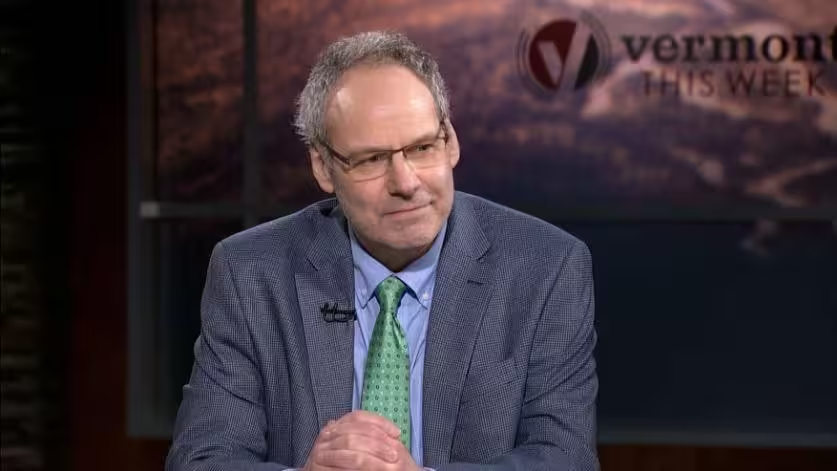
It's Friday, August 14th, and with us on the panel today, we have Lola Duffort from Vermont Public, Kevin McCallum from Seven Days, and Carly Berlin from Vermont Public.
Thank you all so much for being here.
This is the time of year when those of us who are into politics and love watching the horse races and stuff can really get excited, because now we've moved on from the primary in Vermont, we know who's going to be challenging for the governorship now.
And I have to ask right out of the gate, you guys.
I mean, Amanda Janoo, we said she is a political newcomer.
She kind of, I think, upset Aly Richards, who was also running to become the Democratic primary governor nominee.
Is this an upset in your mind?
If so, how big an upset?
Kevin, let's start with you.
Sure.
I mean, this is someone who was a political unknown in the state.
As of March.
No one knew who this was.
And frankly, people that I knew were referring to her as Amanda Jehu.
I mean, they really didn't know her name and they didn't understand where she was coming from.
And she very quickly got momentum and got the fundraising that that was able to put her in a position that was surprising so many people.
She was outspent essentially 2 to 1.
If you add up some of the PAC money that was spent by Aly Richards.
And so, yeah, I think starting from that place and, and beating an opponent who was much better financed definitely qualifies as, as a win.
This is a question more for of what Amanda did write or what Aly Richards perhaps did wrong.
Do you think?
I think both I think sure, this was an upset.
I think Aly Richards was a weaker candidate than the establishment considered her to be.
And that's just because even if you do impressive things in Montpelier, if you've never held office, held statewide office, the voters don't know who you are.
Right.
So she also had no name recognition statewide, right?
People in Montpelier knew who Ellie Richards was and had no idea who Amanda Janoo was.
But basically, for the average person out there, there were kind of equivalent in terms of being an unknown.
But I also think, yes, it is also about what Amanda New did.
Right.
I think she's clearly a really gifted retail politician.
I think you often have an edge if you are the more ideologically committed candidate in a primary, right.
I think that's generally the case, but particularly in this moment.
Right.
And so she was able to position herself as the change candidate and kind of plug into this hunger for change that we are seeing in the Democratic primary electorate nationwide.
Right.
And so I think those two things really propelled her to a narrow but victory.
I'm really curious about that phrase.
Retail politician.
What do you mean by that when you speak about and managing.
Yeah.
So I, I thought Amanda genuine because she was, you know, putting herself forward as, as this change candidate.
But I went to her election night party and I was really struck by what I heard from the folks that had come out, number one, like, I didn't really recognize people.
Right?
And so it was not power.
It was not the usual powerbrokers.
It was not the usual suspects that you see at election night parties.
That was like, this is someone who is actually built like a new power base.
But the people who I talked to spoke about how she went to their towns, and she asked them, what's going right.
What do you think we should be doing and really listen to them?
I heard multiple voters tell me.
Not only did she listen to me, but she was writing down my answers in a little notebook.
And I think the most effective politicians kind of connect with voters on a personal level.
Right?
And she is clearly demonstrated that she is able to do that.
And I think that's rare.
And so I think, you know, charisma is, I think, a huge part of what's led her to have the success that she has had so far in the primary.
And I also think that it's interesting that I don't know that Aly did a very good job of pointing out some of the holes in Amanda's policies and ideas, right?
Early on, they made a commitment that they would not go negative, that they would run a positive, supportive campaign of one another.
They'd be collegial.
And I think that was probably the right move.
Right?
Voters didn't really want to see two Democratic women attacking each other in this primary, right?
So they said, okay, we're just running a positive campaign.
But I think maybe Aly ran to positive a campaign, right?
She did not take the time to say things about Amanda's ideas that were flawed.
And there's a lot of them.
There's a lot of questions about how she's going to implement a lot of the progressive ideas that she's articulated.
And I think if if Aly had done a better job of going on the attack, essentially, of explaining why she felt that some of Amanda's policies were were flawed or overly optimistic or lacked detail or are unaffordable.
I think voters might have taken a closer look at Amanda and had some of those questions themselves.
Well, some of those questions then.
Do you think those are going to come up in the general now as she goes up against Phil Scott?
Absolutely.
No, I mean, that's going to be job number one of the press and of Phil Scott's team of raising questions about the things that Amanda says she wants to do and pointing out that there's their ideas, but they're not plans.
Right.
And there's no money, essentially, or extremely difficult to get the money to do.
The things that she's talked about and lowlands using super well, well.
So I think we can pretty safely predict that would feel Scott is going to do is try and raise a whole bunch of questions about her plans, right?
Because she's been specific about her promises, right?
She's been like, this is who I'm going to tax, and this is what I'm going to do with it.
And so I think he and the media will also ask a lot of questions about sort of whether those two things, right, like what I want to do and who I'm going to tax, whether or not those numbers actually mesh.
And Carly has also done some really good reporting about the second home tax question, which has been floated by basically every major Democrat so far in this election.
We'll talk about that I think, a little bit later.
And then I think what Amanda will do right, and what the media will do will be try and examine his record right on all of these things that have been festering in the state, including probably the biggest thing will be health care.
Right?
So she's proposing universal primary care.
She's going to face a lot of questions about her financing system.
And then I think he's also going to face a lot of questions about the fact that he's been governor for ten years.
And by any objective measure and his own admission, were in a really bad place when it comes to health care, housing and health care affordability.
We also heard day after the election, high level Vermont Republicans saying this is a relief.
We think Janoo is an easier candidate to beat than Richard's.
Right.
And I think part of that to what Kevin was saying earlier is, you know, Janoo really differentiated herself more from Phil Scott than Ali Richards did as a more centrist candidate.
And I think that's going to play into the dynamics we see in the general and what gets lodged from both sides to.
Yeah, go ahead.
I was about to say, I think both I think the Republicans probably are kind of explicitly doing cartwheels.
They're like, this is great.
She'll be easier to beat.
You know, we can paint Democrats as out of touch and just totally disconnected from what everyday Vermonters I think we should be doing here, but particularly the progressive wing of the Democratic Party wants to press this argument.
Right?
Wants to say, actually, we think that what is considered electable is changing, right?
And that people want outside the box thinking and want to propose these big ideas.
And I think, you know, to me, both scenarios are totally plausible.
One where, like Scott dispenses with her much like he did his I mean, I think he won't did quite as well as he did against his last two opponents say.
But like it's super easy and you know, she doesn't put a dent in him.
I also see a scenario where she does a lot better than expected, and that's because she has been able to build like real excitement around her campaign and her ideas.
And so I don't necessarily think that she would be easier to beat than Ali Richards, because Aly Richards was never able to generate sort of momentum.
But what momentum Ali did generate, she has said she's going to pledge that to help Amanda get elected very clearly.
And people say that all the time, right after a primary, that they're going to be unified and they're going to get there.
But you really got the sense from Richards that she's going to do everything she can and urge her supporters to really rally and get behind Amanda.
So I think you're absolutely right that it's I don't think it's going to be a blowout.
I think it is going to do very well.
And she's going to give Phil Scott a challenge that he hasn't had in a long time.
Well, I want to follow up on that a little bit, because we have talked so many times on this program about Phil Scott's phenomenal popularity numbers.
I mean, he really has enjoyed some of the most supportive any governor in the country at one time, I think, being called the most popular.
My question is, though, I think they did, and I'm just speculating here.
But I did think Scott's camp expected Ali Richards to win this primary.
Is there any sense that any of you get that?
Maybe they are a little nervous to what Lola was saying, that Amanda did win this primary and maybe they're thinking, oh, maybe there is.
Especially in the state of Vermont, this, you know, groundswell now behind candidates who are all in on change that maybe Scott is more vulnerable than he's been in the past.
I think.
The poll numbers show that he is more vulnerable than he has been in the past.
But I think, like what Lola was saying, that the the election of Amanda Janoo gives them some comfort, that that vulnerability is not necessarily something she's going to be able to fully exploit.
So the Democrats that have supported Scott in the past will still still do.
So you think he's gotten a lot of support from Democrats here in the state of Vermont?
Well, remember, Amanda, Jana's political platform has a lot of tax increases in it, and there's a lot of wealthy or well-off or moderate income Democrats who are not super excited about seeing their taxes raised, even if it's meant to go to all these laudable health care or child care or school initiatives.
Right.
So, yeah, there's going to be a a significant number of conservative and moderate Democrats who are doing well, okay themselves and don't see the need to upend the system.
And, you know, we'll probably still continue to support Phil Scott.
All right.
Well, we'll certainly find out another race.
That was kind of fascinating, because the way it turned out was the race for lieutenant governor in the state of Vermont.
Molly Gray won easily in this one.
Are we shocked at all about that one?
Lola, let me start with, you.
Know, not surprised.
I mean, I guess a little bit surprised by her margin of victory because her opponent, the one who came in second, Ryan McLaren, had a ton of money behind him and a sitting U.S.
senator, you know, appearing on television ads, being saying, this is the guy you want to elect the lieutenant governor's office.
But, you know, she came in with a huge name recognition advantage.
And it's it's really hard to overcome that, especially because he was never able to really create much to distinguish himself.
Right.
To explain like, this is why I would be so different from Molly Gray.
And they're, you know, they supported the same much of the same policies.
Right?
They had their little pet policy differences, but nothing major.
And they're both kind of fundamentally, you know, pretty insider y, right?
He worked for Peter Welsh for a decade.
And so it was really it was not surprising that she won.
60% of the vote.
Ryan McLaren 27%.
I mean, that's not just a win.
That's kind of a root.
Yes.
Yeah, that was a big one.
Is there anything that you see in Molly Gray getting this Lieutenant governor's job?
You know, she's been in and out of politics, different jobs, as Lola was referring to, that says that she's looking at a more ambitious office down the line.
Well, I don't know about that, but I do know that this means that in the general election, she's heading into her fight with John Rogers, with a good head of steam built up behind her.
And I think this means that she's probably I mean, we saw a poll that shows that she was I don't forget the numbers.
She was at least 15 points above John Rogers in a general election contest.
And so, yeah, she takes that 60%, 61% of the vote from the primary into the general.
And I think puts him in a very difficult spot if she gets that job, if she's lieutenant governor again, or what does that mean for her future?
Well, I think it's bright, right?
I mean, she already has has had a run for Congress that didn't go her way, but she got the name recognition for that effort.
She got dinged for some of the things she did in that election, but she showed that she was a person who could run a campaign like that, and she had big name backers behind it.
And I wouldn't imagine that if she becomes lieutenant governor again after a couple of terms.
Right.
She probably would look to either go to the governor's seat or to DC.
I mean, that just makes sense to me.
As you say, though, she's got to get past John Rogers first.
What do you expect?
I mean, John Rogers came out swinging pretty hard right after she won the primary, right?
Didn't he have a statement?
I think he's worried.
I think he's worried.
Right.
He's only been a lieutenant governor for one term, and he I don't think he's done a lot of things that have have caused Vermonters to be like, oh my God, did you hear what the tenant governor said or what he did, or an initiative that they are getting behind.
So and then, yeah, the hours after her victory, he puts out a statement that says the things that he cares about, right, about affordability and property rights and various things.
And then he tries to tie Molly to the do nothing lawmakers in Montpelier, which is funny because John Rogers was the lawmaker for 20 years in Montpelier.
He's, you know, been in Montpelier for a long, long time.
Admittedly not on the progressive, not a supporter of progressive causes, but to yeah, to try to tie Molly Gray to to the do nothing lawmakers in Montpelier I think is is odd but it really shows that he's he's concerned.
We had some other races we could talk about.
Gerald Malloy became the Republican nominee for the US House, beating Mark cursor pretty handily as well.
Kevin, I know that you were interviewing Mark Kirsten for a while.
Why did Gerald Malloy come out on top on this one?
Well, I just think Mark Kirsten is a fringe candidate, right?
He's a he's a logger from Westminster who got into using or helping use these AI generated videos to attack Becca.
Balance these these just comical videos of her, him picking her up in an excavator and dropping her in a dumpster and just kind of wacky things.
And Malloy is not a very strong candidate.
I don't think against a ballot either, but this wasn't much of a contest for him.
Yeah, we don't think Becca Ballot has much to worry about in this race.
I doubt it.
Yeah, I would I would sort of doubt that too.
I was really fascinated by the race for Chittenden County State's Attorney.
Sarah George was reelected.
She was facing a pretty strong primary challenge from Graham, who outspent her by quite a bit, I think by $100,000 or so.
But it looks like folks in Chittenden County are saying that they want Sarah George to continue her progressive reforms, things like restorative justice, ending cash bail and things like that.
So she she will still have to win the general election, of course, but she has won the Democratic primary there in the legislature.
It looks like it's a good time to be a Senate incumbent, right?
I mean, they all did rather well there.
Yeah.
No, absolutely.
There's there's no real news to report.
Essentially, out of the Democratic primaries, all the incumbents in the Senate certainly, you know, kept their seats.
And we didn't actually spend a lot of time in the in the news corps, in the press corps following those races closely because all the attention was on the lieutenant governor and the governor's race.
Yeah.
I'll give you a quick update on that.
Their reaction bid in the primary closely watched Chittenden County Central race saw newcomer Nikhil Goyle, who managed a record shattering fundraising haul.
He won first place in a three seat race where incumbent centers and Martin Gulik also prevailed.
So we've got a little bit of an update there.
You're caught up with that.
I wanted to talk about something that a vote that was taken, and this deals with school closures in the Washington Central District.
District.
We voters greenlit a new process.
It shifts decision making for school closures to the entire district rather than individual schools.
And this follows a recent closure of closure votes in Worcester and in Callous Lola.
What does this mean now for for voters?
Like if you have a small school and you wanted that school to close.
Other districts, though other other towns can make that decision for that town, right?
Yeah.
I mean, I think this shows that if you want to close the school, you are not going to be able to have.
Usually you need someone other than that town to vote for it.
Right.
Like people do not like to close their own schools, however, and I think that this is important to has been a really interesting and undercover part of this debate.
Some of the folks kind of leading the charge to close callous elementary were callous parents.
Right.
And I something that has, you know, I covered education consolidation debates for like ten years.
And what I have noticed now versus then is that there are a growing number of parents who are supportive of consolidation and I don't know or necessarily think that they're the majority.
I think that parents and community members are increasingly divided on this, and that kind of shows up in things to like when they pull Phil Scott's favorite numbers.
Right?
The number one thing that people cite about what they don't like about what he's been doing is his handling of education.
But one of the number one things people site is something that they like that he's been doing is his handling of education.
And so I think that tells you or suggest to me that this is not something that Vermonters or monolithic about and actually like, really profoundly disagree about.
And that's, that's really interesting.
And it's.
And it's obviously going to be incredibly hard to reconcile.
Right.
Because these are opposing completely opposing visions.
Yeah.
And we're we're not anywhere near a closure on how the entire education reform system is all going to shake out at this point.
It's kind of happening as we're speaking.
Yeah.
Well, if I had to take a wild prediction, I would say that the big historic education reform bill that they passed last year will only ever remain, you know, a big change in law in will probably not actually come to pass.
I got a feeling we're going to be talking about that for sure in the future.
You had mentioned that we're going to be talking about Carly's recent story on second home taxes.
And yeah, I want to get into that, Carly, because this is kind of fascinating.
All the Democratic governor primary candidates were for this tax on second homes.
What is the proposal here?
And what do Democrats, including Amanda Janoo think we can get from this?
You know, it really depends on which of these five candidates you ask, actually.
And the governors and lieutenant governor's race, this was a big theme in the Democratic primary.
And there are sort of three main goals here.
One is to boost housing supply, right, by getting second homes back into the primary residence market to is to lower tax bills for primary residence, and three is to raise revenue for a whole bunch of different kinds of programs depending on which candidate you ask.
Building more affordable housing, funding universal primary care, as we've talked about.
So the idea here is broad light on specifics from many of these candidates, Janoo included.
But this is really, you know, one of these themes that we heard candidates coming back to throughout this primary campaign season as a way to, you know, try to solve a lot of different problems in Vermont at once.
Is there any indication of just how much money could be raised?
I mean, I know it's a difficult question.
It's a difficult question on two fronts, right.
Because we don't know exactly what this tax base would be.
The estimates we have for how many second homes there are very really wildly, if we're talking about census data, about 50,000 homes in Vermont tax Department data suggests 70,000.
That also is dependent on are we talking about hunting camps, things that wouldn't necessarily be fit for year round use?
You know, just defining what we're talking about as a matter of debate here.
Because when I hear second homes, I think big homes, that's what pops into my mind.
That's not.
Really the case.
And, you know, the second piece here is what's the tax rate?
And that is a decision by the legislature.
The legislature sets tax rates.
And, you know, as part of education reform talks over the last few years, there's been movement towards creating a basically second home tax classification.
You know, piece in in our tax law right now.
Right.
Exactly.
Because right now we have, you know, homestead taxes for primary residences and non homestead for everything else.
You've got rental housing, you've got farms, you've got businesses in that column.
Right now.
We have no way to tax second homes without taxing everything else.
That is not a primary residence right.
And so because we have no category, we do not have a second home tax category in our tax code.
We don't know how many second homes there are, and we don't know how much money we could actually raise from a second home, from a second home tax.
And so what that means is that in the absence of this information, right, people are projecting all of their hopes and dreams on this.
On the second home tax, which is wildly popular, the polling on second home taxes shows that Republicans love this.
Democrats love this.
Everyone loves attacks that they don't think they're going to have.
To pay.
Right.
That's kind.
And and also, we have this weird relationship with tourism in Vermont where we both love it, but also we resent the fact that, you know, it sometimes hollows out our communities.
And so it's been and this goes back to, you know, what you were talking about before.
There are a lot of hopes and dreams pinned on this.
And sometimes the numbers that people put out there and looting.
Amanda, Janoo, you mentioned this in your story.
Like said, I think we could raise $1 billion off the second home tax.
And then when the media went to her and were like, where did you where did that come from?
Like, well, it's just a rough estimate.
I very, very rough.
And so I think that yeah, I mean, I think as, as folks think about sort of if we want to do this, I think it's also important to ask for specifics about what we do and do not know before we sort of spend money that could be theoretical.
I want to quickly wrap this by asking you, Carly Berlin, about 30s here.
What is Phil Scott's view on second home taxes?
He's not a fan, you know.
He says no new taxes.
His vision is let's grow the tax base, have more taxpayers to bring down that primary residence rate for everybody.
Well, that's just one topic that's going to be bandied about.
We've got about 80 days until the general election.
So strap in.
And we're of course going to keep you updated on all of this.
And we'll leave it there for this week thanks to our panel.
Lola Duffort from Vermont Public, Kevin McCallum from Seven Days.
And Carly Berlin from Vermont Public, whose reporting is presented in partnership with VT Digger.
Thank you so much for watching.
I'm Mitch Wertlieb.
We'll see you next Friday for Vermont this week.
 New Episode
- News and Public Affairs

Top journalists deliver compelling original analysis of the hour's headlines.
 New Episode
- News and Public Affairs

Today's top journalists discuss Washington's current political events and public affairs.



 New Episode
 New Episode
 New Episode

 New Episode
 New Episode
Support for PBS provided by:
Vermont This Week is a local public television program presented by Vermont Public
Sponsored in part by Lintilhac Foundation and Milne Travel.