Vermont This Week
April 24, 2026
4/24/2026 | 26m 46sVideo has Closed Captions
Chittenden County state’s attorney won’t charge ICE protesters | Hospital finances
Chittenden County state’s attorney won’t charge ICE protesters | Hospital finances | Vermont’s higher education institutions | Moderator - Mitch Wertlieb; Lola Duffort - Vermont Public; Hannah Bassett - Seven Days; Liam Elder-Connors - Vermont Public.
Problems playing video? | Closed Captioning Feedback
Problems playing video? | Closed Captioning Feedback
Vermont This Week is a local public television program presented by Vermont Public
Sponsored in part by Lintilhac Foundation and Milne Travel.
Support provided by:


Vermont This Week
April 24, 2026
4/24/2026 | 26m 46sVideo has Closed Captions
Chittenden County state’s attorney won’t charge ICE protesters | Hospital finances | Vermont’s higher education institutions | Moderator - Mitch Wertlieb; Lola Duffort - Vermont Public; Hannah Bassett - Seven Days; Liam Elder-Connors - Vermont Public.
Problems playing video? | Closed Captioning Feedback
Where to Watch Vermont This Week
Vermont This Week is available to stream on pbs.org and the PBS app.
Support the crew
Help Mitch keep the conversations going as a member of Vermont Public. Join us today and support independent journalism.Providing Support for PBS.org
Learn Moreabout PBS online sponsorshipState law enforcement officials this week blasted a decision by Chittenden County's top prosecutor to not charge protesters arrested during the South Burlington ice raid last month.
I understand now clearly that she is an activist first and a prosecutor second.
We don't have the luxury of determining how we respond to things based on how our personal beliefs are or how we feel.
We follow the rule of law.
Plus, how hospitals and health care regulators are navigating financial pressures.
And look at the impact a changing higher education landscape is having on the state's colleges and universities.
All that and more ahead on Vermont this week.
From the Vermont Public Studio in Winooski.
This is Vermont This Week, made possible in part by the Lintilhac Foundation and Milne Travel.
Here's moderator Mitch Wertlieb.
Thanks for joining us.
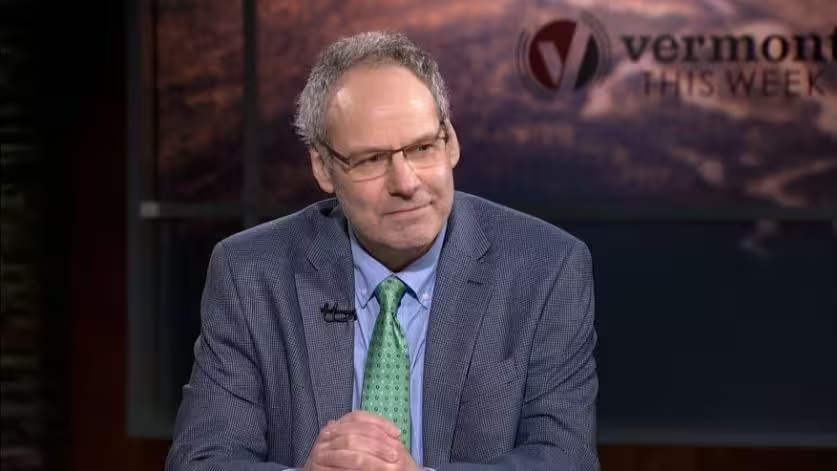
I'm Mitch Wertlieb.
It's Friday, April 24th, and with us on the panel today, we have Liam Elder-Connors from Vermont Public.
Hannah Bassett from Seven Days.
And joining us remotely today.
Lola Duffort from Vermont Public.
And thank you all so much for being here.
Liam Elder-Connors cause I want to start with you because we heard some pretty strong words at the top of the show there from the public safety commissioner of Vermont, Jennifer Morrison.
Reacting to Chittenden County State's Attorney Sarah George deciding not to prosecute some of the protesters at that Ice raid that happened last month.
What is the division between these two here?
What does it boil down to?
So it boils down to Sarah George, the Chittenden County state's attorney deciding not to bring charges in the six instances where people were arrested.
And I think it's actually we kind of have to break those into two groups.
You've got three people that were arrested by Vermont State Police on disorderly conduct charges, and another three who were arrested by Burlington police on some resisting arrest charges hindering law enforcement in one case, assaulting a law enforcement officer.
So the disorderly conduct cases.
Sarah George just declined to charge those outright, essentially saying she didn't really see the conduct, rising to that level or that it was unclear why those three individuals were, specifically targeted and pulled out for arrest when other people were participating in similar behavior.
So she declined to charge those cases.
Now, the Burlington Police arrests, she said, when I talked with her that those approached for her more of criminal behavior or seemed closer to criminal conduct, but she decided to refer those to the Community Justice Center in Burlington, where they'd go through a restorative process because the people that were arrested didn't have prior records, they were lower level charges.
And she also felt, based on her review of video footage of the incident, that police also played some responsibility in escalating situations.
So she wanted to send everybody to a restorative process.
But still, the criticism you're seeing from law enforcement officials is that, Sarah George is not delineating between, First Amendment, you know, protected First Amendment of protesters and then also when some of the protesters behavior, law enforcement said escalated beyond the protected First Amendment, you know, protest issues there.
Well, it seems like Jennifer Morrison then, is, you know, saying, as she said in that quote at the top, that Sarah George is letting her own personal feelings about these things get in the way.
But from what you're telling me, Sarah George is saying she it sounds like she's saying there really isn't enough there for her to prosecute a case successfully.
And it was based on the facts that she's seen on the video.
I mean, that's, you know, all prosecutors make decisions like that.
And I think some of this, you know, Sarah George has been an outspoken, you know, modeled herself as a progressive prosecutor and often not bringing charges in lower level offenses and including sometimes, you know, disorderly conduct charges.
So, you know, it's kind of hard to compare.
You don't want to naturally go through and start comparing each decision that's made.
But, you know, she has been outspoken as a progressive in, in a lot of ways.
And this isn't the first time she's clashed with law enforcement over charging decisions, either.
Right.
We're also just seeing this is such a high profile incident, and state police and Burlington Police and South Burlington Police are under a lot of scrutiny for their actions that day, including, protesters alleging that they used excessive force against them during that and officials that, like Jennifer Morrison, have been defending their officer's conduct that day.
I mean, they're all basing this on the same video they all looked at, because that strikes me as something that's interesting.
You know, two people looking at the same video content and then coming out, coming away with very, very different perspectives.
Yeah.
And you know, I think, that that is certainly a question.
I mean, I've been going through a lot of the footage of that day and trying to get a bigger picture of what's going on just because it it was a pretty chaotic day.
And, oh, I think we're still trying to learn exactly what happened.
And it hasn't really been that long to have, you know, since the incident, it's been a bit more than a month, but there's hundreds of hours of footage and a lot of different things that went on that day.
Yeah.
Authorities released, I think it's 120 hours of of body camera footage.
So it's going to take time to sort through every minute to know exactly what happened.
But one thing that I found interesting too, is that one thing Jennifer Morrison and I would assume Sarah George do agree on is Jennifer Morrison was very critical of Ice and the role that they played, in this entire incident.
You know, she was saying this just made everyone's job more difficult, right?
Yeah.
And that's one of the fascinating parts of going through the body camera footage and reading these after action reports is seeing the extent with which, local police and state police weren't aware of what ICE's plans were and their attempts to try to understand what Ice was planning to do that day and in some cases, really trying to ask them to, you know, hold off and wait for for us to get our teams in place.
And, and really, you know, the struggling at times to, to have a coherent idea of what what Ice was planning as well and also questioning whether the the was it worth it to to take this sort of action based on the whole situation with the protesters there?
The Ice was looking for one particular person, but Ice was very adamant throughout, throughout this that, they were going to go through, they were going to get this warrant and they were going to to go into the house.
Are there any next steps here?
Liam?
As Hannah was saying, there are so many hours of video footage to go through here still.
I mean, do we know if there are going to be more ramifications than anything else coming from this?
Well, state Police and South Burlington Police have said that they don't believe any of their officers used excessive force if they've cleared, you know, any of the complaints that had come through and said they believe their officers acted according to policy.
We're still waiting to hear from Burlington Police, where there's at least one officer who's being, is investigated for alleged use of excessive force.
And Burlington hasn't released their body camera footage yet, so still.
Still waiting to.
There's still a little bit of more footage out there to be publicly released.
All right.
Well, thank you for the update on that.
Liam, I want to move on to a story that, Hannah Bassett you were writing about in seven days a day for.
You have been covering this, of course, as well.
And this has to do with health care in the state of Vermont.
I found this incredibly alarming.
How in your story, you were reporting that the largest hospital network in Vermont, UVM, MSK, is losing on the order of $460,000 per day.
And this has to do with some, new restrictions on, I guess, what they can charge, etc.
bring us up to date on what's happening there.
That number is accurate.
Yeah, that number is accurate.
That was shared out by Doctor Lefler, head of UVM Health Network.
This was shared recently at a quarterly townhall and then later at testimony before the House health care committee at the state House.
As shockingly large as these figures are, it was also, in a way shocking that these numbers are not that surprising to folks who have been really following these, most recent health care reforms that are really trying to rein in the growing health care costs in Vermont.
Vermont has some of the highest health care costs in the country.
And so hospitals experiencing revenue loss is actually somewhat expected at this phase of course.
Correction.
The way that, the head of the Green Gap, the Green Mountain Care Board, which is one of, regulatory bodies here in Vermont, put it to me, is that, you know, we can't have it both ways.
If we're going to be keeping, commercial health care premium increases down, there's got to be a pressure release somewhere else in the system, and this is where that's going to come.
So, UVM health is the, as you said, biggest health care network in the in the state.
They're going to have the biggest numbers.
Share it out.
These are the first big ones that we're hearing.
But this is likely a trend that we're going to keep.
Hearing about with other hospital systems in the, in the state.
Well, the D4, is there any kind of upside here?
Yes.
There is, you know, is big and is scary.
Is that number, sounds like this is in a weird way, good news.
Our house and.
Sorry, our health care prices and premiums are so expensive.
In no small part because, of the revenues and prices that you, VMC, has commanded and, a lot of measures were put in place last year by lawmakers.
In order to rein that in.
Right.
This really strict, drug pricing cap, which is impacting, UVM and then also UVM, MSI negotiated a new contract with our largest insurer and agreed to accept a lot less money from them going forward.
And it is because there is this recognition that we need a really major course correction in terms of how much money our largest hospital takes in.
If the rest of the system is going to be viable.
You know, and I want to say, like observers are worried about hospitals in Vermont going out of business.
No one is worried about UVM going out of business, right?
I mean.
But if they're losing half, nearly half $1 million a day, isn't that inevitably, inevitably going to happen?
So, yes, that number is not sustainable in perpetuity.
Right.
But we are not looking at imminent collapse.
And the reason that, Stephen Leffler is sharing those numbers is to say, like, look, we are we are doing this thing.
We are, of course, correcting.
And it is also, I would imagine, to build a little bit of sympathy as, the hospital embarks a on its, budget setting process with the green Mountain Care Board.
Right.
That is about to get underway.
Lawmakers are also looking at additional reforms that will, you know, put the squeeze on hospital revenues.
There are also about to start negotiating with their nurses.
So they have an interest in being like, hey, this is how much we're being squeezed.
And, you know, to the to Doctor Lafleur's credit, it did not sound to me like he was going in there to sort of scare people.
He was saying, this is expected.
And we know that we have to reckon with these numbers.
And he's also, you know, kind of getting people ready for measures that will have to be taken because, as you pointed out, like losing half $1 million a day is not sustainable in perpetuity.
And that is going to mean changes at VMC and in the larger health network.
And so we will have to see what that looks like.
And it could be some difficult stuff.
And he was clear, I want to, for folks who might be worried about exactly what those changes could mean for their care, their services.
He was clear he's made a commitment previously that there will not be cuts to provider services.
The changes that the hospital is planning to make as these numbers are impacting their revenue, are changes to administrative costs and changes to provider efficiency.
So those are the areas that the hospital sees as rooms for, kind of revenue savings.
Those are generally not areas that impact patients access to specific services.
It could very well impact the provider experience exactly where providers go, the nurses union to Lola's Point is going into, these negotiations, I think it's a very important point that will be worked out, but it's not something that is, a topic of imminent layoffs, for example.
Well, in your story, Hannah Bassett, I noted that the nurses union was very outspoken about some things and a couple things they were saying.
What were included?
Look, we may have to start looking at lawmakers.
Do they have the political will to start putting higher taxes on wealthy Vermonters to help offset some of these costs?
There was also talk about universal health care, right?
Yeah, the nurses union, that's definitely the solution that they, suggested is looking more closely at universal health care as a way out of this, extremely high cost health care system that Vermont has found itself in.
Lola De for.
I know that you've been covering to the, Green Mountain care boards.
The state lawmakers let me back up a little bit.
They last year decided that if patient services were going to be at risk, they wanted to give the Green Mountain Care Board the ability to say, no, you can't do that.
And now, apparently, they are revisiting that idea.
What were their, second thoughts here?
Yeah.
I mean, the story is really about how hard it is to balance, right, this need between affordability in our system and also this need to preserve patient access.
And yeah, there's this strange kind of, regulatory fight that's going on between the Agency of Human Services and the Green Mountain Care Board.
Because, no one wants to be the bad guy and say, no to hospitals when they say, okay, in order to, you know, take, you know, in order to deal with our financial difficulties, we're going to have to cut extra service.
And so lawmakers want, there to be some sort of state oversight of the process, but they're not really quite sure what that should look like.
The Senate has actually said, okay, well, maybe the state doesn't decide.
We just let hospitals decide.
It doesn't look like the House really likes that idea.
But is really struggling with the fact that we do not have a state entity.
That seems, either able or willing to, to take on that task.
But, you know, we'll see what what happens in negotiations.
What happens, do you think kind of as if nothing happens?
Because, again, unless some measures are taken here, as we've established, that number is not sustainable over time in perpetuity.
Right.
It's not sustainable.
But I think, you know, lawmakers were pleased to see the measures that that UVM health is taking this seriously.
I think that's what, Green Mountain Care Board said as well, these steps to cut administrative costs, these steps to improve provider efficiencies, leaning into that more is certainly one part of the solution here.
But there are a lot of levers that need to be looked at here.
Legislators as well saying are looking at reference base pricing, exactly how that will be implemented, whether that will be, implemented, I guess, with a scalpel approach.
Chairwoman black, from the House Health Care Committee put it, or with a broader approach, what will make the most sense for the health care system to navigate these changes that need to happen realistically sooner rather than later?
For Vermonters to be able to keep affording living here and accessing the health care that they need.
Yeah.
I mean, there are people I am sure that are deciding whether or not to to go without health insurance just because the cost is too much and it's eating into other things.
Yeah.
This year, you know, without the health care subsidies that expired earlier this year, that's one of the things that's impacting the revenue that hospitals are being able to get.
People are, there are fewer people who are insured.
Some people have higher deductibles.
That's a disincentive to seek care.
If you have a really high deductible, you might be putting off care, but it will take time, later this year to know if people are delaying care, if people are not getting care that they need at all, or if people are not getting care that they might not have needed that they got before.
So there is just questions that it will take time to know the answer to.
All right.
I feel slightly better coming out of this discussion than going into it.
Thank you, Lola, for saying that.
There is a reason that this could be a bit of a silver lining.
Good news situation.
But Hannah, thank you as well for updating us on that situation.
We're going to have to keep a close eye on that.
I know this is not even close to the last time we're going to be talking about health care.
The other corners.
I want to turn to you because you had some also alarming news to report recently about the state's higher education institutions, based on a new report saying that, there are some new estimates about how these schools are doing.
Yeah, this is, I would say, a decidedly less rosy picture, maybe, than Lola's.
Take on the hospital finances.
But there's a new nationwide estimate that a quarter of four year liberal arts schools could shut down or merge in the next decade.
So we could be seeing hundreds more schools disappear.
And one of the things that was very telling in a lot of ways is the story that we co-published with The Hechinger Report.
The day we published it, Hampshire College in Massachusetts announced that they would be shutting down.
And that's exactly the kind of institute that has been identified as being most at risk, smaller liberal arts schools.
Hampshire is particularly specialized as well.
In a lot of ways.
You know, it's a little bit more of an alternative sort of degree modeling and structure.
But, you know, smaller rural schools are struggling with enrollment.
I mean, that's higher education across the board.
But these places, which we have many institutions in Vermont, are also struggling.
And I know that's something that Lola, you've looked at a lot over the years as well, that that's not a new problem, but it's certainly not getting any better and might be getting worse.
No.
And it's fascinating to me because it feels like we are now like seeing truth.
Right.
So there was this original kind of great contraction that we saw a few years ago in Vermont, when a bunch of schools closed all at once.
The College of Saint Joseph, Green Mountain College, Southern Vermont College.
Ordered.
To, Well, no, Goddard didn't close at that point.
Oh, that's not that.
Yeah.
And and I remember actually talking to the head of the Vermont College of Fine Arts at the time, and I was like, have you ever seen someone kind of come back from the brink?
And he was like, yes.
Goddard.
And of course, now Goddard has since closed.
And the institution that he was the head of has now since closed.
And so we are seeing a this like new wave, of, of closures and at the same time, you know, it's now been a couple of years since, a few of these colleges closed.
I'm thinking about Greenmount College, for example.
And we are really seeing sort of, the, the effects that that creates in the communities where these schools closed.
Right.
There is still the campus, in Poultney.
Green Mountain College is still in this weird limbo.
And that really highlights that when these schools close, it's not just, you know, the people who lose their jobs and the students that have to find a new school to finish out their degrees.
There's also this kind of crater that is left behind communities.
Yeah.
A lot of the identities of these colleges, I'm sorry.
You know, I'll just say, I mean briefly, like the I mean, Sterling College was the kind of the, the main anecdote that we were using, which is a small school up in crafts barre, that announced it was shutting down and there were 35 students there wrapping up their final semester right now.
But the big problem that we're seeing in Vermont, where it was already a bit of an issue, but it's nationally, is that there are fewer, kids graduating from high school.
And then of the youth who do graduate, fewer are going to college.
And so that's where some of the demographic problems are coming into play for colleges, where enrollments declining because there's just a smaller and smaller pool.
There's a lot of reasons why.
And that's a national problem.
That's a national problem.
Yeah.
I mean, so Vermont, you know, we were feeling some of that earlier, but we're certainly feeling it, more now in the rest of the country is also feeling it.
And I think to your point, Liam, with demographic changes here in Vermont without these colleges, I think, you know, Vermont has an older population, statistically speaking, without these colleges to bring youth and younger people.
And it's also one of the ways that younger people have stayed in Vermont.
So without this kind of pipeline, we're losing that system and that, cycle.
And so it's not helping this demographic challenge that this state is experiencing that impacts our economy, our housing market.
It's got a lot of ripple effects.
Well, we've been talking about, you know, the most vulnerable schools again, are these smaller rural schools.
Liam.
But, there was a Wall Street Journal report recently saying, you know, a college right here in Chittenden County up the road, Colchester.
Saint Michael's College is seeing some trouble, too, right?
Yeah.
And I mean that that, report painted a pretty sobering picture of the finances.
And, I mean, that's not to, to be honest, not completely surprising, that I know the school has been struggling and trying to figure out its footing for, for many years now.
But it seems like they're getting they're much more on the brink as well.
So is there any talk about what can be done at this point?
Because these are huge problems, as you're saying, demographics, etc.
it's tough.
It's hard.
I mean, I think Hampshire is another interesting example.
Two were a few years ago.
They were able to stay open after after nearly closing.
But how do you fundraise around that?
I mean, you get a shot in the arm of money and you're maybe open for another year, but the the longevity is just not there.
So you might be able to crisis fundraise enough to stay open a little bit longer with, with your donor base.
But it's not it's not going to keep you going for maybe more than another year or two.
And so I think that's a little bit of a problem that we're seeing at schools.
Yeah.
I also think it's worth underlining that, you know, it's not the demographic.
Cliff would be a huge problem on its own, but it's also that people are increasingly calling into question whether or not a college degree is worth it.
Right.
And that is also really hurting these institutions.
And ironically, the smaller institutions are often the most expensive ones because they don't have large endowments and so they have to ask more of their students to pay full freight.
And then, you know, you have large amounts of student debt.
Yeah.
And the student debt can be so crippling.
That's another expense that can follow people you know well into their careers after they graduate.
Well, we'll just have to keep our on on that as well.
But I do appreciate the update on those stories, from from all of you on that, you know, talking about expenses and trying to save things.
There's another really interesting story you had about it.
And I know you've been following this to the Bennington Battle Monument is, you know, it's sort of an iconic, Vermont, visiting place.
Even though the Bennington battle did not take place in Vermont, as we know.
Anyway, the monument itself is in disrepair, and it's kind of falling apart.
The price tag for fixing it runs up to tens of millions of dollars.
So the state is now seeking input on what to do about this, the future of the Bennington battle monument.
You were talking with one lawmaker who had an idea about what to do.
Yeah.
Last year, this topic came before, I believe there was the House Corrections and Institutions Committee.
The state is looking for ways to repair this important monument.
It's a important historical monument.
Tourist attraction.
But it's fallen into disrepair.
And it needs intervention.
But $40 million, excuse me, is a very steep price tag.
So.
Yeah.
Representative, Sean Sweeney of Shelburne is a, designer contractor by trade.
He has come up with it.
Alternative proposal, at least as of last year.
Out of the box, thinking, thinking about could this be done in a different way?
More cost effective way.
At the time, the proposal was to, essentially wrap the monument in copper.
One of the challenges with the monument is it's made out of sandstone.
The water damage is one of the biggest challenges, to this kind of repeat maintenance that's so costly for the state.
Who knows if it didn't cost $40 million.
Exactly.
Kind of in perpetuity.
So, I know this is something that Representative Sweeney is continuing to look into.
I believe he's traveling down to Washington, DC, where there's another large obelisk because people might know what they've heard of that monument to look into this further.
So there could be other approaches coming out soon.
Thank you for that update.
And for more information on in-person and virtual discussions, you can visit the Agency of Commerce and Community Development website and give your ideas on how to save the Bennington Battle Monument that does it for Vermont this week.
Thank you so much to our panel, Liam Elder-Connors from Vermont Public, Hannah Bassett from Seven Days.
And joining us remotely today, Lola Duffort from Vermont Public.
Thanks so much for watching.
I will see you next Friday on Vermont This Week.
 New Episode
- News and Public Affairs

Top journalists deliver compelling original analysis of the hour's headlines.
 New Episode
- News and Public Affairs

Today's top journalists discuss Washington's current political events and public affairs.



 New Episode
 New Episode
 New Episode

 New Episode
 New Episode
Support for PBS provided by:
Vermont This Week is a local public television program presented by Vermont Public
Sponsored in part by Lintilhac Foundation and Milne Travel.